Fabrinet (FN): Invisible Champion of AI Optical Infrastructure
Fabrinet powers every AI server you've heard of — yet most investors have never heard of Fabrinet. With Q3 FY26 earnings tonight, this report examines whether the sub-micron optical moat justifies 40× earnings, and what to watch in tonight's results.
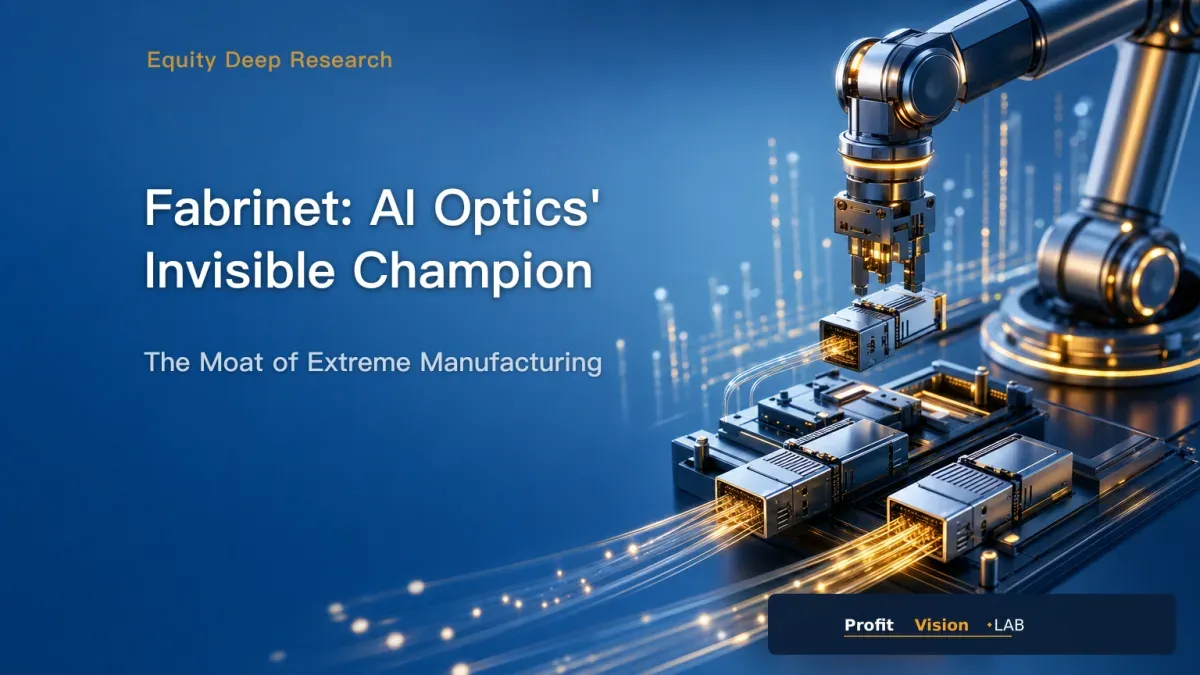
Fabrinet (FN): The Invisible Champion Powering AI Optical Infrastructure
This report examines why Fabrinet occupies a structurally irreplaceable position in the AI optical supply chain — not as a commodity manufacturer, but as a mission-critical precision engineering partner whose non-compete philosophy and sub-micron optical alignment capabilities create switching costs that capital alone cannot overcome. The central question: does the business quality justify the valuation, or is this a case where a legitimate moat has been over-capitalized by the market?
I. Industry Map — The AI Datacenter Supply Chain
Why optical communications is the silent bottleneck of AI infrastructure
As GPU clusters scale from thousands to tens of thousands of chips, the bandwidth required for chip-to-chip and rack-to-rack communication grows faster than the compute itself. Copper interconnects cannot carry this load at the distances and densities required. Optical transceivers — the devices that convert electrical signals to light for transmission — are the structural solution. Their demand is compounding with every generation of AI infrastructure.
The market is in the middle of a transmission speed upgrade cycle: 400G → 800G → 1.6T. Each generation dramatically increases the manufacturing complexity and precision requirements of optical modules. This is not incremental — it is the kind of step-change that creates new structural winners and leaves legacy manufacturers behind.
Global optical transceiver market CAGR is projected at ~25% through 2028. For 1.6T-grade modules, yield control requirements are so demanding that only a handful of manufacturers in the world can meet them consistently. This is where Fabrinet's moat lives.
Where Fabrinet sits in the supply chain
The analogy that captures FN's position precisely: if an AI datacenter is a city, NVIDIA is the power plant, Broadcom is the highway system, Coherent is the fiber optic designer, and Fabrinet is the construction firm that turns blueprints into physical infrastructure. The designer can be replaced. The construction firm that actually knows how to build cannot.
Fabrinet's expanding market opportunity
Beyond mainline optical transceivers, Fabrinet is a critical manufacturer of Optical Circuit Switches (OCS) used in Google's TPU clusters — a high-value niche with limited competition. Its HPC (high-performance computing) segment has emerged as the fastest-growing business line, surging from $15M/quarter to $86M/quarter in a single fiscal quarter, with management guiding toward $150M/quarter within two to three quarters. This HPC trajectory is the most consequential near-term signal in the entire FN investment thesis.
II. Business Model — The Non-Compete Philosophy
Fabrinet is technically classified as an EMS (Electronics Manufacturing Services) provider. This classification materially understates the business it actually operates. In economic substance, Fabrinet is closer to a semiconductor outsourced assembly and test (OSAT) provider — technology-intensive, relationship-driven, and structurally positioned as an extension of its customers' R&D operations.
The organizing principle of Fabrinet's business model is what management calls the "pure foundry philosophy": Fabrinet does not compete with its customers. It does not design optical modules. It does not develop its own product lines. It does not enter markets where its customers operate. This non-compete commitment is not merely a marketing claim — it is the structural foundation of every customer relationship FN has built.
The consequence: optical module designers (Coherent, Lumentum, II-VI) bring Fabrinet into the product design process at the New Product Introduction (NPI) stage — before the product is commercialized. This early-stage collaboration means FN's manufacturing know-how is embedded in the product design itself. By the time volume production begins, switching manufacturers would require effectively redesigning the product. Switching costs are not contractual — they are structural.
This is the same logic that made TSMC irreplaceable in semiconductors. Fabrinet has replicated it in optical manufacturing.
III. Competitive Moat — Five Structural Advantages
1.6T-grade optical modules require alignment tolerances measured in fractions of a micron. This capability takes years of process development and cannot be purchased or licensed. It is the single highest technical barrier in optical EMS manufacturing — and Fabrinet's deepest competitive trench.
By committing not to compete with customers, Fabrinet earns early-stage design access that no competitive manufacturer can replicate. The NPI partnership model means customer switching costs are embedded in the product architecture, not just the supply contract.
D/E = 0.0 with ~$1B in cash. In a capital-intensive manufacturing industry, this is exceptional. It means Fabrinet can expand capacity aggressively (Building 10) at near-zero financial risk, while competitors must either dilute equity or take on leverage to match.
H1 FY2026 revenue of $2.11B has already reached 62% of full-year FY2025 revenue. As volume scales, fixed manufacturing costs spread across a larger revenue base — operating leverage flows disproportionately to margins, widening the cost advantage over smaller competitors.
Top 2 customers (NVIDIA and Cisco) represent ~46% of revenue. Deep integration with anchor customers is the source of the moat — but it is simultaneously the source of the greatest business risk. This is not a moat weakness; it is a moat feature that must be sized correctly.
IV. Financial Performance & Capital Economics
| Metric | Q2 FY26 (Dec 2025) | Q3 FY26 Guidance | Street Consensus |
|---|---|---|---|
| Revenue | $1.13B (+36% YoY) | $1.15–1.20B | $1.19B |
| Non-GAAP EPS | $3.36 | $3.45–3.60 | $3.56 |
| Gross Margin | ~12.4% | ~12.1–12.4% | ~12.3% |
| HPC Revenue | $86M (+473% QoQ) | Continued ramp | >$100M est. |
| YoY Revenue Growth | +36% | ~35–37% | +36.5% |
From the Q2 FY2026 Earnings Call (Feb 2026): "We delivered an exceptional second quarter with record revenue and earnings that significantly exceeded our guidance ranges. Multiple large, key strategic programs across our business all contributed to our outstanding performance."
Capital allocation — the expansion bet
The financial asymmetry of the Building 10 expansion deserves explicit attention. Because Fabrinet carries zero debt, the entire capacity expansion is self-funded. The depreciation burden adds approximately 15 basis points of gross margin headwind — in exchange for positioning Fabrinet as the production-ready manufacturer for the 1.6T cycle. The optionality cost is minimal; the optionality value is substantial.
V. Risk Framework — Categorizing What the Market Is Pricing
The 400G→800G→1.6T upgrade cycle is not a single event — it is a multi-year structural transition. Each generation's complexity increase extends Fabrinet's technical advantage. Competitors cannot close the gap with capital alone; they need years of process learning that Fabrinet has already accumulated.
Deep customer integration creates switching costs — but also creates business fragility. If NVIDIA or Cisco redirects a major program, the revenue impact is not marginal. This risk is manageable through customer diversification over time, but it is real and requires position sizing discipline.
At 40×+ trailing earnings, any growth deceleration creates a compounding downside: EPS misses and multiple compression can move simultaneously. The PEG of ~0.9–1.0 suggests the market is paying a fair price for growth — not a premium — but this math only works if growth sustains.
Silicon photonics and co-packaged optics (CPO) represent a 10-year horizon risk where optical functions move onto semiconductor packaging. Paradoxically, in the near term (3–5 years), CPO increases demand for Fabrinet's high-precision optical assembly expertise. This is a watch-and-monitor risk, not a near-term thesis-breaker.
VI. Three Structural Challenges — Bear Arguments, Addressed Honestly
Executive equity compensation at technology companies typically involves large stock grants that vest over time. CEO sales at regular intervals are often pre-planned (Rule 10b5-1 plans) and reflect portfolio diversification, tax obligations, or estate planning — not a specific view on near-term stock direction. Seamus Grady has been selling periodically for years across multiple price levels.
Management set Q3 guidance meaningfully above Street consensus — not typical behavior from executives who believe the business is deteriorating. The HPC ramp guidance to $150M/quarter, Building 10 expansion, and raised full-year targets are forward commitments that a bearish CEO would not make.
The 2022 capex pause reflected an inventory correction in consumer-facing cloud infrastructure, not a structural reversal. The current AI buildout is driven by sovereign AI mandates, competitive dynamics among hyperscalers (no single player can afford to pause while competitors accelerate), and regulatory requirements that create sticky, durable demand. The demand structure is qualitatively different.
Fabrinet's zero-debt balance sheet with ~$1B cash means it can absorb a capex pause without existential risk. EMS companies that carry leverage during demand downturns face compounding pressure; Fabrinet faces only volume reduction — a meaningful but survivable event. Financial resilience is the cyclical moat.
Post-earnings volatility at high-multiple growth stocks reflects "sell the news" dynamics and forward guidance assessment — not disagreement with the reported numbers. When a 40×+ stock "beats and falls," the market is typically repricing the forward multiple based on guidance credibility, not questioning the historical results. This is a valuation problem, not a business problem.
Known binary risk justifies a known position size response: the Four-Layer Defensive Screen limits exposure to 1 Risk Unit (5% of account) before earnings events. This is not a reason to avoid FN — it is a reason to size appropriately. The structural thesis does not change based on a single quarter's price reaction.
VII. Forward Outlook — Three Catalysts Worth Monitoring
- HPC revenue trajectory toward $150M/quarter. This is the single most important forward indicator. HPC went from $15M to $86M in one quarter — management's $150M target implies the ramp is less than halfway complete. Confirmation of this trajectory in tonight's Q3 results and Q4 guidance would be the most structurally significant data point in the near term.
- Direct-to-CSP first material revenue. Fabrinet is developing direct supply relationships with hyperscalers (AWS, Google), bypassing traditional optical module OEM intermediaries. The first confirmed material Direct-to-CSP revenue would signal a business model upgrade — from manufacturing subcontractor to strategic infrastructure partner — and warrants a meaningful multiple re-rating.
- Building 10 Phase 1 commissioning timeline. The new Thailand facility targeting 1.6T production capacity is the physical embodiment of Fabrinet's 800G→1.6T bet. On-schedule commissioning with early customer qualification data confirms that the capacity investment translates into bookable revenue, not just theoretical capability.
Tonight's Q3 FY2026 earnings — what to watch
| Metric | Company Guidance | Street Consensus | What It Signals If Beat |
|---|---|---|---|
| Revenue | $1.15–1.20B | $1.19B | Optical + HPC demand sustained |
| Non-GAAP EPS | $3.45–3.60 | $3.56 | Operating leverage continuing |
| HPC Revenue | >$86M (Q2 level) | ~$100M+ est. | Ramp trajectory toward $150M confirmed |
| Q4 Revenue Guidance | Not yet provided | $1.25B+ est. | Hyperscaler demand visibility into 2H FY26 |
| Gross Margin | ~12.1–12.4% | ~12.3% | FX headwinds manageable; leverage intact |
VIII. Conclusion — Structural Quality vs. Valuation Reality
Fabrinet represents one of the most defensible manufacturing positions in AI infrastructure. The non-compete moat is genuine. The sub-micron precision capability is irreplicable on a short timeline. The zero-debt financial structure eliminates the survivability risk that plagues capital-intensive businesses during demand cycles. The HPC growth trajectory offers a second engine that is only partially visible in current numbers.
The business case is structurally sound. The valuation case requires discipline.
Business quality assessment
Four-Layer Defensive Screen verdict
| Screen | Criterion | FN Status | Result |
|---|---|---|---|
| Layer 1 · Institutional Flow | A/D Rating ≥ C+, RS ≥ 80 | Post-earnings direction TBD. Pre-earnings: neutral to cautious on CEO selling | Watch → |
| Layer 2 · Moat Quality | ROE ≥ 17%, EPS growth > 25% | ROE 18–19%, EPS +40% YoY, zero debt, ROIC ~40% | Pass ✓ |
| Layer 3 · Volatility | IV Rank > 30% | Pre-earnings IV elevated; post-earnings IV crush typically significant | Conditional |
| Layer 4 · Technical | Price above 50MA, support defined | $480–560 platform consolidation. Needs post-earnings confirmation | Conditional |
Options strategy framework: Pre-earnings, position size is capped at 1 Risk Unit (5% of account) given ±6.5% historical earnings move. Post-earnings, if results are strong and stock holds ~$440–460 support, a Bull Put Spread structure (short put below $440, DTE 30–45 days, Delta < 0.30) becomes structurally sound. A confirmed breakout above $560 with volume expansion opens follow-through entries with defined stop discipline.
The moat is real. The growth is real. The valuation is priced for perfection. Hold the thesis with appropriate position discipline — and watch tonight's numbers.
Think with me, not just trade with me.
U.S. Equities · Options Selling · Deep Research · AI Investing
Data sources: Fabrinet SEC Filings (FY2Q26), Q2 FY2026 Earnings Call Transcript, AlphaStreet Q3 Consensus, TipRanks, SEC Edgar. Published May 4, 2026 — pre-earnings research note.
This report is produced for educational and informational purposes only. It does not constitute investment advice, a solicitation, or a recommendation to buy or sell any security. All investments involve risk, including the possible loss of principal. Past performance does not guarantee future results. Readers should conduct their own due diligence and consult a qualified financial professional before making investment decisions.
© 2026 ProfitVision LAB · Shiba the Disciplined · Think with me, not just trade with me.