
Zscaler (ZS) Post-Earnings Deep Dive: From a 31% Crash to the ZenithLive AI Rebuild
Zscaler (ZS) fell 31% after Q3 FY2026 earnings. This deep dive tracks Baird, BofA, ZenithLive, Zero Trust, AI Broker, FCF guidance, and the post-earnings recovery path.
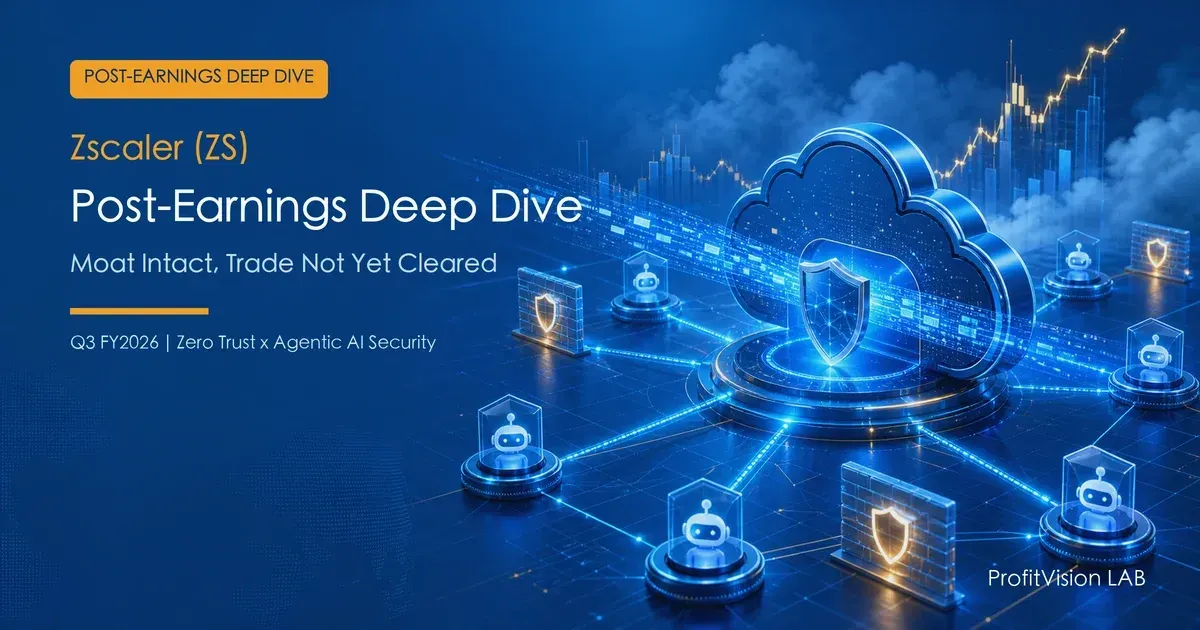
A 31% single-day collapse, three investor touchpoints, seven AI product launches, and a slowly converging analyst consensus — this is the complete ZS post-earnings story through June 13, 2026.
Zscaler's Q3 FY2026 results were genuinely strong — revenue beat by $14.8M, non-GAAP EPS beat by 7%, and non-GAAP operating margin reached an all-time high of 23%. None of that protected the stock. Three forward-looking risks detonated at once: full-year FCF margin was cut by 370 bps, preliminary FY2027 ARR growth was framed at just 16–17%, and two senior sales leaders under new CRO Mike Rich departed. The stock fell 31.5%, the worst single-day decline in its IPO history. Over the three weeks that followed, management worked to rebuild the narrative: the CFO clarified the CapEx logic at Baird, the CEO reframed the AI thesis at BofA, and ZenithLive 2026 unveiled seven products positioning ZS for agentic AI security. Our conclusion: the moat remains intact, but the trade is not yet cleared. ZS moves from “Reject” to “Active Watch”; the real validation point remains the September Q4 FY2026 earnings call.
I. The Three-Week Event Chain
To understand where ZS stands today, the May 27 collapse is not enough. The three weeks after earnings were a narrative repair campaign: management had to show that CapEx was not a structural deterioration, institutions had to recalibrate FY2027 growth assumptions, and the product organization had to prove that the AI security story was more than conference-stage rhetoric.
II. Dissecting the Three Guidance Bombs
2.1 The Quarter Itself Was Clean
Before analyzing why the stock fell 31%, it is worth being clear about what the actual quarter looked like.
| Metric | Q3 FY2026 Actual | Consensus | YoY Growth | Result |
|---|---|---|---|---|
| Revenue | $850.5M | $835.7M | +25.4% | ✅ Beat |
| Non-GAAP EPS | $1.08 | $1.01 | — | ✅ Beat +7% |
| Non-GAAP Operating Margin | 23% | ~21% | +200 bps | ✅ All-Time High |
| ARR | $3,525M | — | +25% | ✅ Solid |
| RPO (Remaining Performance Obligation) | $6,459M | — | +30% | ✅ Accelerating |
| Z-Flex TCV (trailing 12 months) | $10B+ | — | Q3 alone +60% QoQ | ✅ Strong momentum |
| AI Protect Bookings (trailing 12 months) | $100M+ | — | — | ✅ First $100M milestone |
| $1M+ ARR Customers | 748 | — | +18% YoY | ✅ Growing |
By any conventional measure, this was a clean quarter. The problem was that growth stocks are not priced only on what just happened; they are priced on next year's growth rate and the quality of the cash flow attached to it. ZS broke down on the guidance page — specifically on three items that together forced a repricing of the investment thesis.
2.2 Bomb One: FCF Margin Guidance Cut 370 bps — The Capital-Light Narrative Cracked
Full-year FCF margin guidance was slashed from 26.5–27% to 22.8–23.3%, a reduction of roughly 370 basis points. CFO Kevin Rubin attributed this to a front-loaded purchase of data center equipment — memory, storage, and processors — to lock in current pricing ahead of anticipated cost increases.
Traditional P/E ratios are of limited use for GAAP-unprofitable cloud companies. Markets price these businesses primarily on EV/FCF and EV/ARR multiples. When FCF margin falls from 27% to 23%, the same ARR base generates materially less cash, compressing the denominator in valuation models — and at the high multiples ZS carries, the impact is amplified.
The deeper issue: ZS has always commanded a valuation premium on the implicit assumption that it is a capital-light SaaS business — one that can grow without proportional increases in fixed assets. A sudden CapEx jump doesn't just hurt the current-year FCF estimate. It calls that foundational assumption into question, forcing a wholesale reframe of the multiple.
2.3 Bomb Two: FY2027 ARR Guided at 16–17% — A Growth Rate That Reprices the Stock
This is the most consequential of the three bombs. Management offered a preliminary FY2027 ARR growth view of 16–17%, below Street expectations of roughly 20–22%. CFO Rubin cited two contributing factors: caution around the sales leadership transitions and uncertainty about the adoption ramp of the integrated SecOps product set planned for FY2027.
Strip out the Red Canary acquisition contribution, and organic ARR growth runs closer to 21% — with organic Net New ARR growth having already decelerated into the single digits. The market began to ask a harder question: has ZS hit a ceiling in its core enterprise security market?
Is 16–17% a deliberately conservative floor that management expects to beat? Or is it the honest ceiling of a business whose organic growth engine is structurally slowing? This question cannot be resolved before the Q4 FY2026 earnings call in September.
2.4 Bomb Three: Sales Leadership Departures — Execution Uncertainty That Can't Be Quantified
During the earnings call, Chaudhry addressed the sales leadership question carefully:
"Mike has built a strong bench. He has built a strong sales engine. We just want to improve on it — that as these changes are made, it could have impact in the short term, and that is what we are keeping in mind."
— Jay Chaudhry, Q3 FY2026 Earnings Call
CFO Rubin added that the company was taking a "prudent approach" to guidance, recognizing that leadership changes of this nature can be disruptive to the affected organizations. The problem is that pipeline disruption is precisely the metric that takes two to three quarters to manifest in reported numbers — meaning the market had no data to calibrate the risk, only management's word that it is contained.
III. Baird Conference (June 2): The CFO's Damage Control
Seven days after the collapse, CFO Kevin Rubin appeared at the Baird Global Consumer, Technology & Services Conference in New York — his first formal institutional appearance post-earnings. The market had one core question: is the CapEx jump a one-time timing decision, or a permanent shift in ZS's cost structure?
3.1 Three Core Clarifications
Clarification One: CapEx is a timing decision, not a structural change
Rubin framed the Q4 CapEx acceleration as a deliberate front-loading of data center hardware purchases — a bet that locking in current prices would be cheaper than waiting, given his expectation that equipment costs would continue to rise. He was explicit that this is a one-time timing effect and that FY2027 CapEx as a percentage of revenue should normalize downward.
Clarification Two: FCF margin compression reflects CapEx concentration, not operational degradation
Rubin distinguished between two fundamentally different causes of FCF weakness: deteriorating unit economics (which would be alarming) versus a defined-period CapEx spike (which is recoverable). He pointed to the non-GAAP operating margin expansion to 23% — a record — as evidence that the core business remains operationally sound.
Clarification Three: Confidence in FY2027 trajectory, but no new guidance numbers
Rubin reiterated belief in the long-term Zero Trust opportunity but declined to provide any upward revision to the 16–17% ARR preliminary view. The company is clearly trying to set a bar it can exceed rather than risk another downside surprise. That may be prudent guidance discipline, but investors still need September numbers before treating it as fact.
3.2 Institutional Reaction
The Baird conference produced stabilization rather than reversal. Baird's own analyst maintained an Outperform rating with a $230 target (cut from $265 pre-earnings), noting that CFO's CapEx logic was coherent and that the worst-case structural impairment scenario was off the table — but that investors would need to see actual FY2027 numbers before rebuilding full conviction.
IV. Bank of America Conference (June 3): The CEO Rebuilds the Thesis
Eight days post-earnings, CEO Jay Chaudhry took the stage at the BofA Global Technology Conference in San Francisco. Where the CFO's role at Baird was defensive, Chaudhry's role at BofA was offensive: move the conversation away from near-term FCF pressure and back toward ZS's strategic position in the AI supercycle, while directly addressing sales leadership concerns.
4.1 Three Core Arguments
Argument One: AI is a tailwind on both sides — ZS benefits from securing AI and from using AI
Chaudhry's central thesis is that AI creates a double-sided opportunity for ZS. On the threat side, AI-powered attacks are more sophisticated and faster-moving than anything legacy security architectures were designed to handle, increasing urgency for Zero Trust adoption. On the capability side, ZS's own AI-enhanced platform reduces false positive rates and accelerates threat detection. "Protecting AI is not just a job for Zscaler," he said. "It is our mission."
Traditional enterprise networks were built like castles: once a user entered the internal network through VPN, many systems treated that user as broadly trusted. Zero Trust reverses that assumption. Whether the user is in the office, at home, in the cloud, or connecting from a personal device, access is not granted simply because the user is “inside the network.” Every request to an application, database, or API must be evaluated using identity, device posture, location, behavioral risk, and least-privilege permissions.
This is ZS's core value proposition. It is not merely selling a firewall or VPN replacement; it is turning user-to-application connectivity into a cloud-delivered security control point that brokers, inspects, and authorizes each connection. For investors, Zero Trust matters because it shifts security spending from point products toward an expandable platform architecture. The risk is equally clear: if enterprise adoption slows, or if lower-cost competitors capture the control point, ZS's valuation premium comes under pressure.
Argument Two: Zero Trust market penetration is still early — 60% of Global 2000 remain untouched
ZS currently serves approximately 40% of the Global 2000. Chaudhry leaned hard on this number as a rebuttal to market saturation concerns, pointing out that 748 customers have exceeded $1M ARR (up 18% YoY) and that enterprise expansion within existing accounts remains the primary near-term growth engine alongside new logo acquisition.
Argument Three: Conservative FY2027 guidance is intentional, not a signal of impaired visibility
Chaudhry's framing here was the most important part of the BofA appearance. He presented the 16–17% ARR preliminary view as deliberate conservatism — a baseline the company intends to beat rather than another target the market could punish them for missing. That framing gives institutions a reason to keep listening, but it does not remove the burden of proof.
4.2 Mike Rich: A Public Endorsement
Chaudhry used the BofA stage to formally endorse CRO Mike Rich in an institutional context for the first time. The analogy he drew was direct: Rich's role at ServiceNow — leading the business from $80M to $8.5B in revenue — maps explicitly onto ZS's current position at ~$3.5B ARR targeting $5B and beyond.
Rich served as President of the Americas at ServiceNow, where he built and scaled the enterprise sales motion through the company's hypergrowth years. His profile fits the specific need at ZS: not a startup sales leader, but someone who has navigated the complexity of selling an expanding multi-product platform to large enterprise accounts. The two departing sales leaders were his direct reports — likely a consolidation of the previous leadership structure rather than a reflection of Rich's effectiveness.
V. ZenithLive 2026 (June 9–10): Seven AI Products and the Agentic Security Claim
ZenithLive is ZS's annual flagship user and partner conference. This year, management added a dedicated two-hour institutional investor session on the afternoon of June 9 — a deliberate signal that product strategy would be used to rebuild investor confidence. The message was straightforward: ZS is not just a maturing cloud security SaaS company defending its base; it is trying to define the next security control point for autonomous AI agents.
Chaudhry's keynote framed the core thesis: "Traditional security was never designed for millions of autonomous agents that act and reach sensitive data at machine speed. We pioneered Zero Trust Exchange to secure users, branches, and cloud workloads. Now we are innovating to extend Zero Trust security to AI Agents."
5.1 Seven Products — Each Addressing a Specific AI-Era Security Gap
What it does: AI Broker sits between all A2A and MCP communications, functioning as a security enforcement layer. The integrated Agent Registry tracks every agent's authorized scope, logs all interactions, and enforces fine-grained access policies — down to which agent may call which API endpoint under which conditions. Lateral movement between agents is blocked at the protocol layer, not discovered after the fact in logs.
Real-world application: A financial services firm deploys AI agents to run automated client portfolio reviews. AI Broker ensures each agent can only access the specific customer data it is authorized for, enforces policy boundaries in real time, and generates an audit trail that satisfies SOC 2 and SEC requirements — without any manual review by the security team.
What it does: Endpoint AI Security extends ZS's Zero Trust policy enforcement into browser extensions, plugins, and locally running AI tools — the three layers that EDR consistently misses. It detects malicious AI tools, blocks unauthorized local model execution, and performs deep content analysis on AI-generated phishing pages, going beyond domain-name blacklists to understand page intent.
Real-world application: An employee installs a browser extension marketed as an AI productivity tool. The extension silently exfiltrates clipboard contents and stored credentials in the background. Endpoint AI Security detects the anomalous data transmission on the first occurrence and quarantines the extension — behavior that a traditional EDR, operating at the OS and process level, would never surface.
What it does: Powered by Zscaler's acquisition of Symmetry Systems (announced May 2026), AI Access Graph builds a real-time map of how every identity — human user, AI agent, service account — connects to every data source across the enterprise. It provides continuous data lineage tracking and integrates with the Zero Trust Exchange to enforce policies based on that lineage. Security and compliance teams can query: "Which AI agent accessed which data, via which identity, at what time, on what path?"
Real-world application: A hospital system's AI diagnostic agent needs to access patient records across three cloud environments. AI Access Graph tracks every access event with a full identity and data lineage trail. When a HIPAA audit requires a complete access history for a specific patient record over the past 12 months, what would have been a weeks-long manual forensic exercise becomes a minutes-long query.
What it does: ZAgent Framework deploys a set of AI agents that administer the Zero Trust Exchange platform via natural-language prompts. Administrators interact through the Zscaler Experience Center rather than legacy management consoles. The first production agent is the Zscaler Digital Experience Agent, which autonomously diagnoses end-user connectivity issues — identifying whether the root cause is Wi-Fi, ISP, or device-side — and remediates before problems escalate. The framework inverts the typical security-AI relationship: instead of ZS governing AI, AI is governing ZS.
Real-world application: A new AI agent vulnerability is disclosed on a Friday afternoon. The security team needs to update access control policies across 200 global branch offices by Monday. With ZAgent, a single natural-language command initiates the policy update across the entire Zero Trust Exchange environment in under 10 minutes, with automatic documentation of every change — a process that would have taken two days and three engineers on the previous system.
What it does: Zero Trust Enterprise Browser delivers a secure enterprise browsing environment on any unmanaged device without requiring MDM agent installation. Data controls — preventing screenshots, downloads, copy-paste exfiltration — are enforced at the browser sandbox level. Enterprise data never lands on the personal device, but the user experience is preserved. Zero Trust access policies apply identically whether accessed from a corporate laptop or a contractor's personal machine.
Real-world application: A consulting firm's external advisors need to access a client's internal knowledge base and CRM during a six-month engagement. The client cannot install MDM on external consultants' devices. Zero Trust Enterprise Browser provides full access with complete audit logging, enforces data export restrictions, and automatically revokes access the moment the engagement ends — with zero data remaining on any consultant's personal device.
What it does: Zero Trust B2B Connectivity replaces network-level interconnection with application-level access grants. Partners are authorized to reach specific applications or API endpoints — not entire subnets. All B2B traffic is proxied through the Zero Trust Exchange, fully logged, auditable, and instantly revocable without any hardware deployment on the partner side.
Real-world application: An automotive manufacturer's AI-powered supply chain system needs real-time inventory access from 200 component suppliers for production scheduling. Maintaining 200 IPsec tunnels is an operational burden, and a single compromised supplier creates enterprise-wide exposure. Zero Trust B2B Connectivity gives each supplier access to exactly one API endpoint — production schedules in, confirmed quantities out — and a security incident at one supplier has zero blast radius on the others.
What GCP Gateway does: Extends the Zero Trust Exchange to Google Cloud Platform, completing ZS's coverage of all three major hyperscalers (AWS, Azure, GCP). Enterprise AI workloads on any of the three clouds now pass through the same unified ZS policy engine, with consistent visibility and enforcement regardless of deployment location.
What Kubernetes Microsegmentation does: Automatically analyzes container cluster network topology and generates minimum-privilege network policies for each microservice. Policies are managed as code (Policy as Code) and integrate directly into DevSecOps CI/CD pipelines, so security controls update automatically with every deployment rather than trailing behind by weeks.
Real-world application: An enterprise AI inference service runs on GCP; training data lives in AWS S3; model versioning is on Azure. GCP Zero Trust Gateway ensures all traffic into and out of the inference workload passes through the same ZS policy controls as the rest of the environment. Kubernetes Microsegmentation ensures that if the inference pod is compromised, the attacker cannot reach the training data pipeline or model registry — the blast radius is contained to a single pod.
5.2 Why AI Broker Is the Most Strategically Important Product
Of the seven announcements, AI Broker carries the deepest long-term implications. The core insight is that the shift from human users to autonomous agents is not incremental — it is architectural. Human identities are persistent, predictable, and enumerable. AI agent identities are ephemeral, autonomous, and multiplying at machine speed.
ZS's positioning with AI Broker mirrors what the company did with ZPA in the VPN-to-Zero-Trust transition a decade ago: identify the moment when the threat model shifts fundamentally, and plant a security control point before the market has standardized on a solution. This time, the control point is the A2A and MCP communication layer — a market that does not yet exist at enterprise scale, but that Chaudhry is betting will be the next mandatory security category.
Futurum Group analyst Fernando Montenegro offered the most balanced post-ZenithLive assessment: "The direction is right, but the competitive field is not empty. SASE vendors, identity vendors, hyperscalers, and purpose-built AI security startups are all converging on the same control plane. ZS's advantage is its existing enterprise deployment footprint and traffic visibility. The question is whether A2A and MCP traffic can be as cleanly proxied through the Zero Trust Exchange as user-to-application traffic was — and that requires real-world proof."
VI. Post-ZenithLive Analyst Landscape: Price Targets Begin to Converge
6.1 Consensus Snapshot — Three Moments
| Moment | Buy % | Avg. 12-Month Target | Stock Price | Implied Upside |
|---|---|---|---|---|
| Pre-Earnings (May 25) | 38/47 (81%) | ~$268 | $184 | +46% |
| One Week Post-Earnings (Jun 1) | 35/47 (74%) | ~$168 | $127 | +32% |
| Post-ZenithLive (Jun 12) | 38/47 (81%) | ~$194 | ~$135 | +44% |
The pattern is clear: sell-side consensus was worst in the week immediately following earnings, with both Buy percentage and average target at their lows. ZenithLive's product announcements have partially restored both metrics, with the average 12-month target recovering from ~$168 back toward the ~$193–194 range tracked by S&P Global across 47 analysts. This is not a clean all-clear; it is the market lowering the probability of the worst-case scenario.
6.2 The Key Disagreement: Wolfe ($150) vs Cantor ($225)
The $75 spread between the most conservative Buy-equivalent analyst (Wolfe at $150) and the most optimistic (Cantor at $225) captures the genuine uncertainty at the center of this story. Wolfe's conservatism is primarily valuation-driven: even at post-crash levels, ZS trades at EV/ARR and EV/FCF multiples that are elevated relative to peers, and if FY2027 growth genuinely delivers only 16–17%, the current price still implies too much optimism. Cantor's bull case rests on the platform TAM expansion thesis — if Agentic AI Security becomes the next mandatory enterprise security category, ZS's early positioning with AI Broker and ZenithLive could prove extremely valuable, and $225 may ultimately be conservative.
VII. Bull vs Bear: Where Does the Moat Actually Stand?
After reconstructing the three-week sequence, the right question is not whether ZS is a good or bad company. It is whether the evidence has moved from “moat intact” to “tradeable setup.” Those are different thresholds. The moat argument has improved; the entry setup has not fully cleared.
✅ Bull Case — Six Strongest Arguments
- RPO $6.46B, +30% YoY, accelerating: Signed-but-not-yet-recognized contract backlog is the most reliable forward indicator of demand. RPO growth typically leads ARR recognition by 6–12 months. Acceleration here is a meaningful counter-signal to the organic growth concern.
- Z-Flex TCV crossing $10B trailing twelve months: The flexible contract model dramatically lowers trial-to-full-deployment friction. Q3 alone saw $4.8B in Z-Flex TCV — +60% quarter-over-quarter. This is new pipeline methodology, not accounting acceleration.
- AI Protect bookings crossing $100M in 12 months: New product lines at this ramp rate validate ZS's ability to create revenue from innovation, not just expand existing contracts.
- ZenithLive product depth: Seven products covering the full agentic AI threat surface — from endpoint browser plugins to Kubernetes container microsegmentation — demonstrate that the technology moat has not contracted. ZS is expanding into adjacencies, not defending a shrinking core.
- FY2027 guidance is deliberately conservative: Management explicitly framed the 16–17% preliminary view as a floor they intend to beat, not their current best estimate. The two headwinds cited (sales transition, SecOps ramp uncertainty) are quantifiable and time-bounded.
- Mike Rich's ServiceNow precedent: The $80M-to-$8.5B journey at ServiceNow provides the institutional investor community with a concrete historical analog for what ZS's next growth chapter could look like under his leadership.
⚠️ Bear Case — Four Core Risks
- Organic growth deceleration is structural, not cyclical: Strip out Red Canary and organic ARR runs at ~21%, with organic Net New ARR already in single digits. This is not a sales transition artifact — it reflects the competitive pressure from Cloudflare, Netskope, and Palo Alto's platform consolidation push on new logo acquisition.
- CapEx normalization is not guaranteed: Management says FY2027 CapEx will normalize. If it does not — if ZS is genuinely shifting toward a more capital-intensive infrastructure model — the FCF margin compression is structural and the valuation multiple must reset permanently. This risk cannot be dismissed until actual numbers confirm the reversal.
- Agentic AI security is a crowded construction site: AI Broker occupies a real white space today, but SASE vendors, identity vendors, hyperscalers (Microsoft, Google, AWS all have adjacent plays), and purpose-built AI security startups are all converging on the same control plane. The race to define the standard is underway, and ZS does not have a guaranteed win.
- Valuation remains elevated relative to growth peers: Even at $127 post-crash, ZS's EV/ARR and EV/FCF multiples sit above the median for cloud security peers at a comparable growth rate. If FY2027 growth delivers only at the low end of guidance, the implied multiple is difficult to justify — and a second re-rating would be painful.
VIII. Investment Framework: The Four-Layer Defensive Screen Update
8.1 Screen Status — Pre- vs Post-ZenithLive
| Filter Layer | Post-Earnings (May 27) | Post-ZenithLive (Jun 12) | Change |
|---|---|---|---|
| Layer 1: Institutional Flow | ❌ Reject — Panic volume, no institutional accumulation signal | ⚠️ Watch — Price recovering from $127 to ~$135; volume contracting; A/D still under observation | ⚠️ Improving |
| Layer 2: Economic Moat | ⚠️ Watch — FCF guidance cut; organic growth decelerating | ⚠️ Watch — ZenithLive AI products reinforce long-term moat; near-term FY2027 pressure persists | ⚠️ Stable |
| Layer 3: Implied Volatility | ❌ Reject — Post-earnings IV spike; directional risk extreme | ⚠️ Watch — IV declining from peak; approaching range where options selling becomes viable if IV Rank reaches 40–60% | ⚠️ Improving |
| Layer 4: Technical Structure | ❌ Reject — Broke all moving averages; downtrend | ⚠️ Watch — ~7% bounce from $125.66 low; still well below all major MAs; trend remains bearish | ⚠️ Improving |
8.2 Three Scenarios
| Scenario | Trigger Conditions | ZS Price Direction | Suggested Approach |
|---|---|---|---|
| 🐂 Bull (30% probability) | Q4 FY2026 (Sep) organic ARR rebounds; FY2027 guidance revised up to 19%+; FCF margin begins recovering | $170–$200 | Selectively constructive. Once technical pattern stabilizes (~2 weeks), consider Bull Put Spread with strikes at $115–$120 support, DTE 30–45 days, Delta <0.25. |
| ⚖️ Base (50% probability) | Q4 in-line; FY2027 holds at 16–17%; sales team rebuild takes time; ZenithLive products begin gradual penetration | $130–$155 range-bound | Wait. No directional position. Watch for low-volume consolidation formation, then evaluate Iron Condor when volatility supports neutral strategy. |
| 🐻 Bear (20% probability) | Q4 organic ARR further decelerates; FY2027 cut to 13–14%; CapEx stays elevated; additional leadership attrition | Break below $114 (52-week low) | Avoid entirely. A break below $114 opens a Bear Call Spread opportunity. Existing long positions: enforce stop-loss discipline without exception. |
8.3 Key Observation Milestones
| Timeline | Watch For | Green Signal | Red Flag |
|---|---|---|---|
| End of June | Price/volume pattern: low-volume consolidation in $125–$140 range | Weekly volume below average; clear support | Break below $125; new 52-week low |
| July (13F filings) | Institutional positioning during and after the May 27 crash | Known quality funds initiating or adding positions | Continued institutional net selling |
| August | Early AI Broker / ZAgent customer deployment announcements | Named enterprise customer deployments at scale | Silence — no customer proof points |
| September (Q4 Earnings) | Organic ARR, CapEx trajectory, FY2027 formal guidance | Organic ARR rebound; FY2027 revised up; FCF margin recovering | Any of the three deteriorating |
📋 Tracking Log
| Date | Event | PVL Rating | Notes |
|---|---|---|---|
| 2026/05/28 | Q3 FY2026 Earnings Flash Note Published | ❌ Reject | All four screen layers red |
| 2026/06/02 | Baird Conference — CFO Clarifies CapEx Logic | ⚠️ Watch | Bleeding stopped; no positive catalyst |
| 2026/06/03 | BofA Conference — CEO Rebuilds AI Narrative | ⚠️ Watch | Narrative inflection; institutional sentiment stabilizing |
| 2026/06/09–10 | ZenithLive 2026 — Investor Session + 7 Product Launches | ⚠️ Active Watch | Technology moat confirmed; product roadmap credible |
| 2026/06/13 | Full Analysis Published (this report) | ⚠️ Active Watch | Rating updated; consolidation pattern and Sep earnings are triggers |
| 2026/06/15 | FBN Virtual Technology Conference — SVP Steve House | — | Product strategy depth; watch for AI Broker commercial timeline |
| 2026/09 | Q4 FY2026 Earnings (estimated) | — | Critical validation: FY2027 formal guidance + organic ARR + FCF |
Next scheduled update: Post-FBN Conference (Jun 15) or Q4 FY2026 earnings (September)
Early update triggers: AI Broker enterprise deployment announcement; FY2027 guidance revision; technical pattern breakdown below $114
Frequently Asked Questions
Data sources: Zscaler Q3 FY2026 Earnings Call Transcript · Baird / BofA / ZenithLive 2026 Conference Materials · Futurum Group Research · Seeking Alpha Transcripts · Truist / Cantor Fitzgerald / Baird / Wells Fargo / Wolfe Research / Piper Sandler Analyst Reports · StockAnalysis · Google Finance · Zscaler Investor Relations (as of June 13, 2026)
Comments ()