
Cadence Design Systems (CDNS) Deep Research: The Invisible Empire of Chip Design
Cadence Design Systems (CDNS) is core infrastructure for chip design. This deep research note reviews the EDA moat, AI as a tool-consumption multiplier, record backlog, China export-control risk, Synopsys-Ansys competition, and GAAP vs. non-GAAP valuation debate.
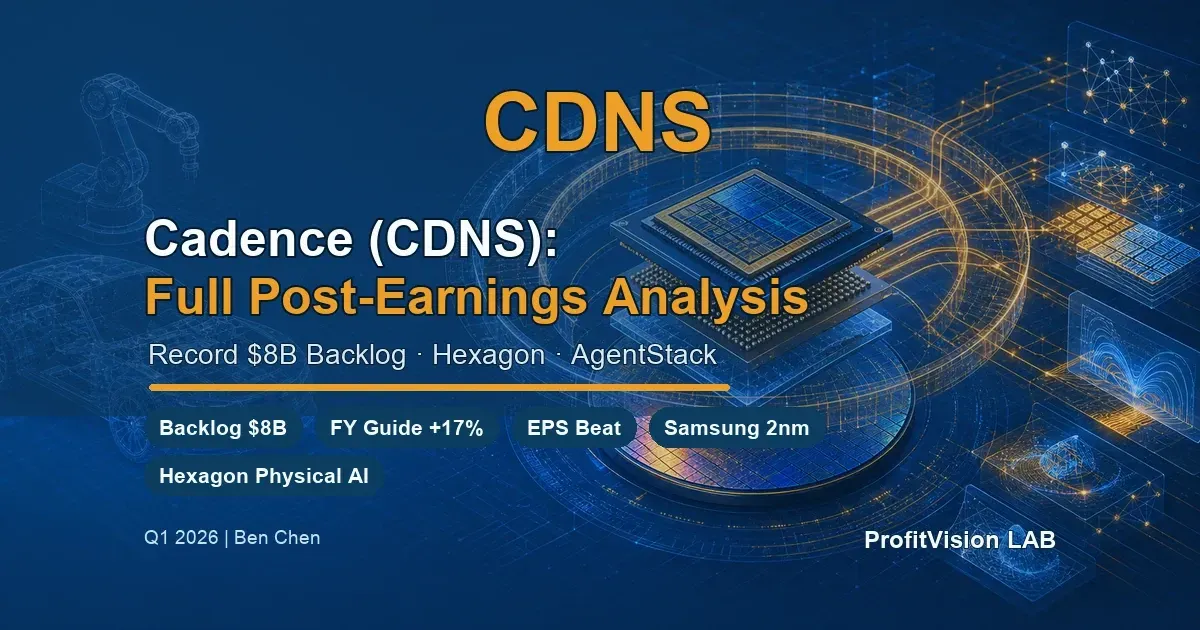
The Invisible Empire of Chip Design
"AI is a multiplier, not a disruptor. China is the real test." That is the core conclusion of this research note. Cadence has corrected from a 52-week high of $376.45 to around $288, and briefly touched $228.20 on April 7, 2026, more than 39% below the high. At the same time, 2025 ending backlog reached a record $7.8B, and 67% of 2026 revenue was already locked in at the start of the year. The gap between market price and business visibility is the starting point of this analysis.
1. The EDA Industry: An Upstream Infrastructure Duopoly
Electronic design automation, or EDA, is one of the most important yet least understood layers of the semiconductor value chain. The core logic is simple: modern chips contain tens of billions of transistors, and their complexity has already exceeded what humans can design manually. EDA software is the toolchain that makes that complexity designable and manufacturable. No EDA, no advanced chips. No advanced chips, no AI.
Figure 1: EDA market share and Cadence's three moat characteristics
EDA spending is R&D infrastructure. In semiconductor downcycles, it is among the last budgets to be cut. Chip companies can delay fabs or equipment purchases, but they cannot stop engineers mid-design without creating larger restart costs. That gives Cadence an unusual degree of resilience.
2. AI Strategy: The Three-Layer Cake and ChipStack Logic
The market's biggest misunderstanding is that AI will make EDA tools obsolete. CEO Anirudh Devgan argues the opposite: AI is a multiplier of Cadence's tool consumption, not a substitute for the platform.
Figure 2: AI is a consumption multiplier for the Cadence platform, not a replacement.
The 2025 Broadcom partnership supports this logic. Broadcom is one of the world's most important custom ASIC design companies, and its decision to work with Cadence on agentic AI workflows directly counters the idea that Cadence is losing the AI era.
3. Financial Performance: What a $7.8B Backlog Means
Figure 3: CDNS financial dashboard - backlog, 2026 guide, and cash generation
4. China Export Controls: The Most Real External Risk
On May 23, 2025, the U.S. Department of Commerce instructed Cadence, Synopsys, and Siemens EDA to stop selling EDA software to Chinese companies. CDNS fell more than 10% that day. This is the most fundamentally grounded part of the recent drawdown and deserves direct treatment.
May 23, 2025: the strictest moment, with sales to China stopped and the stock down more than 10%.
Second half of 2025: the regime shifted toward case-by-case licenses, allowing some business to continue. Management indicated China remained roughly 13% of 2025 revenue and was expected to stay around 12-13% in 2026.
2026: the license regime remains in place while U.S.-China trade negotiations continue. 67% of 2026 revenue was already locked in through backlog.
Medium term: local Chinese EDA vendors are improving, but their advanced-node flow completeness and physics accuracy remain years behind the leading CDNS/SNPS toolchains.
- 12-13% of revenue could be at risk under a full tightening scenario.
- Policy is unpredictable and cannot be solved by business execution alone.
- China's domestic substitution trend is real over the long term.
- The current regime is not a total ban.
- Non-China growth in North America, Europe, Taiwan, Korea, and Japan is strong.
- The $7.8B backlog provides a transition buffer.
- 2025 revenue still grew 14%, proving offset capacity.
Figure 4: China export-control risk and mitigation map
5. Three Bear-Case Challenges and Responses
That concern is valid. China is roughly 12-13% of revenue, and an extreme policy scenario could force a severe revenue reset. But the current reality is not the most bearish case. The license regime has allowed some business to continue, and 2025 growth showed that non-China demand can more than offset a partial China drag. Domestic Chinese EDA replacement also remains technically difficult at advanced nodes.
SNPS + Ansys is a real competitive upgrade. However, Cadence has responded with Hexagon's design and engineering assets and a different system-level strategy. More importantly, leading semiconductor customers rarely want to be captive to one vendor. The EDA market is a two-vendor structure with overlapping but differentiated strengths.
The gap is real and should not be ignored. But free cash flow is the better anchor. Cadence produced $1.59B of FCF in 2025 and repurchased $925M of stock, largely offsetting stock-based compensation dilution. Acquisition amortization is an accounting charge for past capital allocation, not a recurring cash operating cost.
6. Integrated View and Key Checkpoints
China export controls: whether the license regime tightens and whether approval rates fall.
Q1 2026 results: the first quarter is the strongest seasonal quarter and a key business-momentum test.
ChipStack commercialization: customer adoption and revenue contribution are leading indicators for the AI strategy.
Backlog renewal and expansion: whether customers expand Cadence usage in new contracts.
China export controls: real policy risk, but the current discount appears excessive.
SNPS + Ansys: real pressure, but protected by a non-zero-sum duopoly.
GAAP vs. non-GAAP: free cash flow largely resolves the most aggressive critique.
"As the AI supercycle accelerates, from AI infrastructure buildout to physical AI such as autonomous driving and robotics, and then to scientific AI, Cadence's broad portfolio allows us to benefit across different layers of AI applications."
-- Anirudh Devgan, CDNS CEO, Q4 2025 earnings call
Cadence has the strongest business momentum among the five stocks in this research set. A record $7.8B backlog, 67% of 2026 revenue already locked in, and 20% non-GAAP EPS growth describe a company with a durable moat and strong growth visibility. The recent drawdown reflects a mix of rational China-policy discount, exaggerated fear that AI will replace EDA, and broad multiple compression in high-PE software names.
Research cutoff date: April 10, 2026 | Main sources: CDNS Q4 2025 earnings-call transcript, public financial reports, and SEC filings. This article is for research and educational purposes only and does not constitute investment advice.


Comments ()