
Cloudflare (NET) Q1 2026 Full Post-Earnings Analysis: 1,100 Layoffs, a $5B ARR Target, and the Cost of an AI-First Reset
Cloudflare (NET) beat Q1 2026 expectations, then announced a 1,100-person AI-first restructuring. This analysis reviews Q1 results, VoidZero, Investor Day, AgentStack, Cloudflare OS, Rule of 50, and whether the moat is narrowing.
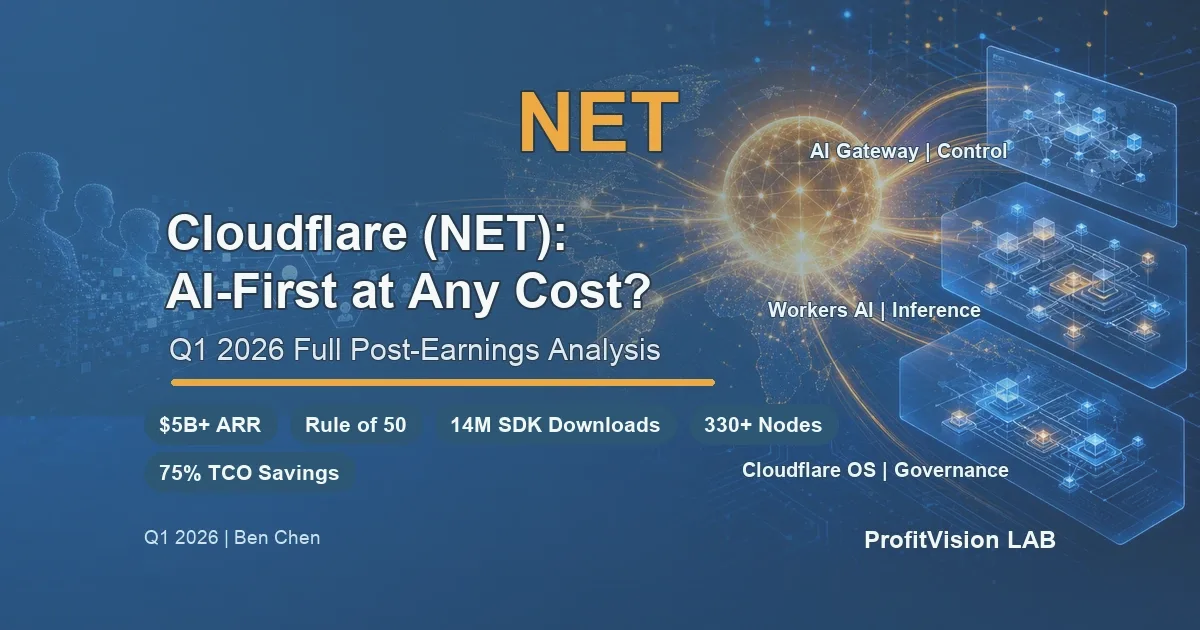
The quarter beat across the board, yet CEO Matthew Prince announced 1,100 layoffs and an AI-first reset, sending the stock down 24% after hours. With the VoidZero acquisition and a $5B ARR target unveiled at Investor Day, how should investors evaluate the bet?
The original research note was based on FY2025 annual-report data. This update incorporates Q1 2026 earnings, the May 7 conference call, the June 4 VoidZero acquisition, and the June 9 Investor Day. The operating numbers were strong: revenue of $639.8M grew 34%, cRPO grew 34%, and EPS of $0.25 beat consensus by 8.7%. But management also announced more than 1,100 layoffs, roughly 20% of the workforce, with $140-150M of restructuring charges expected in 2026. Investor Day added a $5B+ ARR target, AgentStack, Cloudflare OS, and a 2027 target of Rule of 50+. The moat has not been disproven, but the timing and cost of the reset are now the core debate.
1. Original Thesis vs. New Data
| Item | Original research (2026/04) | Q1 2026 + Investor Day | Change |
|---|---|---|---|
| Revenue scale | FY2025 revenue of $2.23B | Q1 revenue of $639.8M, +34% YoY; FY guide of $2.805-2.813B | Positive: growth accelerated |
| cRPO | +34% YoY in Q4 FY2025 | +34% YoY in Q1 2026 | Positive: momentum held |
| Non-GAAP gross margin | 77.1% in Q4 FY2025 | 72.8% in Q1 2026 | Watch: down 130 bps YoY |
| Organization | Traditional high-growth software company | 1,100 layoffs, about 20% of employees, as part of an AI-first reset | Major structural change |
| AI positioning | Workers AI and Gateway were early revenue options | AI-first reset, AgentStack, VoidZero, Isolates architecture | Narrative upgraded; execution still needs proof |
| Long-term target | No explicit target | $5B+ ARR target; Rule of 50 in 2027 | New catalyst |
| Analyst consensus | Not central to the prior note | $243.11 consensus target across 34 analysts, according to S&P Global on 6/11 | About 6.5% implied upside from the 6/12 close |
2. Event Timeline: From Earnings to Investor Day
3. Q1 2026 Earnings Deep Dive
3.1 The quarter itself
| Metric | Q1 2026 actual | Consensus | YoY | Result |
|---|---|---|---|---|
| Revenue | $639.8M | $620.8M | +34% | Beat by about 3% |
| Non-GAAP EPS | $0.25 | $0.23 | -- | Beat by 8.7% |
| Non-GAAP gross margin | 72.8% | -- | -130 bps | Still compressing |
| Non-GAAP operating income | $73.1M | -- | +31% | Still expanding |
| Free cash flow | $84.1M | -- | 13% FCF margin | Improved |
| cRPO | +34% YoY | -- | Flat vs. Q4 | Healthy pipeline |
| Cash and marketable securities | $4.16B | -- | -- | Plenty of liquidity |
| Q2 revenue guide | $664-665M | ~$665-666M | +30% | Slightly below some expectations |
3.2 The 1,100 layoffs: cost cut or architecture reset?
The biggest shock was not the financial result. It was the organizational reset: more than 1,100 layoffs, roughly 20% of the global workforce, with $140-150M in 2026 restructuring charges. About $40M of that is non-cash, and most of the charge is expected in Q2.
"We have never done anything like this before, and we take it very seriously. This is not a cost-cutting action. This is about defining how a world-class, high-growth company should be architected around AI and agents."
-- Matthew Prince, Q1 2026 earnings call
Prince's argument is that AI has become embedded in Cloudflare's operating model. Engineers use AI coding tools; AI agents handle support tickets, compliance reviews, and code review; and output per employee has risen. If fewer people can handle the same operating load with AI tools, the workforce base can be reset.
Rule of 40 is calculated as revenue growth rate plus free-cash-flow margin. A company growing revenue 30% with a 15% FCF margin scores 45, above the usual threshold.
Cloudflare's Investor Day target is Rule of 50 by 2027. That means the company wants to keep high growth while materially improving efficiency. The labor-cost savings from the 1,100 layoffs are one financial lever toward that target.
The market cares because Rule of 40 or Rule of 50 is a fast way to judge whether high-growth spending is producing enough operating leverage.
A 20% layoff is unprecedented for Cloudflare. Customer support quality, sales morale, and engineering throughput could all suffer during the transition. Management says net sales-quota capacity will accelerate in 2026. Q2 is the key checkpoint to verify that claim.
4. Investor Day: $5B ARR and the Technical Architecture Upgrade
4.1 The $5B ARR target and Rule of 50
Cloudflare's 2026 Investor Day at the NYSE revealed a long-term ARR target of more than $5B and raised the 2027 Rule of 40 target from 46%+ to Rule of 50. Against the 2026 revenue guide of roughly $2.81B, the $5B target implies about 78% additional growth. At a 30% compound rate, that path takes about three and a half years, or roughly 2029-2030. Management did not attach a year to the ARR target, likely to avoid overcommitting to a precise timetable.
4.2 AgentStack: the orchestration layer for AI agents
AgentStack is Cloudflare's architectural response to the AI-agent era. It is positioned as an orchestration layer between enterprise AI agents and enterprise infrastructure, combining access control, inference acceleration, and security governance.
AI Gateway: the control plane for all AI calls
Enterprises are using OpenAI, Anthropic, Gemini, custom models, and open models at the same time. That creates scattered API keys, fragmented cost tracking, inconsistent response behavior, and weak audit trails. AI Gateway offers one endpoint for multiple providers, adding logging, rate limiting, cost tracking, retries, fallback, and caching.
Cloudflare is also its own reference customer. Internally, AI Gateway handles about 20M requests and 241B tokens per month for 3,683 engineers. New dynamic-routing features let a customer switch models based on cost, latency, or availability without rewriting application code.
MCP, or Model Context Protocol, is an emerging standard for connecting AI agents to tools. The problem is that enterprises often do not know which MCP servers their agents are using. It may be a third-party plugin installed by an engineer or an external database connected by an AI assistant.
Cloudflare added Shadow MCP detection inside AI Gateway to identify unauthorized MCP-server connections. That turns agent egress into something security teams can observe and govern.
Workers AI: edge inference for low-latency agents
Traditional inference often runs in distant hyperscale data centers. A user request in Taiwan may travel to a U.S. East Coast cloud region and back, adding 150-300 ms of latency. That is a problem for voice assistants, real-time translation, and edge security decisions.
Workers AI runs inference on Cloudflare's global network of 330+ nodes. Code and inference run on the same global edge, reducing cross-cloud hops. This is the core of Cloudflare's claim that its architecture can lower total cost of ownership for certain agent workloads.
| Model type | Callable through AI Gateway | Self-hosted on Workers AI edge |
|---|---|---|
| Anthropic Claude family | Yes, via provider routing | Selected licensed versions where available |
| OpenAI GPT family | Yes, forwarded through Gateway | Open-weight versions where available |
| Kimi, Llama, DeepSeek | Yes | Yes for supported self-hosted models |
| Google Gemini / Gemma | Yes | Selected open or licensed versions |
In proxy mode, AI Gateway forwards requests to an external provider such as OpenAI or Anthropic while adding governance, logging, cost control, caching, and routing.
In Workers AI self-hosted mode, supported models actually run on Cloudflare's edge infrastructure. That can reduce latency and avoid extra cross-cloud hops. For AI agents that make many sequential calls, 100-200 ms of extra latency per call can accumulate into seconds of user-visible delay.
Investor Day disclosed more than 14M Agents SDK downloads. Cloudflare also cited heavy internal Workers AI usage, reinforcing the idea that the product is being validated internally before broader monetization.
Cloudflare OS: the operating system for enterprise data access
Enterprise data is scattered across SaaS apps, private databases, internal APIs, and collaboration tools. Humans are governed by VPN and Zero Trust policies, but AI agents often lack an equivalent control layer.
Cloudflare OS aims to route data access from both humans and agents through a unified security layer. It combines Zero Trust policy, AI Gateway logs, and private-network access so teams can see who or what accessed which data, when, and through which path.
Agent Lee is the first major demonstration of that concept inside the Cloudflare console. It understands account resources such as Workers, DNS settings, and error rates, and lets admins diagnose and fix issues in natural language.
Traditional serverless compute often relies on heavier virtual-machine abstractions. Cloudflare Workers uses V8 Isolates: lightweight isolated execution environments that can start in under a millisecond and disappear after the request completes.
That matters for AI agents because agents may trigger dozens of isolated tool calls in a few seconds. If each call needs a heavy VM start, latency and cost rise quickly. Cloudflare argues that Isolates give it a structural advantage for agentic workloads.
4.3 VoidZero: the developer ecosystem piece
VoidZero brings Vite, Vitest, Rolldown, and Oxc into the Cloudflare orbit. Vite is a default tool across modern front-end workflows. Strategically, Cloudflare is no longer just where code is deployed after development; it becomes part of the developer workflow from project creation to deployment, inference, and monitoring.
4.4 Why did the stock fall on Investor Day?
The event provided architecture and a strategic direction, but not enough near-term monetization anchors. The market wanted Workers AI ARR, paid AI Gateway customer counts, or specific Act 4 revenue guidance. Wolfe Research kept a Peerperform view, noting that the targets were exciting but the AI monetization path was still not specific enough.
5. Bull vs. Bear: Is the Reset Worth the Cost?
Bull case
- cRPO grew 34%: pipeline momentum did not slow despite the market reaction.
- FCF target stayed intact: management said 2026 free-cash-flow expectations were not reduced.
- Agent traffic is becoming real: Cloudflare says AI-agent traffic already surpassed human traffic in early 2026.
- Isolates create a cost advantage: the architecture is built for fast, cheap, repeated calls.
- VoidZero embeds Cloudflare earlier in the developer journey: Vite's large developer base becomes a strategic distribution point.
- Analyst sentiment improved: Morgan Stanley moved to $305, and several major firms raised targets after Investor Day.
Bear case
- Gross margin compression matters: non-GAAP gross margin fell to 72.8%. If Workers and AI products grow faster at lower margins, overall profitability may be capped.
- Q2 will be messy: most restructuring charges are expected to hit Q2, making GAAP results look ugly even if the core business is fine.
- Act 4 monetization is still vague: Investor Day did not give specific ARR or paid-customer data for AI products.
- Valuation remains demanding: at $228.20, the stock still carries a high P/FCF multiple. A longer monetization timeline would pressure the multiple.
6. Analyst Landscape After Investor Day
7. Four Defensive Filters After Investor Day
| Filter | Original view | After Q1 2026 + Investor Day | Conclusion |
|---|---|---|---|
| Positioning | Watch | Stock recovered from $196 to $228.20; analyst sentiment improved, but insider selling needs monitoring. | Watch, leaning positive |
| Moat | Pass | Workers, AI Gateway, VoidZero, and Isolates strengthen the agent-era story. | Pass, strengthened |
| Volatility | Watch | Post-earnings IV is cooling, but Q2 restructuring charges remain a risk event. | Watch |
| Technical setup | Watch | Recovered from the earnings low but still below the pre-earnings area. | Improving |
Overall view: constructive watch. The moat thesis is stronger than before, and post-Investor Day analyst sentiment improved. The next checkpoint is Q2: whether restructuring charges stay within the expected range, FCF margin holds, and sales-quota capacity truly increases.
Tracking Log
| Date | Event | PVL view | Note |
|---|---|---|---|
| 2026/04/14 | Original research note | Watch | Act 1-4 framework established |
| 2026/05/07 | Q1 2026 earnings and 1,100-layoff announcement | Watch | Strong numbers, Q2 restructuring is the key checkpoint |
| 2026/06/04 | VoidZero acquisition | Positive moat signal | Vite ecosystem integrates with Workers |
| 2026/06/09 | Investor Day | Constructive watch | Long-term narrative strengthened; monetization timing still unclear |
| 2026/06/12 | Close at $228.20 | Constructive watch | Up 16% from post-earnings low |
| 2026/08 expected | Q2 2026 earnings | -- | Key validation: charges, FCF, and sales capacity |
Frequently Asked Questions
Sources include Cloudflare Q1 2026 conference-call transcript, Investor Day 2026 materials, SEC 8-K, S&P Global Market Intelligence consensus data as of 6/11, analyst reports from Morgan Stanley, RBC, Piper Sandler, Needham, BTIG, Mizuho, Truist, KeyBanc, UBS, StockAnalysis, Quiver Quantitative, and CNBC as of June 13, 2026.
Comments ()