
Siemens: The Focused Federation—Turning Spin-offs into a Repeatable Art
Siemens spent more than two decades spinning off Infineon, Healthineers and Energy while becoming more focused. This analysis explains the focused federation, Joe Kaeser's fleet philosophy, and how repeatable spin-offs became capital-allocation discipline.
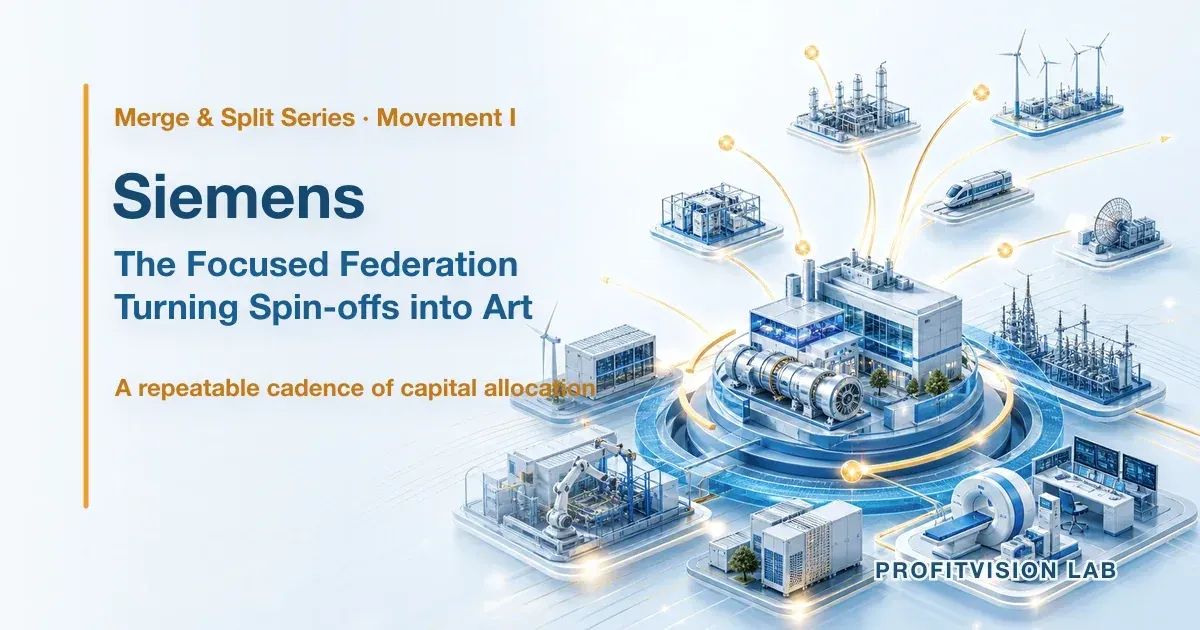
- Siemens turned the "spin-off" from a one-time event into a repeatable, institutionalized capital-allocation discipline: Infineon (semiconductors) in 1999, Osram (lighting) in 2013, Healthineers (medical) in 2018, Energy in 2020—more than two decades of spinning off an independently listed "fleet."
- The key contrast: GE grew weaker the longer it waited and was forced to break into three only when pushed to the cliff edge; Siemens grew stronger with every split, because it let go proactively while each business was still healthy and could still command a good price, avoiding the long-term accumulation of a conglomerate discount.
- This is CEO Joe Kaeser's "fleet of ships" philosophy: rather than being one lumbering aircraft carrier that carries everything, become a fleet of nimble, individually focused ships, letting the parent Siemens AG concentrate on industrial automation and software.
- Cleverer still is "splitting and merging in tandem": even as it spun off energy and medical (split), Siemens spent about US$10 billion to acquire software company Altair (merge)—splitting what should be split, merging what should be merged, all revolving around one iron rule, the best owner test: "am I the best owner of this business?"
How Can a Company Get "Stronger the More It Splits"?
After reading about GE, you may have come away with a sad impression of "spin-offs": that they are amputations to survive after an empire's collapse, the bitter medicine forced down after twenty lost years.
But Siemens offers the exact opposite version. This German industrial giant, founded in 1847, has over the past two-plus decades proactively and continuously spun off its businesses, one after another—and with every piece it shed, it didn't bleed out; it grew more focused and more valuable. Both did the "splitting," but GE was like a forced amputation, while Siemens was like a gardener pruning branches: cutting back the side shoots so the trunk can grow taller.
Where exactly is the difference? The answer is hidden in two words: "timing" and "cadence."
Twenty-five Years, Spinning Off a Whole Fleet
Lay out Siemens's spin-off history and you see a clear, patient trajectory—not one big bang, but a series of carefully arranged acts of "letting go":
Infineon
Semiconductors
Osram
Lighting
Healthineers
Medical
Energy
Power
| Once "a single division within the group" | Now "an independent giant" · market cap (2026.06) |
|---|---|
| Infineon (IFX, spun off 1999) | ~US$130.5 billion (global leader in automotive/power semiconductors) |
| Siemens Energy (ENR, spun off 2020) | ~US$177.5B (recovered sharply from the 2023 crisis trough) |
| Siemens Healthineers (SHL, listed 2018) | ~US$45.5B |
| Three spin-offs combined | ~US$353.5B > the focused parent Siemens AG (SIE) at ~US$239.8B |
Note: market caps are approximate, in US dollars, as of June 2026, and will move with share prices. Siemens Energy briefly fell into crisis in 2023 (massive losses at its wind subsidiary Gamesa) before recovering sharply.
The numbers speak for themselves: businesses that were once just "a single division" within the Siemens group grew, one by one, into giants after going independent—the combined market value of the three spun-off companies alone is about US$353.5 billion, exceeding the focused parent Siemens AG (~US$239.8B). Add the parent and the three together, and this "fleet" carries a total market value of about US$593 billion—far beyond the valuation any single "carries-everything" conglomerate could ever achieve.
With every spin-off, Siemens was not panic-selling in a crisis but letting go calmly while the business was still healthy, still able to fetch a good price, and still able to win a good market multiple. That composure is precisely what most fundamentally separates it from GE.
Joe Kaeser's "Fleet of Ships" Philosophy
Behind this run of serial spin-offs lies a clear vision. Joe Kaeser, who steered the company from 2013 to 2021, put forward a famous metaphor: rather than be one lumbering aircraft carrier that loads everything onto a single hull, turn Siemens into a "fleet of ships"—a group of independent vessels, each nimble, each focused, each able to change course quickly.
During his tenure, Siemens was reshaped from an all-encompassing industrial conglomerate into a structure of "three independent companies + one focused parent": Siemens Energy was spun off, Siemens Healthineers was independently listed, and the "new Siemens AG" focused on industrial automation, smart infrastructure and industrial software. A bloated empire was deliberately reorganized into an agile fleet.
Why Germany Splits So Calmly—Discipline Built by Institutions
Siemens's ability to spin off "continuously, proactively, and without bloodshed" for more than two decades is not just the wisdom of one CEO—it also rests on the unique institutional soil of the German AG (Aktiengesellschaft, a stock corporation). It differs most fundamentally from the United States and Taiwan in three ways:
(2) Codetermination (Mitbestimmung): in companies with more than 2,000 employees, half the supervisory board's seats are elected by employees/unions (the shareholder-side chair holds the casting vote to break a deadlock). So in any major spin-off or restructuring, union representatives sit right there on the supervisory board—forcing management to make spin-offs a "negotiated, well-paced, job-preserving" version, rather than the cliff-edge shock therapy GE went through.
(3) Foundation/family anchor shareholders: many German AGs are anchored over the long term by a foundation or family that controls the company and resists short-term share-price pressure—this is the bedrock that lets German firms pursue "twenty years of consistent" serial restructuring.
Why Does "Continuous, Proactive, Gradual" Beat "a One-time Crisis Break-up"?
Both broke up sprawling conglomerates, so why was Siemens's path so much smarter than GE's? Three things are key:
(1) Timing: let go at the top, not fire-sell at the bottom. Siemens always spun off a business while it was still healthy and in market favor, securing a good valuation and a strong independent starting point. GE, by contrast, dragged on until GE Capital detonated and its market value collapsed by 90%, before being forced to break up—with far worse optics and far weaker bargaining chips.
(2) Cadence: spread the risk, recalibrate continuously. By breaking the spin-offs into a series of small steps over more than twenty years, rather than one big gamble, Siemens could observe, learn and adjust at every step. It's like periodically rebalancing a portfolio, rather than waiting to liquidate everything in a blow-up.
(3) Discipline: make "splitting" a system, not an emotion. For most CEOs, "tearing apart the business you built with your own hands" is an emotionally near-impossible hurdle. Siemens turned it into a calm, repeatable capital-allocation routine—and that is the biggest dividing line between top allocators and empire builders.
The best owner test: Siemens isn't the best owner of semiconductors, but it is of industrial software
Siemens spun off Infineon, Osram and Energy not because these were bad businesses—they are all strong players in their own fields. It was because Siemens recognized: it was not their best long-term owner. Semiconductors have their own brutal capital cycle, lighting commoditizes, energy is a highly cyclical heavy-asset business—their capital-allocation logic, valuation methods and competitive rhythms are all utterly different from the "industrial automation + software" that Siemens wants to focus on. Tying them together would only drag both sides down with the other's cycles and multiples.
Letting them go independent, each to find more fitting shareholders and valuations, is better for everyone. A spin-off is Siemens's most honest and most responsible acknowledgment of the fact that "I'm not your best owner."
Splitting and Merging in Tandem: Spin Off Energy While Buying Software
Here is the lesson from Siemens most worth learning, and the fullest embodiment of this whole series' "Merge & Split" theme—it doesn't only know how to "split"; it is "merging" at the same time.
Even as it spun off energy and medical one by one, Siemens was aggressively "merging" in another direction: it acquired EDA software firm Mentor Graphics (2017, ~US$4.5 billion), and in 2024 announced it would acquire simulation and AI-computing software company Altair for about US$10 billion, aiming to build "the most complete AI industrial-software portfolio."
(1999–2020)
a repeatable discipline
(merging at the same time)
Splitting one moment and buying the next looks contradictory, but it is in fact two sides of the same logic: let go of the businesses where "I'm not the best owner" (split energy, semiconductors, lighting), and buy in the capabilities where "I am the best owner" (merge in industrial software, automation). Both the splitting and the merging serve one goal—making Siemens more irreplaceable on the battlefield where it most deserves to win (industrial digitalization).
GE vs Siemens: Two Ways to Dismantle an Empire
| Dimension | GE | Siemens |
|---|---|---|
| Method of break-up | One-time, crisis-driven | Continuous, proactive, gradual (25 years) |
| Timing | Forced to split after a 90% collapse in value | Let go while businesses were healthy and richly valued |
| Mindset | Amputate to survive | Gardener pruning; fleet management |
| Doing at the same time | Deleveraging, stanching the bleeding | Splitting while buying software (splitting and merging in tandem) |
| Result for the parent | Rebirth after twenty lost years | More focused with every split, continually strengthening the core |
Both arrive at "more focused" as the endpoint, but Siemens's road skipped GE's twenty lost years. The difference isn't whether to split, but whether you split proactively and calmly at the top—or passively and clumsily at the bottom.
Lessons for Taiwan: Make Spin-offs a Discipline, Not Emergency Surgery
(1) The best time to spin off is while the business is still healthy. Don't wait until you're pushed to the cliff edge like GE. Let go proactively at the top, while the market is still willing to grant a good multiple, and you secure the best chips.
(2) A spin-off can be a "system," not a one-time emotional decision. Siemens turned it into a routine action repeated over more than two decades. Make "periodically reviewing: which business am I no longer the best owner of?" a standing item of board homework.
(3) Master both splitting and merging. True masters tear off what shouldn't be kept with one hand and buy in what should be strengthened with the other. A company that only knows how to merge and never how to split will sooner or later become GE; only a company that does both can keep evolving like Siemens.
Up next: Germany's Other Cut of the Century
Siemens is the art of "continuous, gradual" spin-offs. In the next piece, we look at another German industrial giant—the century-old automotive champion Daimler—and how it used one clean "split into two" to separate the Mercedes passenger-car and truck businesses, letting each wheel accelerate on its own.
From a fleet, to a clean cut in two. See you in the next piece, Daimler.
Post-Spin-off Scorecard: Siemens's Serial Spin-offs
Using the six questions from the Introduction, here is the overall verdict on this run of serial spin-offs:
| Checkpoint | Verdict | Notes |
|---|---|---|
| (1) Capital-allocation benefit | ✅ | Continuously focusing; the three spin-offs' combined market cap exceeds the focused parent, and the parent splits while buying software |
| (2) Original shareholders' equity | ✅ | Distribution-style spin-offs; original shareholders hold the parent plus each spun-off company |
| (3) Clean separation | △ | Partial stakes retained (a Healthineers majority; Energy early on), making this a "gradual partial separation," with stakes being reduced over time |
| (4) Synergy trade-off | ✅ | The businesses have different cyclical/valuation logics; there was no real synergy to begin with |
| (5) Exit mechanism | ✅ | A clear, gradual path to reducing stakes |
| (6) Structure type | — | Serial spin-offs + parent-level M&A (splitting and merging in tandem) |
Overall verdict: spin-offs made into a repeatable discipline—stronger with every split; the only "△" is that partial stakes are still retained, so valuation release is gradual rather than delivered all at once.
- Introduction: Merge & Split—the Art of Capital Allocation
- Movement I [Split] · GE: From an Empire's Collapse to a Century Break-up's Rebirth
- Movement I [Split] · Abbott → AbbVie: One of the Most Successful Spin-offs Ever
- Movement I [Split] · eBay → PayPal: When the Child Outgrew the Parent
- Movement I [Split] · Siemens (this piece): The Focused Federation—Turning Spin-offs into a Repeatable Art
- Movement I [Split] · Daimler: Split into Two, Each Wheel Accelerating on Its Own
- …followed by Ferrari, Haleon, GE×Wabtec, Novartis, Philips, Universal Music, Hitachi, Sony
- Movement II [Merge]: Broadcom, LVMH, AB InBev, Schneider, Exor, Fujifilm
Comments ()