
SEPA Methodology Introduction: Three Goals, Three Processes, Five Pillars
SEPA is the entry science after CANSLIM stock selection. This guide explains Mark Minervini's three goals, three processes, and five pillars for turning stock selection into lower-risk execution.
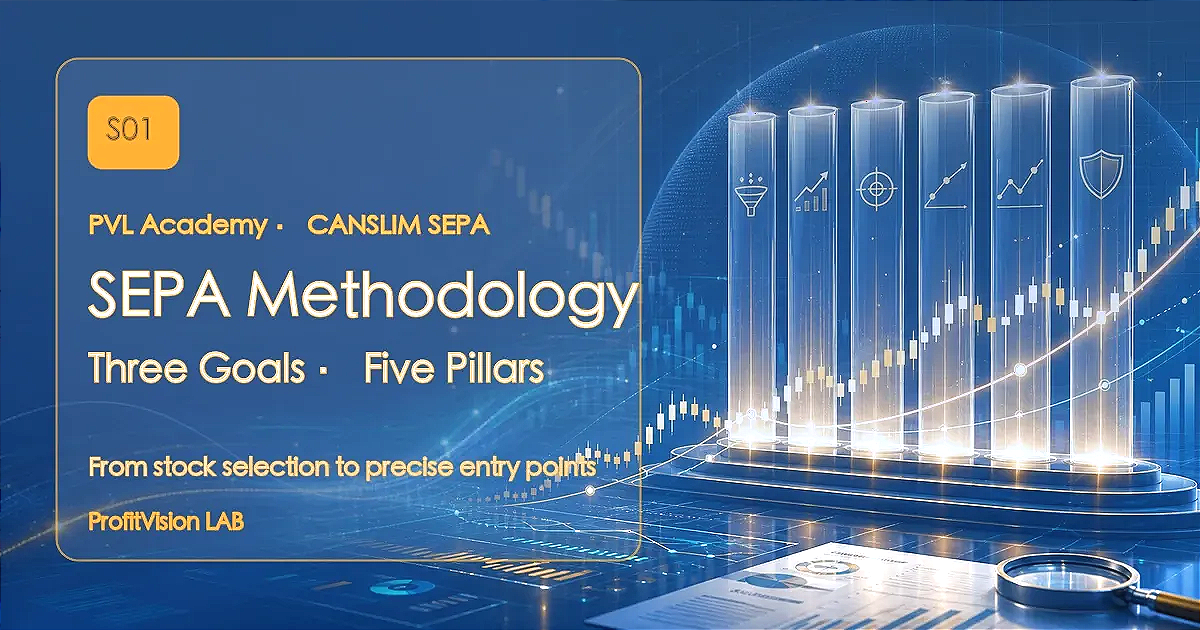
- SEPA (Specific Entry Point Analysis) is the science of stock selection and entry that Mark Minervini developed through years of live trading research. Its core logic: capture the largest gains at the lowest-risk moment, and maximize returns through compounding.
- SEPA's three goals: ① Take Minimal Risk; ② Capture Large Gains; ③ Maximize Compounding — any one missing renders the system incomplete.
- SEPA's three processes: Selection → Trade Execution → Position Management — the order cannot be reversed.
- SEPA rests on five pillars: Categories, Valuation, The Trend, Fundamentals, and Price & Volume — each pillar maps to different letters in CANSLIM.
- CANSLIM defines "which stocks are worth buying"; SEPA solves "when to buy, how much to buy, and how to exit" — together they form a complete superperformance trading system.
Why Do CANSLIM Investors Still Lose Money After Selecting the Right Stocks?
This is a puzzle that many serious CANSLIM students have encountered: you screen for top candidates with quarterly EPS growth exceeding 25%, three consecutive years of accelerating annual growth, and RS Ratings above 90 — yet after entering, the stock goes nowhere, or worse, reverses and hits your stop.
The reason is a fundamental distinction most people overlook: "selecting the right stock" and "finding the right entry timing" are two completely different things. The former is what CANSLIM solves; the latter is what SEPA fills in.
William O'Neil provided a highly rigorous stock selection framework in CANSLIM, but he did not tell you: exactly which day, at which price to buy — nor did he fully specify how large the position should be relative to the account, or precisely when to exit. That is not a criticism of CANSLIM — it was never designed to do those things. The problem is that investors treat a "stock screening system" as a "complete trading system."
"Selecting the right stock is only half the battle. If you buy at the wrong time, even the best stock will cause you to lose money." — Mark Minervini
This is the starting point of Mark Minervini's SEPA: building on CANSLIM's foundation to create a more precise entry science — fully integrating "which stocks to buy" with "when to enter, how to manage the position" into one complete system.
Mark Minervini is a legendary competitor in the U.S. Investing Championship (USIC), having achieved returns exceeding 155% in a single year with a five-year compound annual return exceeding 220%. He is one of the rare practitioners who combines high win rates with high payoff ratios, and the author of Trade Like a Stock Market Wizard and Think & Trade Like a Champion. SEPA is the systematic crystallization of his thirty-year trading career — not academic theory.
Why does USIC performance matter? The USIC is a live-account competition: participants must use real money, and results are verified by independent accountants. Unlike backtests or paper portfolios, USIC results represent real performance in real markets under real risk — which gives Minervini's methodology a rare level of credibility.
What Is SEPA? The Philosophy Hidden in the Name
SEPA stands for "Specific Entry Point Analysis." The word "Specific" is the soul of the entire methodology: entry is not "buy when it feels about right" — it is a strict checklist where every condition must be satisfied before executing the trade.
But if you understand SEPA only at face value as "finding one correct buy point," you miss its depth. SEPA is a complete trading philosophy encompassing the full process from stock screening and trend confirmation to pattern identification, trade execution, position management, and exit strategy. It is not just one entry signal — it is a complete, systematic decision-making framework.
"First make yourself invincible" = Position Management comes first — before every entry, set the stop loss and control the risk, placing yourself in an undefeatable position. Whatever the market does, the worst case is already under control.
"Wait for the moment when the enemy becomes vulnerable" = Trade Execution waits for the lowest-risk point — wait for the VCP to contract to its narrowest, volume to dry up to its lowest, and let the "exploitable moment" emerge naturally rather than rushing into a trade.
Minervini's most-quoted line: "Don't go looking for trades — let the trades come to you." This is the modern version of Sun Tzu's philosophy of patient waiting.
SEPA's Three Goals: Conditions Any Good System Must Simultaneously Achieve
SEPA's three core goals are inseparable — if you only achieve one or two of them, sustained profitability over time is unlikely. What makes these three goals difficult is precisely that they appear to be mutually contradictory on the surface.
These three goals sound simple, yet they hide the most difficult psychological contradictions: to "take minimal risk," you must be capable of standing aside when the pattern is wrong — even accepting a stop loss; to "capture large gains," you must be capable of holding still, resisting the temptation to take profits midway; to "maximize compounding," you must be capable of cutting losses decisively when wrong, never allowing any single trade to damage your capital.
These three goals also correspond precisely to the three primary failure modes of most retail investors: ① entering too early, without stop logic; ② taking profits too quickly, missing the primary advance; ③ refusing to exit on a loss and letting small losses become large ones.
Many investors view a stop loss as "punishment for being wrong" — a fundamental cognitive bias. In the SEPA framework, a stop loss is an actively designed cost, like an insurance premium — you know in advance the worst-case cost and accept it in exchange for the opportunity to participate in a potential large move.
Minervini's math: if you control every loss to 7–8% and winning trades average 25–30% profit, even with a 40% win rate, the overall expectation is positive. The key is not "being right every time" — it is "losing small when wrong and winning big enough when right."
SEPA's Three Processes: Selection → Execution → Management
Minervini organizes SEPA's operation into three sequential processes, each a prerequisite for the next — skipping any one link causes the entire system to break down.
Process 1: Selection
Selection is the foundation of the entire system. Its goal is to screen from thousands of stocks in the market to find candidates that meet the conditions for "superperformance potential." The stock selection criteria integrate CANSLIM's fundamental requirements (C, A, N, I) with SEPA's specific trend conditions (eight Trend Template conditions) and pattern recognition (VCP, Primary Base, etc.).
Stock selection is a "negative screening" process — first eliminate stocks that don't qualify; what remains enters the watchlist. Many investors' problem is skipping rigorous stock selection and jumping directly to stocks that "feel like an opportunity," resulting in entering fundamentally weak candidates.
Process 2: Trade Execution
Even after selecting the right stock, the timing and method of entry equally determine success or failure. Trade Execution's core is identifying low-risk entry points (VCP breakout, Pocket Pivot Point, Gap Up, etc.) and deciding the initial position size.
Minervini emphasizes: the precision of entry timing directly determines the width of the stop loss. If you enter at the right location, the stop loss is typically only 5–8%; if you buy at a high, the same stop logic may cost you 15–20%. The same stock, at different entry timing, produces dramatically different risk/reward ratios.
Process 3: Position Management
The work after entry truly determines the final outcome. Position Management includes: when to add, when to reduce, and when to exit (proactive selling vs. triggered stop). This process directly affects the achievement of both the "capture large gains" and "maximize compounding" goals.
Most educational materials end at Trade Execution and completely ignore Position Management — this is the primary reason many investors "select correctly but achieve poor results."
SEPA's Five Pillars: The Complete Analytical Framework from Selection to Entry
Minervini's methodology specifies five core analytical dimensions, which map exactly to CANSLIM's various aspects, forming a bridge between the two systems:
Categories
Identifying market leaders vs. laggards. Corresponds to CANSLIM L (Leader). Only buy the market leaders ranked in the top tier of their industry group.
Valuation
Understanding that "expensive valuation" does not equal "dangerous." Corresponds to CANSLIM C (Current EPS) and growth potential. High PE in high-growth stocks is often justified.
The Trend
Eight Trend Template conditions confirming a Stage 2 uptrend. Corresponds to CANSLIM M (Market Direction) and technical analysis.
Fundamentals
Accelerating EPS growth, ROE performance, earnings surprises, and Post-Earnings Drift. Corresponds to CANSLIM C + A (Current + Annual EPS).
Price & Volume
Pattern recognition (VCP, Primary Base, Power Play) and volume confirmation. Corresponds to CANSLIM S (Supply & Demand).
Entry Points
VCP breakout, Pocket Pivot Point, and Gap Up — three primary entry types. This is where SEPA surpasses CANSLIM.
The Trend Template is Minervini's eight-condition checklist for confirming a stock is in Stage 2 (the primary advancing phase) — all eight are required:
① Price > 150-Day MA (30-week MA); ② Price > 200-Day MA (40-week MA); ③ 150-Day MA > 200-Day MA; ④ 200-Day MA has been trending upward for at least 1 month; ⑤ 50-Day MA > 150-Day MA; ⑥ 50-Day MA > 200-Day MA; ⑦ Price above 50-Day MA; ⑧ Price is at least 25% above the 52-week low and no more than 25% below the 52-week high.
Why so strict? Because entering a stock that is not in Stage 2 — even with a perfect pattern and outstanding fundamentals — often results in a long, draining wait for the advance to begin. The Trend Template ensures you are only waiting for an entry point on stocks where "the train has already left the station," rather than waiting on the platform for a train that hasn't arrived.
CANSLIM × SEPA Complementarity Map
The best way to understand the two systems is to see them as two layers of one system, not as competing frameworks.
| Dimension | CANSLIM (O'Neil) | SEPA (Minervini) |
|---|---|---|
| Core Question | Which stocks are worth buying? | When to buy? How to buy? How to manage? |
| Stock Selection Criteria | Quantitative thresholds across seven letters (EPS ≥25%, ROE ≥17%, RS ≥70, etc.) | Five-pillar confirmation + eight Trend Template conditions |
| Entry Logic | Breakout from base (cup-with-handle, flat base) | VCP contracts to lowest-risk point for precise entry |
| Position Management | Basic principles (8% stop, pyramid adding) but not detailed | Complete three-process management, including 50-Day Rule and adding strategy |
| Exit Strategy | Basic sell signals but not systematic | Seven topping signals + complete Sell Rules |
| Market Environment | Follow-Through Day confirms bull market | Stage Analysis layered on top of CANSLIM M |
| Applicable Scope | The gold standard for stock screening | Full-process methodology from selection to exit |
In PVL's operating framework, we integrate both systems into four filters:
Filter 2: ROE ≥ 17%, Quarterly EPS Growth > 25% (CANSLIM A + C — Fundamentals)
Filter 3: IV Rank > 30% (SEPA Entry Condition Optimization — Options Strategy)
Filter 4: Price above 50MA (SEPA Trend Template — Technical)
Academic literature contains extensive research showing that over the long run, more than 90% of active funds cannot consistently outperform the market. Minervini's USIC results are impressive, but they represent individual cases during specific periods and specific market environments. More importantly: SEPA requires enormous time and attention — most people who work full-time simply cannot replicate the execution conditions this system requires. Buy-and-hold index funds are the rational choice for most people.
Academic research compares "average active funds vs. indices" and concludes that most funds underperform due to fees, scale constraints, and regulatory limitations. SEPA is designed for individual investors — without those institutional constraints. More importantly: SEPA's core is not "predicting the market" but "strict risk management + waiting for high-probability opportunities." For those willing to invest time to learn, it provides a disciplined, repeatable decision-making framework. If you believe buy-and-hold suits you better, SEPA does not object — the two target different types of investors.
Graham and Buffett's value investing school holds that chasing stocks that have "risen more than 25% and are far from their lows" is essentially paying a premium. Fundamental investors should buy when things are "cheap," not wait for all Trend Template conditions to be confirmed — by then the best part is already over.
Value investing excels with mature, stable, low-growth businesses. But for high-velocity growth companies (accelerating EPS, opening new markets with an N-factor), traditional PE valuation simply fails — these companies' future earning power far exceeds what current financial statements can reflect. SEPA targets high-growth stocks during the "early primary advance," not simple trend-chasing. The divergence between the two methods is rooted in different definitions of "the right type of target."
Every weekend, use CANSLIM's four filters to screen 10–20 candidate stocks: A/D ≥ C + ROE ≥ 17% + EPS > 25% + price above 50MA. Add stocks that pass to a "waiting for pattern to form" watchlist — do not buy immediately.
For each stock on the watchlist, confirm all eight Trend Template conditions, then identify whether a VCP pattern is forming (progressively contracting volatility, drying volume). When the stock breaks above the Pivot Point with volume expanding to at least 1.5× the average, enter with a market or limit order. Simultaneously set a stop loss (typically 7–8% below the Pivot, or at the pattern's low point).
After entry, execute the adding plan: "if the stock confirms above the breakout point for 3–5 days, expand position to 50% of full allocation." If the stock fails to advance effectively within 3 weeks or falls through the stop, exit without exception. Once the stock has risen more than 20%, switch to a trailing stop using the 50-Day MA to protect profits — wait for a topping signal (see M-06 Sell Rules) before actively exiting.
Note: The above is conceptual only. For specific pattern identification, adding timing, and sell signals, refer to subsequent articles E-02 (VCP), M-06 (Sell Rules), and M-07 (Position Management).
Learning Map for This Series
This article is the first in the CANSLIM × SEPA Deep Dive series — and the introduction to the entire series. The series spans 17 articles in three phases, each focused on one core topic, building the complete superperformance framework systematically from foundational to advanced.
Series Article List
- S-01 — Introduction: Three Goals, Three Processes, Five Pillars (this article)
- S-02 — Identifying Market Leaders: RS Rating and Industry Group Analysis
- S-03 — The Truth About Valuation: Why High PE Isn't Dangerous and Low PE Isn't Safe
- S-04 — The Four Stock Life-Cycle Stages and Trend Template
- S-05 — The Fundamental Engine: EPS Cycles and Post-Earnings Drift
- E-01 — Reading Charts: Five Patterns and Institutional Footprints
- E-02 — VCP: Volatility Contraction Pattern Complete Analysis
- E-03 — Time Compression: The Overlooked Dimension of VCP
- E-04 — Pivot Points: Four Steps of Trend Change
- E-05 — Handle, Cheat, and Low Cheat: The 3-C Entry System
- M-01 — Tennis Ball vs. Natural Reaction: Decision Logic While Holding
- M-02 — Confirmation Signals and Violation Signals
- M-03 — Failure Reset: Re-entry Logic After a Failed Breakout
- M-04 — Primary Base: The First Buyable Base After an IPO
- M-05 — Power Play: High-Quality Patterns After an Explosive Surge
- M-06 — Topping Identification and Complete Sell Rules
- M-07 — Risk Management and Position Sizing: The Key to Long-Term System Survival
How Far Is the Distance from "Knowing" to "Being Able to Do"?
The most common learning trap for investors is mistaking "having understood the concept" for "having mastered the method." Both CANSLIM and SEPA are frameworks that require substantial real-world observation and practice to internalize.
Minervini repeatedly emphasizes in his books: he studied markets for over thirty years and organized more than ten thousand historical cases before building the pattern recognition capability he has today. This is not acquired from reading a few articles — it is accumulated through massive observation, recording, and reflection.
This series aims to provide a systematic conceptual framework to help you build the correct cognitive map — knowing "what to practice." Each subsequent article focuses on a specific topic and provides theoretical structure, historical case studies, and actionable judgment criteria.
The next article (S-02) will dive deep into SEPA's first pillar — Categories — from the definition of market leaders and the science of RS Rating to how to identify the most promising industry groups, providing a complete analysis of the deeper logic behind CANSLIM's L.
- Build a personal trading system checklist, mapping each item to the S / E / M three layers
- Before every trade, confirm: Selection signal → Execution pattern → Management rules — all three layers present
- During monthly reviews, analyze failure causes by layer rather than holistically
- Treating the five pillars as independent checklists, ignoring their interdependencies
- Only learning the Execution layer (entry patterns) while skipping Selection and Management
- Trading immediately after reading the overview, without building concrete operating rules for each sub-module
- When the overall market is in a bear market or Distribution phase (M-layer must confirm direction first)
- Without position management and stop rules in place, even perfect entry patterns cannot protect capital
- Without a personal trade journal to review, the framework cannot be internalized as habit
Comments ()