
SpaceX (SPCX) Deep Research: A Cash Cow Carrying Three Burning Dreams
SpaceX priced the largest IPO in history at a $1.77T valuation. This research note separates Starlink’s cash-flow engine from Starship, xAI, and orbital compute, and examines governance risk, related-party transactions, and the tension behind a 94x revenue multiple.
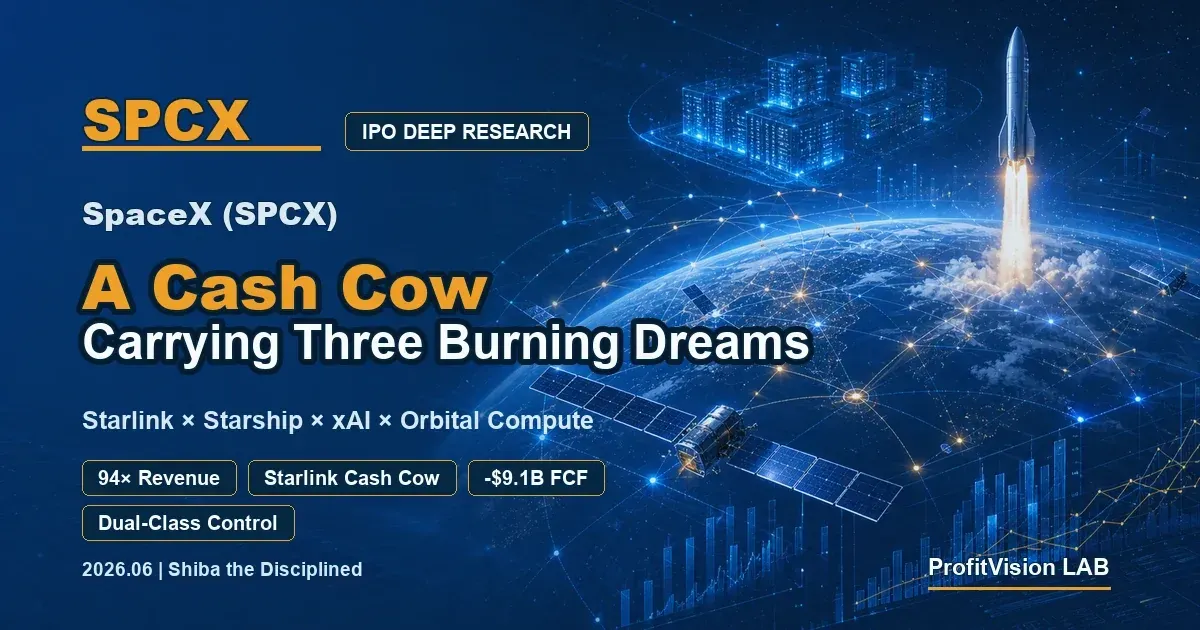
When the largest IPO in history meets a 94x revenue multiple, are you buying Starlink's subscription cash flow — or the option on Starship, xAI, and orbital compute?
On June 12, 2026, SpaceX listed on Nasdaq at $135 per share, anchoring a $1.77T valuation and setting the record for the largest IPO ever; shares rose roughly 28% in the first days of trading, pushing the company past $2T and closing the debut session near $161. This piece is not about whether to buy. SPCX is a freshly listed IPO with a founder holding extreme voting control, multiple cash-incinerating segments, and less than a week of trading history — there is no actionable technical or ownership base to assess. The role here is that of a researcher: to help readers decode the largest IPO in history and offer a perspective that differs from the prevailing market optimism. The deeper question is this — when you bundle a rocket company, a satellite telecom, and an AI startup into a single stock, what exactly is that $2T price tag pricing?
Chapter 1 — Industry Landscape: The Three-Layer Stack of the Space Economy
Don't think of SpaceX as "a company." Think of it as a holding structure spanning three very different industries: space launch, satellite broadband, and AI compute. Each layer has its own growth drivers, customer base, and profit profile.
LEO refers to orbits roughly 300–2,000 km above Earth. Compared with traditional geostationary satellites at ~36,000 km, LEO satellites sit far closer, delivering far lower latency — the physical basis for Starlink's fiber-like experience in rural areas, at sea, and on the battlefield.
The trade-off: each LEO satellite covers a small area, so global coverage requires a constellation of thousands. By 2026, Starlink had deployed over 7,000 satellites in orbit — and the only economical way to deploy that many is to own your own reusable rockets. That is the heart of SpaceX's vertical integration.
The space economy is scaling exponentially. Goldman Sachs has projected the satellite market could grow from roughly $15B to $108B by 2035. SpaceX's distinction is that it doesn't sit at one link of the chain — it controls "launch capability," the upstream bottleneck, and uses it to feed a downstream satellite-broadband business.
Chapter 2 — Business Model & Economic Moat: One Cow, Three Dreams
SpaceX's S-1 discloses three reporting segments: Space (launch services, Dragon, government contracts), Connectivity (Starlink consumer / enterprise / mobility / Starshield national security), and AI (xAI and X Corp, folded in February 2026). Their financial profiles could not be more different.
| Segment | 2025 Revenue | YoY | Profitability | Role |
|---|---|---|---|---|
| Connectivity (Starlink) | $11.4B | +48% | $4.4B operating profit / ~63% EBITDA margin | Cash cow — only profitable segment |
| Space (third-party launch) | $4.1B | +8% | Mainly Pentagon and NASA contracts | Strategic moat — stalled growth, hard to copy |
| AI (xAI / X) | Recently consolidated | — | $6.35B operating loss; drags consolidated net income | Unmonetized long-term bet |
| Consolidated | $18.7B | +43% | ~$4.9B GAAP net loss | — |
The table exposes the core tension: Starlink is already a "telecom business eaten by software." A ~63% EBITDA margin is no longer ISP territory (typically 30–40%) but approaches the structure of premium global software companies. Subscriber growth is equally striking — from 2.3M at end-2023, to ~4.5M entering 2025, to over 9M by year-end, and 10.3M by the end of Q1 2026 across 164 countries.
EBITDA strips out interest, taxes, depreciation, and amortization to gauge a business's core cash-generating power. Starlink's ~63% margin means roughly 63 cents of every revenue dollar is core operating cash flow — software-grade, not telecom-grade.
The hidden assumption: when SpaceX launches its own satellites on its own rockets, at what internal transfer price is Starlink's cost booked? If SpaceX deliberately understates that internal launch cost, Starlink's true margin could fall to 45–50%, and billions in valuation move with it. This is the single most load-bearing assumption in the entire bull case.
2.1 Where the Moat Could Be Breached
Moat analysis can't be one-sided. Three cracks in Starlink's: first, ARPU is already falling — average revenue per subscriber slipped 18% to roughly $81/month between 2023 and 2025 (trading price for global volume). SpaceX reversed course in May 2026 with price hikes of up to $10/month, signaling a shift to monetization, but it also marks the end of the subscriber-growth honeymoon. Second, subscriber growth is decelerating in percentage terms — a classic S-curve inflection. Third, the internal transfer-pricing accounting question noted above.
2.2 Why Acquire xAI / X? The Official Story vs. the Real One
On February 2, 2026, SpaceX acquired xAI (including its Grok chatbot and the social platform X) in an all-stock deal valuing the combined entity at roughly $1.25T, with an exchange ratio of 0.1433 SpaceX shares per xAI share. Understanding the "why" is key to decoding SPCX's valuation — because this is the moment the AI cash-burn got booked onto Starlink's ledger.
The official reason is one line: to build data centers in space. Musk argued that AI progress depends on enormous terrestrial data centers requiring staggering power and cooling, that global AI power demand cannot be met on the ground, and that "space-based AI is obviously the only way to scale." The logic chains the three segments together: SpaceX rockets lift compute hardware into orbit, Starlink's network is the data backbone, and xAI (Grok) is the demand and monetization endpoint.
But the market's read on the real motives is what investors should watch. Most analysts see "orbital data centers" as packaging over three more grounded motives: (1) Using Starlink's cash flow to feed xAI's furnace — a stated aim of the merger was to provide more capital to the cash-intensive xAI and Grok; this is why the consolidated GAAP loss looks so bad, as xAI's losses are absorbed. (2) Bundling Musk's empire into one stock ahead of the IPO — viewed widely as a "trailer" for the mega-IPO; retail buyers of SPCX inherit the entire Musk universe, including Grok's litigation and regulatory exposure. (3) Possible tax considerations — given Musk's overlapping ownership, the deal may navigate around U.S. tax-code §382 limits on net-operating-loss carryforwards.
⚠️ Governance red flags (detailed in Chapter 5 — Risk Factors)
- No fairness opinion: the SpaceX (~$1T) and xAI (~$250B) valuations carried no investment-bank fairness opinion — a hallmark related-party governance gap, since Musk sits on both sides of the deal.
- Vision-language valuation problem: Musk described the merger's ambition as building "a sentient sun to understand the Universe and extend the light of consciousness to the stars" — equal parts ambition and a signal that the goal is too abstract for any financial model.
2.3 Orbital AI Compute: Physics-Feasible, or a Valuation Story?
Since the entire official rationale rests on "data centers in space," does the concept have a physical basis? The answer: directionally there is real engineering logic, but on timing it is a long-dated bet that hasn't crossed its economic threshold. As a ten-year option, fine. As support for today's valuation, dangerous.
Why it isn't pure science fiction: terrestrial AI data centers are hitting three hard walls — grid-interconnection queues stretching past 2030, fierce community opposition to gigawatt-scale campuses (roughly 70% of Americans reportedly oppose nearby AI data centers), and memory-supply shortages. Space offers a different "energy geometry": near-continuous solar power in the right orbits, no land use, no freshwater cooling, no permitting battles. The core thesis is a power-arbitrage play — terrestrial power is getting scarce and expensive faster than launch costs are falling, and at some crossover point orbital compute becomes cheaper than ground.
Terrestrial data centers shed chip heat via air or water. But space is a vacuum — no air, no convective water cooling. The only path is radiation (emitting heat as infrared into space), which is extraordinarily inefficient: Starcloud's white paper estimates a two-sided radiator held near 20°C emits only about 633 watts per square meter — over 1,000 times slower than water-cooling AI chips on Earth.
The implication: shedding the same heat requires enormous radiator area, whose mass must be launched on rockets — so cooling demand directly amplifies launch cost. "Cooling" and "launch cost" are two faces of one problem.
Technical feasibility has been demonstrated, but scale is far off. Startup Starcloud put a satellite carrying an NVIDIA H100 GPU into low orbit in November 2025, proving modern AI accelerators can survive launch, operate under radiation, and run inference and small-scale training within tight power and thermal budgets. But even optimists concede that ground cloud won't be replaced near-term; the real value is turning satellites into "edge nodes," not relocating entire training clusters.
SpaceX's ambition dwarfs Starcloud's. SpaceX has filed with the FCC to deploy up to 1 million solar-powered "orbital data-center" satellites, targeting 100 GW of annual AI compute capacity. For comparison: Starcloud has applied for up to 88,000, Blue Origin 51,600, Google's Project Suncatcher plans launches as early as 2027, and China is pursuing its own. The lane is getting crowded — and everything is still at the "application" and "demonstration" stage.
| Dimension | Bull view | Bear rebuttal |
|---|---|---|
| Energy | Near-continuous solar, no grid queue | Radiative cooling 1,000x slower; radiator mass eats the edge |
| Launch cost | Reusable rockets keep driving cost down | Google's team estimates costs must fall below ~$200/kg (~2035) to make sense |
| Operations | No land, no freshwater cooling, no permitting | Chips need replacing every 5–6 years; in-orbit servicing is extremely costly |
| Commercial reality | AWS, Google Cloud have expressed interest | Starcloud had zero disclosed commercial revenue as of April 2026 — all forward-looking valuation |
For SPCX investors, the key judgment: orbital AI compute is a "real option" embedded in SpaceX's valuation, but its strike date is in the 2030s, not now. Google's Suncatcher team estimates launch costs need to fall below ~$200/kg around 2035 for the vision to pencil out; Starcloud places "cost-competitive with terrestrial" in the early 2030s. Counting it as "imagination" is fair; treating it as the cash-flow basis for a 94x revenue multiple mistakes an option's time value for intrinsic value.
2.4 "One Million Satellites" and the Orbital Commons: An Underpriced Systemic Risk
That orbital-data-center vision hides a scale problem most people miss. On January 30, 2026, SpaceX filed with the FCC to deploy up to 1 million solar-powered satellites at 500–2,000 km. Some scale context:
| Item | Count |
|---|---|
| Active satellites in orbit (Feb 2026) | ~14,000 |
| Current Starlink in orbit | 7,000+ |
| SpaceX's FCC application | up to 1,000,000 |
| Total proposed satellites globally | ~1.23 million |
One company's application is roughly 70x the current global active count. This isn't a "next year" plan; it's land-grabbing the entire 2030s–2040s orbital envelope — and the FCC is still in public comment, far from approval. It exposes a key error: the vision treats orbit as private land SpaceX can apply for at will, but orbit is a commons shared by all of humanity.
Kessler Syndrome: once orbital object density passes a threshold, one collision spawns debris that strikes more satellites, generating debris faster than natural decay removes it — a runaway cascade that can render certain orbital layers permanently unusable. Not sci-fi: there are already ~50,000 debris pieces 10cm or larger, traveling faster than rifle bullets; a single direct hit creates a shrapnel cloud.
Harvard-Smithsonian's McDowell has warned that 100,000 satellites in LEO make a Kessler scenario a real possibility after a few serious mishaps — and SpaceX alone applied for 1 million. The more realistic scenario isn't "space becomes a junkyard" but "so much debris that you maneuver so often the constellations stop being practical."
And if you assume the U.S. can decide this unilaterally, that's exactly the governance failure: space is no nation's territory, and debris carries no passport. Three layers fail. First, the FCC only governs U.S. satellites, but collisions don't recognize jurisdiction — a U.S.–China or U.S.–Europe collision in the same layer threatens everyone. Second, international regulation is essentially empty — the FCC and the UN have yet to establish binding traffic rules for large constellations, partly because the sector grew too fast for "best practices" to exist. Third, competitors are grabbing the same space — China's Guowang and Qianfan, Amazon Kuiper, Blue Origin (51,600), Starcloud (88,000), Google Suncatcher.
2.5 Déjà Vu: Is This the Space Reboot of the 2000 Fiber-Optic Bubble?
If you've been around markets long enough, this script should chill you — because we saw the identical plot in the 1996–2002 fiber-optic bubble. Side by side, the structural symmetry is too close for coincidence.
| Script element | 2000 fiber bubble | 2026 orbital-compute narrative |
|---|---|---|
| Inflated demand forecast | WorldCom claimed "internet traffic doubles every 100 days" (vs. actual annual doubling) | "AI demand grows exponentially; Earth can't hold it; space is the only answer" |
| Frenzied buildout | Global Crossing, Level 3, Qwest borrowed tens of billions to lay 80M+ miles of fiber | SpaceX 1M satellites, Blue Origin 51.6K, Starcloud 88K — a multiplayer scramble |
| Debt / capital-hole financing | ~$90B of fiber investment over four years, debt-funded | SpaceX's ~$119B planned Terafab; ~$17B combined cash burn |
| Demand never showed | By June 2001, ~95% of new fiber sat unused ("dark fiber") | xAI's own compute is underused — leased to Anthropic and Google |
| Outcome | 2000–2002: $2T+ of telecom market value wiped out; Corning ~$100 → ~$1; Global Crossing & WorldCom bankrupt | ? |
The most important lesson from the fiber bubble
The fiber bubble's core error wasn't "fiber was useless" — quite the opposite, that fiber eventually became the backbone of the modern internet. The error was that the slope of the demand curve was catastrophically overestimated: the technology got so good (a single strand went from 2.5 Gbps to 100 Gbps) that supply exploded, while demand climbed linearly, not exponentially. The mismatch left 95% of capacity "dark," prices collapsed, and companies went bankrupt.
The key lesson: infrastructure being useful in the end does not mean early investors make money. Most fiber layers went bankrupt; the later buyers who scooped up dark fiber cheap (Google, the acquirers of Level 3's assets) made the money. Likewise — even if orbital compute truly becomes the AI backbone by 2035, whoever buys SPCX today at 94x revenue may not be the one who profits. You could be footing the construction bill for the "dark satellite" acquirers.
An analogy isn't destiny. SpaceX differs from Global Crossing in one key way: it has Starlink, a real cash cow underneath — it isn't "a fundraising scheme in search of a problem." But that returns us to this report's spine: be clear about what you're buying — the cow that lays golden eggs (Starlink), or the dreams that may become dark satellites (orbital compute). At 94x revenue, the price is clearly paying for the latter.
2.6 Terafab: When the Founder Wants to Smoke a Cigar in a Cleanroom
The orbital-compute dream has an even more absurd upstream dependency. Space data centers need radiation-hardened custom chips, but those can't be bought in sufficient quantity — so Musk's solution is to build the largest semiconductor fab in human history, named "Terafab." This project is the best specimen for calibrating "how much to discount a Musk vision," because it lays one quote and one number out in the sun.
First, the absurd number. Terafab's disclosed capital outlay ballooned from $20B announced in March 2026 to $55B initial / up to $119B fully built per the May filing — nearly 6x in two months. That $119B exceeds the entire ~$52.7B authorized under the U.S. CHIPS Act. Crucially, it's a joint venture funded by SpaceX, Tesla, and xAI — three companies sharing one chairman (a direct callback to the related-party theme in Chapter 5: SPCX shareholders' money goes to subsidize chip demand for Tesla's cars and xAI's data centers).
Now the quote. In January 2026, on the Moonshots podcast, Musk said:
"I think they're getting cleanrooms wrong in these modern fabs. I'm going to make a bet here that Tesla will have a 2nm fab, and I can eat a cheeseburger and smoke a cigar in the fab."
This wasn't a throwaway metaphor — it reflects his actual understanding of the process; he advocates "wafer isolation" to replace cleanrooms. The problem: the feasibility of this approaches zero (an optimistic ~0.001%), because it collides with reality on three fronts:
A 2nm transistor structure is smaller than a virus. A single cigar-smoke particle (hundreds of nanometers across) landing on a wafer can destroy an entire wafer worth tens of thousands of dollars. That's why TSMC spends "billions" on controlled environments: HEPA/ULPA filtration, airflow and pressure control, full-body bunny suits — driving particle counts per cubic meter into single digits. Cigar smoke in a cleanroom is like throwing sand in an operating room.
Industry media put it best: "If Musk genuinely wants cigar smoke drifting across wafers, his yield rates are going to look like a bonfire." The quip exposes not humor but a gap in grasping the most basic contamination-control principle of a field he wants to invest $119B in.
Set "eat a burger, smoke a cigar" against the engineering reality: Terafab is harder than solving satellite cooling. Cooling is at least a physical extension of SpaceX's launch core business; Terafab is a rocket company stepping into leading-edge wafer fabrication that even Intel struggles with, against decades of TSMC and Samsung process know-how — and SpaceX/Tesla's wafer-manufacturing experience is zero. Musk himself concedes the dependency: "We'll buy all the chips from TSMC, Samsung, Micron, but their maximum comfortable expansion rate is much less than we'd like." Translation: because I can't buy fast enough, I'll build the biggest fab in history myself. That is the dream-stacked-on-dream structure:
Each link assumes the prior one succeeds. Analysts politely call it Musk's "15-year strategy" — and "15 years" translates to "don't value it on today's financials."
Chapter 3 — Competitive Dynamics: An Empty Battlefield Is Filling Up
Before the IPO, Starlink ran almost unopposed on an empty field. The key point: the window in which competitors fill that field overlaps precisely with the IPO. SpaceX's first 12–18 public months will be tested against real alternatives, not an empty arena.
| Competitor | 2025 satellite-broadband revenue | Satellites / progress | Key edge / threat |
|---|---|---|---|
| Starlink (SpaceX) | $11.4B, ~63% EBITDA margin | 7,000+, 10.3M users | Leads on scale, cost, cash flow |
| Amazon Leo / Kuiper | No commercial revenue yet | Behind schedule; mid-2026 target to deploy half the constellation | AWS integration + low-price strategy (terminals <$400); the most structural threat |
| OneWeb (Eutelsat) | ~€280M, $456M operating loss | LEO revenue +60% YoY | Enterprise/government channels; far smaller scale |
| China Guowang / Qianfan | Opaque | State-level mega-constellations advancing | Carving share in specific markets |
| Rocket Lab (RKLB) | Launch services focus | Small launch + Neutron in development | A launch competitor, not a direct broadband rival |
Who is the real threat? Amazon. Not because Kuiper's tech is better (it lags badly, with few satellites in orbit), but because Amazon has two weapons SpaceX can't quickly replicate: AWS cloud integration (bundling satellite broadband into enterprise cloud deals) and near-bottomless subsidy capacity (~$20B earmarked, with an explicit low-price push into government and enterprise). As Kuiper goes commercial in mid-2026 and OneWeb's LEO revenue grows 60% YoY, the competitive gap starts closing in the same window as the IPO.
Chapter 4 — Financial Resilience: The Two Faces of Cash Flow
SpaceX's financials demand the coolest reading of this report, because the same company can be described as "minting money" or "bleeding cash" — depending on which line you read.
| Metric (2025) | Value | Interpretation |
|---|---|---|
| Consolidated revenue | $18.7B (+43% YoY) | Strong momentum, Starlink-driven |
| Adjusted EBITDA | ~$6.58B | Core operations generate cash |
| GAAP net income | ~$4.9B net loss | Includes absorbed xAI costs, SBC, debt |
| Operating cash flow | ~$1B (positive) | Core business still generates cash |
| Free cash flow (FCF) | ~ -$9.1B | Capex swallows everything; AI segment dominates |
| 2025 capex | ~$20.7B | AI segment $12.7B — more than 3x the other segments combined |
| Accumulated deficit | ~$41.3B | Not a cosmetic figure |
EBITDA excludes depreciation, amortization, interest, and taxes; GAAP net income includes them all. SpaceX's gulf comes from three places: enormous capex depreciation (~$20.7B capex in 2025), stock-based compensation (SBC), and the losses absorbed after folding in xAI in February 2026.
What investors must note: EBITDA is the number the company wants you to see; FCF is the real cash in and out. 2025 FCF of ~ -$9.1B means that, on its own operations, SpaceX still can't self-fund its dreams — it must keep tapping external financing (which is exactly the purpose of the IPO raise). The losses are largely real cash, not accounting cosmetics: xAI's AI operations alone posted a $6.35B operating loss in 2025.
A sharper risk signal comes from Musk himself: he has warned of a "genuine risk of bankruptcy" if Starship can't reach a flight rate of at least once every two weeks. Against reality — Starship flew just 5 times in 2025 against a public target of 25. That 5-of-25 gap is a clean baseline for how much to discount any Musk timeline. The S-1 also discloses ~$17B in combined space-and-AI cash burn plus up to $119B in planned Terafab capex — a capital black hole.
Chapter 5 — Risk Factors
For international investors, the risks here aren't peripheral footnotes — they are the spine of the thesis. Two stand out beyond the operational and valuation risks already discussed: the governance structure, and the orbital/demand existential risks. We treat governance first, because it is the most underappreciated.
5.1 Governance Cascade: A Serial Offender's History of Related-Party Deals
If orbital compute is SpaceX's "demand-side illusion," governance is its "man-made time bomb." The root question: when one person controls multiple companies and holds near-absolute voting power, what protection do public investors actually get? The answer is unsettling — and it's not speculation. Musk has a documented track record.
The extreme of dual-class structure: ~12.3% economic interest, 85.1% voting power. Post-IPO, Musk holds roughly 12.3% of the economic interest (849.5M Class A shares) but, via super-voting Class B shares (93.6%), commands 85.1% of the vote. (Note: the "42% equity" figure circulating in some coverage is pre-xAI-merger; post-IPO economic interest is diluted to ~12.3%.) The gap is the source of the governance problem: public investors buy a company where one individual can unilaterally approve mergers, acquisitions, executive compensation, and strategic pivots — while bearing only 12.3% of the economic consequences. Musk's comp plan, with vesting tied to market-cap and "human-colony" (Mars) milestones, is the most unconventional in any large-cap IPO in history.
Dual-class structures let founders keep control with little capital: one super-voting share may equal ten ordinary votes. The upside is resisting short-term pressure to pursue a long-term vision; the downside is that when the founder's interests conflict with minority holders', the minority has almost no check — you can vote with your feet (sell) but not with your hands (veto).
In SpaceX's case the risk is amplified, because Musk simultaneously controls Tesla, SpaceX, Neuralink, the Boring Company, and xAI — and no independent board can truly block transactions among them.
The precedent: SolarCity (2016). The best predictor of future behavior is past behavior. In 2016, Tesla acquired SolarCity, founded by Musk and two cousins — criticized for saddling Tesla with debt and an unprofitable entity. Seven shareholder suits were consolidated into one alleging breach of fiduciary duty. All directors except Musk settled for $60M; Musk refused to settle, became the sole defendant, and testified under oath to defend the all-stock deal. Governance experts note Musk's web of companies carries persistent conflict-of-interest potential — and history shows those conflicts materialize.
The reboot: the Tesla → xAI → SpaceX share chain. SpaceX's February 2026 acquisition of xAI pointedly excluded Tesla — even though Tesla had invested $2B in xAI a month earlier. The result is a precise three-step value conversion:
The essence: Tesla shareholders put up real cash and ended up with stock in a company controlled by the same man, its valuation full of imagination. The pre-existing lawsuit over Tesla's xAI investment already alleges Musk used Tesla's balance sheet to prop up his private companies; the merger doesn't resolve those concerns — it complicates the web. Industry commentary calls it a replay of the 2016 SolarCity bailout.
And it isn't only the share swap. "Capital recycling" inside Musk's empire is routine, blurring the truth of SpaceX's financials: xAI bought $269M of Tesla Megapacks in April alone (~$430M last year); SpaceX bought $131M of Tesla Cybertrucks in 2025 at full MSRP with no fleet discount — meaning Tesla got better terms from a related-party buyer than from an independent one. Morningstar's core question is the one every SPCX investor should ask: how much of SpaceX's reported economics are arm's-length, and how much is one man with 85% of the vote recycling capital among entities he controls?
Why is this a structural, litigation-prone risk?
Stack three facts: (1) Musk controls 85% of votes with 12.3% economics, with no independent board to check him; (2) he has the SolarCity precedent — using a public company's resources to bail out his own loss-maker, and refusing to settle even when sued; (3) the Tesla→xAI→SpaceX share chain and pervasive related-party deals are replaying the same pattern.
The implication: if SPCX falls, or if the deal chain is found to have harmed Tesla or SpaceX shareholders, a SolarCity-style derivative lawsuit is a predictable near-certainty, not a tail risk. Worse, Musk's track record shows he won't settle and will litigate for years — an overhang of prolonged uncertainty for the stock.
For public investors, the thing to recognize: buying SPCX isn't just a business bet — it places you inside a serial offender's related-party network, and you hold no voting power to protect yourself. When conflicts arise, the law is your only remedy, and your opponent is someone who litigates relentlessly and controls everything.
5.2 Lockup & Sell Pressure: Staggered Leakage on Deeply In-the-Money Stock
The unlock is not a single-day cliff but a staggered schedule: ~7% at each of 70/90/105/120/135 days post-IPO, another 28% after the Q3 earnings release, and the remainder at 180 days. But employee option strikes were just $37 and $42.40 against a $135 listing and ~$161 first-day close — gains of 3.6–4.4x. Almost no one is underwater, so every window carries strong profit-taking incentive. A roughly 5% "friends-and-family" carve-out has no lockup at all, meaning ~$3.75B of shares could reach the market on day one. Musk voluntarily accepted a 366-day lockup with no early-release exception, but the percentage held by other large 366-day holders is not disclosed in the S-1. The IPO is expected to mint roughly 4,000 new millionaires, with ~400 current and former employees potentially holding stakes over $100M — a large, lightly-anchored pool of motivated sellers.
5.3 Demand Existential Risk & Disclosure Opacity
The orbital-compute and Terafab risks (Chapter 2) compound here: xAI's own compute is already underused and leased out to Anthropic and Google, while more than 30 U.S. states have introduced 300+ data-center bills (New York and Maryland moving to pause new builds) and ESG frameworks penalize the "gas-powered AI" model. The "AI demand grows exponentially" assumption underpinning the entire space-compute thesis is being falsified in real time. Separately, SpaceX has stated it will not release quarterly or annual results via wire services — a structural discount to disclosure transparency layered atop single-CEO dependency.
Chapter 6 — Valuation & Scenario Analysis: What a 94x Revenue Multiple Is Pricing
This report does not forecast price targets; it only runs scenarios. The baseline fact: at a $1.75–1.77T valuation, SpaceX trades at roughly 94x 2025 revenue ($18.7B). Even on the market's ~$25B 2026 revenue estimate, the forward multiple is still ~72x. By comparison, any public space or telecom peer trades far lower. The multiple itself says one thing: the market assumes flawless execution.
| Scenario | Core assumptions | Valuation implication | Investment meaning |
|---|---|---|---|
| 🐂 Bull | Starlink V3 + Direct-to-Cell (with T-Mobile) scale up; Starship hits flight cadence; xAI orbital compute begins to monetize | The three-part option fully pays off; revenue toward $40B+, multiple digested by growth | Bull case holds, but requires flawless execution across multiple fronts at once |
| ⚖️ Base | Starlink grows steadily but decelerates along the S-curve; Kuiper takes share; Starship keeps burning but no disaster | Multiple digested slowly by growth, but GAAP profitability still years away | Reasonable but unremarkable; the current price partly front-runs this |
| 🐻 Bear | Starlink ARPU keeps compressing / transfer-pricing dispute surfaces; xAI burn accelerates; Starship slips badly; lockup sell pressure hits | The 94x multiple "contracts violently"; valuation has no cushion for any negative | Large downside; bears have cited targets as low as ~$75/share |
Which scenario is the market pricing? At 94x revenue and a 28% first-days pop, the market is clearly pricing the bull case — treating Starship and xAI, two unmonetized dreams, as value already realized. That is the stock's greatest fragility: with optimism already in the price, any execution slip on any front can trigger a violent multiple contraction.
If SpaceX eventually qualifies for the S&P 500, it could trigger roughly $400B of passive buying (index funds forced to buy) — a huge potential tailwind.
But there's a gating threshold: S&P 500 inclusion requires sustained, verifiable GAAP profitability. With SpaceX's current GAAP loss, that path is blocked by its own losses — and the newly disclosed GAAP loss draws heightened scrutiny to its accounting and earnings trajectory. (Note: S&P Global has declined to change its inclusion rules, so the most-tracked benchmark won't hold SPCX for at least a year.)
Chapter 7 — Investment Thesis & Tactical Outlook
Core view: SPCX is a "three-part option" stock — you simultaneously buy a cash cow (Starlink), an infrastructure moat (reusable launch), and an unmonetized, possibly illusory long-term bet (orbital compute). At 94x revenue, the price pays almost entirely for that last, least-certain dream. Distinguishing the golden-egg cow from the possible "dark satellite" dream is the one question that decodes SPCX.
✅ Bull Case
- Starlink is a real, software-grade cash cow: $11.4B revenue, ~63% EBITDA margin, 10.3M users and still growing — the quality of this business is beyond doubt.
- A hard-to-replicate vertical-integration moat: reusable launch plus a high share of the U.S. Space Force's Proliferated LEO task orders; rivals can't quickly copy this cost structure.
- Unmonetized long-term options: Starship, Direct-to-Cell, xAI orbital compute — any one paying off could open a vast new TAM, the imaginative basis for the 94x multiple.
⚠️ Bear Case
- Minimal margin for execution error: 94x revenue, consolidated GAAP loss, -$9.1B FCF — any slip on any front can contract the multiple violently.
- Staggered, deeply-in-the-money sell pressure: option strikes of $37–42.40 vs. ~$161 close mean 3.6–4.4x gains; with a 5% friends-and-family carve-out unlocked on day one (~$3.75B), every window has strong selling incentive.
- Governance cascade — a serial offender's related-party history (Chapter 5): 85% voting control on 12.3% economics, the SolarCity precedent, and the Tesla→xAI→SpaceX chain make derivative litigation a predictable near-certainty.
- Orbital-commons systemic tail risk: the 1M-satellite vision assumes infinite orbit; a Kessler cascade would sever the entire "launch → Starlink → cash flow → space compute" narrative at once, and it's beyond SpaceX's control.
- Demand existential risk (the fiber-bubble echo) + Terafab credibility: xAI's own compute is underused and leased out; the "exponential AI demand" premise is being falsified, structurally echoing the 2000 fiber bubble. Terafab's $119B black hole and Musk's "cigar in a cleanroom" remark underscore an execution-credibility gap.
A Researcher's Position (Not Investment Advice)
This piece offers no entry or exit signal — SPCX is a freshly listed IPO with extreme founder control and multiple cash-burning segments, traits that by themselves make it a research subject, not a trading vehicle, at this stage. As a researcher, what I can do is unpack the prevailing optimism and flag three easily overlooked truths: Starlink's cash flow is real, the consolidated loss and cash burn are equally real, and the 94x price is riding almost entirely on the least-certain space-compute dream.
For readers, the useful thing isn't "buy or don't" — it's a ruler for distinguishing: when you look at SPCX, ask which part you're paying for right now. The cow that lays golden eggs (Starlink), or the dreams that may become "dark satellites" (orbital compute)?
Key Variables Worth Tracking
Rather than trading conditions, here are the truth-reveal points to follow: (1) Starlink internal transfer pricing — if the dispute is confirmed and the true margin is revised below 50%, the whole cash-cow narrative re-rates; (2) the trajectory of consolidated FCF — whether xAI's burn converges or spirals decides if the cow outruns the dreams; (3) Starship flight cadence — whether it nears the threshold Musk himself calls existential; (4) validation of space-compute demand — real paying customers, or more of xAI's "compute we can't use, so we lease it out." These four will tell you, earlier than any price chart, whether this is the next infrastructure revolution or the next fiber bubble.
📋 Tracking Log
| Date | Event | Assessment | Outcome |
|---|---|---|---|
| 2026/06/16 | Initial publication (first week post-IPO) | ⏸️ Research-only observation; placed on long-term watch list | — |
Next update: SpaceX's first post-IPO quarterly report, or around the late-2026 lockup expiry.
Early-update triggers: major Starship test results, Kuiper commercialization progress, post-price-hike Starlink ARPU data, and financial disclosure on the xAI integration.
Chapter 8 — Tracking Log & FAQ
Investing involves risk; please assess your own financial situation carefully.
Data sources: SpaceX SEC S-1/S-1A Filings, FCC Filing, Grimes County public hearing notice, CNBC, Reuters, Bloomberg, Bloomberg Law, TechCrunch, Tom's Hardware, Moonshots Podcast, DCD, Fortune, Electrek, Morningstar, Sacra, Scientific American, World Economic Forum, phys.org, Starcloud white paper, public records (as of June 2026).
Comments ()