CANSLIM × SEPA: The Complete Science of Stock Selection and Precision Entry
A complete breakdown of how CANSLIM and SEPA work together: from seven-letter screening criteria to precision VCP entry points and position management.
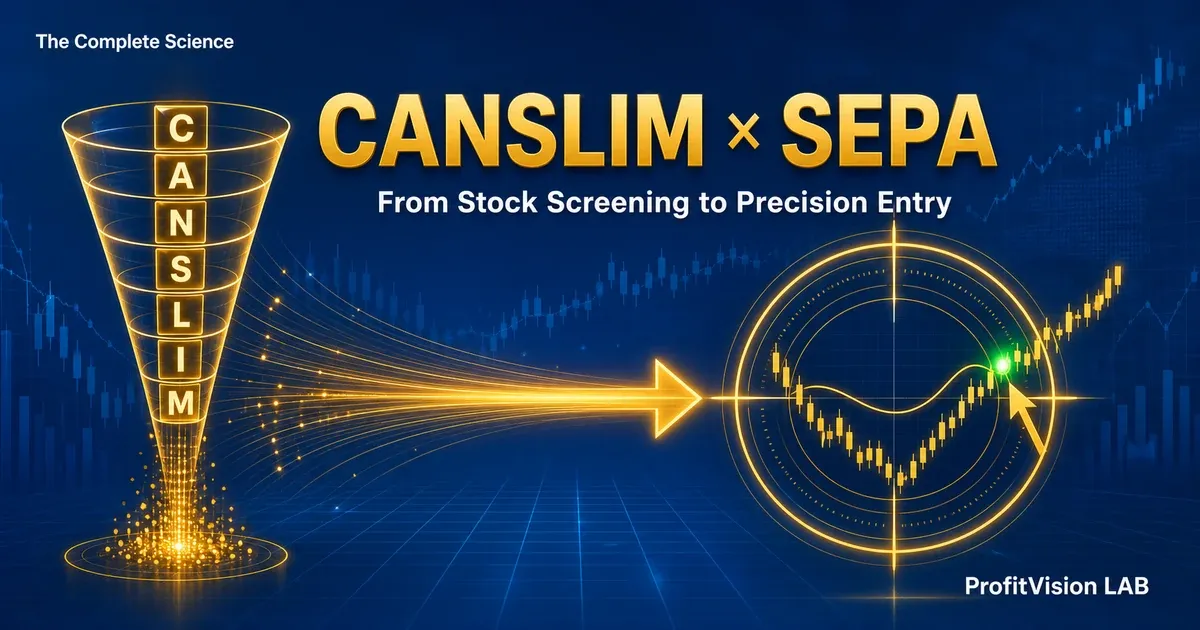
- CANSLIM is the system for finding the right stocks; SEPA is the system for finding the right entry point — you need both. Learning one without the other is the most common source of losses.
- CANSLIM's seven letters set the minimum bar for stock selection: quarterly EPS growth ≥25%, annual EPS growth ≥25% (three consecutive years), RS Rating ≥70 (elite candidates score 90+), increasing institutional sponsorship, and a market in an uptrend.
- Minervini's SEPA methodology layers an eight-condition Trend Template and the VCP (Volatility Contraction Pattern) on top of CANSLIM, solving the problem of "right stock, wrong timing."
- Pocket Pivot Point and Gap Up are advanced supplemental tools within both systems — used to build a position before a standard breakout or to capture a breakout acceleration.
- The PVL Four-Filter system directly integrates both frameworks: Sponsorship (CANSLIM I) → Moat (CANSLIM A+C) → Volatility Screen (SEPA entry conditions) → Technical (SEPA Trend Template).
Why Do Investors Still Lose Money After Learning CANSLIM?
This is the most common question I hear.
An investor reads William O'Neil's How to Make Money in Stocks, memorizes all seven CANSLIM letters, and screens for stocks that genuinely qualify as growth champions — yet still can't make real money, and sometimes even loses. What's going wrong?
CANSLIM is a stock selection system, not a complete trading system. It tells you what to buy, but says almost nothing about where to buy, how to manage risk, or when to sell.
Mark Minervini, after winning the U.S. Investing Championship, developed his own battle-tested methodology and called it SEPA (Specific Entry Point Analysis). SEPA is not a replacement for CANSLIM — it builds a complete risk-control and entry-discipline framework on top of it.
This article is PVL's methodological cornerstone. The goal is simple: help you fully understand the role each system plays and how they integrate into a repeatable, executable workflow from stock selection through to entry.
"I'm not buying stocks — I'm buying superior risk/reward opportunities. Under specific conditions, the probability of losing is very low and the profit potential is very high." — Mark Minervini, Master Trader Program 2025
CANSLIM Fully Decoded: What Each Letter Really Means
O'Neil studied every major winning stock in the U.S. market from the 1880s onward and distilled seven common characteristics. CANSLIM is not an investment philosophy — it is a statistically derived greatest common denominator.
Current Quarterly Earnings
The most recent quarter's EPS growth year-over-year must be at least ≥ 25%; elite candidates often show ≥ 50% or triple-digit growth. Sales growth is also required at ≥ 25%, and both should be accelerating together — not just EPS boosted by cost-cutting alone.
Annual Earnings Growth
Three consecutive years of annual EPS growth ≥ 25%, with return on equity (ROE) ≥ 17%. EPS stability matters too — a highly erratic earnings history is a red flag.
New Products / New Highs
A stock making new price highs is itself an "N" — it signals market endorsement. New products, new services, new management, or a new business model all count. Most investors fear "buying at the top," but the data shows that great winning stocks are almost always making new highs when their big moves begin.
Supply and Demand
A smaller float makes large price moves easier. On breakout day, volume should be ≥ 40–50% above the 50-day average. Management buying shares in the open market is a powerful additional signal.
Leader or Laggard
RS Rating ≥ 80; elite candidates should be ≥ 90 or even ≥ 95. Buy the top 1–2 stocks in a given industry group, not the "cheaper second-tier name."
Institutional Sponsorship
At least 3–5 high-quality funds should hold the stock, with sponsorship increasing in the most recent quarter. A/D Rating ≥ C. Caution: if the top three funds hold 60%+ of shares, concentration risk is elevated.
Market Direction
The most overlooked letter — and the most important. Even the strongest stocks struggle to rise in a market correction or bear market. Wait for a Follow-Through Day (FTD) to confirm a real rally before adding exposure.
Three Hidden Traps Inside CANSLIM
1. C is a rearview mirror, not a forward indicator. You only know EPS growth after the earnings report drops, but the stock has often already moved weeks before. The real skill is positioning based on expected EPS growth and the technical setup — not waiting for confirmation.
2. Every letter has a "passing" threshold, but the great bull stocks excel on every dimension. A stock with 26% EPS growth and an RS Rating of 82 technically qualifies for CANSLIM — but its upside potential is far lower than a stock with 150% EPS growth and an RS of 97. Among qualifying stocks, seek the ones that are dominant on every measure.
3. M governs your position size, not whether you do your research. Even during a market correction, you should keep tracking and watching top-quality names. O'Neil said: "Don't stop doing your screens just because the market is in a correction." When the rally begins, you need a list ready.
SEPA Methodology: Minervini's Evolved System
Building on CANSLIM, Minervini asked a more specific question: "Even when I've selected the right stock, at what precise price point should I buy to minimize risk and maximize reward?" That question is the origin of SEPA (Specific Entry Point Analysis).
SEPA is built on four core pillars:
2. Fundamentals → Does it meet CANSLIM's fundamental thresholds?
3. Catalyst → What is driving the growth? How wide is the moat?
4. Entry Point → Where to buy, where to set the stop, and what is the risk/reward ratio?
The Four Stock Life-Cycle Stages (Stage Analysis)
Stage Analysis was first systematized by technical analyst Stan Weinstein in his book Secrets for Profiting in Bull and Bear Markets, dividing any stock's price cycle into four distinct stages. Minervini incorporated this framework into SEPA, using "only buy in Stage 2" as a core operating discipline.
Market ignores it; price moves sideways
Price makes new highs; moving averages in bullish alignment
Abnormal volume; erratic price action
Below moving averages; bears in control
One of Minervini's core principles: only buy in Stage 2. This sounds simple, but in practice the majority of stocks at any given time are not in Stage 2 (Minervini's practical observation; the proportion varies with market conditions) — which is why your watchlist needs to be long, but your actual trades are few.
The Trend Template: Eight Specific Conditions for Stage 2
All eight conditions must be met to confirm a genuine Stage 2 uptrend (Trend Template to Confirm Stage 2 Uptrend):
- Current price is above the 150-day MA (30-week MA) and the 200-day MA (40-week MA)
- The 150-day MA is above the 200-day MA
- The 200-day MA has been trending up for at least 1 month (ideally 4–5 months or more)
- The 50-day MA (10-week MA) is above both the 150-day and 200-day MAs (perfect bullish moving-average alignment)
- Current price is at least 25% above its 52-week low (elite candidates are often already up 100%, 300%, or more before they consolidate)
- Current price is within 25% of its 52-week high (the closer to the high, the better)
- RS Rating (IBD/MarketSurge) is at least 70; elite candidates are typically 90+. The RS Line should be in an uptrend for at least 6 weeks, ideally 13 weeks or more
- Current price is above the 50-day MA (exception: the "Low Cheat" setup)
VCP: The Essence of the Volatility Contraction Pattern
If the Trend Template is about "finding the right stock," then the VCP (Volatility Contraction Pattern) is about "finding the right entry timing." This is the most recognizable technical setup in Minervini's methodology — and the biggest differentiator between SEPA and other growth-investing approaches.
How the VCP Works
The VCP is conceptually a modern extension of Jesse Livermore's "Line of Least Resistance." Livermore believed that stock prices always move in the direction of least resistance. The VCP is the process of progressively eliminating that resistance within a base — each contraction clears more of the overhead supply until, at the Pivot Point, there is almost no remaining resistance and the stock can explode upward along the path of least resistance.
After a significant advance, a stock enters a consolidation period. Within that consolidation, a series of "volatility contractions" occurs: each pullback is smaller in magnitude than the one before it, and volume dries up progressively with each contraction. This signals that "floating supply" (sellers willing to exit on any weakness) is being flushed out, while institutional buyers are quietly accumulating.
Four Key Characteristics of a Valid VCP
1. The number of contractions is typically 2–4. More than 4 may indicate the stock is building more energy, but could also be a weakening signal. Three contractions is the ideal setup.
2. Each successive contraction must be smaller than the previous one. If the second contraction is larger than the first, the pattern is invalid. Reading left to right, the depth of the base should shrink: "M → S → XS."
3. Volume should approach a "dry-up" level on the final contraction. This signals that the float has been largely transferred to stronger hands. Extremely light volume confirms floating supply has been cleaned out.
4. The breakout above the Pivot Point must be accompanied by a volume surge. Ideal breakout-day volume should be at least 40–50% above the 50-day average. A breakout on light volume is often a Fakeout.
What Does "Extended" Mean?
After a breakout, you can't chase the stock at any price. Minervini's rule: never chase more than 5% above the Pivot Point. Once a stock is more than 5% past its Pivot, it is "extended" — entering there pushes your stop too far away and deteriorates the risk/reward ratio.
This rule frustrates many traders because it means accepting that some good opportunities will simply be missed. But it also prevents the very common outcome of chasing at highs and getting shaken out by normal volatility.
Pocket Pivot and Gap Up: Advanced Positioning Tools
The VCP breakout described above is the standard method. The O'Neil system also includes two supplemental tools that let you begin building a position before a standard breakout, or step in quickly when a breakout accelerates.
Pocket Pivot Point
The Pocket Pivot was developed by O'Neil disciples Chris Kacher and Gil Morales as a technique to identify "early-strength confirmation within a base pattern" — offering a lower-risk entry before the standard breakout occurs.
Pocket Pivot Definition
- An up day where volume exceeds the highest down-day volume of any of the prior 10 trading sessions (stricter version: highest volume in 15 days, or in the past six months)
- Price must be above the 50-day MA, ideally hugging the 10-day MA
- Must be a CANSLIM-quality leader — the Pocket Pivot signal is invalid without strong fundamentals
- Best used: early in a base breakout (especially useful when the market trend is unclear)
Pocket Pivot Sell Rule — The Seven-Week Rule
- If, following the Pocket Pivot, the stock holds above the 10-day MA for at least 7 weeks, sell when price closes below the 10-day MA for two consecutive days
- If the 10-day MA is violated in fewer than 7 weeks, wait for the 50-day MA before selling
Gap Up Entry Principles
Gap ups are normally treated as "extended," but the O'Neil system recognizes that a gap falling within 5% of the top of the base is an acceptable buy point when the following conditions are met:
- Gap size: at least 0.75× the average true range (ATR) over the prior 40 days
- Volume: at least 1.5× the 50-day average volume — the bigger, the better
- Stock quality: applies only to fundamentally excellent market leaders; speculative names do not qualify
- After the gap open you can scale in — buy half shortly after the open, add the remaining half before the close
Rule 2: If the stock falls below the intraday low of the gap-up day → exit immediately. (If the stock is volatile by nature, wait for the close; if the decline is quiet and orderly, exit right away.)
CANSLIM vs. SEPA: Overlap, Division of Labor, and Complementarity
Clarifying the distinct role of each system is the key to avoiding the trap of "learning both but misusing both."
| Dimension | CANSLIM (O'Neil) | SEPA (Minervini) |
|---|---|---|
| Core Question | What to buy? | Where and when to buy? |
| Fundamental Threshold | Detailed (each letter has its own threshold) | Built on CANSLIM, with greater emphasis on catalyst quality |
| Technical Analysis | Pattern recognition (cup-with-handle, double-bottom, etc.) | VCP + eight-condition Trend Template |
| Entry Precision | Breakout buy (relatively broad) | Pivot Point ± 5% (extremely precise) |
| Stop-Loss Logic | Exit below the base low (conceptual) | Explicit: stop below the pivot's base low, risk ≤ 8% |
| Position Sizing | Concentrated (max 5 stocks) | Fixed-risk per trade (each trade ≤ 1–2% of account) |
| Market Timing | FTD to confirm market direction (the M letter) | Respects the market similarly, but places more weight on individual stock Trend Template |
| Sell Rules | More systematic (sell-signal checklist) | Seven-week rule, break of 10-day MA, extended-stock sell signals |
| Best Suited For | Starting point for building a stock-selection framework | Advanced practitioners who need a complete trading system |
One sentence sums up their division of labor: CANSLIM gives you the candidate list; SEPA gives you the trigger and the risk controls. One is the screener; the other is the entry mechanism.
"Stock selection is only half of success. The other half is knowing when to enter, where your stop is, and what your maximum position size is. Without these, even the best stock is just a random bet." — Mark Minervini
The PVL Four-Filter System: An Integrated Design
PVL's selection framework was not designed from scratch. The four filters logically integrate CANSLIM's stock-quality requirements with SEPA's risk and entry discipline into a repeatable workflow.
Maps to CANSLIM I (institutional sponsorship quality)
EPS growth > 25%
Maps to CANSLIM A + C
Optimizes entry risk/reward
Maps to SEPA Entry Point Analysis
Maps to SEPA Trend Template (key condition)
Why These Four Filters, in This Order?
Filter 1 (Sponsorship) is the gatekeeper. Without institutional buying, even the best fundamentals won't translate into price appreciation — there's no force to push the stock higher. This maps to CANSLIM's I.
Filter 2 (Moat) ensures we only engage with companies that have structural competitive advantages, not just cyclical earnings spikes. ROE is a proxy for durable competitive advantage; EPS growth confirms momentum. This maps to CANSLIM's A and C.
Filter 3 (Volatility) is specific to PVL's options strategy (Sell Put / Bull Put Spread) — a high IV Rank means rich option premiums and greater income potential. It also indirectly confirms that the market has meaningful uncertainty about this stock, which operationalizes SEPA's "find the best risk/reward entry."
Filter 4 (Technical) is the final line of defense, ensuring we buy on the right side of the trend, not the left. "Price above the 50MA" is the abbreviated, most critical element of SEPA's eight-condition Trend Template.
Five of the Most Costly Common Mistakes
Buying a stock the moment it qualifies under CANSLIM
Confirm Stage 2 with the Trend Template, then wait for a VCP Pivot breakout before entering. Strong fundamentals do not equal a good entry point right now.
Chasing after a breakout regardless of how far from the Pivot
More than 5% past the Pivot = "extended." Don't chase. If you miss it, wait for the next base to form. Patience is a competitive advantage.
Staying heavily invested while the market is in correction
CANSLIM's M is the most important letter. During a market correction, reduce exposure to 20–30% and wait for a Follow-Through Day before adding back.
Selecting the cheapest stocks (low PE, low price)
Both CANSLIM and SEPA are momentum systems. Target the strongest RS stocks with the best fundamentals — not the "looks cheap" laggards.
Setting stops too far away, letting small losses turn into large losses
The essence of SEPA is risk/reward. Each trade's risk (entry to stop) should not exceed 1–2% of account value, keeping mistakes permanently affordable.
Judging whether a pattern is a VCP "by feel"
Each contraction's depth and volume must be measured quantitatively. Write the numbers down: first contraction 15%, second 8%, third 4% — that is genuine contraction, not a subjective impression.
Real-World Workflow: The Complete Checklist from Weekend Screening to Monday Entry
Weekend (Routine Maintenance)
- Market assessment: Are SPY/QQQ above their 21 EMA and 50MA? Have Distribution Days accumulated recently? How many days have passed since the last FTD?
- Run the four filters: Screen in MarketSurge or Finviz for A/D ≥ C, ROE ≥ 17%, EPS > 25%, price above 50MA
- Trend Template check: Verify all eight Trend Template conditions on each candidate; remove any that fail even one
- VCP identification: Look for VCP patterns on daily and weekly charts; mark Pivot Point levels
- Set alerts: Place price alerts 0.5–1% above each Pivot Point and wait for breakout confirmation
Trading Day (Execution)
- Pre-market: Check overnight futures, major news, and the likely opening direction of the broad market
- Breakout confirmation: Price breaks above the Pivot Point, and within 30 minutes volume is clearly expanding (vs. average) — only then enter; don't rush if volume is insufficient
- Risk calculation: (Entry − Stop) ÷ Account Size; verify each trade's risk ≤ 1 RU ($600 for PVL)
- Entry execution: Use a limit or market order to establish the initial position within 1% of the Pivot (typically 50% of the planned full position)
- Adding to winners: If the stock advances 3–5% after entry, add to reach the full position at the first pullback support level
The Shared DNA of Both Systems
On the surface, CANSLIM is fundamentals-driven and SEPA is technicals-driven. But beneath both lies the same core assumption:
The best stocks are driven by the best institutional money. Your job is to follow the institutional footprint — entering when they are just beginning to buy in size, and exiting when they are beginning to sell.
CANSLIM's "increasing institutional sponsorship" (I) and "high breakout volume" (S) mirror SEPA's "post-contraction volume dry-up followed by a surge on breakout" — both are tracking the same signal: the direction of institutional money flow.
Neither O'Neil nor Minervini attempts to predict how far a stock will go. They both identify situations with a probabilistic edge — where, at a specific point in time, the odds of losing are far lower than the odds of winning — and they act at that moment, waiting patiently the rest of the time.
Two Additional Notes for U.S. Investors
1. These systems were built for U.S. equities. The CANSLIM/SEPA toolchain is most complete and most data-rich in the U.S. market. Liquidity, institutional structure, and market depth are all optimized for the indicators and thresholds described here. PVL's coverage focuses primarily on U.S. stocks for exactly this reason.
2. Weekly charts are far less noisy than daily charts. Both O'Neil and Minervini emphasize using weekly charts for directional context and daily charts for entry timing. The best patterns are cleaner and more reliable when viewed on the weekly timeframe.
Conclusion: Build a Repeatable System — Let Discipline Replace Guesswork
CANSLIM and SEPA each answer a different question: "what to select" and "when to act." They are not opposites — they complete each other.
Investors who master CANSLIM can usually identify great stocks, but they often enter at the wrong time, get shaken out by normal consolidation, and watch the stock climb to its target price after they've been stopped out.
Mastering SEPA's Trend Template and VCP solves the timing problem. Knowing the Pocket Pivot and Gap Up rules lets you position flexibly across different market environments. And the four filters tie it all together into a repeatable weekly workflow.
The greatest value of a system is not raising your win rate on any single trade — it is ensuring your losses are small when you're wrong and your gains are large when you're right. That is the asymmetric payoff every elite trader talks about.
- Build your own "trading system checklist" and map it to all three layers
- Before each trade, confirm: Selection signal → Execution pattern → Management rules — all three layers must be present
- During periodic reviews, diagnose failures layer by layer rather than evaluating the system as a whole
- Treating SEPA × CANSLIM as a collection of tactics and picking fragments at random
- Learning only the Execution layer (entry patterns) while skipping Selection and Management
- Confusing a short-term trading framework with a long-term holding philosophy
- When the overall market is in a bear phase or Distribution phase (the M layer must be confirmed first)
- When an entire sector is in broad retreat and the Selection layer has no viable candidates
- When there are no clear position-sizing and stop-loss rules in place — precise Execution signals become meaningless