Time Compression: VCP's Most Overlooked Second Dimension
Time compression is the overlooked second dimension of VCP patterns. This article explains how higher lows, tightening pullbacks, shorter contractions, and volume dry-up reveal the real SEPA accumulation structure before breakout.
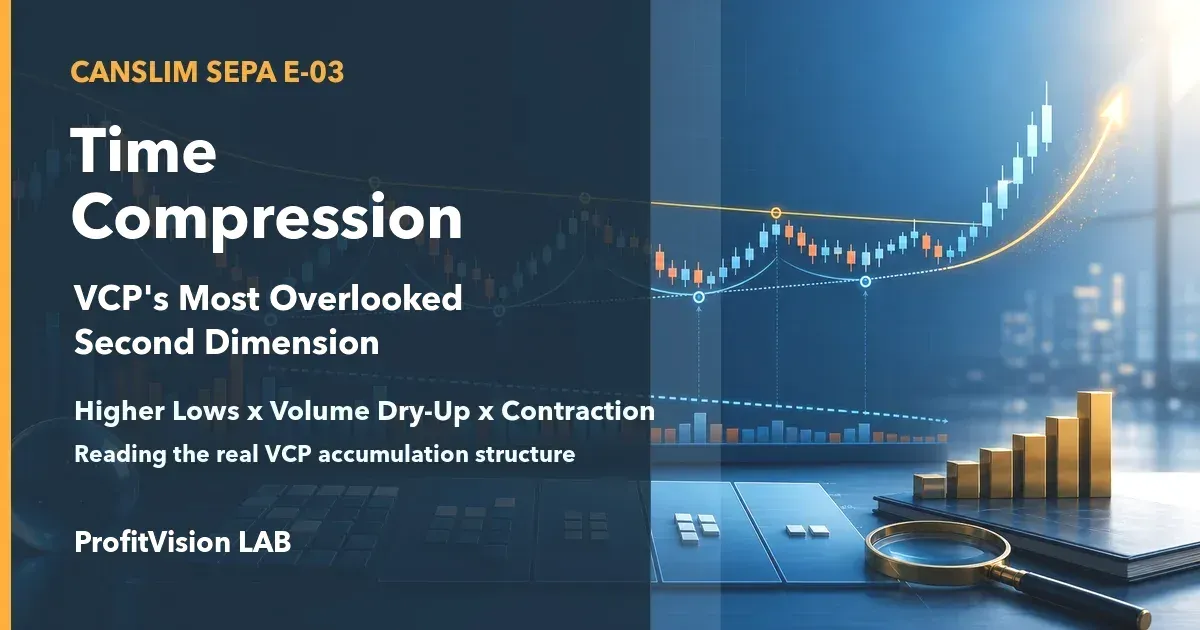
- VCP's "volatility contraction" encompasses two dimensions: magnitude contraction (the depth of each pullback is shrinking) and time compression (the duration of each pullback is shortening). Most investors focus only on magnitude and routinely overlook the time dimension.
- The core meaning of time compression: sellers' "patience" is rapidly disappearing — from early sellers who needed weeks before they were willing to sell, to later sellers who dump their shares within days or even a single day and then disappear entirely.
- A pattern where "magnitude contracts but time does not compress" is the most common misidentification error in VCP — it indicates that while selling pressure is weakening, it continues for a sustained period and does not represent true supply exhaustion.
- The extreme form of time compression is the "Tight Area": the stock barely moves for several days, volume dries up to near-zero (choke volume), then suddenly explodes — this is the perfect terminal state of time compression.
- From a practical trading standpoint: time compression tells you "when to get ready" — when you see the final T contracting both quickly and tightly, a breakout may be only days away, requiring close daily monitoring.
The Overlooked Second Dimension: Why Time Matters as Much as Magnitude
In E-02, we broke down the core logic of VCP: each pullback's magnitude must decrease, reflecting ongoing supply absorption. But Minervini repeatedly emphasizes in his courses that VCP's complete definition contains two dimensions:
Dimension 1: Magnitude contraction — T1 pulls back 20%, T2 pulls back 12%, T3 pulls back 7%
Dimension 2: Time compression — T1 lasts 4 weeks, T2 lasts 3 weeks, T3 lasts 1.5 weeks
Many beginners focus only on magnitude contraction and end up identifying many "false VCPs" — magnitude is shrinking, but each T lasts the same length of time, or even grows longer. The market logic behind such patterns is entirely different from a genuine VCP.
"It's not just that the pullbacks are getting smaller — the duration of the pullbacks must also be getting shorter. If the second pullback takes longer than the first, that is not a VCP." — Mark Minervini, 2025 Mark Minervini
The Market Psychology Behind Time Compression
Why is time compression so important? Let us understand it from the perspective of supply absorption:
In a stock that has just completed its first major rally and has begun to consolidate, early investors with very low cost bases (they bought at the bottom and now have substantial paper profits) might be thinking: "I'll wait for the stock to rally a bit more and confirm the trend hasn't reversed before I sell."
First pullback (T1): This batch of early investors begins taking profits gradually. Their selling takes a considerable amount of time (because their position sizes are large and require multiple days to fully exit). So T1 is the longest contraction.
Second pullback (T2): Fewer sellers remain, and those who do have less patience than the first batch — when they see the stock weaken again, they quickly dump their holdings. So T2 is shorter than T1.
Third pullback (T3): Very few sellers remain, and they have almost no patience at all — the moment they see any weakness they immediately sell, and when they are done there are no more sellers left. T3 ends very quickly.
This process is the time sequence of "supply exhaustion" — the quantity of sellers diminishes with each stage (magnitude contraction), and sellers' patience also disappears (time compression). Ultimately, selling pressure is dramatically reduced, and even modest buying can push price higher.
Valid vs. Invalid Time Compression Examples
✅ Valid Time Compression
| T | Magnitude | Duration | Status |
|---|---|---|---|
| T1 | -18% | 5 weeks | Baseline |
| T2 | -11% | 3 weeks | ✅ Dual contraction |
| T3 | -6% | 1.5 weeks | ✅ Dual contraction |
Magnitude and time contracting simultaneously — VCP confirmed. Breakout after T3 completes is the lowest-risk entry point.
❌ Invalid Time Compression
| T | Magnitude | Duration | Status |
|---|---|---|---|
| T1 | -18% | 3 weeks | Baseline |
| T2 | -11% | 5 weeks | ❌ Magnitude shrinks but time extends |
| T3 | -7% | 4 weeks | ❌ Still extended |
Although magnitude is shrinking, each pullback lasts longer and longer — showing the resilience of selling pressure. This is not a genuine VCP.
Tight Area: The Extreme Form of Time Compression
The most extreme expression of time compression is when the stock enters a state known as a "Tight Area": price oscillates in an extremely narrow range (e.g., only 2–3% from high to low), volume dries up to near-zero (choke volume), persisting for several days or more than a week.
A Tight Area is the ultimate form of time compression — not just time shortening, but time nearly "stopping," with the stock sitting there waiting for a triggering event (typically one high-volume up day) to ignite the breakout.
Date      Price    Volume    Notes
─────────────────────────────────────
Day 1   $50.25   500K     Normal consolidation
Day 2   $50.40   380K     Volume beginning to contract
Day 3   $50.15   290K     Continues contracting, range narrowing
Day 4   $50.30   210K     Extreme contraction, near standstill
Day 5   $50.20   180K     Final day of Tight Area
─────────────────────────────────────
Day 6   $52.80  1,850K   ← Breakout! Volume 8.7× prior day
On the tape, the final few days of a Tight Area the stock appears almost "asleep" — this is precisely the pre-breakout state most welcomed by Minervini in identifying Pocket Pivot Point opportunities. The smaller the volume dries up, the more explosive the eventual breakout tends to be.
How Time Compression Helps Real Trading Decisions
Understanding time compression is not merely academic — it has direct practical benefits:
1. Knowing "When to Monitor Closely"
When you observe that the final T of a stock has already been very short (e.g., T3 is already into its first week), you know a breakout may be only days away. You need to check daily, have your limit buy order ready, and not miss the entry window.
2. Identifying "False VCPs" — Avoiding Entries at the Wrong Moment
If you see magnitude contracting but time growing longer, this is not a genuine VCP. Even if price "breaks out" of some small high point, this is not a SEPA-validated low-risk entry point — continue waiting.
3. Patiently Waiting During the Tight Area — Do Not Act Prematurely
Many investors see a Tight Area and rush to enter, reasoning that the breakout could come "any moment." But SEPA requires entry after the breakout is confirmed (with volume confirmation), not during the Tight Area itself. Entering early means your stop below the Tight Area's lows is tighter — a single false breakout could take you out.
| Situation | Correct Action | Incorrect Action |
|---|---|---|
| T1 just completed, T2 beginning | Continue watching; wait for T2 to complete | Entering early because "the pattern has started" |
| Final T still in progress (not complete) | Wait for the final T bottom to form, then wait for the breakout | Trying to "bottom-fish" during the final T's decline |
| Tight Area in progress | Set limit order; wait for a volume-confirmed breakout | Entering in the middle of the consolidation |
| Breakout confirmed (sufficient volume) | Enter as planned; stop below the final T bottom | Hesitating; waiting for more confirmation and chasing higher |
The Relationship Between Time Compression and Pocket Pivot Point
The ideal pre-condition for a Pocket Pivot Point — detailed in separate O'Neil Disciples analysis — is precisely a completed period of time compression (ideally a Tight Area):
- Volume has been contracting for multiple consecutive days (the tail end of time compression)
- Price oscillating in a narrow range with no clear direction
- Then an up day appears with volume exceeding that of any down day in the prior 10 trading sessions
This is the definition of a Pocket Pivot Point — and its trigger almost always occurs on the first explosive day after time compression has completed. Understanding time compression means understanding why Pocket Pivot Point works at a fundamental level.
- Consolidation period ideally 6–15 weeks; too short (under 3 weeks) or too long (over 6 months) reduces credibility
- Each consolidation's duration should be shorter than the previous one, confirming the time compression trend
- Reduce position size or skip breakouts where time has not adequately compressed; wait for the next pattern
- Looking only at magnitude contraction while ignoring whether time also contracts, creating a "pseudo-VCP"
- Treating an excessively long consolidation (6+ months) as evidence of greater reliability
- Using fixed week counts as hard criteria, ignoring each stock's individual characteristics
- When overall market volatility is elevated, normal time compression patterns can be disrupted
- In thinly traded small caps, volume dry-up during consolidation may not truly indicate reduced supply
- Near earnings windows, patterns may complete earlier or later than expected due to news-driven factors