
Global AI Governance Investment Map: Six Layers of Compliance Demand in 2026
AI governance is moving from ethics language into mandatory compliance budget. This 2026 investment map uses six AI governance layers to connect global regulation, cybersecurity, workflow, audit evidence, and public-market software opportunities.
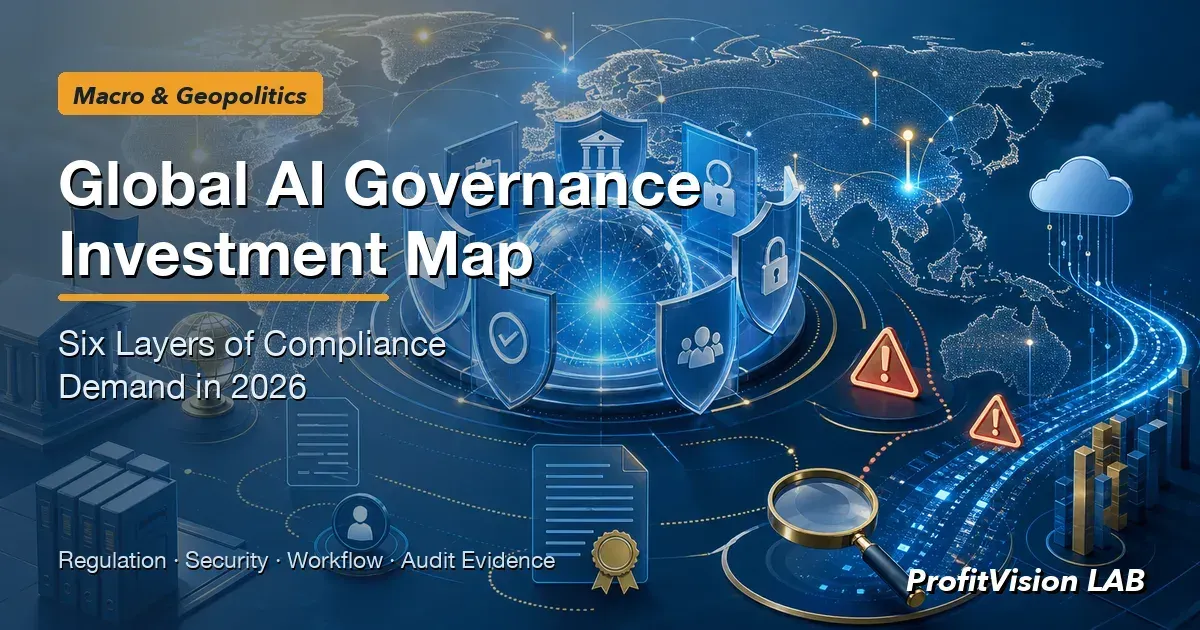
As “AI must be governed” moves from principle to law, compliance spending is becoming a mandatory enterprise budget line. This framework maps seven major jurisdictions and six governance layers into an investable software roadmap.
- AI governance spending is shifting from optional IT budget to mandatory compliance budget; investors should focus on workflows, evidence trails, and enforcement timelines.
- The six-layer AI governance framework is essentially an enterprise procurement checklist: inventory, data foundation, security, model assurance, human oversight, and compliance audit.
- There are few pure-play public AI governance stocks; the clearer beneficiaries are platforms that already control enterprise traffic, identity, data, workflow, and audit records.
- The highest-conviction layers are data security and human oversight, where CRWD, OKTA, PANW, NOW, and CRM already have natural entry points.
- Taiwan’s AI Basic Act matters less as a standalone statute and more as a signal that sector-specific rules in finance, healthcare, labor, and privacy could force enterprise adoption.
For the past three years, “responsible AI” mostly lived inside corporate white papers and ethics committees. It sounded serious, but it did not always require real spending. That is now changing. The EU, China, South Korea, Taiwan, and a growing patchwork of U.S. state laws are turning AI governance from a values statement into an operational obligation.
For investors, the question is not whether AI regulation will slow innovation. The more useful question is simpler: what will enterprises have to buy in order to avoid fines, litigation, model failures, and reputational damage?
Why is 2026 the turning point for AI governance?
The EU AI Act can impose penalties of up to EUR 35 million or 7% of global annual turnover, depending on the violation. China has already required security assessments and algorithm filings for certain generative AI services. South Korea’s AI Basic Act takes effect in 2026 and can reach foreign providers serving the Korean market under specific conditions. Taiwan’s AI Basic Act has also entered into force, with sector-specific rules expected to follow.
The investment relevance is straightforward: once a software category becomes a way to avoid enforcement risk, its budget resilience changes. A company can delay a productivity upgrade during a slowdown; it cannot easily ignore a regulatory obligation.
How does the six-layer AI governance framework become a buying list?
AI Inventory is the starting point. Enterprises cannot govern what they cannot see. Shadow AI detection, AI system registration, model ownership, and risk classification are likely to become common requirements across regulatory regimes.
Data Foundation determines both model quality and legal defensibility. When a regulator asks where training or inference data came from, a stronger model is not enough. The enterprise needs lineage, provenance, quality checks, and evidence.
Data Security and Access is the cleanest public-market layer. AI agents act on behalf of humans, which makes machine identity, least privilege, privileged access management, and key control more important than they were in traditional SaaS workflows.
Model Assurance is technically demanding, but the public-market exposure is still limited. Many pure-play vendors in model validation, red teaming, fairness testing, and AI assurance remain private. Public investors are mostly getting indirect exposure through observability and governance platforms such as DDOG and IBM.
Human Oversight is not primarily an algorithm problem. It is a workflow problem. Whoever owns enterprise approval paths, case routing, exception handling, and task assignment has a natural right to compete for the oversight layer.
Compliance and Audit converts the previous five layers into an evidence chain that internal audit teams, external accountants, regulators, and legal departments can actually use.
Where does the global AI regulatory map stand now?
| Jurisdiction | Core Regime | Key Timeline | Intensity | Cross-border Reach |
|---|---|---|---|---|
| European Union | AI Act + Omnibus timeline reset | Prohibited practices started in Feb. 2025; GPAI duties started in Aug. 2025; high-risk obligations are being reset under the Omnibus political agreement toward Dec. 2027 and Aug. 2028, pending formal process | Highest | Yes, for products and services entering the EU market |
| China | Generative AI measures, synthetic content labeling, Cybersecurity Law amendments | Enforcement began in 2023; labeling rules effective in Sept. 2025; amended Cybersecurity Law effective in Jan. 2026 | High | Yes, for relevant services inside China |
| South Korea | AI Basic Act | Effective Jan. 2026 | Medium-high | Potentially applies to qualified foreign providers serving the Korean market |
| United States | State-law patchwork: Colorado, California, Texas, and others | Compliance expectations build from 2026 onward | Medium | State-level, but large enterprises need multi-state compliance |
| Japan | AI Promotion Act | Effective June 2025 | Low | Limited |
| United Kingdom | Regulator-led adaptive approach | Still evolving, without one unified AI statute | Low-medium | Limited |
| Taiwan | AI Basic Act | Promulgated Jan. 14, 2026; sector regulators expected to develop implementing rules within two years | Low-medium, framework-based | Limited |
The EU delay is not a bearish signal. It is a timeline reset. GPAI obligations have already started, which means model providers and large enterprise adopters have begun governance preparation. The delayed high-risk system obligations push the second wave of deployer spending into 2027–2028 rather than eliminating it.
Asia is moving faster than many investors assume. China has already enforced AI-related rules. South Korea’s AI Basic Act comes into effect in 2026 and keeps a regulatory hook for cross-border providers. Taiwan has entered the framework-law stage, with sectoral rules likely to matter more than the basic statute itself.
The U.S. fragmentation is a hidden cost amplifier. The absence of one federal AI law does not mean enterprises avoid compliance. It means they may need platforms that can map one internal policy against many overlapping state regimes.
Which public-market companies benefit from the six AI governance layers?
| Layer | Enterprise Function | Public-Market Examples | Why They Fit |
|---|---|---|---|
| ① Inventory | Shadow AI detection, model registry | PANW, ZS, NET, DDOG | SSE/CASB platforms see enterprise AI traffic; observability platforms see service registration |
| ② Data | Lineage mapping, data quality | SNOW, PLTR, CRM | Data clouds and data platforms can embed AI governance into existing data governance |
| ③ Security | Encryption, RBAC, least privilege, key management | CRWD, OKTA, PANW, VRNS | Identity and privileged access control become core infrastructure in the agentic AI era |
| ④ Assurance | Red teaming, drift detection, fairness testing | DDOG, IBM | Most pure plays are private; public proxies are LLM observability and watsonx.governance |
| ⑤ Oversight | Decision review, escalation, accountability mapping | NOW, CRM | This is a workflow layer, and ServiceNow’s AI governance control-tower logic fits naturally here |
| ⑥ Audit | Regulatory mapping, audit trails, incident reporting | IBM | The more fragmented regulation becomes, the more valuable multi-jurisdiction mapping engines become; pure public audit exposure remains limited |
Structural thesis 1: Fragmentation helps platforms
Seven jurisdictions, multiple cross-border triggers, and a 50-state U.S. patchwork will push enterprises toward platforms that can write one policy and map it against many regulatory obligations. That is a structural advantage for companies such as PANW, ZS, NOW, and IBM.
Structural thesis 2: Demand arrives in two waves
The first wave, from 2025 to 2026, is driven by rules already in force and should concentrate around inventory, data, and security. The second wave, from 2027 to 2028, is likely to expand into model assurance, human oversight, and formal audit evidence as high-risk obligations become more operational.
Structural thesis 3: Security and oversight are the highest-conviction layers
Data security does not need to wait for regulation. The rise of AI agents already makes machine identity and least privilege a necessity. Human oversight is also a common requirement across jurisdictions, which naturally favors workflow platforms.
What does Taiwan’s AI Basic Act signal for investors?
Taiwan’s AI Basic Act is a framework law. It does not immediately impose detailed operating duties on every private company. The real requirements are likely to come from sector regulators through implementing rules and amendments to existing laws.
For Taiwan-focused investors, the transmission chain is clear: sector rules emerge, regulated institutions must classify and document AI systems, and demand rises for cybersecurity services, systems integration, data governance, and compliance consulting.
Financial institutions are likely to be first in line. This is consistent with global experience: finance is usually the first major industry to buy AI governance infrastructure because model errors can quickly become credit risk, consumer protection disputes, and supervisory liability.
How should investors track whether AI governance is becoming real revenue?
Signal 1: Regulatory milestones. Watch the EU Omnibus formal process, Taiwan’s first sector-specific AI rules, and early enforcement actions under U.S. state laws.
Signal 2: Platform vendor disclosure. Track how often PANW, ZS, NOW, DDOG, CRM, and IBM discuss AI security, AI governance, AI compliance, and related ARR contribution on earnings calls.
Signal 3: Private-company exits. If companies such as Vanta, OneTrust, Drata, Credo AI, or Holistic AI move toward IPO, public markets may finally get cleaner AI governance exposure. If they are acquired by platform incumbents instead, it would reinforce the platform-integration thesis.
What is the bottom line for the global AI governance investment map?
“AI needs governance” was an ethics statement in 2024, a policy direction in 2025, and a budget item with deadlines and penalties from 2026 onward.
The investor’s job is not to chase every company that claims to sell AI governance. The job is to stand where the money must pass: enterprise traffic, data foundations, identity controls, workflow systems, and audit records. Those are the places where AI governance spending is most likely to turn into durable gross margin.
Comments ()