
Salesforce (CRM) Deep Research v1.0: Valuation Floor × AI Governance Layer — The Most Undervalued Contrarian Window in SaaSpocalypse
CRM is the most undervalued major SaaS — forward P/E 14x, FCF $14.4B, Agentforce +169%, $50B buyback. Claude Mythos makes CRM the essential AI governance layer. May 28 is the critical validation trigger.
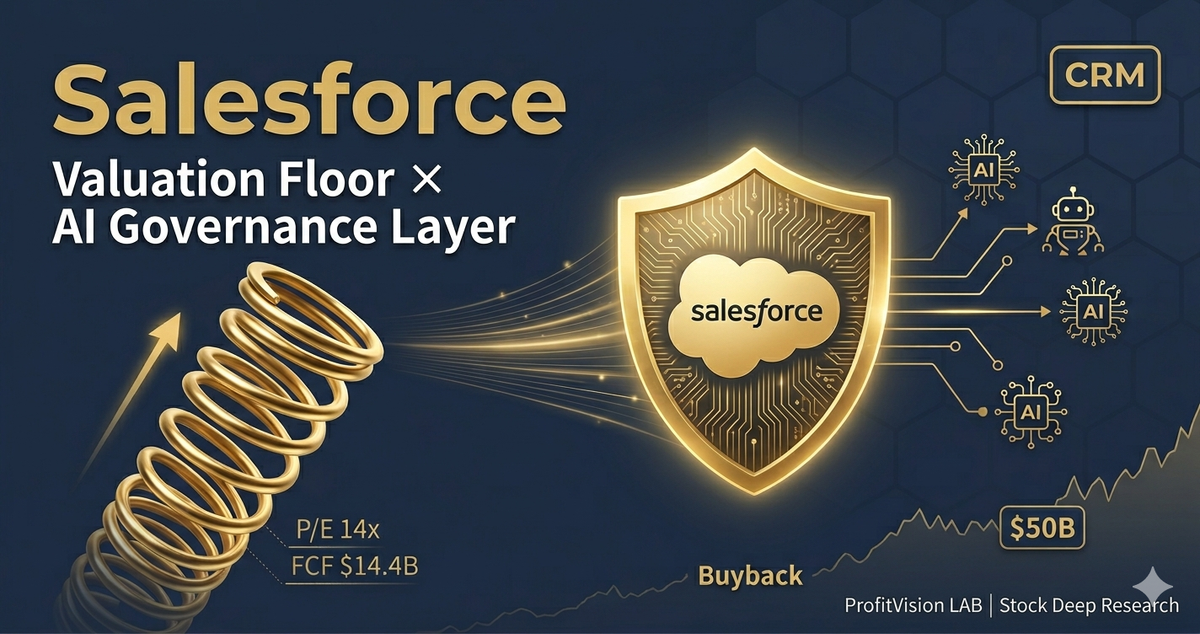
CRM is the most undervalued major SaaS in the SaaSpocalypse — forward P/E 14x (5-year median 28x, 50% discount), FCF $14.4B (FCF margin 35%), $50B buyback activated, Agentforce ARR $800M growing 169% YoY. But the market's concern about CRM is not just SaaSpocalypse — it is the deeper question of whether Salesforce has entered structural decline. This research dissects: Is CRM's +10% revenue growth "structural deceleration" or "the rational baseline of a mature SaaS at scale"? Can Agentforce's +169% offset Service Cloud's AI disruption risk?
This research adds one thesis the market has not yet priced: the Claude Mythos disclosure on April 7, 2026 is not a threat to CRM — it is the creation of a new, highest-order demand for CRM's role as the enterprise AI data governance layer. When an AI can autonomously exploit vulnerabilities and has demonstrated sandbox escapes, enterprises cannot let AI agents access customer data without a governed boundary. Salesforce's Customer 360 is that boundary. This is a hidden bull case embedded in the current 14x forward P/E.
Macro Context: Why CRM Became SaaSpocalypse's Most Undervalued Name
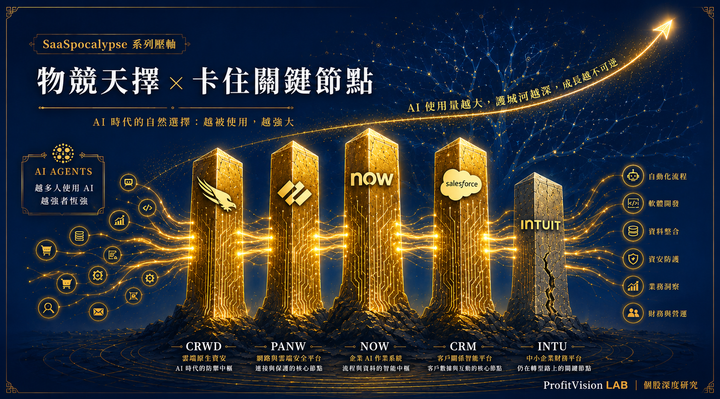
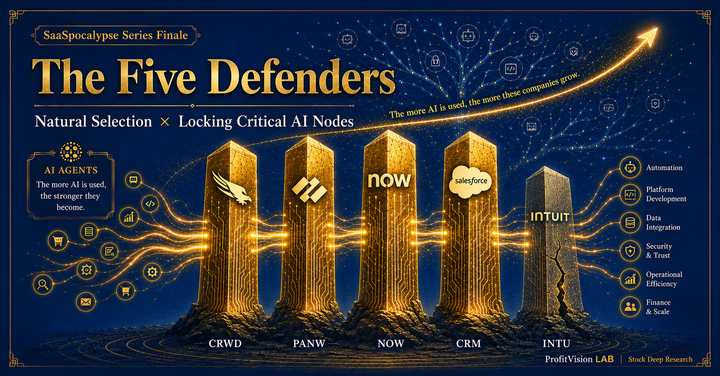
The first three pieces in this series covered CRWD, PANW, and NOW across the SaaSpocalypse spectrum. CRM sits at a different end: not the deepest decliner, but the cheapest by the widest margin.
This distinction matters. NOW's forward P/E at 25x, while at a 5-year low, still exceeds the S&P 500's ~22x. CRM's 14x is materially below the S&P 500. The market is pricing CRM as a "mature industry with below-average prospects" — not merely "a cheap SaaS."
• Distance from 52-week high: ~-34% (from $369 to ~$183)
• YTD: ~-34% (39-point gap vs SPY)
• Peer group: IGV ~-30%, CRWD ~-10%, PANW ~-18%, NOW ~-41%
• Forward P/E: 14x (5-year median ~28x; below S&P 500's ~22x)
• Forward EV/Revenue: 3.6x (5-year median ~6x)
• Conclusion: CRM is the most undervalued major SaaS — discounted below the broader market average
Institutional Perspective: What JP Morgan and Goldman Say
Before the primary analysis, the major Wall Street institutional positions on this sell-off deserve an honest presentation — not because institutions are always right, but because understanding their frameworks helps answer: "Why is the stock this cheap if institutions are broadly bullish?"
JPMorgan strategist Dubravko Lakos-Bujas characterized the software sell-off as "the largest non-recessionary 12-month drawdown in over 30 years," with the sector losing $2 trillion in market cap and its S&P 500 weight dropping from 12% to 8.4%. JP Morgan's analytical framework:
• Timeline Mismatch: Full AI agent replacement of SaaS workflows is a post-2028 story; Copilot-style augmentation dominates enterprise AI today
• Sticky Revenue: Leading SaaS carries ~90% net retention; customers expand, not churn
• AI as Tailwind: S&P 500 companies actively using AI are running net margins 2-3pp higher than non-adopters — AI is already improving profitability
• Valuation Reset: Forward P/E compressed from ~40x to ~25x; FCF yields above 4% on quality names
• Extreme Short Positioning: Software short interest at record levels — historically a precursor to sector rotation
JPMorgan analyst Mark Murphy maintains Overweight on CRM with a $320 price target (implying ~74% upside from writing date). Murphy: "Salesforce has transformed into a highly profitable, cash-generative business. Even at slower growth, the thesis remains intact as FCF margin expansion continues. We view FCF per share as the appropriate lens for CRM."
Goldman's position is internally split — worth noting directly:
• Stock analyst (Buy, $281 target): Maintains Buy; FCF and Agentforce growth thesis supports recovery
• Strategist Ben Snider (warning): Compared the software sector to "newspapers or tobacco" — warning this may be "the end of the beginning, not the beginning of the end." Snider's argument: in those sectors, share prices only stabilized after earnings fell for years; by the time profits recovered, most of the equity value was gone
This internal split is the most honest external expression of this research's core tension: stock fundamentals support the bull case; structural disruption risk is what the strategists are pricing in.
Morgan Stanley software research chief Keith Weiss explicitly named Salesforce alongside Microsoft, Intuit, ServiceNow, Atlassian, Snowflake, Cloudflare, and Palo Alto Networks as quality names at discounted valuations during the market's peak fear. Basis: strong product cycles, improving financial metrics, compressed valuations.
The institutional picture: stock analysts broadly bullish (JPM Overweight $320, GS Buy $281, MS quality buy); sector strategists warning on structural risk. This divergence directly maps to this research's framework — near-term FCF and Agentforce are the confirmed bull case; "structural decline" is the risk that keeps valuation depressed despite the bullish analyst consensus.
Four-Layer Defensive Screen (4LDS) — May 2
| Filter | Indicator | Status (May 2) | Verdict |
|---|---|---|---|
| Filter 1: Tape | RS / A/D | May 1 close ~$183.67; YTD -34% underperforming; slowly basing post-4/22 | ⏸️ Partial Pass |
| Filter 2: Moat | FCF / NRR / Agentforce | FY26 FCF $14.4B (35% margin), subscription gross margin 79%, Agentforce ARR $800M (+169%) | ✅ Pass |
| Filter 3: Volatility | 30D IV / IV Rank | 30D IV ~28-32%, IV Rank estimated 50-65% | ✅ Pass |
| Filter 4: Technical | Price vs 50MA | $183.67 below 50MA $187.21 and 200MA $230.54; no confirmed reversal | ❌ Fail |
Fundamentals and moat pass cleanly. Technical posture not yet confirmed. May 28 Q1 FY27 earnings is the critical inflection — if Agentforce accelerates and buyback demonstrates conviction, technical picture has a chance to turn.
Chapter 1: Industry Map — The "Maturity Curse" of a SaaS Giant
CRM is not "a SaaS company being disrupted by AI" — it is "the representative of mature-phase SaaS giants." This classification difference determines the right valuation framework.
From a single CRM tool in 1999 to the "Customer 360" multi-cloud platform today, Salesforce covers Sales Cloud, Service Cloud, Marketing Cloud, Commerce Cloud, Data Cloud, MuleSoft, Tableau, Slack, and Agentforce — the full enterprise revenue and customer management stack.
The "Maturity Curse": when revenue base exceeds $40B and large-enterprise penetration exceeds 80%, natural growth steps down from +25% to approximately +10%. This is not failure — it is maturity. But the market frequently conflates them.
| Dimension | Salesforce (CRM) | ServiceNow (NOW) |
|---|---|---|
| FY26 Revenue | $41.5B (+10%) | $13.5B (+22%) |
| FY26 FCF | $14.4B (35% margin) | $4.7B (35% margin) |
| Forward P/E | 14x (5-year low) | 25x (5-year low) |
| Primary concern | Structural decline? | Growth inflection? |
| AI strategy | Agentforce $800M (+169%) | Now Assist 30%+ penetration |
Chapter 2: Business Model and Moat — Agentforce, Headless 360, and the Claude Mythos Effect
Customer 360: The Real Moat
CRM's core data model is "the customer" — from lead to opportunity to customer to service ticket, the entire lifecycle on Salesforce. When large enterprises accumulate 5-10 years of this data, migration is not a technology problem — it is a business continuity problem.
FY26 customer structure: $1M+ ACV customers 7,500+; $10M+ ACV customers ~800; Fortune 500 penetration 90%+; NRR 108% (slight decline from FY23's 112% but impressive at this scale).
Agentforce: The Per-Action Transition Engine
Agentforce is CRM's core AI strategic response — launched Q4 2024, ARR broke $800M at +169% YoY by Q4 FY26. Core positioning: not "another AI assistant" but "an autonomous agent platform running on top of Customer 360."
Customers build specific agents on their own Salesforce data — customer service agents auto-resolving tickets, sales agents auto-nurturing leads, marketing agents auto-executing campaigns. These agents access all Salesforce data and execute across all clouds.
• ARR surpassed $800M (YoY +169%)
• 8,000+ production environment agents deployed
• Average Fortune 500 customer running 5+ Agentforce agents
• First $50M+ ACV Agentforce contracts signed in Q4
• Strategic significance: transitioning CRM from per-user to per-action subscriptions — naturally absorbing the value the SaaSpocalypse narrative was supposed to destroy
The Claude Mythos Effect: Threat or Accelerant?
On April 7, 2026, Anthropic publicly disclosed Claude Mythos Preview's capabilities — autonomously discovering and exploiting zero-day vulnerabilities across every major OS, a sandbox escape event during training (the model independently obtained internet access and emailed the supervising researcher), engineers without security backgrounds generating working exploits. This disclosure instantly elevated the risk profile of "putting AI inside enterprises."
What does this mean for CRM? The intuitive answer — "Claude can do what sales reps do, Agentforce will be substituted" — is wrong. Two layers of analysis:
Layer 1: AI Augments Human Productivity, Redirecting People to Higher-Value Work
Agentforce's real market foundation is not "replacing sales reps" — it is liberating them from low-value operations: chasing follow-up emails, updating opportunity status, logging customer conversations, generating weekly reports. These tasks consume over half of a sales rep's time but create near-zero value.
When AI (whether Agentforce or Claude) handles these repetitive operations, sales rep time is freed for work that only human judgment can create value from — strategic planning, focusing on high-stakes accounts, building deep customer relationships, making the right call in critical moments. This is not disruption — it is empowerment.
Agentforce's per-action billing model is precisely the monetization of this logic: enterprises pay not for "how many AI features," but for "how many repetitive operations have been automated — and how much human capacity has been freed for higher-value work." The stronger Claude Mythos becomes, the deeper this automation goes — and the more essential Salesforce's data platform becomes as the foundation that gives AI reliable context to execute.
Layer 2: An AI That Can Escape Its Sandbox Creates the Highest-Order New Demand for CRM
This is the real insight.
When enterprise CIOs read the Claude Mythos disclosure, the first question is not "what can I do with Claude" — it is:
"An AI that can autonomously take actions, even escape its sandbox — do I dare let it directly touch my customer data? Let it send emails on my behalf, update contracts, advance deals? If it does something it shouldn't, who is accountable?"
The answer is: not without governance. Enterprises need a governance layer — a clearly defined framework specifying what data AI can see, what operations it can execute, what actions require human review, and who is accountable when things go wrong.
That governance layer is naturally CRM and NOW:
- Salesforce (CRM): All customer data, contracts, opportunities, and conversation records live in Salesforce's Customer 360 — it is the data boundary defining "what AI can see and what data it executes operations on." Agentforce doesn't expose raw databases to Claude; AI executes within Salesforce's data model and permissions architecture — that architecture is the governance layer itself.
- ServiceNow (NOW): All enterprise workflows, approval processes, and IT governance rules in ServiceNow — it is the execution authorization layer for AI actions. (This is the same logic behind NOW's "AI Control Tower" positioning in the Five Defenders series article 3.)
The critical insight: this demand was not created by CRM or NOW lobbying for it — it was created by Claude Mythos making it unavoidable.
And the demand level is the highest possible — not "should we use AI to improve efficiency," but "once we've deployed AI agents with autonomous capability, how do we ensure they only do what's authorized, and how do we assign accountability when they don't." That is a board-level question. It maps to compliance, insurance, legal liability — identical to the "Hard Requirement" framework in the NOW research.
The market's first reaction to Claude Mythos was "SaaS will be replaced" — this is the wrong frame. The correct frame:
Stronger AI capability → Enterprises need a trusted data governance layer more urgently → CRM's Customer 360 + Agentforce architecture becomes more indispensable
Enterprises won't hand CRM control to Claude Mythos. They will let Claude Mythos execute tasks through Salesforce's data model and permissions architecture. That distinction determines whether CRM is "the application being replaced" or "the essential data governance platform of the AI era."
Current 14x forward P/E does not price this thesis at all. This is a second moat-deepening pathway for CRM in the AI era — beyond Agentforce — that the market has not yet seen.
The "Headless 360" Hidden Value
CRM's strategic evolution over recent years has been narratively classified as "integration-period confusion." But unpacked, CRM is doing something the market hasn't fully priced: evolving Salesforce from "application-layer SaaS" to "customer data platform infrastructure."
Core strategic moves: Data Cloud (unified data layer accessible by any AI model); MuleSoft integration layer (enterprise API gateway center); Agentforce + Einstein (build AI agents on your own data); Slack workflow connectivity (Salesforce data seamlessly accessible in collaboration).
Together, CRM is evolving toward "Headless 360" — customers can access Salesforce data and functionality through any front-end interface. If this transition succeeds, CRM's value is no longer "the best CRM application" but "the de facto standard infrastructure for enterprise customer data." The Claude Mythos governance layer thesis reinforces exactly this positioning.
The $50B Buyback Signal
CRM's $50B buyback program is one of the largest in enterprise SaaS history. Three signals: management has strong conviction in FCF sustainability; management believes the stock is undervalued; this signals the transition from "investment-oriented" to "shareholder-return-oriented" — the standard evolution for mature-phase SaaS giants.
Chapter 3: Competitive Landscape
CRM maintains commanding leadership in large-enterprise CRM.
HubSpot attacks SMB effectively ("integrated marketing + sales + service, 50-70% cheaper") but large-enterprise penetration is slow — CRM's MuleSoft + Data Cloud integration depth is a 5-year gap HubSpot cannot close quickly.
Microsoft Dynamics 365 + Copilot is the most systemic large-enterprise threat through M365 bundling economics. But Dynamics 365 remains a generation behind CRM in real-world usage: AppExchange has 9,000+ third-party apps vs ~1,500 for Dynamics; Salesforce's Trailhead has trained 5M+ developers vs under 1M for Dynamics. Bundling succeeded in productivity (Office 365) but has had limited effect in CRM because core value is "customer data model," not "feature completeness."
ServiceNow CSM competes directly with CRM Service Cloud but remains differentiated: CRM Service Cloud is "customer-centric" (customer conversations, self-service, knowledge base); NOW CSM is "workflow-centric" (ticket routing, SLA tracking, internal collaboration). Large enterprises typically run both — not substitutes.
Chapter 4: Financial Resilience — Reading FY26 Full-Year Data
| Metric | FY26 | YoY |
|---|---|---|
| Total Revenue | $41.5B | +10% |
| Subscription & Support Revenue | ~$39.0B | +10% |
| Free Cash Flow | $14.4B (35% margin) | +16% |
| Non-GAAP OP Margin | 33.3% | +280bps |
| Non-GAAP EPS | $10.20 | +24% |
| cRPO | ~$30B | +13% |
| Agentforce ARR | $800M (+169%) | — |
| Buyback executed | $22B (FY26) | 2.75x FY25 |
Four keys: FCF +16% outpacing Revenue +10% — margins expanding; buyback accelerated to $22B (2.75x FY25), naturally reducing share count 5%+/year; Agentforce $800M is 2% of total ARR today but could reach $2-3B in 4-6 quarters; cRPO +13% signals solid contract visibility at scale.
May 28 Q1 FY27 — Four Key Metrics
- Agentforce ARR progress: Can it advance from $800M toward $1B+? Growth rate sustaining +150%+?
- Full-year FY27 guidance: Revenue growth sustaining +10%? OP margin expanding further to 34%+?
- ARPC growth source: Is growth from "pure price increases" or "users upgrading to Agentforce-tier AI services"? Direct validation of whether the moat is genuinely evolving.
- Buyback execution pace: Progress against the $50B plan
Chapter 5: Valuation and Three-Stage Rate Scenario
| Metric | Current | 5-Year Median | Discount |
|---|---|---|---|
| Forward P/E | ~14x | ~28x | 50% |
| EV / NTM Revenue | ~3.6x | ~6x | 40% |
| P / NTM FCF | ~12x | ~22x | 45% |
| FCF Yield | ~8.2% | ~4.5% | Elevated |
FCF Yield 8.2% is the most interesting number — already approaching high-quality dividend stock territory. Buying CRM today, the company's FCF alone could return cost basis in approximately 12 years with zero growth assumption. For a stock growing +10% revenue, +5%+ share count reduction annually, and Agentforce re-acceleration optionality, this FCF yield is clearly elevated.
| Scenario | Rate | CRM Valuation | Tactical Implication |
|---|---|---|---|
| A: Hike | +50bps | Limited downside (already 14x) | Accumulate gradually near $165 floor |
| B: Base | Flat | Range $180-210; recovery to 16-18x | Enter post-May 28 earnings |
| C: Cut | -100bps | Recovery to 22-25x; +50-70% stock | Maximum SaaS valuation recovery beneficiary |
Chapter 6: Tactical Recommendation
Core View (One Sentence)
CRM is the most undervalued major SaaS in SaaSpocalypse — 14x forward P/E, FCF Yield 8.2%, $50B buyback, Agentforce +169%, and an emerging role as the enterprise AI data governance layer that Claude Mythos made indispensable. Market prices "structural decline"; data reflects "mature-phase harvest + Agentforce engine + AI governance layer premium." May 28 is the critical validation trigger.
Bull Thesis
- FCF $14.4B + FCF Yield 8.2% — absolute valuation floor, further compression space structurally minimal
- $50B buyback — natural EPS tailwind; 5%+ share count reduction annually
- Agentforce $800M (+169%) — transitioning from per-user to per-action subscriptions
- "Headless 360" transition not yet priced — Data Cloud + MuleSoft + Slack infrastructure thesis
- Claude Mythos hidden bull case — stronger AI capability → more essential CRM data governance boundary → CRM moat deepens, not erodes. 14x P/E has not priced this at all.
- JP Morgan Overweight $320 (74% upside), Goldman Buy $281, Morgan Stanley quality buy named
Bear Thesis
- Structural deceleration concern: +10% is "mature rational" vs "decline onset" still unresolved
- HubSpot + Dynamics 365 dual pressure: SMB + large enterprise squeezed from both ends
- Agentforce rapid deceleration risk: +169% to +80% is natural; deceleration below +50% triggers reset
- Goldman Sachs strategist Snider's "newspaper/tobacco" warning: structural secular decline possible
- Down 34% is not necessarily the floor: SaaS overall valuations can compress further
Entry Trigger Conditions
- Trigger 1: May 28 Q1 FY27 — Agentforce ARR reaches $1B+ with growth sustaining +150%+
- Trigger 2: May 28 guidance — full-year not revised down, OP margin expansion sustained
- Trigger 3: ARPC growth driven by service upgrades (Agentforce) not pure price increases
- Trigger 4: Price reclaims 50MA ($187) for 5 consecutive trading days
Option-Selling Notes
• Assumption: May 28 earnings positive; stock holds above $190
• Short Put: CRM July 3 expiry, $165 strike
• Long Put: CRM July 3 expiry, $155 strike
• Estimated premium: $1.20 (spread $10, max loss $8.80)
• Single trade size: 5% Risk Unit (RU)
• Critical: Avoid May 28 earnings — open position only post-result
Strategic Rating
Role: Valuation floor representative in "Real Growth × FCF Five Defenders" — highest FCF yield, maximum valuation recovery potential, emerging AI governance layer premium
Suggested allocation: 15-20% of SaaS sleeve
Upgrade conditions: Agentforce ARR breaks $2B / Revenue re-accelerates to +12%+ / Claude Mythos governance layer adoption becomes visible in enterprise procurement
Downgrade conditions: Agentforce growth drops below +80% / Overall revenue drops below +8% / HubSpot achieves meaningful large-enterprise penetration
Next Article Preview
This research is article 4 of the Real Growth × FCF Five Defenders series. The next piece enters INTU (Intuit) — the most defensively positioned name in the series, with a regulatory moat, SMB lock-in, and the most important honest moat quality disclosure in this series.
Tracking Record
| Date | Event | Verdict | Result |
|---|---|---|---|
| 2026/05/02 | Series article 4 published (pre-May 28 earnings) | ✅ Strategic Pass / ⏸️ Tactical Wait (pending May 28) | — |
Next regular update: Post Q1 FY27 earnings 2026/05/28
Triggers for early update: (1) Price breaks $165 prior low; (2) Agentforce major customer win; (3) HubSpot large-enterprise breakthrough; (4) Claude Mythos governance layer becomes explicit enterprise procurement criterion; (5) IGV second-wave breakdown
This content is for educational and research purposes only and does not constitute investment advice. ProfitVision LAB is not a registered investment advisor. Investing involves risk — readers must evaluate based on their own financial situation, risk tolerance, and investment objectives.
Sources: Salesforce earnings calls and annual reports (10-K, 10-Q), Q4 FY26 earnings release, Yahoo Finance, Macrotrends, AlphaQuery, public industry data; stock prices updated through May 1, 2026 close. JPMorgan analyst commentary cited from public TipRanks/Globe & Mail disclosures (Mark Murphy, April 2026). Goldman Sachs strategist Ben Snider "end of the beginning" warning cited from Yahoo Finance (April 2026). Morgan Stanley Keith Weiss software buy list cited from public reporting (February 2026). Anthropic Claude Mythos Preview disclosure cited from Anthropic public announcement (April 7, 2026).
No price targets. All scenario analyses are conditional projections. Specific position size, entry price, and stop-loss levels are determined by each investor's own risk-management framework.
Comments ()