
Amphenol (APH): From Depression-Era Factory to AI Backbone
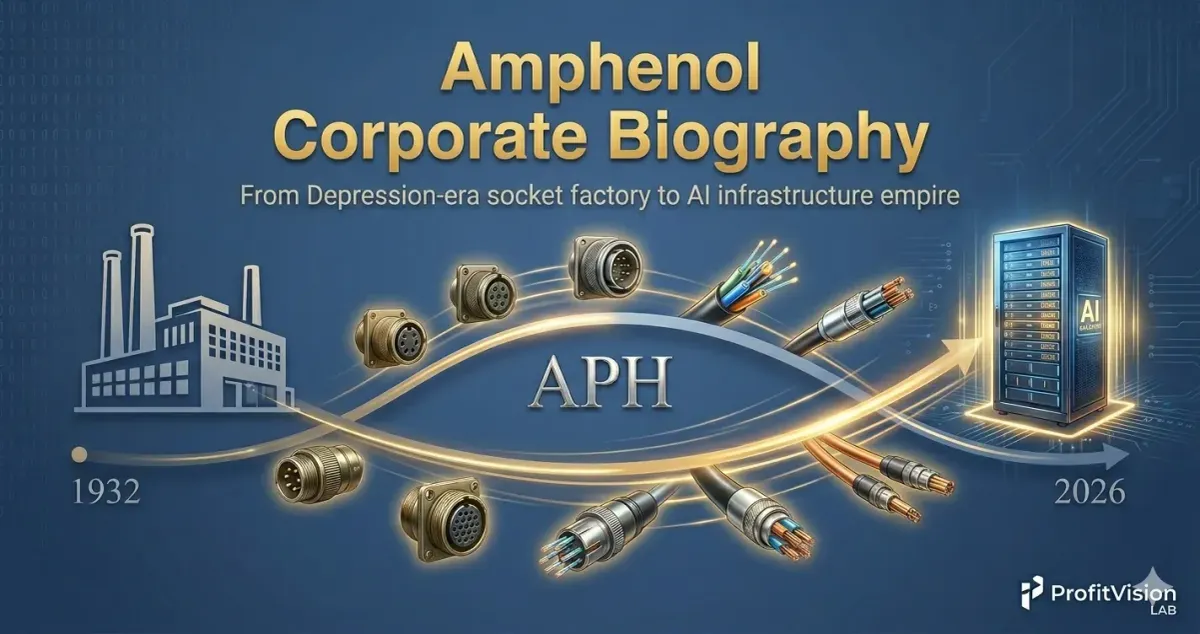
From a 1932 Depression-era socket factory to a $170B AI infrastructure empire — APH built its moat through extreme decentralization, 100+ acquisitions, and the financial discipline to compound for 93 years. Understanding APH's history is the best case study of culture as economic moat.
Chapter 1: Founding DNA — One Decision at the Bottom of the Depression
In 1932 Chicago — the darkest year of the Great Depression, with unemployment near 25% — an engineer named Arthur J. Schmitt incorporated the American Phenolic Corporation with a simple insight about radio tube sockets.
The incumbent solution used brittle ceramic materials. Schmitt discovered that phenolic plastic (Bakelite) could produce more durable, cheaper, and easier-to-manufacture sockets. His first major customer was RCA — the era's technology giant.
① Focus on components, never systems. Always sell parts to OEM customers, never assemble the final product. This allowed APH to simultaneously serve competing customers while maintaining irreplaceability.
② Quality first, never decline an order. Schmitt's culture of never saying "we can't do this" became the technical foundation for the Harsh Environment Solutions business line decades later.
The Depression itself became Amphenol's competitive filter — weaker rivals folded, while APH's lean cost structure and clear technical barriers allowed it to consolidate market position during the downturn. Crisis is a stress test for moats — a pattern that repeated itself in the 2008 financial crisis and the 2020 pandemic.
Chapter 2: Nine Pivotal Moments — The Timeline That Changed APH's Trajectory
Arthur J. Schmitt incorporates American Phenolic Corporation in Chicago. First major order from RCA establishes the "electronic component supplier" positioning.
Wartime demand exploded for reliable connectors. APH's 5015 AN circular connectors became the U.S. aviation industry standard, supplying over 60% of aircraft connectors and virtually all coaxial cable for military aircraft. This period laid the technical foundation and brand trust for the Harsh Environment Solutions business.
Listed on the NYSE under "APL" in 1957, raising expansion capital. The following year merged with G.W. Borg Corporation, entering automotive instruments and industrial electronics — renamed Amphenol-Borg. APH's first cross-sector diversification attempt produced mixed results, and the organization spent decades digesting the Borg acquisition's complexity.
After 32 years at the helm, Schmitt retired. The company entered a prolonged period of management confusion: acquired by Bunker-Ramo in 1967, then by Allied Chemical in 1981. Over fifteen years, APH was treated as a financial instrument — non-core businesses expanded, and the connector DNA became diluted.
LPL Investment Group acquired APH for approximately $430 million in an LBO, appointing Edward DeGeorge as CEO. DeGeorge made one radical decision: eliminate nearly all centralized functions and restructure every business unit as an independent P&L center, with GMs fully accountable for their own financials. This "extreme decentralization" model became the bedrock of APH's competitive advantage.
IPO completed, re-listed under the now-familiar "APH" ticker. The company had been streamlined to core connector operations, decentralized culture was taking root, and APH entered its accelerated growth phase.
KKR acquired a majority interest for $1.5 billion, appointing Martin Loeffler as Chairman & CEO. KKR brought not just capital but a "systematic M&A" mindset — clearer acquisition criteria, more standardized integration processes. During Loeffler's tenure (1997–2009), dozens of acquisitions expanded APH from under $1 billion to over $3 billion in revenue. KKR exited in the mid-2000s, leaving behind a self-propelling compounding machine.
Norwitt joined APH after Harvard and rose through the ranks over 25+ years before becoming CEO. His core contribution was distilling "decentralization" from a management style into a replicable corporate DNA — embedding it into every acquisition integration process. Under his leadership (2009–present), APH has completed 100+ acquisitions, growing revenue from $3 billion to $23.1 billion.
The 2020 pandemic supply chain disruption barely touched APH — the decentralized "local manufacturing" model proved the ideal buffer. By 2025, the IT datacom business surged from ~20% to 37% of revenue, with organic growth exceeding 100%. The August 2025 announcement and January 2026 close of the CommScope CCS acquisition ($10.5 billion) — APH's largest-ever deal — directly locked in the fiber interconnect market for hyperscale AI data centers.
Chapter 3: M&A Philosophy & Integration Playbook — The Secret to Acquiring 10 Companies Per Year Without Indigestion
Many companies pursue "M&A-driven growth" strategies but ultimately collapse from integration failures — cultural clashes, management chaos, margin erosion. APH has completed over 100 acquisitions in 30 years, consistently bringing acquired companies' margins to group level within 24 months. The Playbook behind this is worth understanding deeply.
Three Core Acquisition Principles
Major Acquisition Milestones (Selected)
| Year | Target | Strategic Rationale | Outcome |
|---|---|---|---|
| 1986 | Socapex (France) | Entry ticket to European military/aerospace connector market | ✅ European manufacturing base established |
| 2005 | SV Microwave + Teradyne Connection Systems | RF connectors + high-density electronic connectors | ✅ Telecom equipment mainboard market entry |
| 2013 | GE Advanced Sensors (~$318M) | Major sensor business expansion | ✅ ISS segment formation catalyst |
| 2021 | MTS Sensors (~$950M) | Industrial sensor market leadership | ✅ ROIC exceeded group average |
| 2024 | Carlisle Interconnect Technologies (CIT) | Aerospace connector leadership reinforcement | ✅ Aerospace competitiveness significantly enhanced |
| 2025–2026 | CommScope CCS (~$10.5B) | Fiber interconnect / AI data center critical infrastructure | ⏳ Integration in progress — the critical verification |
How the Integration Playbook Actually Works
Step 1: Retain original brand, customer relationships, technical team
Step 2: Plug into APH's global purchasing scale (material costs immediately drop 5–15%)
Step 3: Access APH's global sales network (cross-sell opportunities surface within 90 days)
Step 4: GM begins participating in APH's performance review rhythm; P&L accountability drives efficiency naturally
Step 5: Typically 18–24 months for margins to reach group level
Key success factor: APH's headquarters is intentionally kept tiny. There is no attempt to "manage" acquired companies centrally — instead, GMs are empowered within clear performance frameworks to figure it out themselves.
Chapter 4: Leadership Succession & Cultural DNA — 93 Years of the Relay Race
APH's culture is not a mission statement on the wall — it's a decision-making philosophy transmitted through the actions of each generation of leadership. Studying this succession chain reveals remarkable consistency.
—
1964
Engineer by training. Core contribution: establishing a "technical quality first" corporate culture and the "focus on components" business model. Led for 32 years, guiding APH from the Great Depression through post-WWII growth. His departure left a 20-year management vacuum, inversely proving the weight of founder DNA.
—
1997
Arrived post-LBO. Made the single most important organizational decision in APH history: abolish all centralized functions and fully decentralize. He laid the organizational DNA of modern APH — a brief tenure with permanent impact.
—
2009
Appointed by KKR. Drove systematic M&A strategy, building the "Serial Acquirer" operating model with KKR's capital backing. During his tenure, APH transformed from a regional connector company into a multinational with clear global footprint. Currently still serves as Chairman.
—
Present
Harvard-educated, rose through APH's ranks over nearly 30 years before becoming CEO. His core contribution is being the best possible evangelist of "decentralized culture" — not through mandates, but by recruiting entrepreneurially-minded GMs, setting clear financial targets, and letting them run their businesses. Under his leadership, APH has completed 100+ acquisitions and expanded adjusted OPM from ~17% to 26.2%. Widely regarded by Morningstar and institutional analysts as one of the best CEOs in industrials.
Five Core Principles of APH's Cultural DNA
Chapter 5: Financial Discipline DNA — Two Decades of ROIC at 2× WACC
Key Financial Metrics (FY2025)
(All-time high)
vs WACC ~11%
(Doubled YoY)
Long-Term Financial Trend (OPM & Revenue, 2021–2025)
| Year | Revenue | YoY Growth | Adj. OPM | EPS (Adj.) | FCF |
|---|---|---|---|---|---|
| 2021 | $10.5B | +25% | ~19% | $1.10 | $1.4B |
| 2022 | $12.8B | +22% | ~20% | $1.27 | $1.8B |
| 2023 | $12.6B | -2% | ~20% | $1.26 | $2.2B |
| 2024 | $15.2B | +21% | 21.7% | $1.89 | $2.2B |
| 2025 | $23.1B | +52% | 26.2% | $3.34 | $4.4B |
Capital Allocation Philosophy
Priority 1: Organic growth R&D and capex ($1.0B capex in 2025)
Priority 2: M&A (5–10 deals per year, $1–2B combined annually)
Priority 3: Share buybacks (moderate, not aggressive)
Last: Dividends (~0.8% yield, sustainable but not the focus)
The rationale: APH believes its own ROIC (26%+) far exceeds external capital market returns, so capital should stay inside the company to compound rather than be distributed prematurely.
Crisis Resilience Test
| Crisis | APH Performance | Peer Comparison | Conclusion |
|---|---|---|---|
| 2008–2009 Financial Crisis | OPM dipped from ~17% to ~15%, rapid recovery | TE Connectivity dropped further | Decentralized model provides buffer |
| 2020 COVID-19 | Full-year revenue only -5% | Industrial stocks averaged -15% | End-market diversification worked |
| 2023 Consumer Electronics Downturn | Full-year flat (-2%) | Defense + AI offset weakness | Portfolio balance increasingly robust |
Chapter 6: The Evolution of the Moat — From Craftsmanship to Ecosystem Barriers
| Era | Moat Form | Depth | Primary Threat |
|---|---|---|---|
| 1932–1964 Founding Era | Technical craftsmanship + quality reputation ("Schmitt never declines an order") | Moderate | Low-cost copycat manufacturers |
| 1987–2000 Rebuilding Era | Decentralized operating model + purchasing scale (post-KKR restructuring) | Medium-High | Vertical integration by large electronics conglomerates |
| 2000–2020 Expansion Era | Design-in barriers + end-market diversification + M&A integration capability | High | Asian low-cost connector manufacturers |
| 2020–Present AI Era | AI infrastructure physical hub + hyperscaler deep customer lock-in + fiber interconnect vertical integration (CCS) | Very High | AI CAPEX cycle reversal; CCS integration failure |
Chapter 7: Lessons for Long-Term Investors
Core insight: APH is one of the rare companies that "builds moats through engineering rigor, manages through entrepreneurial instinct, and compounds through capital allocator logic."
Three Reasons APH Can Compound Long-Term
Three "Compounding Termination" Early Warning Signals
Evaluation Framework for Long-Term Investors (Beyond P/E and P/B)
| Metric | How to Track | Alert Threshold |
|---|---|---|
| M&A Integration Efficiency | Does OPM reach group average within 24 months post-acquisition? | 2 consecutive misses → downgrade rating |
| ROIC vs WACC Spread | ROIC should sustainably exceed WACC by 10%+ | Spread narrowing below 5% → caution |
| GM Retention Rate | Average GM tenure at business units (should be 10+ years) | Large-scale GM turnover → culture disruption signal |
| End-Market Concentration | No single end market should exceed 40% of revenue | IT datacom exceeding 40% → elevated cyclical risk |
| FCF Conversion Rate | FCF / Net Income should hold steady above 80% | Below 70% for two consecutive years → quality deterioration |
Appendix: Amphenol Timeline (1932–2026)
| Year | Event | Type |
|---|---|---|
| 1932 | Arthur J. Schmitt founds American Phenolic Corporation in Chicago; first product: radio tube socket | 🏗️ Founded |
| 1936 | Introduces 75-series microphone connector and lock-in socket; both become industry standards | 🏆 Market Position |
| 1941 | Renamed Amphenol Corporation, combining "American" + "phenolic" | 🔄 Transformation |
| 1941–1945 | WWII: Becomes largest connector supplier to U.S. aviation industry (60%+ market share) | 🏆 Market Position |
| 1945 | First public capital raise (bonds + stock); market cap ~$4M | 💰 Financial Milestone |
| 1957 | Listed on NYSE under "APL" | 💰 Financial Milestone |
| 1958 | Merges with G.W. Borg Corporation; renamed Amphenol-Borg | 🤝 Acquisition |
| 1964 | Founder Schmitt retires; company enters management drift era | 👤 Leadership |
| 1965 | First international expansion: Japan, India JVs; acquires European connector company Tuchel | 🌍 International |
| 1967 | Acquired by Bunker-Ramo Corporation | 🔄 Transformation |
| 1981 | Bunker-Ramo acquired by Allied Chemical; APH becomes a subsidiary | 🔄 Transformation |
| 1986 | Acquires French Socapex; establishes European military connector base | 🤝 Acquisition |
| 1987 | LPL leveraged buyout ($430M); DeGeorge drives complete decentralization | 🔄 Transformation |
| 1991 | Re-listed on NYSE as "APH"; first IPO of modern Amphenol | 💰 Financial Milestone |
| 1993 | Establishes Amphenol Fiber Systems International; enters fiber optic market | 🔄 Transformation |
| 1997 | KKR acquires majority stake ($1.5B); Martin Loeffler appointed CEO | 🤝 Acquisition / 👤 Leadership |
| 2005 | Acquires SV Microwave (RF) and Teradyne Connection Systems ($390M) | 🤝 Acquisition |
| 2009 | R. Adam Norwitt appointed CEO; modern APH's final form takes shape | 👤 Leadership |
| 2013 | Acquires GE Advanced Sensors ($318M); sensor business expands significantly | 🤝 Acquisition |
| 2016 | Acquires FCI Asia (telecom/datacom interconnect) | 🤝 Acquisition |
| 2021 | Acquires MTS Sensors ($950M); industrial sensor leadership | 🤝 Acquisition |
| 2023 | IT datacom business accelerates; AI infrastructure demand begins driving growth | 🏆 Market Position |
| 2024 | Acquires Carlisle Interconnect Technologies (CIT); 2:1 stock split | 🤝 Acquisition |
| 2025 | Full-year revenue $23.1B (+52%), adjusted OPM 26.2%, FCF $4.4B — all-time records | 💰 Financial Milestone |
| 2026/01 | Closes CommScope CCS acquisition ($10.5B); APH's largest-ever single deal | 🤝 Acquisition |
Investing involves risk. Please evaluate carefully based on your own financial situation.
Data sources: Amphenol official website, SEC filings, MacroTrends, StockAnalysis, public records
Comments ()