
Discipline Has a Price: Why TCAF Wins and RVER Loses
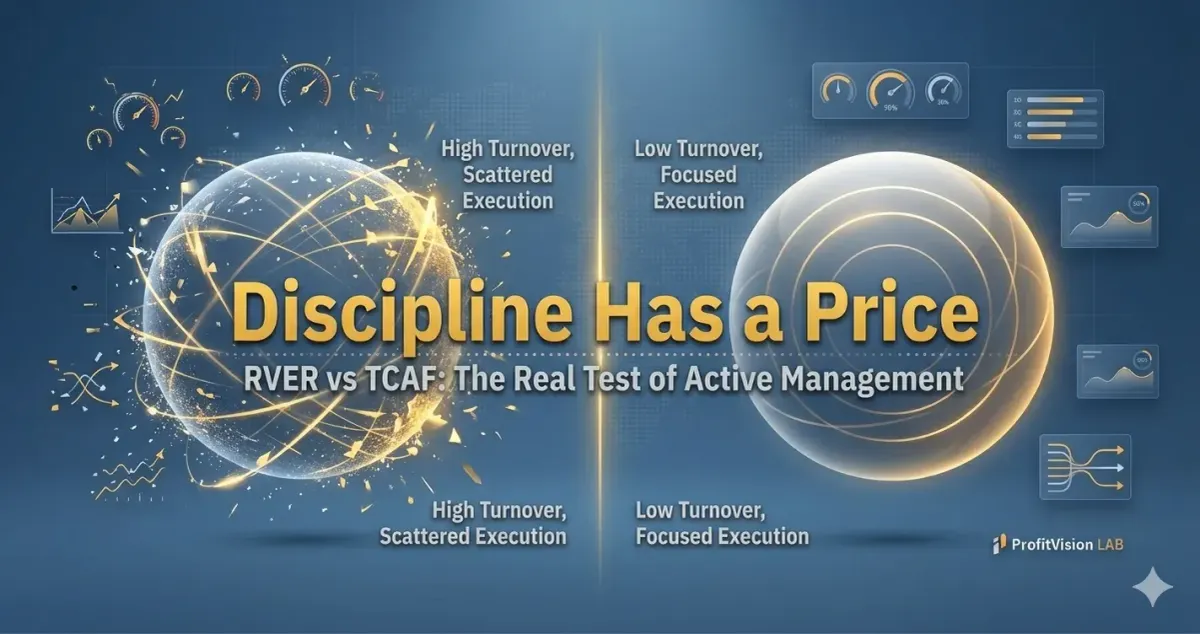
RVER and TCAF are both actively managed GARP ETFs with similar expense ratios, but turnover differs by 6x and AUM differs by 50x. This four-dimensional comparison dissects what active management really delivers — discipline is what gives alpha its market price.
Why These Two Funds Make the Best Comparison
The market has many ETFs labeled "active GARP," but RVER and TCAF form the most instructive comparison set. On surface conditions, they look highly similar: both are actively managed, both espouse GARP philosophy, both target U.S. large-cap growth, both have expense ratios in the "reasonable active ETF range," and both are run by experienced managers with 20–30 year track records.
Yet under this similarity sits radically different execution detail and long-term performance. Placing the two on the same table allows readers to see, with their own eyes, the real substance of "active management": under the same banner, one fund executes rigorous long-term holding while the other runs high-frequency theme rotation. The latter is essentially momentum trading dressed as GARP; the former is what the philosophy actually requires.
Head-to-Head: Four Dimensions of Execution
Trenchless Fund ETF
River1 Asset Management
vs. S&P 500: -7.87%
Capital Appreciation Equity ETF
T. Rowe Price
vs. S&P 500: flat to slight win
Left: RVER | Right: TCAF
Dimension 1 Scale: Liquidity Determines Execution Cost
RVER's $127M AUM is small by active ETF standards. Average daily volume sits around 5,000 shares (often well under 1,000 shares actually traded), which creates two structural problems:
- High entry/exit cost: bid-ask spread averages around 0.21% — not extreme, but each round-trip costs individual investors about 40 bps in friction.
- Amplified internal trading costs: small AUM combined with high turnover is the most damaging combination. Each portfolio adjustment carries higher impact costs relative to fund size, and accumulated over a year, this consumes a substantial portion of nominal returns.
TCAF's $6.9B AUM is 54x RVER, with daily volume above 650,000 shares and bid-ask spreads close to zero. This scale provides managers with genuine execution flexibility — entering and exiting positions doesn't materially move stock prices, and internal trading costs approach those of index ETFs.
A $100M active ETF with annual turnover above 100% structurally cannot beat its larger peers. This is not a manager skill problem — it is a physics problem. Too little capital, too much movement, and the alpha gets handed to market makers.
Dimension 2 Turnover: The GARP Litmus Test
This is the single most direct test of whether "active GARP" is real or a label.
True GARP investors — from Peter Lynch's prime at Magellan to T. Rowe Price's flagship PRWCX — have averaged 1.5 to 3 year holding periods. The reason is straightforward: GARP's core assumption is that markets temporarily mis-price growth stocks, and time is needed for fundamentals to compound while valuation re-rates. If positions are sold within 0.43 years, there is no opportunity for "reasonable price" to emerge.
RVER Turnover: 232%
2.3 complete portfolio replacements per year, average hold of 0.43 years (~5 months). In substance, momentum trading rather than GARP.
"GARP" is the package, not the strategy.
TCAF Turnover: 36.5%
0.36 portfolio replacements per year, average hold of 2.74 years. Aligned with genuine GARP holding philosophy — time given for fundamentals to validate valuation.
Execution philosophy aligned.
An often-overlooked consequence: turnover has a direct amplifying effect on tax inefficiency. For U.S. taxable accounts, 232% turnover generates short-term capital gains taxed at ordinary income rates (up to 37%), while 36.5% turnover produces predominantly long-term capital gains taxed at 15–20%. For taxable holders, the after-tax gap between RVER and TCAF is likely larger than the pre-tax gap.
Dimension 3 Holdings: Style Drift vs. Style Consistency
RVER's Style Drift
RVER's most recent top ten holdings: NVDA, HPE, AVGO, EQT, META, IBRX, PANW, CLSK, UBER, CDE. Of these, EQT (natural gas), IBRX (clinical-stage biotech), CLSK (Bitcoin miner), and CDE (silver mining) collectively comprise 23.23% of the portfolio — none of which fits GARP's dual requirement of "growth at a reasonable price."
More critically, the holdings have turned over rapidly. Three weeks earlier, the top five were Meta, NVDA, MSFT, ServiceNow, and Amazon. Three weeks later, MSFT, ServiceNow, and Amazon had completely disappeared, replaced by HPE, EQT, IBRX, and CDE — names with profoundly different style characteristics. This is theme rotation, not GARP.
TCAF's Style Consistency
TCAF holds approximately 100 names with top-10 concentration around 40% (compared to RVER's 59.65%). Core holdings emphasize stable, profitable large-caps — Apple, Amazon, Thermo Fisher, Danaher, Becton Dickinson. Common characteristics across these names: stable earnings, predictable cash flows, valuations not absolute bargains but reasonable relative to their quality.
TCAF also holds some non-traditional large-cap growth names, but in smaller proportions, more diversified, and stylistically aligned with the fund's philosophy. Readers can identify a clear "GARP editorial voice" running through the entire portfolio, rather than monthly theme switching.
Dimension 4 Performance: The Final Verdict on Structural Differences
All these execution differences ultimately translate into performance. As of March 31, 2026:
| Period | RVER NAV | TCAF NAV | S&P 500 |
|---|---|---|---|
| Q1 2026 | -11.18% | -9.6% YTD | -4.33% |
| Trailing 1 Year | +5.22% | +7.6% | +17.80% |
| Since Inception (Annualized) | +5.62% | ~ +13% | +13.49% (RVER period) |
Key observations:
- RVER's 1-year return of +5.22% trails the benchmark by 12.58 percentage points — a serious failure signal for an active ETF.
- TCAF's 1-year return of +7.6% also lags the benchmark, but the gap is reasonable (~10 percentage points) and consistent with the long-term GARP characteristic of "relative underperformance in strong bull markets, relative protection in bear markets." TCAF's mother fund PRWCX has an excellent downside protection record across the 2008, 2020, and 2022 bear markets.
- The performance gap between RVER and TCAF over the same period is approximately 7–8 percentage points — most of which derives from turnover and holdings discipline, not stock-picking talent itself.
The Real Price of Active Management
The contrast between these two funds reduces to a single proposition: "active management" by itself creates no value — execution discipline creates value.
RVER charges 0.65% for active management and delivers 232% turnover, style drift, and material benchmark underperformance. This 0.65% is not the price of alpha; it is the price of "willing to be called a fund."
TCAF charges 0.31% for active management and delivers 36.5% turnover, stylistic consistency, and benchmark-comparable returns. This 0.31% is not a fee for outsized alpha; it is a reasonable admission ticket for "qualified active management" — what investors receive is bear market protection and long-term stability.
The value of active management is not "I can beat the index," but "I can use discipline to avoid specific weaknesses of the index." The first is marketing copy; the second is a defensible value proposition.
Three Takeaways for Disciplined Investors
Takeaway 1: Turnover Is the First Check on Active ETFs
For any ETF labeled "active selection," "active GARP," or "active growth," check turnover first. Above 100% indicates momentum strategy in substance, not long-term holding. Above 200% means the product is high-frequency theme rotation rather than active value selection.
Takeaway 2: Scale × Turnover = Hidden Cost
$100M AUM combined with 200% turnover structurally cannot outperform larger peers because internal trading costs erode alpha. When evaluating, add 30–50 bps of estimated implicit trading cost on top of the visible expense ratio to approximate true holding cost.
Takeaway 3: Distinguishing Real Active From Fake Active
Real active management characteristics: long holding periods (turnover < 50%), stylistic consistency (quarterly holdings changes within 10%), stable scale (AUM doesn't need rapid growth to maintain liquidity), and verifiable stated strategy (managers publicly disclose decision logic, not "mysterious composite scores"). Apply this standard to any active ETF — roughly 70% will be filtered out.
Conclusion: Discipline All the Way Down
For ProfitVision LAB readers, the most important insight from this comparison is — when buying active ETFs, what you're really buying is "the manager team's execution discipline," not "their stock-picking ability." Stock-picking ability is a relatively subjective judgment, but execution discipline can be verified through objective metrics: turnover, scale, holdings consistency.
RVER is not a bad fund, and its managers are not incompetent. It simply applies a "momentum rotation dressed as GARP" strategy at the wrong scale, producing structural losses. TCAF is not a genius fund, and T. Rowe Price's stock-picking ability is not necessarily better than RVER's, but their execution discipline justifies the 0.31% expense ratio, producing long-term qualified returns.
This is the essence of "I teach you how to think, not just what to do": providing a standard operating procedure to verify active ETF discipline, so you can independently judge whether the next active fund is worth holding — without relying on Morningstar ratings or sales pitches.
Tracking Record
| Date | Event | Verdict | Result |
|---|---|---|---|
| 2026/05/08 | Initial publication (RVER vs TCAF) | TCAF qualified / RVER not recommended | — |
Next scheduled update: After RVER releases Q3 2026 performance, monitor whether turnover and holdings discipline correct. If correction observed, upgrade to watchlist; if no correction, maintain "not recommended."
Data sources: River1 Asset Management, T. Rowe Price official fact sheets; SEC EDGAR filings; Yahoo Finance, StockAnalysis, ETF Database public data.


Comments ()