
Beyond Entry: NVDA Options Decision Framework
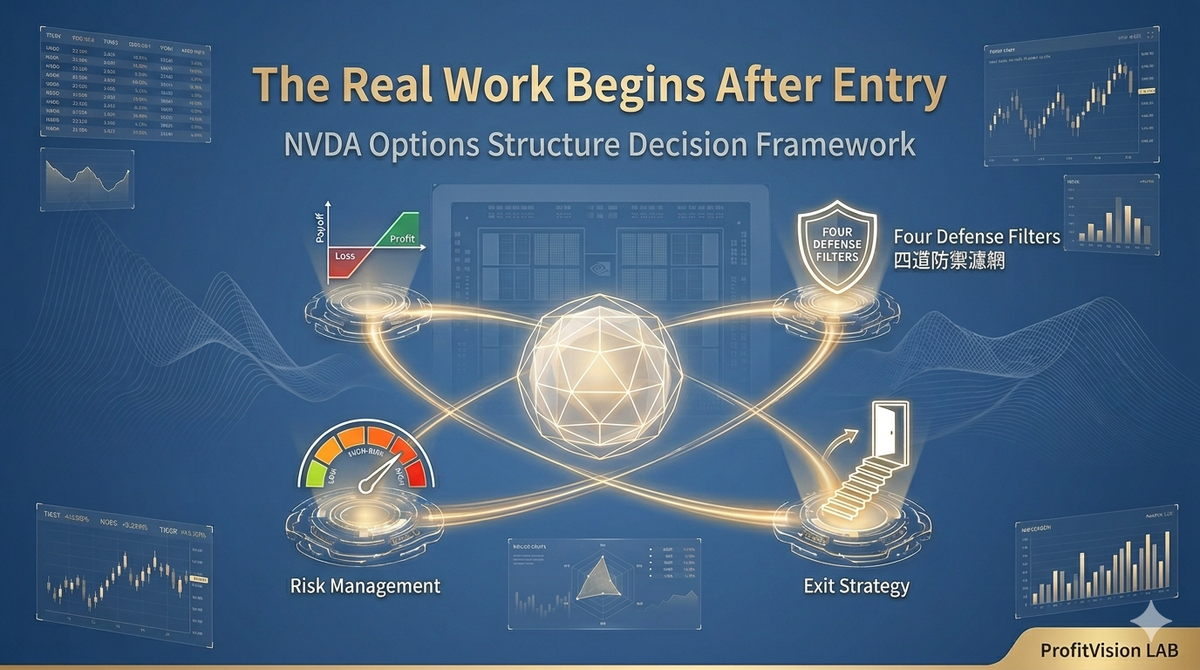
The breakout signal is public information. "What to do next" is where the real work begins. Using NVDA as a case study, this article builds a complete options decision framework across five layers: Four Defense Filters, Three Market States, exit strategy, reward-risk ratio, and position discipline.
Options Strategy · Decision Framework
The breakout signal is public information. But "what to do next" is where the real work begins. Using NVDA as a teaching case, this article breaks the act of entering a trade into three layers: whether to participate at all, which structure to use, and how much capital and risk you're exchanging for what potential return.
✍️ Shiba the Disciplined ⏱️ ~18 min read 🎯 Premium Member Article
I. Market Observation: NVDA Breaks Out of a Year-Long Consolidation
As of the close on April 28, 2026, NVDA traded at $213.13. On April 27, the stock touched an all-time intraday high of $216.83, officially breaking out of nearly a year of consolidation. From a technical standpoint, this was a high-volume breakout above prior highs — a signal that the stock has ended its sideways phase and entered price discovery.
| Metric | Value |
|---|---|
| Close Price (4/28) | $213.13 |
| Prior Day Close | $216.61 |
| 52-Week Range | $104 – $217 |
| Distance from Low | +105% |
| Market Cap | $5.18T |
| 30-Day IV | ~43–50% |
| Source: alphaquery / unusualwhales | |
At the same time, the market was processing two competing narratives. On one side: AI infrastructure capex was still accelerating — Amazon raised its 2026 capex target to $200B, while Alphabet planned up to $185B in data center expansion. On the other: rising ROI skepticism and the potential displacement threat from custom silicon chips eating into GPU demand.
All of this is publicly verifiable. But for an options trader, "the stock broke out" and "should I act?" are two entirely different questions. The breakout tells you the bias is bullish — it does not tell you:
Three Unresolved Key Questions
(1) Does this stock's own fundamentals and institutional sponsorship warrant participation?
(2) What does the current options market structure (IV, liquidity) favor — which type of strategy?
(3) Given your specific account size, which structure offers the best tradeoff between capital usage and risk exposure?
The purpose of this article is to break these three questions down into a reusable decision framework, using NVDA as a teaching case to walk through the process. NVDA here is merely a "teaching instrument" — the real focus is the framework itself. Please read with your eyes on the thinking process, not the specific numbers as entry recommendations.
II. Why You Can't Just Chase the Breakout: Three Common Retail Traps
Before entering the framework, we need to surface the most common mistakes retail traders make. These aren't new observations — they repeat themselves every time a momentum move begins.
Trap 1: Buying Leveraged ETFs (NVDL, SOXL)
When NVDA breaks out, many traders instinctively reach for NVDL to "capture 2x the upside." The problem: leveraged ETFs use a daily reset mechanism, and consecutive volatility causes compounding decay (volatility decay). A simple example — NVDA up 10%, then down 10%:
| Asset | Day 1 +10% | Day 2 −10% | 2-Day Return |
|---|---|---|---|
| NVDA Stock | 110 | 99 | −1.0% |
| NVDL (2× Leverage) | 120 | 96 | −4.0% |
The higher the volatility and the longer you hold, the more a leveraged ETF drifts from the underlying's cumulative return. Barely usable for single-day traders; structurally wrong for anyone trying to ride a multi-month trend.
Trap 2: Buying OTM Calls Outright
Another common reflex: buy a 30-DTE out-of-the-money Call, betting on a fast, large move. This structure has two hidden costs:
Theta decay: The closer to expiration, the faster time value erodes. A 30-DTE OTM Call sees dramatically accelerating decay in its final two weeks — even if the stock goes sideways, the position bleeds.
IV crush: When IV is elevated and you buy Calls, if the expected big move doesn't materialize quickly and IV contracts, you can lose money even if you're directionally correct. NVDA's 30-day IV of ~43–50% isn't extreme, but it's not a buyer-friendly low-IV environment either.
Practical note: Long options strategies (buying Calls, buying Puts) have structurally low win rates. Per CBOE's published options expiration statistics, the historical long-run profitability of pure long options positions is below 35%. This doesn't mean buying options is always wrong — it means it's only appropriate when IV is relatively low, directional conviction is very high, and the time window is sufficiently long — all three simultaneously.
Trap 3: Going All-In on a Single Contract
Options have inherently high leverage — 1 contract controls 100 shares. An NVDA ATM Call at $213 costs roughly $1,500–$2,000 in premium, but it represents exposure to $21,300 worth of stock. If you size that as 30–50% of your account, a single directional miss can cripple your portfolio.
ProfitVision LAB's position management standard: single-trade Risk Unit (RU) capped at 5% of account equity. A $10,000 account has a maximum loss per trade of $500. This is an engineering problem, not a psychology problem.
III. The Four Defense Filters Applied to NVDA: PV Rating System as Sponsorship Benchmark
Now into the framework itself. ProfitVision LAB's "Four Defense Filters" is a sequential gating mechanism: before executing any options trade, you check four dimensions in order — Institutional Sponsorship, Moat, Volatility, and Technical Structure. Fail any single filter, and you don't trade.
This section uses NVDA to demonstrate the process. Assessments below use the ProfitVision Rating System (PV Rating System) as the sponsorship scoring baseline — ProfitVision LAB's proprietary methodology, calculated from publicly available price-volume and earnings data. It has no direct affiliation with subscription-based rating services.
Filter 1 | Institutional Sponsorship: PV Institutional Buy Strength + PV Relative Strength
Thresholds:
PV Institutional Buy Strength ≥ 50 (signals strong institutional flow)
PV Relative Strength ≥ 80 (52-week return in the top tier of the Nasdaq Composite)
| NVDA Estimate | Value (estimated from 4/28 public data) | Reading |
|---|---|---|
| 52-Week Return | ~+88% (source: tradingeconomics) | Far above Nasdaq median |
| PV Relative Strength (est.) | ≥ 90 | ✅ Pass |
| PV Institutional Buy Strength (est.) | 50–65 range (13-week accumulation structure) | ✅ Pass |
Large-cap liquidity adjustment note: NVDA's market cap has reached $5.18T, placing it among the top three global equity weights. For "liquidity provider" stocks of this type, PV Institutional Buy Strength is structurally biased toward the 40–60 range — fund rebalancing, hedging, and redemptions all hit the most liquid names first. Therefore, this case applies the large-cap relaxation clause: when PV Relative Strength ≥ 85, the buy strength threshold may be relaxed from 50 to 40.
Filter 2 | Moat: PV Profit Quality Score
Thresholds:
PV Profit Quality Score: A or B (total score ≥ 70)
ROE ≥ 17%, TTM Net Margin ≥ 15%, Revenue 3Y CAGR ≥ 15%
| Sub-Item | NVDA Value (Yahoo Finance, 4/27) | Score |
|---|---|---|
| Revenue Growth (3Y CAGR est.) | ≥ 60% (driven by AI capex cycle) | 25 / 25 |
| TTM Net Margin | 55.6% | 20 / 20 |
| TTM ROE | 101.49% | 30 / 30 |
| ROE Improvement Trend | Sustained 50%+ high-water mark | 20 / 25 (high-base protection applied) |
| Total Score | 95 | PV Profit Quality: A ✅ Pass |
One important caveat: NVDA's current high ROE and net margins reflect the sweetest phase of the AI capex supercycle. The diminishing returns risk most discussed in the market — hyperscaler ROI skepticism toward GPU spend, custom silicon gradually displacing general-purpose GPU demand — will not show up in today's ROE figure. It will be tested in the earnings reports of the next 4–8 quarters.
Filter 3 | Volatility: Options Market Structure
Thresholds:
IV ≥ 30% (sufficient premium cushion for seller strategies)
DTE 30–45 days (the Theta decay sweet spot)
Open Interest ≥ 100 (operational liquidity)
| Item | NVDA Current Status | Reading |
|---|---|---|
| 30-Day ATM IV | ~43–50% | ✅ Well above 30% threshold |
| Options Chain Liquidity | Weekly and monthly chains complete; OI typically in the tens of thousands | ✅ Ample liquidity |
| Bid/Ask Spread | ATM spread < 1% | ✅ Tight quotes |
Seller's-eye view: NVDA's IV isn't extreme, but at 43–50%, premium sellers (selling Puts, Bull Put Spreads) collect meaningful premium per trade. For buyers (buying Calls), this same IV level is expensive — IV crush risk is non-trivial. The same market data sends opposite signals to buyers and sellers — this is the core divergence in strategy selection.
Filter 4 | Technical Structure: Price Structure
Thresholds:
Price above 50MA
For Bull Put Spread: short put strike below major support
PV Relative Strength ≥ 80
NVDA closed at $213.13 on 4/28, holding near the prior high of $216. The 50MA is estimated around $190–$195; the primary technical support sits near the $200 round number and the 50MA zone. Technical structure: pass.
Four Defense Filters Summary
NVDA Case — Filter Results:
Filter 1 Sponsorship: ✅ Pass (PV Relative Strength ≥ 90; buy strength passes under large-cap relaxation)
Filter 2 Moat: ✅ Pass (PV Profit Quality A; ROE / net margin / growth all full score)
Filter 3 Volatility: ✅ Pass (IV ~45%; ample liquidity)
Filter 4 Technical: ✅ Pass (above 50MA; breakout above prior highs)
All four filters pass — but this only means NVDA qualifies to enter the structure-selection stage. It does not equal a buy recommendation. The next question is: "Given current market conditions, which structure do I use?"
IV. Three Market States: Letting Market Condition Determine Options Structure
The same bullish outlook on NVDA can map to completely different options structures depending on where the market currently stands. ProfitVision LAB classifies the market into three states, each with a preferred structure:
State 1 — Clear Uptrend → Preferred: Bull Put Spread
Sell an OTM Put (the floor) + buy a further OTM Put (cap the risk). Collect premium + time decay + upside direction; maximum loss is defined.
State 2 — Range-Bound Chop → Preferred: Iron Condor
Build spreads on both sides simultaneously. If price expires within the range, collect premium from both ends. Requires rigorous range assessment.
State 3 — Downtrend → Preferred: Bear Call Spread or Cash
Don't fight the trend. Sitting in cash is preferable to forcing a bullish structure into a declining tape.
NVDA's current state reads as State 1 (uptrend breakout). But this reading carries a built-in caution: position risk at the moment of breakout is typically higher than mid-trend. Breakouts frequently undergo a "false break → retest → re-breakout" sequence. If you choose to enter on breakout day, you're accepting elevated entry-timing risk.
Mid-trend vs. breakout-day entry: The conservative approach is to wait 5–10 days for the price to hold above the prior high before sizing in. The aggressive approach is to enter on breakout day with a reduced position size (cut from the normal 5% RU to 2.5% RU). Neither is wrong — the difference is what risk you accept in exchange for what opportunity.
V. Capital Usage & Reward-Risk Comparison: Three Bullish NVDA Structures
This is the core teaching section. "Bullish on NVDA" can be implemented through at least three different options structures. Their capital usage, maximum loss, and win-rate characteristics differ enormously. The table below compares them side by side (all numbers are for illustration only — actual fills will vary with market conditions).
Shared assumptions: Stock at $213, target expiration ~35 DTE, IV ~45%, directional bias: bullish.
| Structure | Specific Trade (example) | Capital Required | Max Potential Gain | Max Potential Loss | Win-Rate Profile |
|---|---|---|---|---|---|
| Option A Buy ATM Call |
Buy 1x $215 Call, 35 DTE | ~$1,300–1,500 (premium) | Theoretically unlimited (profit as far as stock rises) |
$1,300–1,500 (premium goes to zero) |
Structurally low (requires large move, fast) |
| Option B PMCC |
Buy LEAPS Call (Jan 2027 $200, ~270 DTE) + Sell short-term OTM Call ($230, 35 DTE) | ~$3,500–4,500 (net debit) | Capped (short call strike is the ceiling) |
Full LEAPS premium (time risk extended, reducible with rental income) |
Moderate (time is a friend structure) |
| Option C Bull Put Spread |
Sell $200 Put + Buy $190 Put, 35 DTE ($10 wide spread) | $1,000 (spread width × 100) |
Premium collected (example: ~$200–300) |
$1,000 − premium (~$700–800) |
Structurally high (win as long as price stays above short put strike) |
The Core Difference Between the Three Structures
Option A (Buy Call) is the most intuitive but least favorable for small accounts. The P&L profile looks attractive (unlimited profit vs. capped loss), but the structural disadvantages — "time is working against you" and "IV must cooperate" — cause long-term win rates to remain persistently low. Best suited for: extremely high directional conviction, short window, relatively low IV.
Option B (PMCC) is a trade-time-for-space structure. Buy a long-dated LEAPS Call as a "synthetic stock" position, then sell short-term Calls to collect premium and progressively reduce your cost basis. Ideal for those who are medium-to-long-term bullish but want to reduce capital commitment and accumulate the position through rental income. However, PMCC is unsuitable for entering on breakout day — the LEAPS strike selection typically needs to be done at a lower support level; entering on breakout day means buying LEAPS at an unfavorable high-IV moment.
Option C (Bull Put Spread) is the structure most aligned with this system's philosophy. It translates "bullish directional view" into "I don't expect it to break below support" — simultaneously capping maximum loss via the spread so each trade's risk is strictly contained within your RU. Especially friendly to small accounts ($10K–$30K) because unlike Option B, it doesn't require a large upfront LEAPS premium.
The deciding variables for structure selection:
(1) Your account size: Small accounts (under $10K) should prioritize Option C; Option B's LEAPS cost will consume too many RUs.
(2) Your time window: Want to see a result within 30 days → Option C; building slowly over 3+ months → Option B; high-conviction 1–2 week catalyst play → Option A.
(3) Your directional conviction: 50–60% confidence → Option C (wide margin for error); 80%+ confidence → Option A may be considered (no margin for error).
VI. Post-Entry Management: Exit Strategy + Reward-Risk Ratio + Position Discipline
Everything discussed so far covers pre-entry decisions — stock selection, structure selection, timing. But the hard truth of live trading is: how you survive after entry is more determinative of long-term performance than how well you picked the entry. This section unpacks the three key post-entry actions: when to exit, how to calculate reward-risk, and how to size positions for different experience levels.
6.1 Exit Strategy: Every Trade Needs Three Pre-Set Exit Paths
The most common mistake options traders make: entering with thoughts of "how much will I make" without clearly defining "when will I leave." The professional approach: before pressing the entry button, all three exit paths are already written down.
Exit Path A — Expire worthless (ideal): The position expires OTM and worthless. The best outcome for a premium seller; full premium collected. Also the least common outcome.
Exit Path B — Take profit early: When 50%+ of maximum premium has been collected and more than half the time to expiration remains, close proactively. Lock in gains, free up buying power, rotate to the next trade. This is the seller's discipline.
Exit Path C — Stop loss: When the pre-set stop condition is triggered (price level, P&L dollar amount, or technical breakdown — pick one), close unconditionally. No negotiating, no waiting for a bounce.
| Structure | Path A — Expire | Path B — Early Exit | Path C — Stop Loss |
|---|---|---|---|
| Option A Buy ATM Call |
ITM at expiry: exercise or sell to realize profit OTM: premium goes to zero (worst case) |
Close when premium is up 50%+, or when stock reaches original price target | Close when premium is down 50%, or stock breaks below entry-day support (Buyers can't hold and hope — time is against you) |
| Option B PMCC |
Short Call expires OTM: keep the LEAPS Sell another short-term Call next cycle |
Close entire LEAPS position when up 30%+ Or buy back short Call when up 50% |
LEAPS drops 25% below entry cost or stock breaks below 50MA with trend breakdown Close entire position — don't keep the long Call alone |
| Option C Bull Put Spread |
Stock stays above short put strike: entire spread expires worthless, full premium collected |
50%+ of premium collected with more than half the time remaining → close proactively | Stock breaks below short put strike (or Delta rises from 30 to 60+) Close unconditionally — don't wait for expiration |
The most common breach in stop discipline: Most traders know they should stop out — they just don't execute when the stop arrives. Common rationalizations: "Just a little longer." "It might bounce tomorrow." "I'm long-term bullish on this name." The system's hard rule: enter a GTC (Good-Till-Cancelled) stop order on the platform before entering the trade. Don't rely on intraday willpower. Psychological battles consistently lose to mechanical execution.
6.2 Reward-Risk Ratio (RR): Expected Value Comparison Across Three Structures
The reward-risk ratio expresses maximum potential gain as a proportion of maximum potential loss. But a high RR doesn't automatically mean it's worthwhile — you also need to multiply by win rate to get the true Expected Value (EV). The table below provides a full comparison using example numbers for all three structures (illustration only):
| Item | Option A — Buy Call | Option B — PMCC | Option C — Bull Put Spread |
|---|---|---|---|
| Entry Cost (capital used) | $1,500 | $4,000 | $1,000 (margin) |
| Max Potential Gain | Unlimited (example target: +$3,000) | $1,500 (capped at short call strike) | $250 (premium collected) |
| Max Potential Loss | $1,500 (premium to zero) | $4,000 (LEAPS to zero) | $750 (spread − premium) |
| RR (Gain:Loss) | 2 : 1 | 1.5 : 2.7 | 1 : 3 |
| Structural Win Rate (est.) | ~30% | ~55% | ~70% |
| EV Calculation | 0.3 × $3,000 − 0.7 × $1,500 = −$150 | 0.55 × $1,500 − 0.45 × $4,000 = −$975 | 0.7 × $250 − 0.3 × $750 = −$50 |
| Single-Trade EV Conclusion | Negative EV Requires >50% conviction to turn positive | Negative EV Requires stop discipline to avoid worst-case loss | Slightly negative EV Requires win rate ≥75% to turn positive |
The key message this table is making:
(1) In a pure probability model with no filtering and no discipline, all three structures have negative EV — that is the market's baseline. Options are not free money.
(2) What actually turns EV positive is the Four Defense Filters raising your entry win rate above the structural baseline. For example: Option C's structural win rate is 70%, but if the stock passed all four filters, the practical win rate can rise to 75–80%, flipping EV positive.
(3) Stop discipline discounts the maximum potential loss. The calculations above assume holding to the worst-case expiration. If you mechanically stop out when the stop level hits, your average realized loss will be far less than the maximum.
This is why professionals emphasize both method and discipline: the method (Four Defense Filters) raises win rate; the discipline (stops + early exits) suppresses realized losses. Do both, and EV has a fighting chance of being consistently positive.
6.3 Position Sizing: Beginner's 1-Contract Rule vs. Veteran RU Control
With entry and exit covered, the final piece is "how large to size." This is the most commonly ignored factor — and the most determinative of long-term survival.
Beginner's Iron Rule: The 1-Contract Rule (First Contract Discipline)
Regardless of whether your account is $5K, $15K, or $30K — for your first 20 trades, use exactly 1 contract per trade. This rule isn't about limiting gains; it's about completing your live-market apprenticeship at the lowest possible cost.
Why beginners must follow the 1-contract rule:
(1) You don't yet know your emotional reaction to drawdowns. Losing $500 on 1 contract versus $2,500 on 5 contracts are psychologically incomparable.
(2) You don't know whether you'll honor your stop when it arrives. 1 contract's pain is absorbable; 5 contracts' pain will force you into bad decisions.
(3) You don't know your platform's order mechanics (GTC, Day Order, IOC). Sizing up on your first trade is paying tuition at maximum cost.
After 20 trades, review your win rate, stop execution rate, and emotional consistency — the data will tell you whether you're ready to scale.
Veteran Rule: Size by Risk Unit (RU) per Strategy Type
After accumulating 20+ live trades with consistently positive quarterly results, position size can scale up by strategy type — but maximum potential loss per trade remains strictly capped at 5% of account equity (the RU limit).
Using Option C (Bull Put Spread) as the example: max loss per trade = spread width × 100 − premium collected. Three account sizes compared:
| Account Size | RU Limit (5%) | Option C Example: $10-wide spread / $250 premium collected | Contracts Allowed |
|---|---|---|---|
| $5,000 (just starting) |
$250 | Max loss per contract $750 > RU → This structure is not viable |
0 contracts Use a narrower spread ($5-wide) or build capital first |
| $15,000 (small account) |
$750 | Max loss per contract $750 = RU → Just at the ceiling, no room to add |
1 contract Full RU committed; no cushion |
| $30,000 (steady operation) |
$1,500 | Max loss per contract $750 = 50% RU → Can hold 2 contracts simultaneously |
2 contracts Room to diversify across multiple names; reduces single-stock event risk |
Why does the $5K account result in "0 contracts" for this example? This isn't meant to discourage beginners — it's to emphasize that structure selection must follow your capital level. A $5K account wanting NVDA-level options exposure must use a narrower spread (e.g., $200/$195 — a $5-wide spread) to bring max loss down to $250 within the RU limit. Put differently: the more expensive and volatile the underlying, the more limited a small account's structural choices become. This is reality, not a flaw. Many beginners force a $10-wide spread on a $5K account; the first big drawdown takes out 15% of the account in one hit — that's the most common breach of this discipline.
| Dimension | Beginner (first 20 trades) | Veteran (consistently positive) |
|---|---|---|
| Position Size | Fixed 1 contract, no exceptions | RU-calculated, max 2–3 contracts |
| Structure | Option C only (Bull Put Spread) — simple, defined max loss | All three structures, selected by market state, time window, and conviction |
| Number of Names | Max 1 stock at a time | Max 3–4 names, diversifying event risk |
| Stop Execution | GTC stop order placed on platform before entry — no intraday decision-making | Same + psychological stop (pause for 1 week after 3 consecutive losses) |
| Review Frequency | Trade journal for every trade | Monthly review; quarterly strategy reassessment |
VII. Conclusion: Bringing the Case Back to the Framework
This article walked through "should I trade NVDA, and with which structure" as a complete decision process from start to finish — not to give you a trade, but to give you a reusable thinking path.
When the next stock produces a similar breakout signal — whether it's NVDA, AMD, AVGO, or some name we haven't noticed yet two years from now — this framework should apply directly:
Self-Checklist When a Breakout Signal Appears:
- Does this stock pass all Four Defense Filters? (Sponsorship, Moat, Volatility, Technical)
- Which of the three market states is the current tape in? (Uptrend, Range, Downtrend)
- What are my account size, time window, and directional conviction levels?
- Of the three bullish structures (Buy Call / PMCC / Bull Put Spread), which best matches my situation?
- What is the Risk Unit (RU) for this trade? Does it comply with the ≤5% single-trade limit?
- Breakout-day entry vs. waiting for a retest — which do I choose, and why?
- Have I already written down all three exit paths before pressing the button? (Expire, Early Exit, Stop Loss)
- Is the GTC stop order already entered on my platform? Or am I still relying on intraday willpower?
- What is this trade's RR and EV? Is my conviction level sufficient to flip EV positive?
- What spread width fits my account size? Is max potential loss within the RU ceiling?
- Am I in the beginner 1-contract phase, or the veteran RU-control phase? Do my trade count and consistency qualify?
If you can make this checklist a conditioned reflex every time a breakout fires — you've made the critical transition from "signal follower" to "system executor."
That is ProfitVision LAB's core positioning: I teach you how to think, not just what to do. NVDA was only a borrowed case. The real asset is the process you take with you.
Disclaimer & Data Notes
This article is educational content intended to explain ProfitVision LAB's decision framework and options structure characteristics. It is not individual investment advice. All data (stock prices, IV, sample options prices) are sourced from publicly available data (Yahoo Finance, AlphaQuery, UnusualWhales, TradingEconomics) as of April 27–29, 2026. Actual market conditions at the time of any trade may differ materially from the descriptions herein.
Scoring note: This article uses the ProfitVision Rating System (PV Rating System), a proprietary stock-scoring methodology developed independently by ProfitVision LAB, calculated from publicly available earnings and market price-volume data. PV Institutional Buy Strength and PV Relative Strength use the Nasdaq Composite as the comparison benchmark. This system is independently developed and is not a translation or re-derivation of any subscription-based rating service.
Readers should fully understand options-specific risks — including time decay, volatility risk, liquidity risk, and maximum potential loss — and make independent investment decisions consistent with their own financial situation and risk tolerance. All options trading involves risk of loss of principal.
— Shiba the Disciplined
© 2026 ProfitVision LAB · I teach you how to think, not just what to do.



Comments ()