IBKR: 7 Switches to Flip After Funding Your Account
Don't rush to trade after funding. Spend 10 minutes enabling these 7 switches: stock lending, class action recovery, 4.8% cash interest, Portfolio Margin, transparent options commissions, dividend reinvestment, and recurring investments.
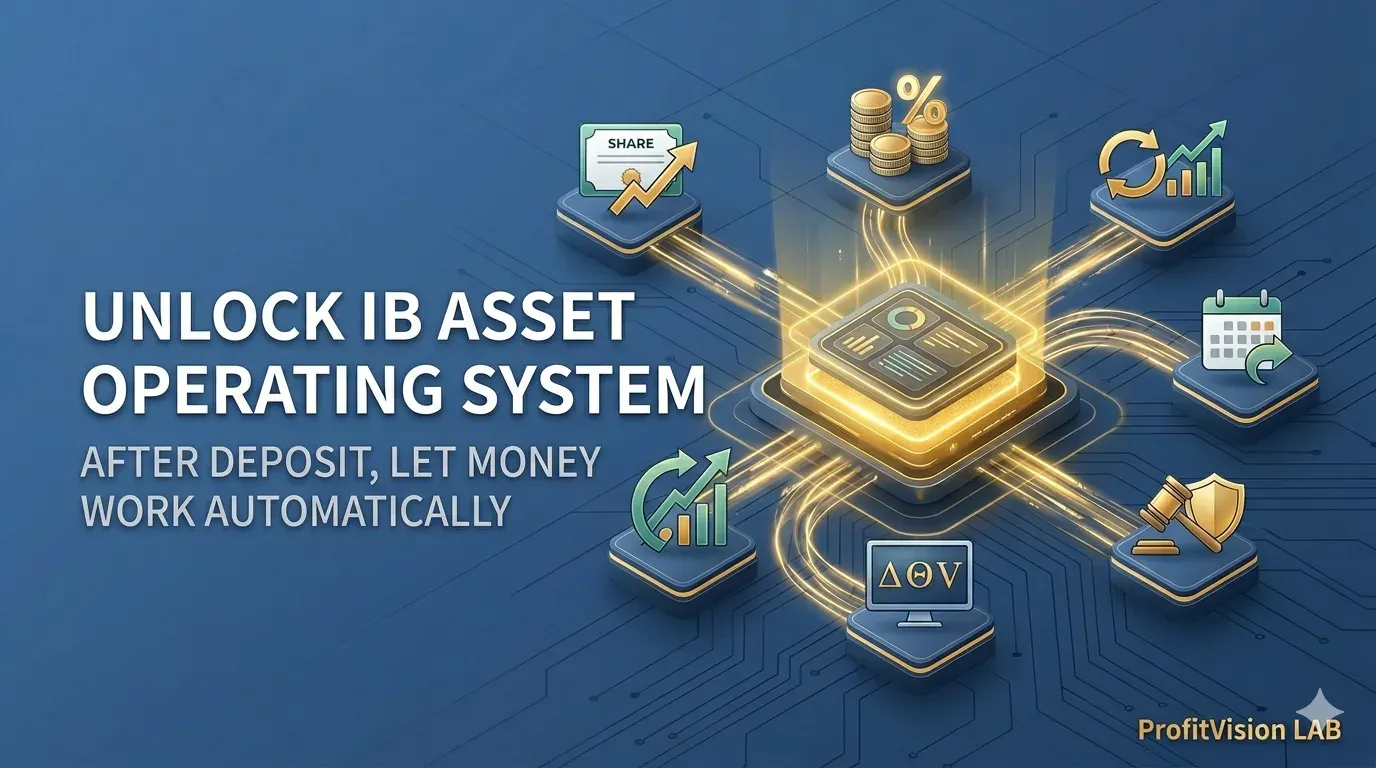
IBKR isn't just a brokerage account — it's a configurable asset operating system. After funding, flip these switches immediately so your cash, positions, and legal rights all run on autopilot.
At ProfitVision LAB, we are allergic to idle capital. Cash sitting still. Positions doing nothing. Every moment your assets aren't working is efficiency leaking out of the system. After your first deposit, run through this checklist — and put your account into automated profit-and-defense mode.
01 Stock Yield Enhancement Program (SYEP): Your Positions as Rental Income
If you plan to hold NVDA, VOO, VTI or similar equities long-term, waiting passively for capital appreciation is leaving money on the table. Through the Stock Yield Enhancement Program (SYEP), IBKR lends out your fully-paid shares to institutions with short-selling demand. You retain full ownership and voting rights — and collect 50% of the lending fee.
This is a second cash flow layer on the same asset. Your position stays intact, and during sideways consolidation periods, the account is still generating income. The higher the short demand on a stock, the higher the lending rate — meaning your most volatile, high-conviction holdings can earn the most while they wait.
02 Securities Class Action Recovery: Passive Defense You Never Have to Think About
This is the most overlooked switch for international investors. When a company you hold settles a class action lawsuit and distributes compensation, the default process requires you to file paperwork — English legal forms, strict deadlines, complex procedures.
With this service enabled, IBKR handles everything on your behalf. When settlement funds arrive, the system notifies you and deposits directly to your account. Zero effort on your end.
03 Idle Cash Interest: Your Dry Powder Earns While It Waits
In a 2026 rate environment, cash shouldn't sit idle. For accounts with net equity above $10,000, IBKR pays approximately 4.8% annualized on uninvested USD balances above that threshold (adjusts with Fed rate changes).
Your wait-for-pullback capital. Your option margin reserves. Cash parked between trades — none of it is dead money at IBKR. Every day it accrues. At meaningful account sizes, this number becomes genuinely significant over a year.
No manual setup required. Eligible accounts are enrolled automatically. Confirm monthly interest credits in your account statements.
Advanced Features: Hidden Advantages for Options Traders
🏦 Margin Rates: A Structural Edge on Leverage Cost
IBKR's current margin rate runs approximately 5–6% — substantially below major US retail brokers like Fidelity and Schwab (typically 10–12%). For PMCC traders carrying LEAP positions, this cost differential directly impacts holding costs over months.
Once your account net equity reaches $100,000 USD, you can apply for Portfolio Margin. Rather than calculating margin on a position-by-position basis, the system evaluates risk at the portfolio level. The result: significantly lower margin requirements for the same set of positions, and meaningfully more capital available for deployment.
📋 Options Commissions: Transparent Pricing, No Hidden Costs
IBKR Pro uses a Tiered rate structure that decreases with monthly volume, plus third-party fees (exchange, regulatory):
| Monthly Volume | IBKR Pro Base Rate | Notes |
|---|---|---|
| ≤ 10,000 contracts | $0.65/contract | + exchange & regulatory fees |
| 10,001–50,000 contracts | $0.25–$0.50/contract | tiered by premium size |
| 50,001–100,000 contracts | $0.25/contract | all premium levels |
| ≥ 100,001 contracts | $0.15/contract | institutional-grade volume |
| Minimum per order | $1.00/order | |
Most retail traders stay under 10,000 contracts/month. Your all-in cost is typically $0.65 base + ~$0.10–$0.20 exchange fees ≈ $0.85/contract. As volume scales up, the rate drops to $0.15 — a significant advantage for high-frequency and institutional operators.
IBKR Lite (US residents only) uses a different structure: $0.25–$0.65/contract based on premium size, including clearing and regulatory fees.
💱 Multi-Currency Account × Cross-Market FX
IBKR supports a true multi-currency account — USD, JPY, EUR, HKD and more held simultaneously. For Taiwan-based investors, TWD-to-USD conversion typically happens at a local bank before wiring funds to IBKR (smaller amounts via digital banks like Line Bank; larger transfers through competitive-rate channels like Taipei Fubon Bank).
Once you're operating inside the account — say, converting USD to JPY for Japanese equity exposure, or USD to HKD for Hong Kong options — IBKR's FX execution prices near interbank rates, with spreads well inside typical retail banking.
※ FX platform availability varies by account type and region. Taiwan-based users should confirm available features directly with IBKR.
📊 Risk Navigator: Greek Exposure at the Portfolio Level
When you're running multiple options positions simultaneously, the hardest thing to manage is aggregate risk exposure. Risk Navigator gives you a consolidated view of your entire account's Greeks — total Delta, total Theta, total Vega — so you can see your directional exposure and time-decay rate at a glance, without manually adding up each leg. For multi-leg strategies like PMCC, Iron Condor, or strangle positions, this tool isn't optional — it's the risk management backbone.
📈 Dividend Reinvestment (DRIP): The Minimum-Friction Compounding Path
IBKR offers a Dividend Reinvestment checkbox — enable it and cash dividends automatically repurchase shares of the same holding (including fractional shares), no manual action required. Over years of holding, this steadily lowers your average cost basis through compounding.
🪙 Fractional Shares × Recurring Investments: The Automated Compounding Engine
High-price stocks like Amazon, TSLA, or NVDA can be purchased in fractional shares — eliminating the constraint of buying whole shares. Capital allocation becomes precise, not rounded.
But the real power of fractional shares is what it unlocks: IBKR's Recurring Investments feature. Setup is simple:
VOO / NVDA / VTI
$300–$500/cycle
Weekly / Monthly
Fractional precision
Even at $1,200/share for NVDA, a $300 monthly allocation executes precisely. No market timing. No checking prices. Discipline runs automatically.
Asset OS Activation Checklist
| Feature | Action Required | What It Does |
|---|---|---|
| ⚡ SYEP Lending | Manual Enable | Positions generate lending income automatically |
| 🛡️ Class Action Recovery | Manual Enable | Legal compensation deposited, zero paperwork |
| 💰 Cash Interest ~4.8% | Auto Enrolled | Idle cash accrues daily interest |
| 📈 Dividend Reinvestment | Manual Enable | Dividends auto-reinvested, lowers cost basis |
| 🪙 Recurring Investments | Manual Setup | Fractional DCA executes on schedule |
| 📊 Risk Navigator | Built-In Tool | Portfolio-level Greeks for options risk control |
| 🏦 Portfolio Margin | Apply at $100K+ | Lower margin requirements, more deployable capital |
Closing: The Compounding Moat of Marginal Efficiency
The gap between professional traders and average investors rarely comes down to stock-picking skill. It comes down to an obsession with marginal efficiency.
Low-friction funding is the foundation. 4.8% cash interest makes your dry powder self-multiply. SYEP lending is the second cash flow layer on every position. Class action recovery is silent passive defense. Low margin rates compress leverage costs. Transparent commissions eliminate hidden friction. Recurring investments put compounding discipline on autopilot.
Seven features, stacked — a compounding moat against market friction.
When your assets work while you sleep, you gain the patience to wait for the next high-conviction entry.