
Is the 30% U.S. ETF Dividend Tax a Non-Issue for Taiwanese? How the Tax Actually Adds Up
The 30% U.S. ETF dividend withholding tax is often misread by Taiwanese investors. This guide explains withholding, capital gains, Taiwan AMT, estate tax exposure, and when UCITS ETFs may make sense.
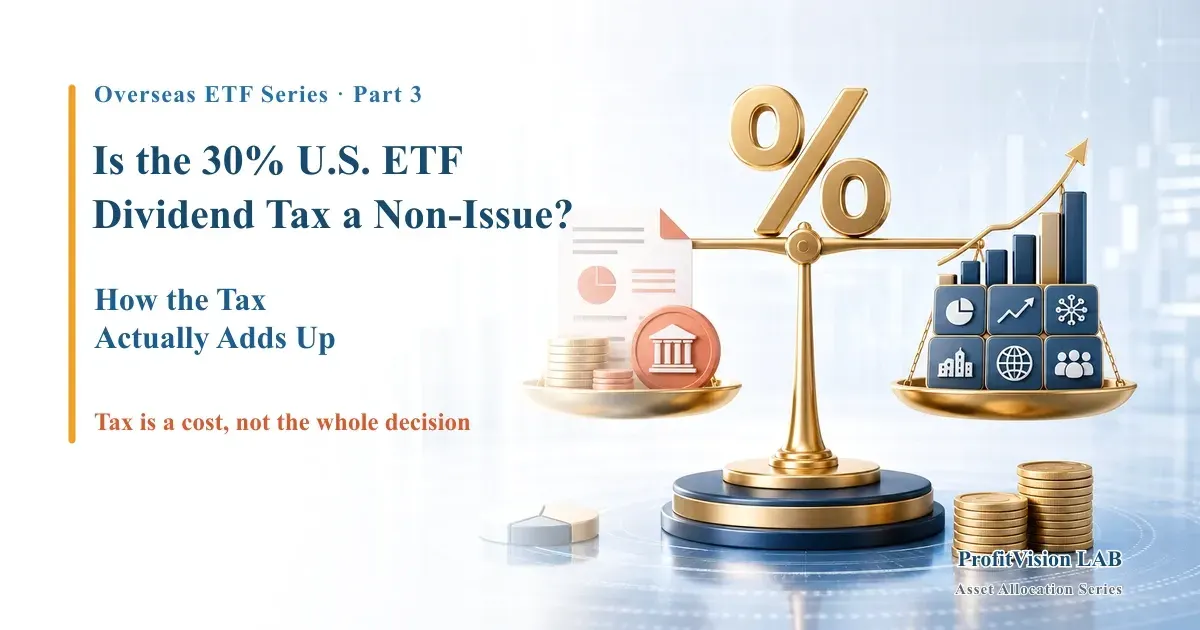
"U.S. dividends get hit with 30% withholding" keeps a lot of Taiwanese from going abroad. But that number is badly misread — what it gets multiplied by is what actually matters. This piece runs the tax line by line, and you'll see: tax is a cost, never a reason not to buy.
- The 30% is multiplied by the yield: a growth ETF (QQQ) yields about 0.5%, so every US$100,000 loses just ~$150 a year — practically nothing. What's worth calculating is a high-dividend strategy (SCHD: ~$1,050 per $100,000).
- Taiwan's tax is nearly the same as the U.S.'s: a Taiwan high-dividend stock's real tax burden is 28% separate taxation + 2.11% NHI supplementary premium = 30.11%; the U.S. is 30%. The gap is only 0.11% — the rates are essentially the same; the difference is the opportunity the U.S. offers.
- Not every "distribution" is withheld at 30%: long-term capital gain distributions are 0%, Return of Capital is 0%, BDCs refund 80–90% the next year, and futures-based ETFs use a blended rate — flinching at "30%" is often a misunderstanding.
- Estate tax: the U.S. doesn't automatically know you've died. The trigger is heirs moving the account. Advance planning works — a joint account (JTWROS) is the most common practical fix.
- Taiwan AMT: 99% of readers never touch it. To push VOO dividends over the NT$1 million threshold you'd need about US$2.5 million in holdings (realized gains count as overseas income too, but selling Taiwan stocks is exempt). Don't give up overseas allocation over it.
- UCITS is not a cure-all: it cuts dividend tax to 15% and shields against estate tax, but the hidden cost in liquidity and spreads often exceeds the tax saved on a low-yield growth holding.
Before "30%" scares you off — what it's multiplied by is the point
Almost every Taiwanese investor frowns the moment they hear "U.S. dividends are withheld at 30%." But that number, on its own, means nothing. The 30% is multiplied by the yield — how much that cut hurts depends entirely on the yield of the ETF you bought.
30% times a 0.5% yield and 30% times a 3.5% yield are two completely different things. Let's just put the dollars on the table:
| ETF type | Cash yield | Annual drag after 30% withholding | % of principal |
|---|---|---|---|
| Growth (e.g. QQQ) | ~0.5% | ~$150 / yr | 0.15% |
| Broad market (e.g. VOO) | ~1.3% | ~$390 / yr | 0.39% |
| High dividend (e.g. SCHD) | ~3.5% | ~$1,050 / yr | 1.05% |
Yields are illustrative and move with price each year. The point: the absolute size of the drag is decided entirely by the yield.
See it? If you buy a U.S. ETF for growth, not for income, the 30% is simply not your concern — a growth ETF's return comes almost entirely from price appreciation, and capital gains are out of range of that 30% (more on this in the next section). That $150 withheld each year all but disappears against twenty years of compounding.
What you should actually reach for the calculator over is a high-dividend strategy. A 3.5% yield cut down to 2.45%, a difference of over a thousand dollars a year — that's when tax becomes a variable worth seriously weighing. So the real message here is: figure out which kind of ETF you're holding first, then decide whether to care about that 30%.
You may not have realized: Taiwan's tax is almost the same as the U.S.'s
Many treat the 30% as "the penalty for going abroad," figuring there's no such thing if you stay in Taiwan stocks. The truth is the opposite — the skin taken off your Taiwan dividends is just as thick.
Taiwan dividend income, under the separate-taxation option, is 28%. But many forget there's another layer: the 2.11% NHI supplementary premium. Add them together:
| Where you collect the dividend | Tax structure | Actually taken |
|---|---|---|
| Taiwan high-dividend | 28% separate taxation + 2.11% NHI supplementary premium | 30.11% |
| U.S. ETF | 30% withholding (for non-U.S. persons) | 30.00% |
| Gap | 0.11% | |
0.11% apart. In other words, the "30%" keeping you from going abroad can't be dodged by collecting dividends at home either — and Taiwan even takes an extra 0.11%. On the tax-rate front, the two sides are flat even. The real difference isn't the tax — it's that the U.S. lets you buy instruments and strategies that simply don't exist in Taiwan's market.
Some ask: don't U.S. ETF dividends also get a layer of NHI premium scraped off? No. The NHI supplementary premium applies to Taiwan-source dividend income; overseas dividends from a U.S. ETF are outside its scope. So this comparison is clean: Taiwan 30.11%, U.S. 30%, with no hidden second layer.
Here's an angle few discuss but that matters a lot: Taiwanese have universal health insurance, so they don't need investment dividends to cover medical bills. Americans — and many markets where large out-of-pocket healthcare is the norm — must lean on stable passive cash flow in retirement, and so are naturally drawn to high-dividend assets.
Taiwanese don't carry that pressure. That "medical security" gives us the room to be patient long-term holders — no rush to collect income every quarter, which makes low-payout, compounding growth ETFs a natural fit. And growth ETFs happen to be exactly the category where "30% is almost invisible." An institutional advantage quietly pushes Taiwanese toward the most tax-efficient side of the table.
"Distributions" come in many kinds — not all are withheld at 30%
This is the most misunderstood part of the whole tax discussion. People treat "distribution" as one thing, but the money an ETF pays you is, in the eyes of U.S. tax law, several different kinds — with wildly different rates:
| Distribution type | Withholding for Taiwanese | Notes |
|---|---|---|
| Ordinary dividend | 30% | Most high-dividend ETF distributions fall here |
| Long-term capital gain distribution | 0% | Fund-realized long-term gains, exempt for non-U.S. persons |
| Return of Capital | 0% | Returns your own principal; not income |
| BDC distributions | 30% upfront, 80–90% refunded next year | Refunded via the Qualified Interest Income (QII) mechanism |
| Futures / commodity ETFs | Blended rate, well below 30% | Section 1256 (60% long-term + 40% short-term) |
A few points worth remembering:
- Capital gains are out of range of the 30%. The price gain when you sell an ETF, and the long-term capital gain distributions a fund realizes internally, are withheld at 0% for non-U.S. persons. This is exactly why a growth ETF's tax drag is so small — its return is almost all capital gains, not dividends.
- A BDC's 30% is a "false withholding." For business development company (BDC) distributions, the broker withholds 30% upfront, but the following year, based on the fund's reported Qualified Interest Income (QII) percentage, 80–90% of it is refunded to you. The withholding figure at the time looks alarming, but it's not the final result.
- ETFs holding derivatives get a break. Futures-based and commodity ETFs mostly use the Section 1256 blended rate, with a real tax burden far below the 30% on ordinary dividends.
So "flinching at the sight of 30%" is often the mistake of lumping every distribution together. First figure out what kind of money your ETF is actually paying you.
Estate tax sounds frightening — but first understand how it's triggered
Online discussion of U.S. estate tax scares people away from even opening an overseas brokerage account: a non-U.S. person holding more than US$60,000 of U.S. assets has estate-tax exposure on death, up to 40%. The threshold is real and the number is correct. But in practice, there's one thing almost nobody spells out:
The IRS has no global death registry that "notifies the U.S. the moment a Taiwanese person passes away." The often-misunderstood FATCA and CRS report "the balances and income of reportable accounts" — they never report "who has died." And the Taiwan–U.S. FATCA is a Model 2 arrangement: Taiwanese financial institutions report "U.S. tax residents'" accounts one-way to the IRS; it does not report back on Taiwan residents. As for CRS, the U.S. doesn't participate in it at all. What actually starts the estate-tax process is the moment heirs try to withdraw from, transfer, or close the account — the U.S. broker requires estate-tax documents (such as a transfer certificate) before any transfer.
This isn't about teaching you to dodge tax — it's to make a practical point clear: because the trigger is the "inheritance action," advance planning genuinely works.
The most common, most practical solution is a joint account (JTWROS, Joint Tenancy with Rights of Survivorship). The defining feature is the "right of survivorship" — when one holder dies, the account assets pass directly to the other co-holder, without going through a complex probate process. Between spouses, or trusted family, this is a common way to greatly reduce after-death trouble.
The principle is simple: the larger the position, the more worthwhile it is to set the account structure up in advance. A few thousand dollars isn't worth fretting over; but once your U.S. assets reach six figures, spending a little time planning the account form is far better value than leaving the money in Taiwan and giving up overseas allocation. If you're doing real account-structure and cross-border inheritance planning, one conversation with an advisor versed in U.S. tax is a worthwhile investment.
Taiwan AMT: 99% of readers never come close
Another favorite scare is Taiwan's "Income Basic Tax (AMT)" — overseas income gets taxed. It sounds frightening, but once we convert the threshold into "how rich you'd have to be to reach it," you'll relax.
The rule is two gates:
- Gate one: your full-year overseas income must first exceed NT$1 million to be included in the calculation at all.
- Gate two: the resulting basic income amount must then exceed the NT$7.5 million exemption (raised from NT$6.7 million effective the 2025 filing year) before any tax is actually owed.
VOO's net yield is about 1.3%. To get "dividends" alone over the NT$1 million (≈ US$32,800) threshold —
$32,800 ÷ 1.3% ≈ holding about US$2.5 million (≈ NT$77 million) of VOO
And that's just gate one, "included in the calculation"; the NT$7.5 million exemption still lies beyond it. For the vast majority of readers, this is a distant threshold.
Here's an asymmetry most people get wrong and that's worth pausing on: the gain when you sell Taiwan stocks isn't subject to Taiwan income tax (securities-transaction income tax is suspended; only the transaction tax applies); but the gain when you sell a U.S. ETF counts as "overseas property-transaction income" and is included in the AMT's overseas income. The U.S. doesn't tax a non-U.S. person's capital gains, yet Taiwan pulls them into AMT — so overseas income isn't just about dividends; realized gains count toward that NT$1 million threshold too.
The same "selling stock for a gain" is fully income-tax-free if you stay in Taiwan stocks, but gets pulled into the AMT's overseas income once you switch to U.S. stocks. It sounds like a raw deal, but don't forget the threshold we just calculated: pushing overseas income (dividends + realized gains) past NT$1 million in a single year already requires a sizable position or a one-off large profit-taking. For someone who holds long-term and doesn't realize gains frequently, this gap is almost a paper rule.
The real operational point is pacing: once overseas income tops NT$1 million, it's the "full amount" that's included, not just the portion above the line. So near the threshold, realizing gains across multiple years and controlling each year's realized amount keeps you comfortably under. Willing to hold, willing to spread it out — this is exactly the long-term-holding edge that Taiwanese earn from the security of their health insurance, and it happens to be the most tax-efficient too.
But honestly — if your overseas allocation is already big enough to worry about AMT, that's a happy problem, and by then you should have a professional advisor anyway. Don't let a threshold 99% of people never reach become your excuse not to go abroad.
Irish UCITS: not a cure-all, but an option with a cost
Whenever tax-saving comes up, someone recommends "buy Ireland-domiciled UCITS ETFs" (e.g. CSPX). It does have two real benefits: dividend withholding drops from 30% to 15% (because Ireland has a tax treaty with the U.S.), and because it's an Irish asset, it's outside the scope of U.S. estate tax.
Sounds perfect. But treating UCITS as a "cure-all" is a trap — its costs are usually left unmentioned:
- Lower liquidity, wider bid-ask spreads. UCITS are mainly listed on European exchanges like London, with trading volume not in the same league as U.S.-listed ETFs. Every entry and exit pays that wider spread — an invisible but real cost.
- The 15% is a permanent fund-level loss, unlike Taiwan AMT, which has an exemption threshold you can stay under.
- It doesn't solve your Taiwan-side reporting duty. The capital gain on selling UCITS is still overseas income.
It comes back to the yield. If you're buying a low-yield growth ETF — where 30% withholding only drags a fraction of a percent to begin with — the bit of dividend tax UCITS saves likely doesn't even cover its wider bid-ask spread. Paying a bigger hidden cost to save small change: not worth it.
Where UCITS genuinely makes sense: large positions (where the estate-tax shielding value becomes significant), or high-dividend strategies (where the 15%-vs-30% gap is magnified by the high yield). For an ordinary retail investor who mainly buys growth, holding U.S. ETFs directly is usually cleaner and cheaper. Ireland was never a one-size-fits-all answer; it's a conditional trade-off.
Putting tax back where it belongs: a cost, not a reason
Having run the numbers, we can put tax back on the right scale. A growth ETF's 30% withholding, multiplied by a 0.5% yield, is an annual drag of just 0.15%. Meanwhile, a Taiwan market-cap ETF versus its U.S. counterpart differs by about 0.4% in expense ratio alone — and the expense ratio is charged every year, with certainty, compounding, with no yield level, distribution type, or refund mechanism to dodge it.
In other words: for a growth ETF, the savings from "avoiding the 30% dividend tax" by not buying U.S. stocks don't even cover the extra 0.4% expense ratio you pay instead. Tax drag 0.15%, fee disadvantage 0.4% — laid side by side, the gut instinct that "30% is terrifying" doesn't hold up. Tax is a real cost, but it's often smaller than fees, smaller than expense-ratio compounding — and it should never become the reason "not to buy."
Frequently Asked Questions
📚 Further Reading
- Overseas ETF (1): Why You Should Know Overseas ETFs — Learn the Rules Before You Open the Menu
- Overseas ETF (2): Overseas Broker vs. Sub-Brokerage — How Do Taiwanese Actually Buy?
- Overseas ETF (4): Core Market Allocation — How to Choose Among VOO, QQQ, VT?
- Overseas ETF (5): International Diversification, Hedging U.S. Concentration (VEA / IXUS / AVDV)
Figures used: U.S. dividend withholding for non-U.S. persons 30%, long-term capital gain distributions 0%, BDC Qualified Interest Income (QII) refunds and Section 1256 blended rate; U.S. non-resident estate-tax exemption US$60,000, top rate 40%; Taiwan Income Basic Tax Act overseas-income NT$1 million threshold, basic-income-amount NT$7.5 million exemption (from the 2025 filing year, formerly NT$6.7 million), overseas property-transaction income (including gains on selling overseas ETFs) included in overseas income, Taiwan securities-transaction income tax suspended; Taiwan dividend separate taxation 28% plus 2.11% NHI supplementary premium. All figures are as of mid-2026; exemptions and rates may be adjusted annually — verify the latest version before relying on them. A proposed U.S. bill to unilaterally cut withholding for Taiwan (toward ~15%) was not yet in effect as of mid-2026; 30% still applies.


Comments ()