
ASML Research: Can EUV Monopoly Become a Platform?
ASML equity deep research on EUV lithography monopoly, High-NA EUV growth, semiconductor equipment cycles, export controls, and whether ASML can turn optics, precision mechanics, metrology, and software capabilities into a broader manufacturing platform.
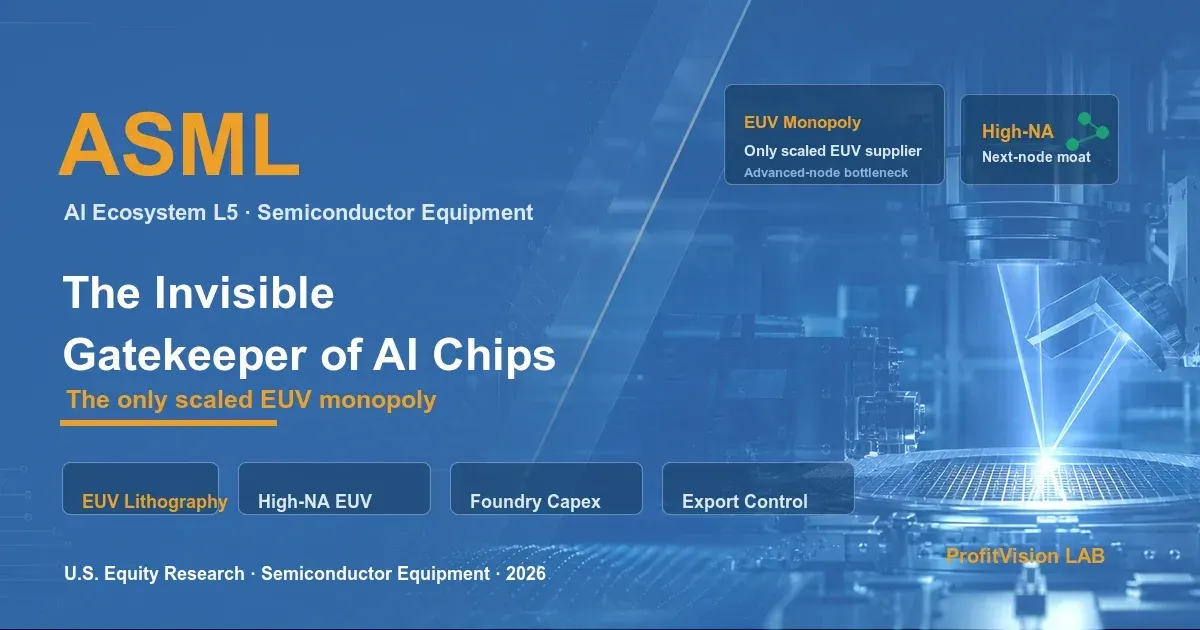
Without ASML lithography systems, advanced-node AI chips do not exist. The sharper question is whether this one-leg company can turn optics, precision mechanics, metrology, and software capabilities into a broader semiconductor manufacturing platform.
Core thesis: ASML is one of the closest things to a true monopoly in public markets. It is the only company capable of producing commercial EUV lithography systems, the tools required for advanced semiconductor manufacturing below 7nm and central to 3nm, 2nm, and future AI chip roadmaps.
ASML reported Q1 2026 net sales of €8.8 billion, gross margin of 53.0%, and net income of €2.8 billion. The company now expects 2026 total net sales of €36–40 billion with gross margin of 51–53%. In PVL's AI ecosystem map, ASML sits in Layer 5: Semiconductor Equipment, the physical bottleneck behind advanced AI silicon.
Why Is ASML the Gatekeeper of AI Chips?
AI demand is often discussed through NVIDIA GPUs, hyperscaler capex, or data center power. But the chain begins earlier. Advanced AI chips require leading-edge semiconductor nodes, and leading-edge nodes require EUV lithography. ASML is the only commercial supplier of that technology.
This means ASML is not merely a beneficiary of AI. It is part of the production precondition. If TSMC, Samsung, Intel, or memory makers need more advanced-node capacity, ASML is in the procurement path.
| PVL Filter | Current Reading | Verdict |
|---|---|---|
| Capital / Ownership | Global institutional core holding; strategic supplier to the semiconductor ecosystem. | Pass |
| Moat | Only commercial EUV supplier; High-NA extends the monopoly into the next node era. | Pass |
| Volatility | Semiconductor equipment cycles and export-control headlines can create attractive volatility windows. | Watch |
| Technical Setup | Recovering from the 2024 order shock; better after confirmation of order momentum. | Watch |
The EUV Moat: Engineering, Not Branding
An EUV lithography machine is one of the most complex commercial machines ever built. It depends on precision optics, vacuum environments, plasma-generated light sources, nanometer-stage control, advanced metrology, and a supplier network that spans the Netherlands, Germany, the United States, and Japan. This is not an advantage a competitor can close with a larger marketing budget.
What is High-NA EUV? NA stands for numerical aperture. Existing EUV systems use 0.33 NA. High-NA EUV raises that to 0.55, enabling finer resolution for future nodes. Each High-NA system is far more expensive than a standard EUV system and cannot be substituted by upgrading old tools. It creates a new high-ASP equipment cycle.
Business Model: Systems Plus Installed Base
ASML's revenue is not only new systems. Installed Base Management, service, field upgrades, and maintenance provide recurring revenue attached to a growing installed base. This matters because semiconductor equipment demand is cyclical, but the installed base creates a more durable floor than a pure new-system sales model.
Q1 2026 reinforced that point: total net sales were €8.8 billion, while Installed Base Management sales reached €2.488 billion. That service and upgrade layer is a quiet but powerful part of the ASML moat.
ASML Is a One-Leg Company: Stable, but Not Naturally Explosive
From a business-model perspective, ASML is not a multi-engine platform company like Microsoft, NVIDIA, or Broadcom. It is closer to a one-leg company taken to an extreme: one critical step in semiconductor manufacturing, made almost impossible to replace. That creates exceptional stability, but it also caps the natural upside. Most of ASML's growth remains tied to foundry capex, advanced-node timing, and the EUV / High-NA EUV replacement cycle.
Yamaha is a useful contrast because its diversification was not random. On the surface, musical instruments, motorcycles, audio systems, semiconductors, and factory automation look unrelated. Underneath, the transferable capabilities were continuous: acoustics, wood processing, casting, precision machining, electronics, and mass production. A piano frame must withstand enormous string tension while preserving elasticity and resonance; that metalworking know-how later helped Yamaha move into engines. The sound-quality demands of electronic instruments pushed Yamaha into in-house LSI development. Musical-instrument production know-how also spilled into factory automation and industrial robots. Yamaha's lesson is simple: products may change, but capabilities can be abstracted and translated.
The same question matters for ASML. Can the capabilities behind EUV — optics, precision mechanics, vacuum systems, light sources, metrology, control software, and supplier coordination — be abstracted beyond one lithography product into a broader semiconductor manufacturing platform? More precisely, ASML is not just an equipment maker. It is a holding and coordination layer for technical capabilities: Zeiss optics, Cymer light sources, HMI metrology, and ASML's own system integration form a manufacturing capability no single customer can easily recreate. If ASML expands, the logical path is not random diversification, but outward from optics, precision mechanics, metrology, process control, and software optimization.
Geopolitics: The Moat Cuts Both Ways
ASML's strategic importance makes it valuable, but it also makes it politically exposed. Export controls against China have already reshaped parts of the demand map. The key investor point is not to ignore this risk. The key is to separate temporary order timing, DUV exposure, and structural EUV monopoly power.
The U.S., the Netherlands, and allied governments can influence where ASML tools are shipped. That means headline risk will remain permanent. But it also means ASML's technology is viewed as nationally strategic, which reinforces the scarcity value of the company.
Financial Quality and 2026 Outlook
ASML reported Q1 2026 net sales of €8.8 billion, gross margin of 53.0%, and net income of €2.8 billion. Management expects Q2 2026 sales of €8.4–9.0 billion and full-year 2026 sales of €36–40 billion. The update matters because it indicates stronger customer demand visibility and a firmer AI-driven capacity expansion cycle.
In PVL's view, ASML is not a "cheap cyclical" story. It is a monopoly-quality equipment company that still moves with semiconductor capex cycles. That combination requires disciplined entry timing.
Valuation and Tactical View
ASML deserves a premium multiple because the EUV monopoly is extremely difficult to replicate. But premium quality does not eliminate timing risk. The better setup appears when order momentum improves while valuation still reflects fear from the prior equipment cycle.
Key Risks
- Semiconductor capex cycle: foundry and memory customers can delay tool purchases in downturns.
- Export controls: geopolitical restrictions can affect China-related demand and investor sentiment.
- High-NA timing: delays in customer adoption could pressure the long-term growth narrative.
- Valuation: monopoly quality is already partly priced in.
- One-leg ceiling: if ASML's core capabilities cannot spill over into broader process control, metrology, or software optimization, long-term growth remains tied mainly to lithography cycles.
FAQ
What does ASML do?
ASML builds lithography systems that chipmakers use to print circuit patterns on wafers. Its EUV systems are essential for advanced-node semiconductor manufacturing.
Why is ASML called a monopoly?
Because it is the only company that can commercially supply EUV lithography tools at scale. Competitors exist in older DUV tools, but not in EUV.
How does AI help ASML?
AI demand drives advanced-node capacity expansion at leading foundries and memory manufacturers. More advanced capacity means more need for EUV, High-NA EUV, service, and upgrades.
Sources: ASML Annual Report 2024, ASML Q1 2026 financial results press release, ASML Q4 2025 and Q1 2026 investor materials, ASML Investor Day 2024, StockAnalysis, Bloomberg public market data, and ProfitVision LAB industry notes as of June 2026.
© 2026 ProfitVision LAB · I teach you how to think, not just what to do.
Comments ()