
Debt Quality & Liquidity | Is the Cash Conversion Cycle (CCC) a Weapon or a Time Bomb?
Use the cash conversion cycle, short-term debt, leases, and supplier finance arrangements to judge whether a company's cash chain can actually hold.
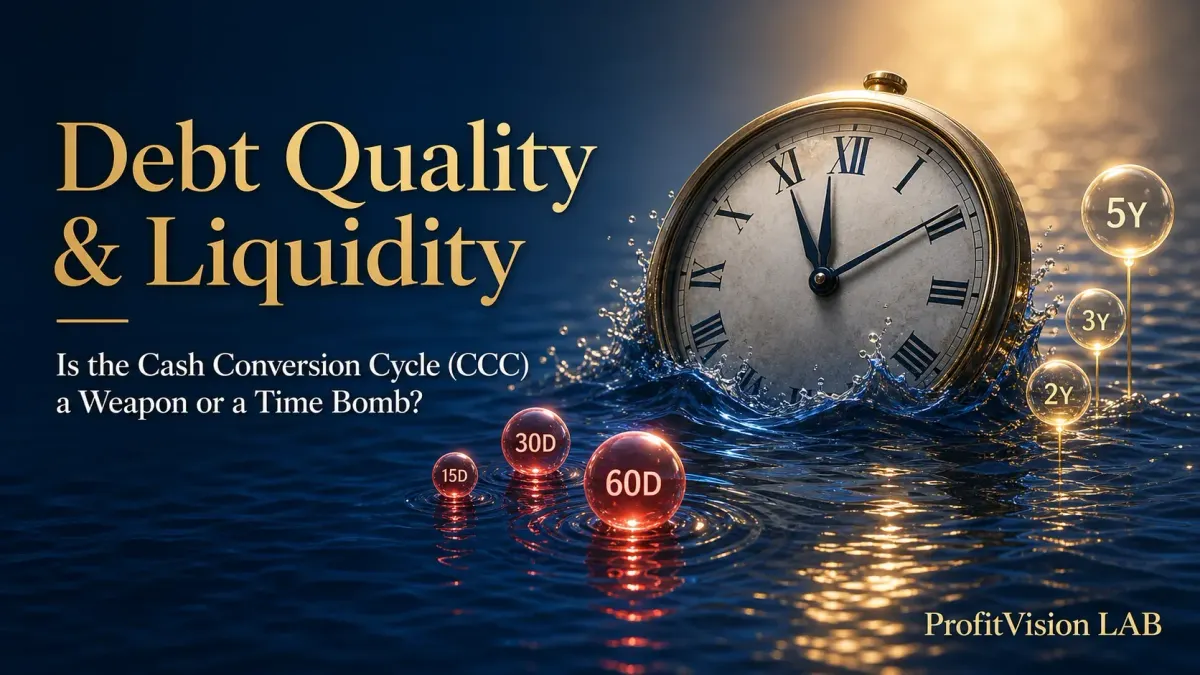
The introductory series taught you how to read the Cash Conversion Cycle (CCC); this article teaches you how to tell whether the Cash Conversion Cycle (CCC) is a weapon or a time bomb — and the supplier finance arrangements (SCF) that may sit behind it.
If you do not come from a finance or accounting background, start with the one sentence that matters most: companies often do not die from losses first. They die from running out of cash first. Liability analysis is not only about how much a company owes. It is about when those obligations come due, what the company will use to repay them, and whether the cash on hand can carry the business through a period when banks, suppliers, and funding markets all tighten at the same time.
So the goal of this article is not to memorize every liability line item. It is to ask three practical questions: First, how much cash pressure does this company face over the next year? Second, is its Cash Conversion Cycle (CCC) a real business advantage, or just an illusion created by delaying payment? Third, are meaningful obligations being hidden in leases, contingencies, supplier finance arrangements (SCF), or note structures in the footnotes? If you read liabilities through those three questions, the balance sheet stops being a list of amounts owed and becomes a stress test of whether the business can survive a tightening cycle.
- Companies rarely die from losses first — they die from a cash crisis. Liquidity and Solvency are two fundamentally different dimensions.
- A negative Cash Conversion Cycle (CCC) means the company collects cash before paying suppliers — a genuine competitive advantage. But artificially improving the Cash Conversion Cycle (CCC) by stretching payables is financial stress in disguise.
- Supplier Finance Arrangements (SCF) can inflate DPO and understate accounts payable. Carillion's 2018 collapse is the defining case study.
- China's supply chain commercial acceptance bills — such as BYD's DiChain platform — create concentrated credit risk for suppliers; any wobble in the issuer's creditworthiness amplifies financial stress non-linearly across the supply chain.
- Banks like JPMorgan cannot be analyzed with ordinary CFO / FCF frameworks; the relevant metrics are regulatory liquidity ratios: LCR, NSFR, and CET1.
1. Why Profitable Companies Still Fail
Financial analysis has two concepts that are constantly confused: Liquidity and Solvency. Solvency asks whether total assets exceed total liabilities over the long run; liquidity asks whether tomorrow's bills can actually be paid. The vast majority of corporate failures begin not with a solvency collapse, but with a liquidity rupture.
In other words: the books may still show a profit and net assets may still be positive — yet when banks stop rolling over credit lines, suppliers demand cash upfront, and notes payable or commercial paper come due, a single blocked link in the chain is enough to trigger a cascading failure. This is what investors often call an “ink-black bankruptcy”: the company appears profitable on paper, yet dies first from a cash break.
Three Real-World Cases
Carillion (2018): One of the UK's largest construction-services groups, reporting profits every quarter right up to its collapse. The problem: it used Supplier Finance Arrangements (SCF) to artificially reduce reported accounts payable and extend effective payment terms. Once banks stopped renewing those facilities, cash dried up instantly. We dissect this in detail in Section 6.
China Evergrande (2021): The core problem was not a shortage of assets — it was a presale-deposit-funded rolling-debt model that became unsustainable after policy tightening. Massive short-term financing instruments matured simultaneously, and the liquidity window slammed shut.
Wirecard (2020): The balance sheet showed €1.9 billion in cash — cash that simply did not exist. This is a problem more fundamental than liquidity: fraudulent asset quality (covered in Advanced Series③ Asset Quality). The case also illustrates that the word "cash" appearing on a balance sheet does not mean those funds are actually deployable.
2. Short-Term Debt, Long-Term Debt, and the Debt Maturity Profile
The first step in reading liabilities is not to look at the total — it is to examine the Debt Maturity Profile. This schedule is typically found in the "Long-Term Debt" section of annual report footnotes, laying out repayment amounts for each of the next five years. Debt concentrated in a single year is the biggest red flag: it means the company must refinance heavily in that year, and any tightening of capital markets or sharp rise in interest rates dramatically amplifies the risk.
The standard metric for assessing debt-service capacity is the Interest Coverage Ratio, which has three common variants:
Version 2 (Cash Flow): CFO ÷ Interest Expense (post-tax cash flow concept)
Version 3 (EBITDA): EBITDA ÷ Interest Expense (common in capital-intensive industries)
Version 1 is the most conservative; Version 3 is the most generous. Capital-intensive companies (telecoms, refineries) habitually present the EBITDA version — investors should watch whether the denominator is being padded by depreciation. As a general guide, a ratio below 3x warrants heightened scrutiny; below 1.5x is in the danger zone.
| Company | Long-Term Debt Overview | Cash / Net Cash | Interest Coverage | Risk Assessment |
|---|---|---|---|---|
| NVDA FY2025 | LT debt $8.5B, well-staggered maturities | Cash $8.6B + ST investments $29.2B Net cash ~$38B+ |
Extremely high (virtually no pressure) | Low |
| TSM FY2024 | LT debt NT$720B, used for capex financing, maturities staggered | Ample cash, capex plan well-defined | >80x (interest expense NT$13B) | Low |
| JPM FY2024 | Bank-specific framework; total deposits $2.4T | CET1 15.7%, regulatory surplus | N/A (LCR / NSFR apply) | Requires bank framework analysis |
| MNST CY2024 | Zero long-term debt | Cash $2.7B, DPO ~30 days | N/A (no debt) | Very low |
| COST FY2024 | LT debt $6.5B, lease liabilities $3.4B | Cash $9.9B, Cash Conversion Cycle (CCC) ~−30 days | High (stable earnings) | Low |
3. Lease Liabilities
From 2019 onward, IFRS 16 (international) and ASC 842 (US GAAP) require companies to bring operating leases onto the balance sheet as Right-of-Use (ROU) assets and corresponding lease liabilities. Overnight, many companies' debt figures jumped sharply, causing widespread market confusion.
Take Costco as an example: FY2024 lease liabilities were approximately $3.4B, but this is entirely a strategic asset. The low-price advantage of a warehouse-club retailer rests on the ability to secure large sites in the right locations — leases are a strategic tool underpinning the moat, not a source of financial stress.
How do you distinguish lease character? The core question is: "Is this leased asset essential and irreplaceable for the business model, or does it reflect overexpansion into a substitutable asset?" Large retail sites, leased aircraft fleets, restaurant locations, and central kitchens often fall into the first category because the business cannot operate without them. In airlines, for example, many carriers do not buy their entire fleet outright; they lease aircraft to reduce upfront capital spending, preserve cash, and adjust fleet size more flexibly as routes change. A large lease liability, by itself, does not automatically mean financial distress. By contrast, if a pre-profit startup signs ten-year office or store leases and keeps expanding locations while lease liabilities balloon, that is more likely a sign of overly optimistic strategy and impaired financial flexibility.
4. Contingent Liabilities
Contingent Liabilities are conditional potential obligations — they only result in an actual cash outflow when a specific future event occurs. Under IAS 37, if the probability of outflow is "probable" (typically interpreted as >50%) and the amount can be reasonably estimated, the liability must be recognized as a provision. If the probability is below "probable" but not "remote," it is disclosed in the footnotes but not recognized on the balance sheet.
Typical items include: litigation settlements, warranty obligations, environmental remediation liabilities, and government subsidy clawbacks. These liabilities are most often buried in the "Commitments and Contingencies" footnote — and because they are not required to appear in the primary financial statements, investors frequently overlook them.
The 3M case is the most instructive recent lesson: asbestos litigation (Aearo Technologies) plus PFAS (per- and polyfluoroalkyl substances) contamination lawsuits accumulated over $16B in settlement obligations across a decade-long legal process, with the scale of settlements expanding and resisting prediction throughout. An investor reading only the face of the balance sheet would have seen none of the bomb's true dimensions.
5. Cash Conversion Cycle (CCC): Benign vs. Malignant
Cash Conversion Cycle (CCC) = DIO (Days Inventory Outstanding) + DSO (Days Sales Outstanding) − DPO (Days Payable Outstanding)
A lower (or negative) value means the company "does business on other people's money"
The Cash Conversion Cycle (CCC) is a double-edged sword. Two companies can both show a negative Cash Conversion Cycle (CCC), yet the underlying logic may be completely different.
Benign Cash Conversion Cycle (CCC) (Weapon): The Costco Template
COST FY2024 Cash Conversion Cycle (CCC) was approximately −30 days, driven by: ① Membership fees collected in cash before members even begin shopping; ② The warehouse club's rapid-turn model clears inventory in roughly 30 days; ③ Although DPO is only about 30 days (not unusually long), the cash-first structure still produces a negative Cash Conversion Cycle (CCC). This is a textbook case of genuine competitive advantage converting into a funding advantage.
Hallmarks of a benign Cash Conversion Cycle (CCC):
- Real pricing power — cash is collected upfront because of customer stickiness or business model design, not compulsion
- DPO growth is proportional to business scale — suppliers accept longer terms because the buyer's negotiating position has genuinely strengthened
- Inventory turnover continues to improve — indicating healthy demand, not fire-sale liquidation
Malignant Cash Conversion Cycle (CCC) (Time Bomb): Stretching Supplier Payments
When a company's DPO keeps extending but the business is not growing commensurately, supplier relationships are deteriorating, or DPO expansion far outpaces any improvement in DSO — that improvement in the Cash Conversion Cycle (CCC) is financial stress wearing a disguise.
- DPO jumps sharply while supplier complaints and payment disputes rise
- Accounts payable grows materially year-over-year without a proportional increase in procurement volume
- The company is simultaneously borrowing in short-term funding markets — indicating real cash is not ample
- The company is using Supplier Finance Arrangements (SCF), including reverse factoring structures (detailed in the next section)
6. Supplier Finance Arrangements (SCF)
Supplier Finance Arrangements (SCF) is the cleaner umbrella term and aligns better with current IFRS wording. One common structure inside that umbrella is reverse factoring: the buyer enters an agreement with a bank, allowing suppliers to elect early payment from the bank at a discount, while the buyer repays the bank at the original due date.
The arrangement appears to benefit all three parties: suppliers improve their cash flow, the buyer maintains long payment terms, and the bank earns a discount spread. From a financial analysis perspective, however, it creates a serious information distortion:
- DPO appears to lengthen — the balance sheet shows longer payables, but in reality the bank has already funded the suppliers
- AP is understated — under pre-amendment IFRS / GAAP, "accounts payable already funded by the bank" was not necessarily disclosed separately as an "SCF liability"; it could remain classified as ordinary AP or simply disappear from AP
- Liabilities are understated — the buyer's obligation to the bank sits outside normal accounts payable, making it very difficult for external investors to detect
Carillion 2018: The Definitive Case Study
Carillion's SCF arrangements totaled hundreds of millions of pounds, allowing it to compress reported accounts payable on the face of the balance sheet and make the Cash Conversion Cycle (CCC) look manageable. When suppliers needed cash, they discounted with the bank — Carillion's AP balance never fully reflected the real pressure. Once banks reassessed the risk and declined to renew those facilities, Carillion instantly faced enormous actual payment obligations that the balance sheet had never fully disclosed. In January 2018 it declared insolvency “suddenly” — even though the auditors' report had not sounded the alarm before the collapse.
Tesco 2014 Supplier Payment Terms Scandal
Tesco was found to have systematically delayed payments to suppliers and charged fees under various pretexts (including listing fees), arrangements that kept Tesco's AP balance looking normal on paper while suppliers quietly accumulated cash pressure. This case prompted the UK government to legislate limits on large-retailer payment behavior, and also focused the market's attention on the quality of DPO, not just its level.
IASB 2023 Amendment: IAS 7 Requires Separate SCF Disclosure
From 2023 onward, the IASB's amendment to IAS 7 requires companies to separately disclose in the footnotes the amounts, maturity terms, and relationship to AP for SCF arrangements. This is a meaningful step forward for financial transparency — but the quality of disclosure still varies widely across companies, and analysts should proactively cross-check.
Step 1: Input Documents
Upload the annual report PDF or 10-K / 20-F footnote text; if you have Excel financial data, attach it as well to facilitate multi-year trend calculations.
Step 2: AI Analysis Tasks
- DPO trend over the past 5 years (any unusual spikes?)
- Full-text search for SCF keywords: supplier finance arrangement / reverse factoring / confirming payable / supply chain finance / DiChain / commercial acceptance bill / supplier finance arrangements
- Short-term debt ÷ Cash and equivalents (ratio >1 is a warning signal)
- Interest Coverage (all three versions: EBIT / EBITDA / CFO)
- Notes Payable year-over-year changes
Step 3: Red Flag Output (Quantitative Thresholds)
- Interest Coverage (EBIT) < 3x → Yellow flag; < 1.5x → Red flag
- DPO increases >10 days in a single year + SCF keyword hit → High alert
- Short-term debt / Cash > 1.2x → High refinancing pressure
- Contingent liability footnote language upgrades from "remote" / "reasonably possible" to "probable"
Step 4: Prompt Template (Including SCF Keywords in English and Chinese)
"Please search the following annual report text for all paragraphs related to supplier finance arrangements (SCF). Keywords include: supplier finance arrangement, reverse factoring, confirming payable, supply chain finance, trade payable facility, accounts payable programs, commercial acceptance bill, DiChain, supplier finance arrangements, notes payable financing. For each match, list the relevant passage verbatim, the amount, and the maturity structure, and indicate whether these payables are classified as accounts payable (AP) rather than interest-bearing debt."
7. BYD's DiChain: China's Local Version of Supplier Finance Arrangements
DiChain is a supply chain finance platform built and operated by BYD. The core mechanism: BYD issues commercial acceptance bills to suppliers through the platform; suppliers holding the bills can discount them with financial institutions on the platform to receive cash promptly, while BYD settles on the bill's maturity date.
This arrangement is not unique to BYD among Chinese manufacturers — Geely, CATL, and other industry leaders operate similar platforms. From a commercial logic standpoint, it addresses cash flow needs for smaller suppliers in the chain while allowing leading manufacturers to extend payment terms — a commercially understandable structure.
However, investors need to understand the structural risks embedded in this model:
- Three layers of pressure on suppliers: ① Tying up their own cash while waiting for payment; ② Bearing an interest cost when discounting; ③ Highly concentrated credit exposure to the bill-issuing anchor enterprise
- Credit concentration effect: If the issuer's credit rating is questioned or the issuer faces a liquidity squeeze, the discount cost for suppliers holding the bills rises sharply, and financial stress throughout the supply chain amplifies non-linearly
- Disclosure gap: Chinese listed companies' disclosures of commercial acceptance bills within accounts payable are less detailed than post-amendment IFRS standards require; particular attention should be paid to the scale and trend of the "Notes Payable / Bills Payable" line item
The key is not to decide first whether the platform is “good” or “bad.” The key is to decide whether it functions as an efficiency tool or a financing substitute on the financial statements.
First, check whether notes payable are growing faster than revenue and procurement. If notes payable keep surging while sales and shipments are not growing at the same pace, the company may be relying more and more on bills to delay real cash payment.
Second, check whether an improved Cash Conversion Cycle (CCC) is mainly coming from a longer DPO. If inventory and receivables are not improving, but DPO jumps sharply, the better-looking CCC deserves a discount.
Third, check whether suppliers are absorbing higher funding costs. If suppliers have to discount, transfer, or continuously circulate these instruments within the ecosystem, the core company is shifting its own funding need downstream.
Fourth, check whether the instrument is bank-accepted or commercially accepted. A bank acceptance bill rests on bank credit; a commercial acceptance bill rests on the issuer's own credit. They are not the same risk class.
Fifth, ask whether the structure can turn a single-company risk into a full supply-chain shock. The biggest danger in these arrangements is not merely delayed payment by one core company. If the anchor company's credit weakens, financial institutions cut limits, and upstream suppliers are already thinly capitalized, the pressure embedded in bills, receivables, and discounting can cascade very quickly into a liquidity event — and in the worst case into a multi-tier supplier failure wave across the industry.
This section describes the commercial acceptance bill mechanism purely from a structural supplier-finance perspective and does not constitute any negative judgment or investment assessment regarding BYD or any other company.
Taiwan also has similar supplier-finance platforms, but the structure is usually different. Most public Taiwan cases are closer to a model where the supplier uses contracts, purchase orders, shipment evidence, or receivable data from a core enterprise to apply for bank financing. In substance, that remains primarily a two-party credit relationship between the bank and the supplier, with the core enterprise supplying transaction data and credit support. That differs from a DiChain-style triangular structure where the core company itself issues the instrument and the supplier then discounts that instrument. The headline category may still be “supplier finance arrangements,” but the channel through which risk propagates is not identical.
8. The Special Framework for Banks
Analyzing a bank like JPMorgan Chase with the standard CFO (operating cash flow) or FCF (free cash flow) framework is not appropriate. For a bank, "raw materials" are funds and "products" are also funds — the scale of cash flows in and out is inseparable from the core business.
The key metrics for bank liquidity are four numbers within the regulatory framework:
- LCR (Liquidity Coverage Ratio): High-Quality Liquid Assets ÷ Net Cash Outflows over the next 30 days. Regulatory minimum ≥ 100%, meaning the bank can survive 30 days of stress without external funding. JPM FY2024: approximately 110%.
- NSFR (Net Stable Funding Ratio): Available Stable Funding ÷ Required Stable Funding — measures the stability of the funding structure over a one-year horizon. Regulatory minimum ≥ 100%.
- Deposit stability: JPM FY2024 total deposits $2.4T, with high-stickiness retail deposits (low interest-rate sensitivity) forming the most important liquidity moat. During the 2023 Silicon Valley Bank (SVB) crisis, large banks like JPM actually benefited from deposit inflows — a vivid illustration of how deposit-base quality differs.
- CET1 (Common Equity Tier 1 ratio): JPM FY2024 at 15.7%, well above the regulatory minimum of approximately 11.5% — a robust solvency buffer.
Provisions for Credit Losses are another critical variable: JPM FY2024 credit loss provisions were $10.7B. The year-over-year change in this number directly reflects management's view of the credit cycle and is one of the primary levers for managing reported earnings.
A negative Cash Conversion Cycle (CCC) sounds impressive, but the source matters enormously. TSMC's Cash Conversion Cycle (CCC) is close to zero or slightly positive — that is the normal level for a capital-intensive manufacturer, with no supplier-finance magic involved. Amazon's and Costco's negative Cash Conversion Cycle (CCC) reflects genuine pricing power: customers pay first, inventory arrives later. But for parts of China's EV supply chain — particularly Tier 2 and Tier 3 automakers — a negative Cash Conversion Cycle (CCC) may partially originate from DiChain-style supplier finance arrangements: bundling payables into supplier-financing instruments, shortening the apparent payable balance and flattering the Cash Conversion Cycle (CCC), while suppliers are in effect providing financing for the automaker at a higher cost of capital. The diagnostic question is straightforward: Is the company's pricing power real? Do suppliers have better alternatives?
Many investors read financial statements by looking only at the "debt ratio" — but that single number conceals the most important question: when does the money come due? A company can carry a 60% debt ratio and be perfectly healthy (long-term financing matched to long-term assets), or carry a 30% debt ratio and be on the edge of catastrophe because a concentrated wall of debt matures next year in a tight credit market. Assessing debt quality requires three things: maturity distribution (how much is short-term?), refinancing capacity (credit rating, banking relationships, bond market access), and liquidity buffer (does cash plus available credit facilities cover all maturities coming due in the next 12 months?).
Industry Liquidity Quick Reference
| Industry | Typical Cash Conversion Cycle (CCC) | Primary Liability Types | Key Watchpoints |
|---|---|---|---|
| Warehouse Retail (COST) | Negative (weapon) | Lease liabilities, modest long-term debt | Membership fee cash flow, inventory turnover speed |
| Tech Hardware (NVDA) | Neutral to positive | Minimal LT debt, net cash dominant | Inventory build risk, DPO changes |
| Semiconductor Manufacturing (TSM) | Positive (manufacturing cycle) | Long-term debt (capex financing) | Capex plan vs. debt maturity alignment |
| Beverages / Consumer (MNST) | Low positive | Virtually no interest-bearing debt | DSO (channel receivables) management |
| Banking (JPM) | N/A | Deposits, senior debt | LCR, NSFR, CET1, Provisions for Credit Losses |
| Construction & Engineering | High positive (advance payment risk) | Contract advance payments, notes payable | Supplier Finance Arrangements (SCF), project completion cash flow |
| Airlines | Positive | Lease liabilities (large aircraft fleet) | Lease liability scale post-IFRS 16 |
| Chinese Manufacturing | Positive | Commercial acceptance bills, bank loans | Notes payable concentration, bill instrument type |
Three Common Traps to Avoid
Trap 1: Looking at total debt without examining structure. A company with $10B in long-term debt maturing entirely in ten years is far safer than one with $3B maturing next year. Maturity structure matters more than total amount.
Trap 2: Treating a rising DPO (Days Payable Outstanding) as proof of stronger bargaining power. A rising DPO (Days Payable Outstanding) must be cross-checked against supplier complaint levels, the existence of Supplier Finance Arrangements (SCF), and whether business volume has grown proportionally. Looking only at DPO — or only at a prettier Cash Conversion Cycle (CCC) — is incomplete.
Trap 3: Assuming "if there's profit, there's no liquidity problem." Carillion reported profits in the very quarter it collapsed. Profitability and cash flow are two separate systems — "earning accounting income" and "having money in the account" are not the same thing.
Further Reading
The analytical lens on debt quality is tightly linked to asset quality — when receivables quality deteriorates, payables pressure often rises simultaneously. We recommend pairing this article with Advanced Series③ Asset Quality: The Truth About Intangibles and Goodwill to build the habit of examining both sides of the balance sheet together.
For a deeper look at how management uses provisions and accounting estimates to influence how liquidity appears in the financial statements, Advanced Series⑤ Management Discretion will take this further.
Special Note | Section 7, "BYD's DiChain," is intended solely to explain the structural characteristics and potential risks of the commercial acceptance bill mechanism as a form of supply chain finance, for purely financial education purposes. It does not constitute any accusation, negative judgment, or investment rating regarding BYD or any other company.
— Ben Chen | We teach you how to think, not just what to do.

Comments ()