Taiwan Is Already the World's Seventh-Largest Stock Market — And This Is Just the Beginning
On April 16, 2026, Taiwan's stock market capitalization broke through $4.14 trillion, surpassing the UK to become the world's seventh-largest stock market. An island with a GDP just a quarter the size of the UK's, Taiwan has a market cap-to-GDP ratio of 423%, among the top three globally. Three flywheels are igniting at once, and the roadmap to the top three is clear. This is not just investment analysis — it is a citizen's statement of confidence in Taiwan.
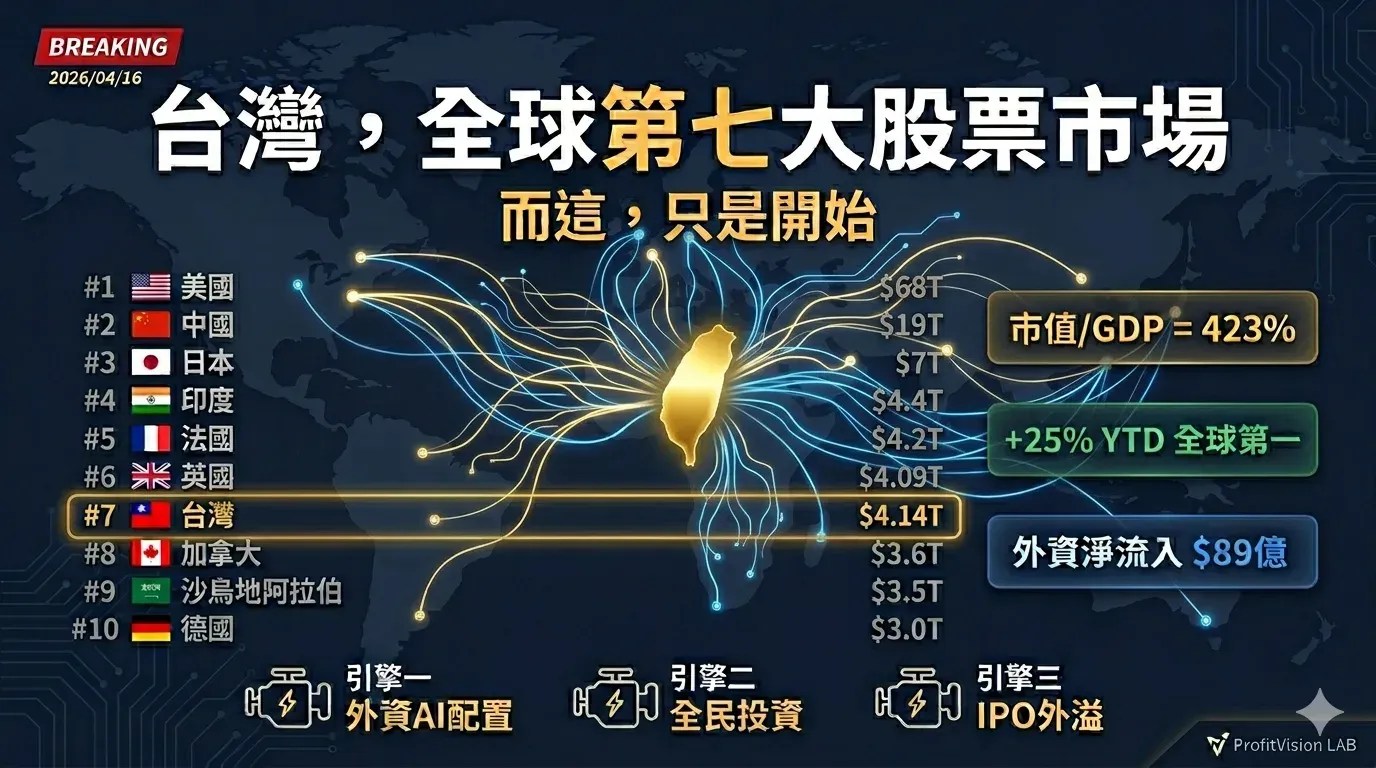
An island with a GDP a quarter the size of the UK's just surpassed it in stock market value. It's not luck — it's the inevitable result of thirty years of building the AI supply chain. And three flywheels are spinning up at once.
On April 16, 2026, Taiwan's stock market capitalization broke through $4.14 trillion, surpassing the UK to become the seventh-largest stock market in the world. The number alone is striking — an island with a GDP of just $977 billion has a capital market larger than that of the UK, whose GDP is $4.3 trillion. But what matters more is this: this is only the beginning. Taiwan has three structural engines igniting at the same time, and a clear roadmap toward the global top three. This is not just investment analysis — it is a citizen's statement of confidence in Taiwan.
Taiwan's stock market capitalization has broken through $4.14 trillion, surpassing the UK's $4.09 trillion to become the world's seventh-largest stock market.
The TAIEX is up +25% year-to-date in 2026, making it the first major market in the world to fully recover its losses from the Iran war, and it hit an all-time high on April 16. Foreign net inflows reached $8.9 billion in April alone, close to a historic high.
"Taiwan continues to be viewed as a proxy for AI hardware exposure — as long as AI capex momentum continues, inflows should remain supported." — Yoon Ng, Head of Asia-Pacific at Broadridge
I. April 16, 2026 — A Day Worth Remembering
Let me state a fact first, and let it sink in for a few seconds.
The UK's GDP is $4.3 trillion. Taiwan's GDP is $977 billion — less than a quarter of the UK's.
The UK has a population of 67 million. Taiwan has a population of 23 million — less than a third of the UK's.
The UK is the birthplace of the Industrial Revolution, one of the world's global financial centers, and the London Stock Exchange has a history of over three hundred years. Taiwan's stock exchange was founded in 1961 — nearly two and a half centuries later than London's.
And yet, on April 16, 2026, Taiwan's stock market capitalization surpassed the UK's.
Taiwan's market cap: $4.14 trillion. The UK stock market's cap: $4.09 trillion.
Taiwan is now the world's seventh-largest stock market.
I want every person in Taiwan to feel the weight of this number. Not out of pride, but out of understanding: the corporate creativity represented by the capital market in this place where we live and work has already far exceeded what its geographic size and population would suggest.
And all of this happened under the shadow of "the Taiwan Strait could erupt into conflict at any time."
II. Why This Number Is So Striking
If you skim past the headline "Taiwan surpasses the UK" too quickly, it might just look like another piece of financial news. But if you stop to understand the proportions behind it, you'll feel an almost absurd contrast.
Among the top three globally
Extremely deep market
A normal level
Taiwan is over 4x higher
2026/04/16
7th in the world
Only 22% of the UK's
Yet its market cap already exceeds it
Taiwan's market cap-to-GDP ratio has reached 423%. This means the market value created by Taiwan's listed companies is 4.23 times the size of the entire Taiwanese economy.
Only a handful of countries in the world can achieve this ratio — the United States (roughly 220%), Switzerland (roughly 280%), and Taiwan. And the only explanation for how Taiwan achieves 423% is this: what Taiwanese companies produce is worth far more to the world than Taiwan's own economic scale would suggest.
In other words: Taiwan is a place that has "compressed and packaged" global influence onto a small island.
"Taiwan's market cap-to-GDP ratio of 423% is not a sign of a bubble — it's the capital markets correctly pricing Taiwan's irreplaceability in the global supply chain. This number shouldn't cause worry. It should be a source of pride." — Shiba the Disciplined
III. How Taiwan Got Here — Thirty Years of Global Ranking Evolution
Taiwan's stock market didn't leap to seventh place overnight. This is the compounding result of thirty years of corporate accumulation, industrial upgrading, and capital deepening.
| Era | Driving Force | Taiwan Market Cap (approx.) | Global Rank (approx.) |
|---|---|---|---|
| Early 1990s | Electronics manufacturing takeoff, PC supply chain | Under $100B | Fringe of top 20 |
| 2000s | Semiconductor foundry dominance established | $200–400B | Approx. 15th–18th |
| 2010s | Apple supply chain, smartphone boom | $600B–$1T | Approx. 12th–15th |
| 2020–2022 | Pandemic tech-demand boom, TSMC market cap surges | $1T–$2T | Approx. 10th–12th |
| 2023–2024 | AI capex cycle, CoWoS capacity crunch | $2T–$3.5T | Approx. 8th–10th |
| 2026/04/16 | AI hardware dominance confirmed, record foreign inflows | $4.14T | 7th, surpassing the UK |
From outside the top 20 to 7th in the world — thirty years. Taiwan's ascent is the complete narrative of its evolution from a "contract-manufacturing island" into the "core of AI infrastructure."
IV. Where Taiwan Stands Now — A Snapshot of the Global Market Cap Rankings
Let's place Taiwan within the global coordinate system.
V. Three Flywheels, Igniting at Once
What got Taiwan to seventh place globally was decades of accumulated history. What will carry Taiwan toward the global top three are three structural engines running simultaneously right now.
The key thing about these three engines is that they reinforce one another:
Foreign inflows → Taiwan's stock market rises → Taiwanese wealth increases → more people are willing to invest in Taiwan's market → domestic capital deepens → market resilience strengthens → foreign investors gain more confidence holding Taiwan → new-industry IPOs become more attractive → market breadth increases → Taiwan's weight in indices like MSCI rises → forced passive-fund allocation increases → market cap rises further.
This is a positive flywheel — not linear growth, but compounding acceleration.
VI. Taiwan's Hidden Champions — A Supply-Chain Break Would Cost More Than Oil Ever Did
What sustains this flywheel isn't just TSMC. Taiwan's nodes in the global supply chain are broader, deeper, and more irreplaceable than most people realize.
The 1973 oil crisis pushed the world into a decade of stagflation. But oil had substitutes — the North Sea fields, the shale revolution, renewable energy. Taiwan's hidden champions have no substitutes:
| Industry | Representative Companies | Global Position | Difficulty of Replacement |
|---|---|---|---|
| Wafer foundry | TSMC | 92% global share below 7nm | Extremely high, 10+ years |
| Packaging and testing | ASE, King Yuan Electronics | World's largest, over 50% share | High, 5–8 years |
| PCB copper-clad laminate | Elite Material, ITEQ | Key material for AI servers | High, few alternative suppliers |
| Precision machine tools | Hiwin, AirTAC | Top three in global precision transmission | Medium-high, 3–5 years |
| AI thermal solutions | Auras, AVC | Nvidia-certified supplier | Medium, long certification cycle |
| Optical lenses | Largan Precision | Primary supplier of Apple's high-end lenses | High, yield rates hard to replicate |
These companies share a common trait: they are highly customized and deeply embedded in customers' production processes, making the cost of switching suppliers far greater than the price of the component itself. Once a supply chain is disrupted, customers can't simply "switch suppliers" — they must spend six months to two years re-qualifying a new one, during which their production lines may be forced to a halt.
This is exactly why the world's most sophisticated capital — foreign institutional investors — is willing to hold 44.8% of Taiwan's stock market even against the backdrop of "the Taiwan Strait could erupt into conflict at any time." Because they have run the numbers: the cost of a break in Taiwan's supply chain is less bearable than almost any geopolitical risk.
VII. The Roadmap to the Top Three
Now let's turn to the most important question: can Taiwan reach the global top three?
The answer is: yes, but it will take time, policy, and the continued operation of the three engines.
The path to third place (Japan) is not a pipe dream, but it requires several key conditions to hold simultaneously:
Condition One: The AI capex cycle continues into the 2030s. The four major North American CSPs' 2026 capex will total $453.9 billion, up 18% year-over-year, with no sign of slowing. TSMC's CoWoS capacity continues to expand, with monthly capacity expected to reach 115,000 wafers in 2026.
Condition Two: A new wave of IPOs from Taiwan's supply chain. Precision industry, defense, biotech, green energy, AI thermal solutions, silicon photonics — listings from these new industries will reduce the Taiwan market's overconcentration in TSMC and attract a wider range of institutional capital.
Condition Three: A rising weight for Taiwan in the MSCI index. Taiwan's weight in the MSCI Emerging Markets Index automatically rises as its market cap increases, driving up forced allocation from global passive funds and forming a positive cycle of capital inflows.
VIII. Taiwanese People, You Owe Yourself a More Serious Assessment
In this chapter, I want to step away from the numbers and speak directly.
In Taiwan, there is a deep-rooted psychological habit: chronically underestimating and doubting our own achievements.
We say "the Taiwan Strait risk is too great, I don't dare invest in Taiwan's stock market" — yet foreign investors hold 44.8% of it. We say "Taiwan's stock market is far worse than the US market" — yet 0050's 15-year CAGR differs from VOO's by only 0.1 percentage points. We say "Taiwan is just a contract-manufacturing island" — yet Taiwan's market cap-to-GDP ratio is 423%, among the top three in the world. We say "TSMC's presence in Taiwan carries geopolitical risk" — yet every one of the world's most sophisticated institutional investors chooses to hold it.
This habitual self-underestimation is a luxury. Because every time you say "Taiwan can't do it" and choose not to invest, you are handing your own home-field advantage to the foreign investors who are willing to invest in Taiwan.
Right now, Taiwan is the world's seventh-largest stock market. An island with a GDP a quarter the size of the UK's has surpassed it in capital market value.
This fact shouldn't surprise you. It should make you reassess: has your confidence in Taiwan kept pace with what the market data shows?
IX. Five Recommendations for Policymakers
What got Taiwan to seventh place globally was the spontaneous force of enterprise and the market. Getting to the top three will require proactive policy. Here are five concrete, actionable directions:
X. A Citizen's Manifesto
This article began with numbers. I want to close it with a few words.
Taiwan is where I live, where I work, where I earn, spend, and pay taxes in NT dollars every day. Taiwan is also the core of the world's most important semiconductor supply chain, the most irreplaceable node in the infrastructure of the AI era, and a place that, under the shadow of "could be attacked at any moment," has still built the world's seventh-largest stock market.
I don't invest in Taiwan's stock market not because Taiwan isn't good — I don't invest because I haven't yet understood just how good Taiwan is.
Taiwanese people have an advantage that foreign investors can never replicate: we live inside this market. We speak Chinese, we know friends who work at TSMC, we know what time MediaTek's earnings call starts, and we have connections at every node of the supply chain.
Turning this home-field advantage into investment action is the most rational financial choice a Taiwanese person can make — and the most powerful collective vote of confidence.
13.26 million brokerage accounts, 2.73 million holders of 0050, 986,000 people on monthly dollar-cost-averaging plans — these Taiwanese people have already spoken through their actions.
Taiwan is already the world's seventh-largest stock market.
And this is only the beginning.
XI. Why Foreign Investors Choose Taiwan — The Most Honest Risk Assessment
Let's switch perspectives to that of foreign investors, and understand why they continue to hold 44.8% of Taiwan's market cap under the shadow of "Taiwan Strait risk."
Foreign investors are not charities. They have the strictest risk-control frameworks, the most sophisticated geopolitical assessment models, and the most professional research teams. Every single position they hold is backed by hundreds of pages of due diligence and quantified risk analysis.
So when these institutions decide to hold 44.8% of Taiwan's stock market, what conclusion did their risk assessment reach?
The answer lies in one detail: they are not "ignoring" Taiwan Strait risk — they have "calculated it" and concluded that this risk is bearable.
From foreign investors' perspective, the expected return of holding Taiwan's market includes: the structural growth dividend of the AI hardware supply chain, TSMC's monopolistic moat from its technological lead, and the diversification benefit of NT-dollar-denominated assets within a global portfolio. The discounted value of Taiwan Strait risk has already been priced into Taiwan's relatively lower price-to-earnings ratio (compared to US tech companies with equivalent growth rates).
In other words: foreign investors' 44.8% ownership is the result of their most honest risk assessment of Taiwan. It's not optimism, and it's not neglect — it's a rational allocation reached after careful calculation.
Three Layers of Meaning Behind the Foreign Ownership Structure
The composition of foreign ownership in Taiwan's stock market is not uniform:
Layer One: MSCI passive capital — forced allocation from global index funds and ETFs. Taiwan's weight in the MSCI Emerging Markets Index is about 16%, meaning every passive fund tracking this index globally must hold a corresponding proportion of Taiwanese stocks. This capital does not easily withdraw over Taiwan Strait headlines, because it isn't an active decision — it's driven by index rules.
Layer Two: Thematic active funds — global active funds themed around AI hardware and semiconductors. These funds choose to overweight Taiwan because it is the purest investment vehicle for AI infrastructure. Nvidia's orders flow to TSMC, and TSMC's growth is reflected in Taiwan's stock market — this logical chain is clear and unavoidable.
Layer Three: Sovereign wealth funds and long-term institutions — Norway's Government Pension Fund, Singapore's GIC, the Abu Dhabi Investment Authority, and others. These institutions have the longest investment horizons, and their allocation to Taiwan represents a judgment of confidence in Taiwan's outlook over a decade or more.
The simultaneous influx of these three layers of foreign capital is not a coincidence — it is an objective reflection of Taiwan's capital market's position within the global system.
XII. Taiwanese Capital Should Work for Taiwan
There's a number that's rarely discussed: the total financial assets held by Taiwanese households are estimated at over NT$60 trillion (roughly $1.9 trillion). This includes bank deposits, funds, insurance, and stock holdings.
This is an enormous figure. If Taiwanese people shifted more of this capital from low-return time deposits and insurance products into long-term investments in Taiwan's stock market, it wouldn't just grow individual wealth — it would deepen and strengthen the resilience of Taiwan's entire capital market.
Consider this comparison:
| Form of Capital | Estimated Size | Average Annualized Return | Opportunity Cost (vs. 0050) |
|---|---|---|---|
| Taiwan bank time deposits | Approx. NT$35 trillion | 1.5–2.0% | Forgoes roughly 12–13% per year |
| Taiwan life insurance | Approx. NT$20 trillion | 2.5–3.5% | Forgoes roughly 11% per year |
| Long-term holding of 0050 | 0050 AUM of NT$1.55 trillion | 14.8% (15-year CAGR) | The best home-field choice |
Every year, Taiwanese people park tens of trillions of NT dollars in time deposits earning 1.5–2%, while complaining that their retirement savings aren't enough. This isn't a lack of financial literacy — it's a cognitive problem. A misplaced fear of Taiwan's stock market has caused Taiwanese people to miss out on the strongest compounding engine available on their home turf.
If Taiwanese households shifted just 10% of their financial assets from time deposits into Taiwan equity ETFs, that would be NT$6 trillion in fresh capital inflow, directly lifting Taiwan's market cap. And the returns earned on that money in Taiwan's stock market would ultimately flow back into Taiwan's consumption, investment, and social welfare — a closed capital loop that lets Taiwan's wealth circulate and compound within Taiwan itself.
XIII. A Comparison with Israel — Pressure as a Source of Creativity
In the history of global capital markets, there is one example most similar to Taiwan: Israel.
Since its founding, Israel has fought multiple wars for survival, is surrounded by hostile neighbors, and has never had a single truly "safe" day. Yet today, Israel has the highest unicorn density per capita in the world, ranks among the top three globally in per-capita venture capital, and the Tel Aviv Stock Exchange keeps hitting new highs.
Israeli entrepreneurs never said "let's wait until things settle down to start a company." Israeli investors never said "the risk is too great, we don't dare invest in the Israeli stock market." What they said instead was: "Precisely because the future is uncertain, we must create tomorrow's value today."
The similarities between Taiwan and Israel run far deeper than most people realize:
| Dimension | Israel | Taiwan |
|---|---|---|
| Geopolitical situation | Surrounded by hostile neighbors, existential threats | Cross-strait tensions, geopolitical pressure |
| Population | Approx. 9.5 million | Approx. 23 million |
| Core competitiveness | Cybersecurity, military technology, agri-tech | Semiconductors, AI hardware, precision manufacturing |
| Global influence per capita | Extremely high | Extremely high |
| Entrepreneurial culture | "Startup Nation" | Taiwan's hidden-champion culture |
| Effect of pressure | Converted into innovative drive | Converted into a relentless pursuit of precision manufacturing |
Israel has a saying: existential pressure means they can't afford to waste a single opportunity, because tomorrow is uncertain, so everything today must be done to the fullest.
Taiwan carries a similar cultural undertone. Taiwan's engineering culture, the resilience of its small and medium enterprises, and the rapid adaptability it has shown in every global supply-chain crisis — all of these are forms of competitiveness forged under pressure.
Taiwan Strait risk is not Taiwan's curse — it is the forge of Taiwan's competitiveness.
XIV. The Next Decade for Taiwan's Stock Market — Five Structural Drivers
Looking ahead, five structural drivers are taking shape for Taiwan's stock market over the next decade:
Driver One: Long-Cycle Demand for AI Infrastructure
The four major North American CSPs (Microsoft, Google, Amazon, Meta) plus Oracle will spend a combined $453.9 billion in capex in 2026, up 18% year-over-year. Nvidia's latest forecast suggests AI inference demand will grow "a billionfold" over the next five years. All of this demand ultimately requires chips made by TSMC, packaging from Taiwan's assembly-and-test houses, and circuit boards from Taiwan's PCB makers.
The AI infrastructure build-out isn't a one- or two-year theme — it's a long-term structural demand extending into the 2030s. This is Taiwan's most important long-term tailwind.
Driver Two: The Capital-Market Monetization of Taiwan's Defense Budget
Taiwan's government continues to raise its defense budget, targeting 3% of GDP. This isn't just military spending — it's a capital market opportunity: AIDC (aerospace precision manufacturing), CSBC Corporation (shipbuilding), and Evergreen Aviation Technologies (aircraft maintenance) — this cluster of defense supply-chain companies is growing rapidly and entering the capital market through listings.
Rising defense budgets amount to the government providing long-term revenue visibility to these companies. The logic resembles the growth of Lockheed Martin and RTX in the US during the Cold War — government procurement is the most stable form of long-term order flow.
Driver Three: The Boom in Biotech and AI Healthcare
Taiwan's biotech sector saw 15 IPOs in 2024, a record high, with 2026 expected to set a new peak. More importantly, three directions — AI medical imaging, genetic testing, and CDMO (contract development and manufacturing organizations) — are converging to form Taiwan biotech's second growth curve.
aetherAI (AI medical imaging) and MicroBase Technology (inhalation drug-device combination CDMO) — the listings of this new generation of biotech companies are giving Taiwan's capital market real depth in biotech for the first time, moving beyond the one-dimensional narrative of contract manufacturing and hardware.
Driver Four: Green Energy and Power Infrastructure
Electricity demand from AI data centers is growing exponentially. Nvidia's Rubin Ultra NVL576 is expected to draw up to 600kW, meaning a modern AI data center can consume as much power as a mid-sized city. Taiwan's power-equipment suppliers — Delta Electronics, Walsin Lihwa, and Kolin — are direct beneficiaries of this demand, and their order visibility extends three to five years out, locked in by the timeline of global data center construction.
Driver Five: Continued Institutional Improvement of Taiwan's Capital Market
Innovation Board 2.0 removed the qualified-investor restriction (2025), expanding the pool of potential investors in the Innovation Board from 300,000 to 13 million accounts. A Startup Board 2.0 is being planned, offering a lower-threshold capital market channel for small, medium, and micro enterprises. These institutional reforms allow more high-quality growth companies to enter the capital market, continuing to expand the breadth and depth of Taiwan's stock market.
XV. A Letter to Taiwan's Future
This is the final chapter of the third installment of this series, and I want to close it in the most direct language possible.
Taiwan is now the world's seventh-largest stock market. This position was built brick by brick, over thirty years, by hundreds of thousands of Taiwanese companies, millions of engineers and workers, and 13.26 million Taiwanese investors.
It didn't fall from the sky. It is the collective result of Taiwanese people choosing to keep working, keep starting companies, and keep investing — even while living every day against the background noise of "Taiwan Strait risk."
This position is one Taiwan has earned.
But what matters more is this: it is only the starting point.
Taiwan's AI supply chain is deepening, not contracting. Taiwan's IPO market is expanding, not shrinking. Foreign ownership of Taiwan's stock market is rising, not retreating. Taiwan's domestic investors are maturing, not panicking.
Four arrows, all pointing up.
I can't predict exactly when Taiwan's stock market will overtake India, or when it will challenge Japan. But I know this direction is correct, this momentum is real, and this story is worth Taiwanese people believing in for themselves.
Because ultimately, how far a capital market can go doesn't just depend on how foreign investors see it. It depends even more on whether the people within that market have the courage and the awareness to believe that where they stand deserves to be taken seriously.
"Taiwan is already the world's seventh-largest stock market. Did you know that? Do you believe it? Are you ready to seriously invest on your own home turf?" — Shiba the Disciplined, April 17, 2026
XVI. An Action List for Taiwanese Investors
This article has covered a lot of macro argument. To close, I want to translate it into concrete action. Because "I teach you how to think, not just what to do" — but "how to think" ultimately has to be converted into "what to do."
If You Haven't Started Investing in Taiwan's Stock Market Yet
Open a brokerage account today and set up a dollar-cost-averaging plan for 0050. The amount doesn't matter — even NT$3,000 a month is fine. What matters is building the systematic habit of "buying automatically every month, ignoring the headlines, regardless of whether Taiwan Strait tensions are rising."
Thirty years from now, the compounding from this habit will make you thank yourself today.
If You're Already Investing in Taiwan's Stock Market, But at a Low Allocation
Re-examine your asset allocation. If you have a large amount of capital sitting in 1.5% time deposits, that's a tax you're paying every year to "Taiwan Strait fear." Move a portion of it systematically into Taiwan equity ETFs, and let your home-field advantage start working for you.
A suggested evaluation framework: your allocation to Taiwan's stock market should be at least roughly proportional to the share of your spending that's in NT dollars. If 90% of your spending is in NT dollars, at least 50–60% of your assets should probably be in NT-dollar-denominated assets — and Taiwan equity ETFs are the most efficient choice among them.
If You're Already a Long-Term Investor in Taiwan's Stock Market
Keep doing what you're doing. Keep adding to your position during every Taiwan-Strait-related panic sell-off. History tells you that every single time, it has been the right call.
At the same time, consider extending your confidence in Taiwan to a broader level: follow policy discussions about Taiwan's capital market, and support reforms that make it more international, deeper, and more resilient. Because the long-term growth of Taiwan's stock market needs not just capital from individual investors, but continued improvement in the policy environment.
If You Are a Foreign National Working in Taiwan
Taiwan's stock market is open to foreign investors. If you live and work in Taiwan, holding Taiwanese stocks isn't just a financial decision — it's also a statement of confidence in the community you're part of. Taiwan's capital market welcomes every investor willing to make a long-term bet on Taiwan, regardless of nationality.
If You Are a Policymaker or Opinion Leader
Taiwan's capital market reaching seventh place globally is an achievement that deserves wider discussion and promotion. It should be included in high-school financial-literacy curricula. It should become a proud narrative in Taiwan's external messaging. It should trigger a serious policy conversation about "Taiwan's next step: a sovereign wealth fund, capital-market internationalization, and attracting global talent."
This achievement isn't a political accomplishment — it's a result created collectively by all Taiwanese people. Letting more people know about it is everyone's responsibility.
XVII. Three Articles, One Complete Thesis
Looking back at the path this series has taken:
Part One dismantled the biggest psychological barrier — that Taiwan Strait risk is a false premise. The market has already priced it in; thirty years of history show every panic has been a buying opportunity, and the six lines of defense leave no ground for the argument "don't invest in Taiwan's stock market."
Part Two provided the data support — 0050's 15-year CAGR differs from VOO's by only 0.1 percentage points, the total-return index outperforms the price index by a factor of 13x versus 5x, and Taiwanese investors hold three hidden home-field advantages. Taiwanese people don't need to look elsewhere.
Part Three provided the macro perspective — Taiwan is the world's seventh-largest stock market, three flywheels are igniting simultaneously, the roadmap to the top three is clear, and Taiwan deserves to be taken more seriously — including by Taiwanese people themselves.
Put together, these three articles form one complete thesis:
Taiwan is your home turf.
There's no excuse of Taiwan Strait risk on home turf — that risk has already been priced in.
Home-turf returns are no worse than US stocks — the data tells you so.
Home turf is heading toward the global top three — the trend tells you so.
Investing on your home turf is the most rational financial choice a Taiwanese person can make, and the most powerful collective vote of confidence.
13.26 million brokerage accounts have already spoken. What about you?
XVIII. This Story Belongs to Every Taiwanese Person
As this article draws to a close, I want to say one final thing.
The protagonist of the story of Taiwan's capital market reaching seventh place in the world is not TSMC, not Morris Chang, and not any single entrepreneur or policymaker.
The protagonist of this story is every ordinary person who works, pays taxes, invests, and starts businesses in Taiwan.
It's the engineer working the night shift in the Hsinchu Science Park to finish chip production. It's the office worker dollar-cost-averaging into 0050 every month. It's the master machinist skillfully operating a five-axis machining center at a precision factory in Taichung. It's the regulatory-affairs staffer preparing FDA filings at a biotech company. It's the farmer in Tainan leasing land to a solar power developer.
The market capitalization of Taiwan's capital market is the monetized expression of the value these people have created. $4.14 trillion is not an abstract number — it is the result of the labor, creativity, technical skill, and perseverance of millions of Taiwanese people, converted by the global capital market into its most direct language: money.
This number should make every person in Taiwan feel a different kind of weight: not pride, but responsibility.
The responsibility is this: Taiwan's next step matters more than ever before.
Taiwan now stands at a historic position — not just seventh place, but a turning point that is determining just how far it can go. Three flywheels are turning, the long AI cycle is unfolding, new industries are joining the ranks, and room for policy reform is opening up.
At this moment, what Taiwanese people need is not just foreign investors' confidence — they need their own confidence.
Investing in Taiwan's stock market is an act that expresses confidence.
Not because Taiwan has no risk — Taiwan has never lacked for risk.
But because the people of Taiwan, amid that risk, have created the world's seventh-largest stock market.
And they haven't stopped yet.
Taiwan is already the world's seventh-largest stock market. And this is only the beginning.
The Weight of a Number, the Start of an Era
Let me close this article with one final perspective.
It took the UK three hundred years to build one of the world's most important financial centers in London, accumulating $4.09 trillion in stock market value. It took Taiwan sixty-five years, under the shadow of a neighbor that publicly declares it is "ready to unify by force at any time," to build $4.14 trillion in stock market value.
In less time, under greater pressure, a larger capital market was built.
This is efficiency, this is resilience, this is competitiveness in the Taiwanese style — pushing every resource to its fullest under adversity, creating results disproportionate to the pressure applied.
The world's investors have already seen this, and they've told you their judgment with a 44.8% ownership stake.
Now it's Taiwan's turn to see it for itself.
Believe it. Invest in it. Keep this flywheel turning.
Because Taiwan's story is not finished yet. And the next chapter should be written by the people of Taiwan themselves.
Part One: Taiwan Strait Risk Is a False Premise
Six lines of defense dismantled the argument; the market has already priced it in — a known risk is a risk that can be managed.
Part Two: Taiwan Stocks vs. VOO vs. QQQ
The CAGR gap between 0050 and VOO is just 0.1 percentage points; once hidden costs are considered, Taiwanese people don't need to look elsewhere.
Part Three: Taiwan Is Already the World's Seventh-Largest Market
Three flywheels are igniting at once, the roadmap to the top three is clear, and Taiwan deserves to be taken more seriously.
Core thesis: Taiwan is not a second-best choice — Taiwan is home turf. Investing on home turf is the most rational starting point.
© 2026 ProfitVision LAB · Shiba the Disciplined · Think with me, not just trade with me.
Data sources: Bloomberg (2026/04/16), CEIC Data, Taiwan Depository & Clearing Corporation, PwC Global IPO Watch, Broadridge, and public sources.