Danaher's Forty Years: From Speculator to Industrial Empire, and the Test of Century-Long Succession -- An M&A Map for Eight Taiwanese Companies
400 acquisitions, 40 years, a $21.4 billion largest-ever bet -- how did DBS turn speculators into an industrial empire? The Mongol Empire moment facing Foxconn, Delta, and Fubon, and the M&A windows of opportunity for five mid-sized companies: Yageo, Advantech, Feng Tay, Inventec, and Foxlink. A ProfitVision LAB think tank report.
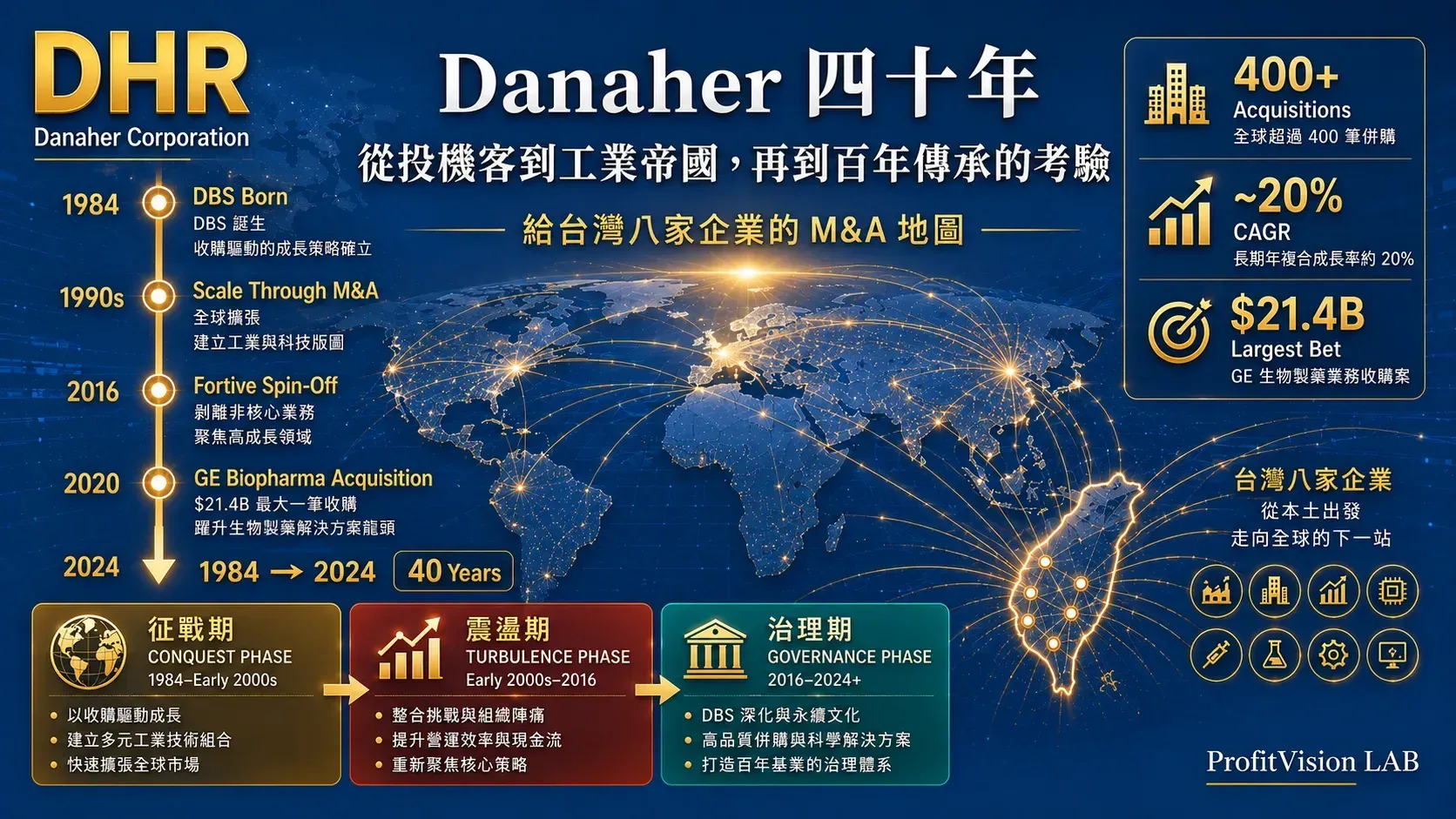
(1984-2024)
(1986-2014)
GE Biopharma (2020)
Yet Still Growing
- DBS (Danaher Business System) is the common language behind Danaher's 400 acquisitions over 40 years — it isn't a management tool, it's a system that institutionalizes "the ability to transform" as organizational DNA. This is Danaher's truly irreplicable moat.
- Danaher's evolution has three stages: opportunistic arbitrage (1984-1990) → building the system (1990-2001) → institutional compounding (2001-present) — most Taiwanese companies are still stuck at the threshold between stage one and stage two.
- Danaher has gone through three leadership successions (Rales → Culp → Blair) and three major spinoffs (Fortive / Envista / Veralto), each one a stress test of "can DBS outlast the individual" — and every time, it passed.
- Taiwan's three major conglomerates (Foxconn, Delta Electronics, Fubon) are facing their own "Mongol Empire moment" — the conquerors are handing over the reins. Can the governors keep the empire thriving for a century? This is their most critical test for 2026-2035.
- Based on the ProfitVision M&A Maturity Matrix, five mid-sized Taiwanese companies (Yageo, Advantech, Feng Tay, Inventec, Foxlink) each have different M&A windows of opportunity, but share a common gap: the institutional capability to upgrade from "opportunistic" to a "systematic M&A platform."
To understand Danaher, you can't just look at what it looks like today — a life-science and industrial-science conglomerate with a market cap of over $80 billion. You have to start from its least glamorous beginning: two arbitrageurs living off leveraged deals, and a real estate trust nobody had ever heard of.
This starting point matters, because it makes a single point clear: Danaher's success isn't talent, and it isn't luck — it's the compound interest of choosing, again and again over forty years, "the harder but more correct path."
Origin
Brothers Steven Rales and Mitchell Rales, in their twenties, made their name in Washington DC through leveraged buyouts and asset restructuring. In 1984, they acquired a real estate investment trust called Diversified Mortgage Investors (DMI) — their first platform, and the predecessor of today's Danaher. In 1985, the company was renamed Danaher, after a fishing creek in Montana.
In the early years, the Rales brothers' logic was pure financial arbitrage: buy undervalued industrial companies, cut costs, sell off or keep the cash-generating businesses. This was no different in essence from any 1980s leveraged buyout fund. What changed everything was a chance factory visit.
The Borrowed Map
Around 1987, during a factory visit, the Rales brothers encountered the Toyota Production System (TPS) in action for the first time — not the theory in a book, but a real, running production line: standardized operations at every workstation, waste tracked systematically, improvement not an individual act but a daily culture.
They made a decision no one else had made: not just to learn TPS, but to redesign it as a toolkit for M&A integration. This decision started Danaher's transformation from a financial arbitrageur into a system builder.
The crucial leap in thinking: "The companies we acquire have problems not because their business is bad, but because their processes are full of waste. If we can systematically eliminate waste, we can turn an ordinary company into an excellent one." This is the intellectual starting point of all of DBS.
Taking Root
In the 1990s, Danaher began systematically building out DBS (the Danaher Business System): Policy Deployment to cascade strategy layer by layer, intensive Kaizen Events, and a DBS Leader talent-development pipeline. This was no longer just a philosophy — it was an organizational language with tools, processes, and a talent pathway.
The 1998 acquisition of Fluke (industrial measurement instruments, $625 million) and the 1999 acquisition of Hach (water quality analysis, $435 million) were DBS's first large-scale real-world validations. After DBS was implanted, both companies saw significant improvement in on-time delivery, inventory turnover, and customer satisfaction. For the first time, Danaher had a "transformation track record" it could show the next seller.
Evolution
In 2001, Larry Culp took over as CEO. He did something no one had done before: he extended DBS's "eliminate waste" logic from the factory floor to sales, marketing, R&D, and talent management. This became "Growth DBS" — the same framework applied to sales-funnel conversion, shortening the quoting process, and compressing R&D cycles.
In 2011, Danaher acquired Beckman Coulter (medical diagnostics equipment) for $6.8 billion — the largest acquisition in Danaher's history at the time, and also the toughest test yet for DBS: bridging the cultural gap from industrial to medical, integrating a complex global sales network, all while preserving existing R&D capability. Three years later, Beckman Coulter's service-business gross margin had risen 9 percentage points, and customer satisfaction hit an all-time high.
During Culp's tenure (2001-2014), Danaher's stock rose from about $12 to $84, a 7x return. In 2018, he was recruited by GE's board to "put out the fire" as GE's CEO — that choice, in itself, was the market's highest compliment to DBS's capability.
Letting Go
In 2015, Danaher acquired Pall Corporation (filtration and separation technology) for $13.8 billion. The following year (2016), they did something that confused the market: they packaged up their massive industrial businesses — tools, electronic test, and motion technology — and spun them off into an independent, publicly traded company called Fortive, worth about $15 billion.
Why give up something that had already succeeded? Because these businesses had a different capital-allocation logic, a different customer-development rhythm, and different DBS use cases than Danaher's future direction — life sciences. Keeping them under one roof would have slowed both sides down. The spinoff let both move faster — and DBS culture migrated along with Fortive, proving that the system could genuinely operate independently, without needing Danaher's parent structure.
"How does someone who can conquer learn to let go?" — this is a question Taiwanese business owners have rarely been forced to confront.
Transformation
After the Fortive spinoff, Danaher's business mix transformed from an "industrial tools conglomerate" into a "life sciences and diagnostics platform." Water-quality monitoring (Hach), gene sequencing (Leica Biosystems), biopharma equipment (Pall), clinical diagnostics (Beckman Coulter) — every one of these businesses shares a common trait: once the instrument is sold, the ongoing consumables, reagents, and maintenance contracts create recurring cash flow, and DBS-driven service-quality improvements translate directly into higher customer retention.
The logic behind this transformation: Danaher wasn't chasing a hot market, it was searching for the industry structure "best suited for DBS to work its magic." Life sciences satisfies every condition: a fragmented market, plenty of room for improvement, high service-based revenue, and regulatory barriers that keep competition from encroaching too quickly.
The Big Bet
In 2020, as COVID-19 ravaged the world and global capital markets shook, Danaher completed a $21.4 billion acquisition of GE's biopharma business, renaming it Cytiva. This was the largest single acquisition in Danaher's history — and also the biggest bet placed at the most chaotic possible moment.
The core of the decision logic: Cytiva's business is biopharma manufacturing equipment and consumables — and vaccine production requires enormous amounts of this kind of equipment. The global emergency mass-production of COVID-19 vaccines caused Cytiva's orders to explode within a year of the acquisition. This wasn't luck — it was a deep understanding of the industry trend, backed by institutional confidence that "DBS can integrate quickly."
Without forty years of accumulated integration capability, closing a $21.4 billion acquisition in the middle of a pandemic would have been a gamble; with DBS, it was a calculated, giant bet.
Succession
In 2020, Rainer Blair took over as CEO (Culp had already left in 2018 to lead GE). In 2023, Danaher spun off its environmental and applied solutions business again, forming Veralto — the third voluntary act of letting go, and the third stress test of how deeply institutionalized DBS really is.
The problem Blair faces is Danaher's own Mongol Empire problem: can DBS keep functioning as the organization's backbone without the Rales brothers, without Culp? Veralto has operated independently since going public, and Fortive has continued to complete multiple acquisitions using DBS logic — the preliminary answer is: yes.
But this question will never have a final answer. Institutional resilience can only be reconfirmed at the next stress test.
Layer One (Tools): DBS's four components (Policy Deployment, Kaizen Events, Growth DBS, talent replication) are publicly known concepts, but the version of these tools refined through forty years of real-world Danaher practice contains an enormous amount of tacit knowledge that can't be learned from a book.
Layer Two (People): DBS Leaders who truly know how to apply DBS in an M&A integration context are among the scarcest management talent in the world. Danaher's talent-development pipeline is an industry standard that no company can replicate within five years.
Layer Three (Track Record): This is the deepest moat. Four hundred successfully transformed companies form a one-of-a-kind "transformation track record" — this lets Danaher show a seller real, verifiable proof of "you will become better in our hands" at the next acquisition. Any competitor would need forty years to replicate this record.
History has a recurring pattern: the person who can build an empire isn't necessarily the person who can make it last.
Genghis Khan unified Mongolia and swept across Eurasia — one of the greatest conquerors in human history. But the person who truly turned the Mongol Empire from "great conquest" into "great governance" was Kublai Khan — the one who knew how to dismount, build institutions, and transform nomadic conquest into a settled empire. Without Kublai's institutionalization, the Mongol Empire would just be a glorious chapter of history; with him, there was a Yuan Dynasty.
Taiwanese companies now stand at the same fork in the road. The first-generation founders built their own empires — with execution, connections, luck, and opportunities unique to their era. Now that the second generation has taken over, the question they face is no longer "how do we conquer the next market," but "how do we keep this empire growing in a far more complex world." M&A is one of the most powerful tools available to answer that question — but only if you've first built the institutional readiness Danaher had.
The Conquest-to-Governance Transition Curve: Three Stages — Where Is Your Company?
Based on Danaher's forty-year path, ProfitVision LAB proposes the "Conquest-to-Governance Transition Curve," dividing a company's M&A maturity into three stages:
Danaher Equivalent: 1984-1990
Where Most Taiwanese Companies Sit Today
Danaher Equivalent: 1990-2001 transition
Taiwan's Three Major Conglomerates Are Entering This Now
Danaher Equivalent: 2001-present
Taiwan's Most Achievable Target
The Three Major Conglomerates: The Empire Is Built, the Test Is Succession
Each of Taiwan's three major conglomerates has built a globally scaled empire, but all of them are facing the same question: the conqueror is handing over the reins — can the institution catch it?
Empire Scale: annual revenue exceeding $200 billion, 1 million employees worldwide, the primary contract manufacturer for the iPhone.
Conquest Capability (the Terry Gou Era): Sharp (2016, $3.5 billion), Belkin (2018), the MIH EV alliance — Terry Gou was a born conqueror, building his empire through extreme execution and personal charisma.
The Mongol Empire Problem: Young Liu took over as a professional manager, not through family succession — rare among Taiwan's large conglomerates. Foxconn's challenge isn't "finding the next Terry Gou," it's building an "M&A decision-making system that works without Terry Gou."
EVs (MIH) Are the Biggest Exam: transitioning from EMS to an EV solutions provider requires more than manufacturing capability from Foxconn — it requires software integration, brand building, and ecosystem management, areas where a DBS-equivalent capability isn't yet in place. If MIH succeeds, Foxconn will have the prototype of its own "growth DBS."
Empire Scale: annual revenue of about $12 billion, spanning power management, automation, and infrastructure solutions.
Why It's Taiwan's Closest Match to Danaher: Bruce Cheng started with a single capacitor, and used "energy conservation, love the earth" as a genuine corporate mission (not marketing copy) — that in itself is a long-termist organizational DNA that aligns closely with DBS's philosophy. Delta's lean-manufacturing capability is a management tool that can be transplanted into an acquired company.
M&A Moves Already Made: Eltek (Norwegian power, $117 million), Delta-Q Technologies (Canadian EV charging) — the direction is exactly right, but the scale isn't yet systematic. What Delta needs is to upgrade from "opportunistic acquisitions" to the institutional infrastructure of a "platform-style Serial Acquirer."
The Mongol Empire Problem: as Bruce Cheng steps back in his later years, how the governance structure balances tension between the professional manager (Ping Cheng) and the founding family (Yancey Hai) while simultaneously pushing a more aggressive M&A strategy is Delta's biggest organizational test over the next five years.
Potential Acquisition Directions: small European industrial-automation companies (easiest for a DBS-equivalent transplant), North American charging-infrastructure makers (EV positioning), Asian Building Management System makers (smart buildings).
Empire Scale: one of Taiwan's largest financial holding companies, spanning insurance + banking + telecom (Taiwan Mobile) + media (momo), with combined total assets exceeding NT$9 trillion.
Conquest Capability (Across Generations of the Tsai Family): Tsai Wan-lin laid the foundation of the insurance empire, and Daniel Tsai / Richard Tsai completed the second generation's horizontal expansion (the NT$14 billion acquisition of Taiwan Life, the integration of Taipei Fubon Bank). Fubon's M&A activity is real — but mostly consolidation within the Taiwan market, not outward conquest.
The Mongol Empire Problem: as the Tsai family transitions from the second to the third generation, succession at a financial conglomerate is more complex than in manufacturing — regulatory requirements, risk culture, and the governance structure across diverse businesses are all tests. The deeper challenge: how to use M&A to build the next decade's moat under fintech disruption, a low-rate environment, and geopolitical pressure?
The Biggest M&A Opportunity: Southeast Asian financial markets — Fubon Bank Vietnam is the precedent. With Southeast Asia's middle class rising and digital finance demand exploding, Fubon has the brand, the capital, and the rigorous discipline of Taiwan's financial regulation as a foundation for management export.
Five Mid-Sized Companies: The Window Is Open, but Time Is Limited
Compared to the three major conglomerates, five mid-sized companies share a distinctive advantage: they don't yet carry the inertial baggage of a massive bureaucracy, but they already have enough management depth and cash flow to kick-start a real M&A flywheel. The window is open — but it won't stay open forever.
Why It's the Closest Match to Danaher: Yageo is already acting as a Serial Acquirer — Pulse Electronics in 2018, KEMET in 2019 ($1.8 billion, the leading US passive-components maker), and CCO Technology in 2020. It's further down this road than any other Taiwanese company.
A Perfect Market Structure: the global passive-components market is naturally fragmented, with the top five players holding less than 50% combined share, and plenty of niche players across Europe, Japan, and the Americas. This is a textbook Serial Acquirer platform market — even more fragmented than the industrial market Danaher entered.
The Gap: The Integration System Isn't Yet a Tool. Yageo knows "how to manufacture better," but it doesn't yet have a methodology as clearly named, tooled, and externally demonstrable as DBS. The KEMET integration process relied more on the execution ability of Taiwanese cadres than on a replicable system. The next major acquisition needs "Yageo's DBS," not just "Yageo's cadres."
A Unique Advantage: Advantech's "Co-Creation" ecosystem strategy is, at its core, a platform version of DBS logic — not doing everything itself, but building a framework in which partners (ISVs, system integrators, vertical-market specialists) create value. This organization thinks closer to "platform-style M&A" than any other Taiwanese manufacturer.
Market Opportunity: Industry 4.0, smart manufacturing, edge computing — every vertical market globally (healthcare, energy, transportation, agriculture) has plenty of niche companies with "an existing customer base but a lack of digitization capability." These are Advantech's ideal DBS acquisition targets.
The Biggest Gap: capital scale. Advantech's market cap and cash reserves limit the size of deals it can do. Upgrading into a true Serial Acquirer requires a more systematic capital-markets strategy — leveraged buyout structures, PE co-investment, convertible bonds — tools Advantech hasn't yet used to their full potential.
A Hidden "DBS Equivalent": Feng Tay is the world's largest contract manufacturer of Nike athletic shoes. Nike's supplier audits are among the strictest systems in the world — quality, delivery time, environmental standards, labor standards, each with quantified metrics. Decades of passing Nike's audits have given Feng Tay a "high-standard manufacturing management capability" — a DBS-equivalent capability that could be transplanted into an acquired company.
A Structural Advantage: Nike orders carry extremely high stickiness, providing stable, predictable cash flow. This is an ideal foundation for an M&A flywheel — using stable cash flow to fund acquisitions, using acquisitions to expand capability boundaries, using new capabilities to win more orders from Nike (or other brands).
The Biggest Gap Is Vision: Feng Tay's management has never been forced to think in M&A terms, because there's always another Nike order waiting. The inertia of "passive growth" has left them without any drive to actively explore "what could I become if I acquired a functional-materials company?" This gap in vision isn't a matter of capability — it's a matter of mindset.
Potential Acquisition Directions: recycled athletic materials, smart manufacturing equipment, consolidating Southeast Asian vertical suppliers (upstream control of production bases in Vietnam and Indonesia).
Why the Window Is Now: Inventec is a core ODM manufacturer for AI servers, with deep co-development relationships with hyperscale cloud customers like Microsoft, Meta, and Google. This customer trust is a rare ticket in — before the AI infrastructure market consolidates rapidly, Inventec has a chance to use M&A to upgrade itself from a "manufacturing executor" into an "AI infrastructure solutions provider."
The Danaher-Logic Parallel: just as Danaher used manufacturing management capability as its acquisition anchor, Inventec could use "AI server integration capability + major-customer trust" as its anchor, acquiring adjacent capabilities like cooling systems, AI inference software, and edge-computing hardware.
The Biggest Challenge: Cultural Transformation. The core of EMS culture is "shipment volume, delivery time, cost" — an organization driven by these three metrics naturally resists the "long timeline, high tolerance, cultural integration" that M&A requires. This cultural transformation is harder than any technical challenge.
Urgency: the AI server market is consolidating extremely fast, and the landscape could be settled within three to five years. This is why Inventec's window is the shortest — right now is its last golden window to make strategic acquisitions as an "AI ODM partner."
Why the Connector Market Suits a Serial Roll-Up: the connector market shares the same logic as Amphenol's (APH) — naturally fragmented, highly customized, with niche players in every vertical market (automotive, medical, industrial, aerospace). Foxlink already has a global manufacturing footprint with a product line that overlaps heavily with APH's, but at only 1/8 of APH's scale — that gap is exactly the opportunity.
A Geopolitical Advantage: APH expanded globally from a US base; Foxlink is integrating westward from a Taiwan/Asia base — in the current geopolitical environment, Western customers are actively seeking "non-China" backup supply sources, giving Foxlink a chance to reach US and European customers it previously couldn't, positioned as a "strategic backup." M&A is a fast way to get that ticket in.
The Biggest Gap: Foxlink's management currently lacks a systematic M&A thinking framework. To replicate APH's decentralized Serial Acquirer model, the first step is to build "Foxlink's version of the APH philosophy" — what do we let an acquired company keep, and what do we insist on transplanting?
The ProfitVision M&A Maturity Matrix: Which Quadrant Is Your Company In?
Based on Danaher's forty-year path, ProfitVision LAB has built the "M&A Maturity Matrix," plotting the world's major M&A platforms and Taiwanese companies' current positions along two dimensions: "integration intensity" and "degree of systematization."
X-axis: Integration Intensity (Low: barely integrated → High: deeply embedded)
Y-axis: Degree of Systematization (Personality-driven: relies on individuals → Institutional: relies on systems)
Based on Danaher's path, the upgrade requires three preconditions to be in place simultaneously:
① Name your integration philosophy — not "send Taiwanese cadres to run it," but a management-export system with a name, tools, and a training pipeline (Advantech's Co-Creation and Delta's energy-efficiency framework are both candidates)
② Build an integration talent pipeline — who are your "DBS Leaders"? How are they developed? How do they rotate through and take root in acquired companies?
③ Accumulate a transformation track record — every successful integration is trust capital for the next acquisition. This record needs to be systematically documented and shown externally, not just kept as an internal report.
Conclusion: As a Think Tank, Helping Taiwanese Businesses Reach a Century
Danaher spent forty years telling the world one thing: a company's greatness doesn't come from how brilliant its first-generation founder was, but from every generation of leadership making "the harder but more correct choice."
Choosing systems over personality. Choosing institutions over individuals. Choosing to let go when an already-successful business becomes an obstacle to the future. Choosing to place the biggest bet at the most chaotic moment — provided you have forty years of accumulated integration capability behind you.
Taiwanese companies have gotten to where they are today through the previous generation's unparalleled execution, an acute sensitivity to customer needs, and the survival wisdom to navigate complex global supply chains with ease. These are real competitive advantages, and there's no need to sell them short.
But over the next decade, execution alone won't be enough. The dimension of competition has shifted from "who can do it fastest, most precisely, most cheaply" to "who can use M&A to quickly acquire capabilities they don't have, enter markets they can't otherwise reach, and let local talent shine everywhere in the world."
Danaher's forty years are a road already traveled. The map is right here. Where Taiwanese companies go next depends on whether they're willing to pick up this map — and then go further than it did.
This corporate-biography series isn't just about recording someone else's path to success — its mission is to give Taiwanese companies a globally informed strategic map. Taiwanese companies have the capability to become active players on the global M&A stage — what's missing isn't resources, it's vision and institutional readiness.
As a think tank, we will keep studying the world's most successful corporate biographies in depth, distilling strategic frameworks that Taiwanese companies can apply directly. This is ProfitVision LAB's commitment to Taiwan's business community.
- Amphenol's Ninety Years: From a Mining-Camp Connector to a Global Decentralized Empire — A Map of Institutional Trust for Taiwanese Companies
- Trust-Based M&A Overview: Five Models — After the Acquisition, Do You Choose Trust, or Control?
- Danaher / DBS: System-Implantation M&A — Building Trust Through Transformation, and Where Are the Limits?
- Constellation Software: The Promise to Never Sell — The Serial Acquirer's Platform-Compounding Moat
- Berkshire Hathaway: The Permanent-Home Philosophy — The Extreme of Personal Trust and the Succession Challenge