Veeva: The Most Underrated Cash-Flow Machine of the AI Era — the Real Winner Isn't the One Building the AI
While the market obsesses over AI transforming drug discovery, Veeva is doing something else entirely — making sure that no matter who discovers the drug, they have to go through its system. This isn't a growth stock. It's the industry's toll gate.
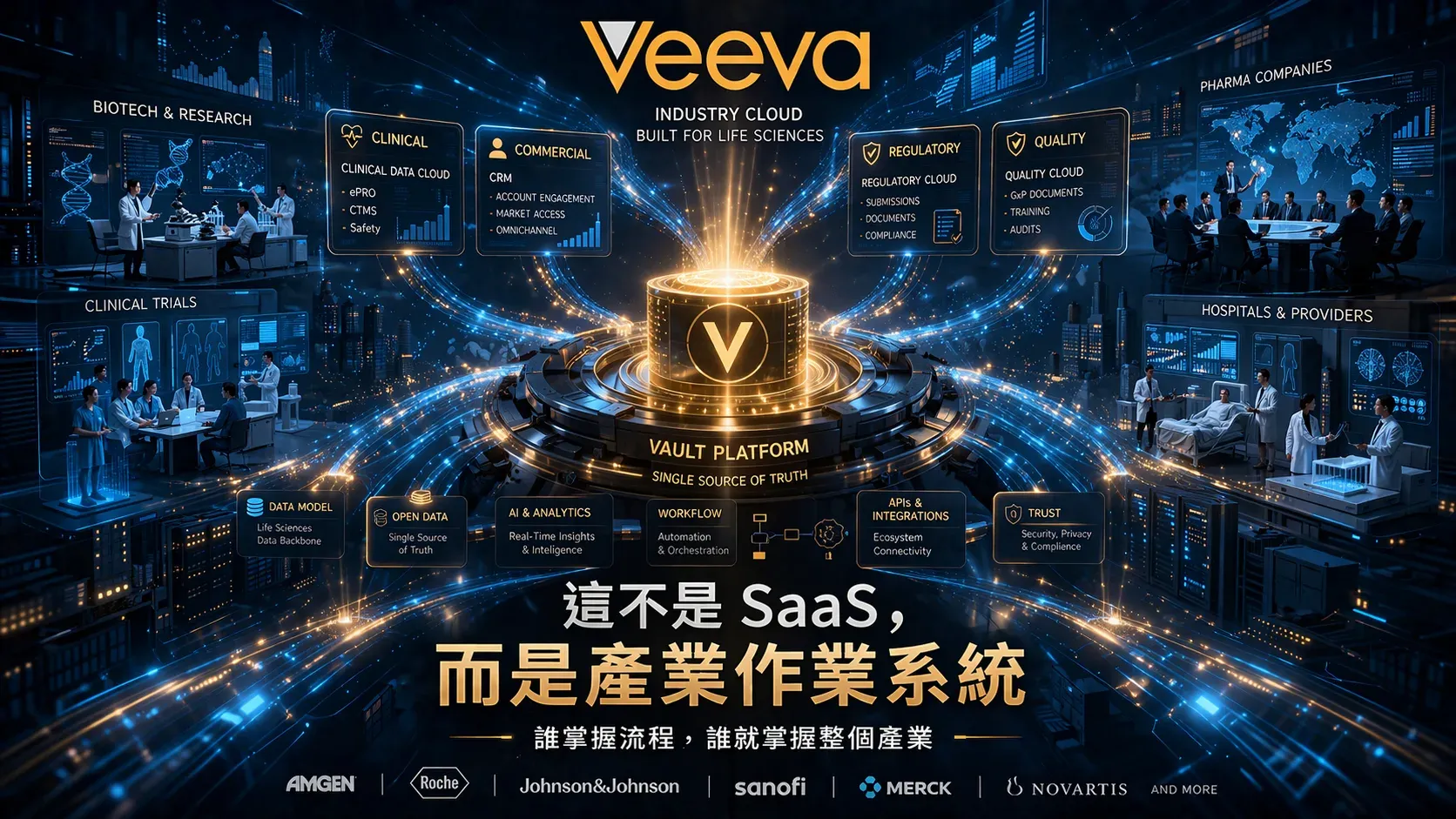
1. Starting with a Question: Which Vendor Does a Pharma Company Least Want to Replace?
Imagine you're the CIO of a mid-sized pharmaceutical company, reviewing next year's IT budget. On your desk is a report listing every piece of software spend that could be "optimized." You go through each line, checking off items to hand to your team for renegotiation or replacement.
But there's one vendor where your pen lingers on the line for a long time — and in the end, you quietly skip it.
That vendor is very likely Veeva.
Not because its software is particularly cheap, and not because the sales relationship is particularly good. It's because you know clearly: the cost of replacing Veeva far exceeds the cost of continuing to pay for it. Your clinical trial documents live there. Your FDA submission records live there. Your quality management system is built on its framework. Your field reps around the world use it every day to visit physicians. Replacing it would mean re-validating your systems, rebuilding processes, retraining staff, and risking documentation issues during an FDA inspection. That's a risk no CIO wants to take on.
This is the essence of Veeva Systems. It isn't the flashiest tech company, and it isn't the most exciting name in the AI era — but over the past fifteen years, it has quietly embedded itself into every core process of the global pharmaceutical industry, making itself something that "can't be replaced."
In an investing era chasing AI, chasing disruption, chasing explosive growth, Veeva represents a completely different investment proposition: certain compounding, not an uncertain bet.
2. What Veeva Actually Does: How a Company Becomes an Industry's Operating System
To truly understand Veeva, you first need to understand a fundamental predicament of the pharmaceutical industry: it's a "regulatory hell."
Developing a new drug, from initial compound screening to final launch, takes 10 to 15 years on average and costs more than $2 billion. Throughout this long process, every stage is strictly governed by the FDA, the EMA, and other national regulators. You must document every experiment, retain every file, track every adverse event, and manage every regulatory submission. A lapse anywhere along the way can, at best, delay a launch, or at worst, get an entire application rejected — and in the most severe cases, trigger huge fines and legal liability.
Before Veeva existed, pharma companies handled these problems with a chaotic patchwork: homegrown systems, Excel spreadsheets, paper documents, and scattered third-party software. Different departments used different systems, data couldn't flow between them, audit trails were a nightmare, and regulatory compliance was maintained manually.
When Veeva's founder Peter Gassner started the company in 2007, he spotted this opportunity. His core insight was: the pharmaceutical industry doesn't need generic enterprise software — it needs a vertical SaaS platform that deeply understands the industry's regulatory logic. He brought Salesforce's CRM architecture into life sciences, later expanding into clinical, regulatory, quality, and safety, gradually building a cloud platform that covers the entire drug lifecycle.
Today Veeva has two core business lines:
Veeva Commercial Cloud serves the commercial side of pharma companies — mainly a CRM system that lets field reps track physician visits, manage sample distribution, and log interactions. This sounds unremarkable, but all of the top 20 global pharmaceutical companies are Veeva CRM customers, and many small-to-mid-size pharma companies rely on it heavily as well. Veeva's share of this market exceeds 80% — essentially a monopoly.
Veeva Vault is a more complex, more deeply embedded product line serving the R&D and operations side of pharma companies. Under Vault sit more than a dozen modules: eTMF (electronic Trial Master File) manages clinical-trial documentation; RIM (Regulatory Information Management) tracks submission status across global markets; the Safety system manages drug safety reporting; QMS (Quality Management System) handles deviations, CAPAs, and change control; and PromoMats manages regulatory review of marketing materials. Every module is a critical tool deeply integrated into a pharma company's daily operations.
The design logic of this product matrix is a carefully engineered "multi-module lock-in strategy": the more Veeva modules a pharma company uses, the higher the overall cost of switching away. A company using only Veeva CRM has a switching cost that's still within an acceptable range; but a company simultaneously using CRM, eTMF, RIM, QMS, and Safety faces a cost and risk of replacing all its Veeva systems that's unbearable for any rational management team.
3. The Essence of the Moat: Why an "Industry Standard" Is Harder to Break Than Technology
When discussing the moats of tech companies, investors typically reach for a few frameworks: network effects, switching costs, economies of scale, intangible assets. Veeva has all of these, but its deepest moat is something often overlooked: it has become the industry's de facto standard.
What does "de facto standard" mean here? It means Veeva's presence has moved beyond the level of a "product choice" and into the realm of "how the industry operates." When a pharmaceutical company recruits a new Regulatory Affairs hire, the job description lists "familiarity with Veeva Vault RIM"; when a CRO (contract research organization) wants to serve large pharma clients, it must be able to operate on Veeva eTMF; when a newly funded pharma company is about to start clinical trials, it goes to Veeva to implement systems rather than evaluating alternatives, because consultants and industry veterans all tell them "everyone uses Veeva."
This dynamic of "everyone uses it" creates a self-reinforcing effect: the more customers Veeva has, the more familiar the industry becomes with Veeva, the lower the resistance for new customers to adopt Veeva, and the more Veeva's customer base grows. This isn't a technical moat — it's a social and institutional moat, far harder to replicate than technology, because technology can be imitated, but the operating habits and talent ecosystem an industry has built over decades can hardly be changed quickly.
More importantly, the pharmaceutical industry has an instinctive preference for "the standard." In an industry where every decision could be scrutinized by the FDA, choosing the "industry standard" is the safest defensive strategy. If you use a non-standard system and something goes wrong, you have to explain to regulators why you didn't use the widely accepted tool; but if you use Veeva, and nearly everyone else uses Veeva too, then "choosing Veeva" is itself an endorsement of reasonableness. This psychological logic continuously reinforces Veeva's standing.
A key framework to think through: the depth of a moat can be measured by "customer switching cost." But a more precise way to measure it is to ask: under what circumstances would a customer "rather keep paying than switch"? For Veeva's Vault RIM customers, the answer to this question is essentially "always" — because switching at any point means taking on uncertainty in the most sensitive area of regulatory compliance. This stickiness of "paying not because you like it, but because you have no choice" is the real moat.
4. Financial Structure: an Almost Perfect Income Statement
When analyzing growth tech companies, we're used to accepting a narrative of "losing money now, profitable in the future." That's true of Tempus AI, and true of most AI biotech companies. But Veeva is different — it's already a smoothly running cash-flow machine, and it doesn't ask you to believe in any future story.
The essence of software economics
operating margin
A clean capital structure
Share from subscriptions
Put these four numbers together, and you get a picture rarely seen among tech companies. A gross margin above 75% means more than 75 cents of every additional dollar of revenue stays with the company. A 44.9% operating margin means Veeva converts nearly half its revenue into operating profit — a top-tier figure even among mature SaaS companies. Zero long-term debt means the company doesn't rely on external leverage, keeping its financial structure extremely sound. And 90% subscription revenue means Veeva's revenue is highly predictable, largely insulated from market cycles.
But behind these numbers lies a more important logic worth understanding: Veeva's high margins don't come from squeezing customers — they come from the structural advantage of its business model. Once a product is established, has a regulatory-compliance framework built around it, and has a large customer base, the marginal cost of adding each new customer is extremely low. Veeva doesn't need a large sales force to convince customers — industry word of mouth and the standardization effect sell for it. It also doesn't need frequent, large-scale product overhauls — core regulatory-compliance needs are relatively stable, and changes are incremental, not disruptive.
The elegance of this business model lies here: its moat deepens at the same time its margins rise. Every new module launched adds revenue on top of an existing customer base, at nearly zero marginal cost. Every additional module a customer adopts raises their switching cost, and strengthens Veeva's pricing power. This is a virtuous compounding cycle.
5. AI's Role at Veeva: Not Disruption — Reinforcement
Against the backdrop of AI sweeping through the entire tech industry, one key question facing Veeva is: will AI disrupt it?
This question deserves to be taken seriously, because there's a reasonable line of concern behind it: if AI can automate document processing, regulatory review, and clinical data management, is there still a need for these existing, complex software systems? Could large AI companies like OpenAI, Anthropic, and Google step directly into a pharma company's IT ecosystem and make Veeva redundant?
The logic behind this concern is sound, but the conclusion is wrong. The reason: AI itself isn't a solution that can be directly deployed into a regulated environment — it needs a "container," a platform that has already been validated, already meets regulatory requirements, and already integrates historical data. And Veeva is exactly that container.
Veeva's AI strategy is, at its core, a logic of "AI as an add-on, not a replacement." It has rolled out a series of AI Agents on the Vault platform that can automate document classification, extract key information from regulatory documents, help draft standard sections of FDA submission materials, and auto-generate summaries for safety reports. These features directly boost how efficiently pharma companies use Veeva, while also raising Veeva's ARPU (average revenue per user) — because these AI features are priced as add-on modules or upgraded tiers.
The cleverness of this AI strategy: it doesn't disrupt Veeva's existing business logic at all — it adds a new revenue layer on top of that existing logic. Pharma companies don't need to replace Veeva because of AI — on the contrary, they need to buy Veeva's AI add-ons to enjoy AI-driven efficiency gains within Veeva's own system.
The deeper logic: Veeva's AI features run within an environment full of sensitive regulated data. Pharma companies can't send clinical trial data, regulatory submission documents, or quality-management records to an external AI service — that raises complex issues of data sovereignty, confidentiality agreements, and regulatory compliance. Veeva's AI runs inside the customer's own data environment — an advantage general-purpose AI tools can't easily replicate.
6. The ARPU Growth Path: From "a Single Tool" to "a Full Ecosystem"
Understanding Veeva's long-term growth logic hinges on understanding its ARPU (average revenue per user) growth path. Veeva's growth doesn't come primarily from adding new customers — it comes from existing customers adopting more modules, buying higher tiers, and adding on AI features.
Veeva's Net Revenue Retention (NRR) has long held above 110%, meaning that even without adding a single new customer, growth from existing customers alone can push Veeva's total revenue up more than 10% a year. This is an extremely strong business trait — it means customers aren't just "staying," they're "spending more."
7. The Real Shape of the Risks: Not Absent — Just a Matter of Time Horizon
Any honest investment analysis must confront risk directly. Veeva looks nearly perfect, but it does have some risk factors worth taking seriously.
In the near term, the most direct risk comes from the cyclicality of the pharmaceutical industry itself. When large pharma companies face a patent cliff (a blockbuster drug's patent expiring, with generic competition compressing revenue), or undergo large-scale M&A (which typically leads to IT-spending cuts post-merger), Veeva's growth rate can temporarily slow. In 2023, Veeva did indeed experience a stretch of slower growth caused by large-customer consolidation — a reminder to investors that it isn't entirely immune to pressure on the customer side.
Veeva was originally built on the Salesforce platform before later migrating to its own self-built Vault platform. Salesforce itself is actively pushing into the life sciences vertical, launching a Life Sciences Cloud aimed at pharma companies. While the market-share gap is currently still wide, this competition is worth tracking long-term. The CRM business is the part of Veeva relatively more exposed to challenge — switching costs are high, but they don't carry the same regulatory-compliance weight as Vault RIM.
AWS, Microsoft Azure, and Google Cloud are all actively expanding into the life sciences vertical. If a cloud giant decides to invest sufficient resources to replicate Veeva's product features and integrate them into its own cloud ecosystem, it could create competitive pressure over the long run. But the key counterargument: what these companies lack isn't technology — it's a deep understanding of the industry's regulatory landscape and an already-established FDA validation framework. That takes years of investment to build, not something that can be caught up to quickly.
Veeva's forward P/E typically runs between 35–45x, a valuation that reflects expectations of sustained 13–16% revenue growth and steadily improving margins. If growth falls short of expectations, or if AI add-on adoption doesn't move as fast as the market hopes, the valuation could face a correction. This isn't a problem with the company's fundamentals — it's a problem with market expectations.
But these three risks all share a common trait: they're long-term, slow-moving, and trackable. They don't carry the kind of binary risk seen at Tempus, where "if the model doesn't hold up, the whole thing collapses." Even in the face of competition, the erosion of Veeva's moat would be a slow process, giving investors ample time to observe and react.
8. Investment Strategy: the Right Way to Approach a Cash-Flow Asset
Veeva isn't a stock that will make you 100% in three months. That needs to be said plainly up front. Its true nature is a long-term compounding machine — while you hold it, what you're enjoying is sustained revenue growth, stable margins, and the valuation support that comes from a continually deepening moat.
For options traders, Veeva's characteristics make it very well suited to a Covered Call strategy. The reason is its relatively low IV (typically between 20–30%), meaning you don't have to bear much volatility risk while still collecting premium consistently by selling calls, lowering your cost basis over time. This strategy assumes you're willing to hold VEEV stock long-term and accept the possibility of having shares called away during a sharp rally.
While holding VEEV shares, sell calls each month with a Delta of roughly 0.20–0.25, targeting 1–1.5% in monthly premium income. Executing this when IV is elevated around earnings can capture richer premium. Well suited to using VEEV as the "defensive core" of a portfolio, continuously lowering your cost basis with a CC strategy.
Around VEEV's earnings, when IV briefly spikes, a Bull Put Spread is worth considering. Because VEEV's fundamentals are solid, a spread set below a major support level carries a relatively high win rate. The risk is a sharp drop triggered by a disappointing earnings report, but VEEV's fundamentals rarely fall far short of expectations.
9. TEM vs. VEEV: Two Investment Philosophies Within the Same Industry
In the previous installment of this series, we did a deep dive into Tempus AI. Placing these two companies side by side offers a rare opportunity: seeing, within the same industry, two starkly different investment theses coexist.
Growth driver: ARPU expansion + AI add-ons
Financial traits: high margins + zero debt + predictable
Risk type: slow erosion (observable, actionable)
Best for: investors who value certainty, hold long-term, and need stable cash flow
Options strategy: Covered Call, Bull Put Spread
Growth driver: shift in Data's revenue share + licensing expansion
Financial traits: high growth + persistent losses + cyclical
Risk type: binary validation (either the thesis holds, or it doesn't)
Best for: investors who accept uncertainty, have a view on the cycle, and use strict risk controls
Options strategy: Bull Put Spread, LEAPS calls
Neither of these companies is "better" than the other. They represent a fundamental question you, as an investor, must answer for yourself first: are you buying certainty, or are you buying possibility?
The price of certainty is: you have to accept that Veeva won't hand you a 5x or 10x explosive return. Its compounding is slow, visible, and predictable. The price of possibility is: you have to accept that Tempus's story might take 3 to 5 years to be validated, and along the way you could face enormous volatility, and might even be forced out at a loss before the story ever plays out.
A mature portfolio should hold both of these theses — but how much you allocate to each depends on your risk tolerance, holding period, and market view. In an environment like early 2026, with AI valuations running high and market uncertainty rising, a "high-certainty compounder" like VEEV may carry more value in a portfolio than at almost any point before.
10. Conclusion: the Most Boring Company Is Often the Best Long-Term Holding
Investing markets carry a deeply rooted bias: we like companies with a story, we like disruptive technology, we like explosive growth. That's not wrong — these traits sometimes do correspond to enormous wealth-creation opportunities. But what we often overlook is that the "boring" companies — the ones with no heart-racing story, that simply and quietly execute and keep making money — are often the most stable source of long-term compounding.
Veeva is exactly that kind of company. It doesn't do AI drug discovery, doesn't disrupt existing pharmaceutical processes, and doesn't tell a grand story about changing the world. What it does, stripped down, is help pharma companies keep their documents in order, keep their processes correct, and stay in regulatory compliance. That sounds unremarkable — but in an industry where "keeping your documents in order" can determine whether a drug ever makes it to market or gets sold worldwide, this "unremarkable" thing carries astonishing commercial value.
In the story of AI biotech, Tempus is the protagonist, and Veeva is the stage. The protagonist might rise and fall dramatically, but the stage — as long as the industry exists and the show goes on — will always be there, collecting rent for every performance.
One last question worth sitting with:
Most investors ask "who's going to change this industry?" But the question that really determines long-term wealth is a different one: "No matter who changes this industry, who's guaranteed to be the one collecting the toll?"
In the world of life sciences, Veeva's answer is: I am.
📚 AI BioTech Series
- Part 1: Tempus AI — the Only AI Biotech Turning Data Directly Into Cash
- Part 2: Veeva — the Most Underrated Cash-Flow Machine of the AI Era (this article)
- ← Back to the AI BioTech series overview