The Hidden Giant of the AI Generation: How the AIPO ETF Captures the 'Power Consumption' Super-Cycle
NVIDIA sells AI's brain; AIPO invests in the heart, blood vessels, and nervous system that let that brain run. No matter who wins the AI war, they'll need electricity — that's the most certain thing in the AI era, and it's the core investment logic behind AIPO.
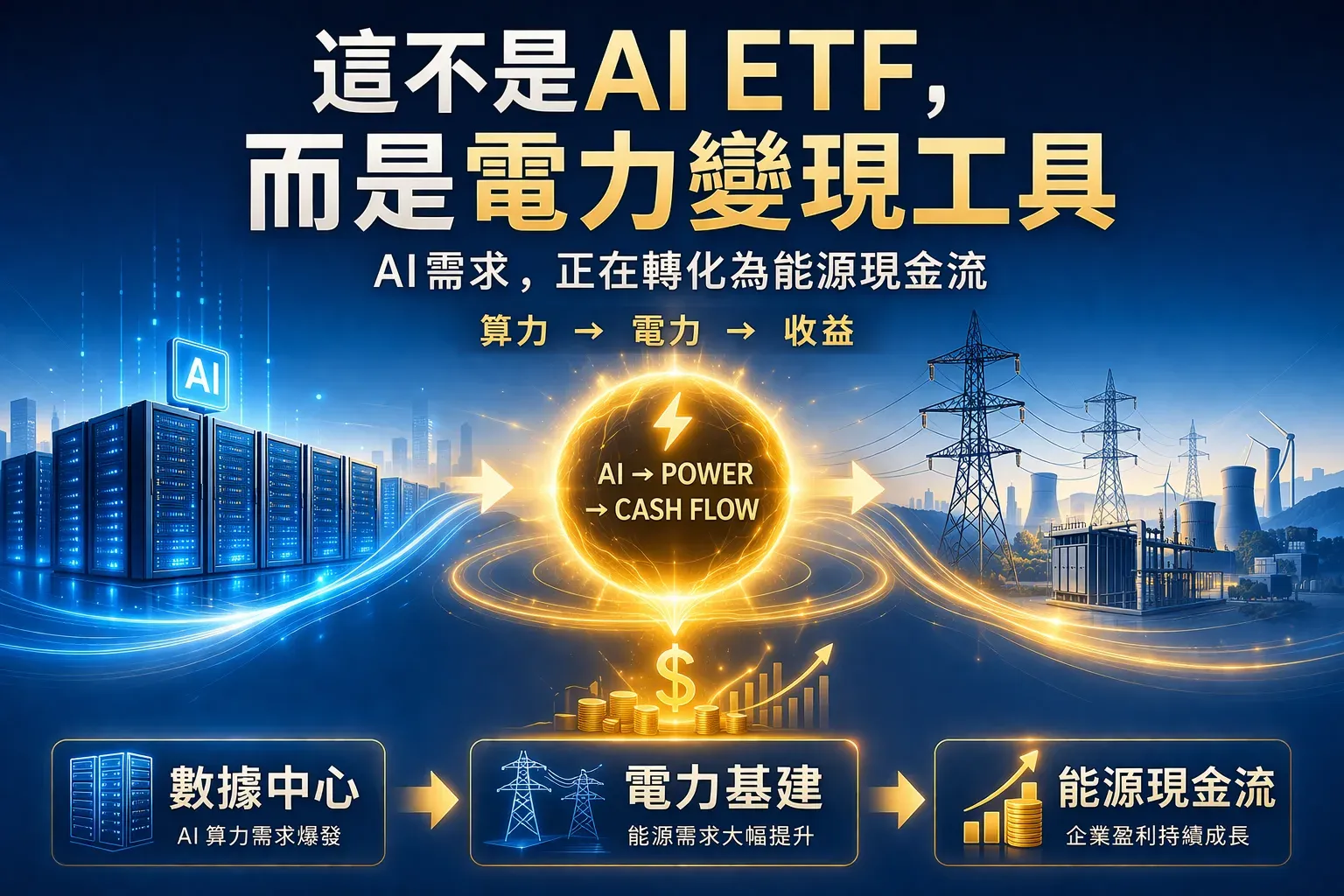
- AIPO doesn't invest in AI's "brain" (chips, models) — it invests in AI's "body," the physical infrastructure that lets the whole system run
- "No matter who wins the AI war, they'll need electricity" — AIPO is a pick-and-shovel strategy, not a bet on which company comes out on top
- The IEA forecasts global data-center power consumption will reach 1,000 TWh by 2030 — equivalent to recreating Japan's entire electricity consumption — a structural demand shift, not a cyclical fad
- Core risks: the thematic ETF's valuation is already elevated (P/E ~35–42x), it's less than two years old, and the Middle East conflict has introduced new geopolitical risk to AI power infrastructure
- Suggested positioning: a satellite position (5–15%), paired with STRL + FN to fill gaps in data-center construction and optical networking
1. When AI Needs Power: An Underrated Super-Cycle
The biggest investment theme since 2023 has been "artificial intelligence" — no argument there. NVIDIA is up more than tenfold in two years, and Microsoft and Google keep hitting new highs in market cap. But the next-level question is one most people haven't gotten to yet:
According to the IEA's latest forecast, global data-center power consumption will grow from roughly 500 TWh in 2024 to over 1,000 TWh by 2030 — equivalent to recreating Japan's entire national electricity consumption within six years. In the US, data centers' share of total national power consumption is accelerating from 2.5% in 2023 toward 8–10%.
- Combined 2025 data-center capex from the four hyperscalers — Microsoft, Google, Amazon, and Meta — exceeded $200 billion, and is expected to keep expanding in 2026
- A single ultra-large data center consumes 100–500 MW, equivalent to the power usage of 100,000–500,000 households
- Training a single large language model can consume more power than hundreds of households use in a year
- Vertiv (an AIPO holding) had a backlog of $15 billion in 2026, up over 100% YoY, with revenue visibility extending past 2027
This isn't a short-term speculative fad — it's a structural super-cycle. Just as the 2000s shale revolution kicked off an entire investment cycle in energy infrastructure, the rise of AI is driving a construction boom of comparable, or even greater, scale — the leading players have shifted from pipelines and steel to transformers, cooling systems, grid-upgrade equipment, and nuclear power plants.
AIPO (the Defiance AI & Power Infrastructure ETF) is an investment vehicle built directly on this logic. NVIDIA sells AI's brain; AIPO invests in the heart, blood vessels, and nervous system that let that brain actually function.
2. What Is AIPO? Fund Overview and Differentiated Positioning
AIPO, formally the Defiance AI & Power Infrastructure ETF, listed on NASDAQ on July 24, 2025, and is the first thematic ETF in the market focused specifically on the intersection of "AI and power infrastructure." Less than six months after launch, its AUM surpassed $100 million, and it now stands at roughly $160–190 million — the pace of inflows reflects how much the market has embraced this theme.
AIPO tracks the MarketVector US Listed AI and Power Infrastructure Index, with a core screening criterion of: US-listed, and at least 50% of revenue from AI and power-infrastructure-related business. That 50% threshold is the key differentiator — it ensures the holdings are "genuine" AI-power beneficiaries, rather than diversified conglomerates with only marginal exposure.
The coverage spans: decentralized energy technology, grid equipment and components, electric utilities, construction and engineering, data-center operations, and AI computing hardware. The expense ratio is 0.69%, a standard level among thematic ETFs.
3. How Do the Top 10 Holdings Form a Complete "Power to Compute" Supply Chain?
AIPO's top 10 holdings account for roughly 54% of total assets, positioned across four nodes of the AI physical-layer supply chain:
| Company | Ticker | Supply-Chain Node | Core Thesis |
|---|---|---|---|
| GE Vernova | GEV | Power Generation | The energy-technology company spun off from GE, spanning gas, nuclear, wind, and electrification equipment — one of the largest power-equipment suppliers in the world |
| Constellation Energy | CEG | Nuclear | The largest nuclear power generator in the US, which has already signed an agreement with Microsoft to restart the Three Mile Island plant to provide 24/7 baseload power for data centers |
| Bloom Energy | BE | Decentralized Energy | Solid oxide fuel-cell technology, generating power directly on-site next to a data center, bypassing grid bottlenecks |
| Eaton Corporation | ETN | Transmission & Distribution | Power-management business accounts for roughly 70% of revenue; the CEO has publicly stated data-center demand is "unprecedented," with strong order visibility |
| Hubbell | HUBB | Grid Equipment | A core supplier of switchgear, connectors, and distribution products needed for grid upgrades |
| Quanta Services | PWR | Grid Construction | North America's largest power transmission and distribution construction company, a direct beneficiary of grid upgrades and data-center interconnection work |
| Vertiv Holdings | VRT | Cooling & Power Management | A leader in data-center cooling and power management, with a $15 billion backlog in 2026, up over 100% YoY |
| NVIDIA | NVDA | Compute Hardware | The dominant player in the GPU market, held as "benchmark exposure" to ensure the portfolio doesn't miss the core compute name |
| Broadcom | AVGO | Chip Design | AI ASIC chips and networking semiconductors, the primary supplier of custom AI chips to Google and Meta |
| Cameco | CCJ | Nuclear Fuel | The largest uranium miner in the world, a direct beneficiary of the nuclear renaissance, supplying the key raw material for AI compute's long-term power source |
This supply chain forms a complete logical loop: nuclear fuel (CCJ) → power generation (GEV, CEG, BE) → transmission and distribution (ETN, HUBB, PWR) → facility management (VRT) → compute (NVDA, AVGO).
4. Where Are AIPO's Four Structural Advantages?
Selling Picks and Shovels, Not Betting on Who Strikes Gold
In a gold rush, the people selling picks and jeans often earn more reliably than the prospectors. The same logic applies to AI investing: no matter whether OpenAI or Google comes out ahead, no matter whether Llama or Claude is smarter, both need power, cooling, and data centers.
The DeepSeek episode is the best validation of this. When NVDA fell 17% in a single day on an efficiency breakthrough, power-infrastructure stocks declined far less — the market quickly realized that cheaper AI models don't reduce compute demand; they expand total demand by lowering the barrier to usage. This is Jevons Paradox playing out in real time in the AI era.
Structural Demand, Not a Cyclical Fad
The problem with traditional utility stocks is that their revenue is highly tied to the economic cycle. But AI data centers' power demand is different in nature: hyperscaler capex plans typically run 3–5 years, and once a data center breaks ground, power contracts are often 10–20 year agreements. Even if the economy slows, contracts already signed won't be canceled, and construction already underway won't stop. This gives AIPO's industrial holdings an important "backlog buffer."
A Dual Nuclear × Natural Gas Energy Strategy
What AI data centers need most is uninterrupted 24/7 baseload power — that's precisely nuclear's advantage, unlike weather-dependent solar or wind. Microsoft's restart of the Three Mile Island plant, and Google's and Amazon's aggressive push into small modular reactors (SMRs), are both reinforcing this trend. AIPO holds CEG (nuclear) and CCJ (nuclear fuel), giving it direct exposure to this structural shift.
Primarily Industrial Stocks — Realized Revenue, Not Future Expectations
AIPO's largest sector allocation is industrials (roughly 55%), not tech stocks. Industrial stock prices reflect more of "orders already signed" and "contracts already being executed," rather than the discounting of sentiment-driven future expectations. When tech stocks swing sharply on valuation corrections, industrial stocks tend to hold up better thanks to the visibility of their order backlog.
5. Risks You Can't Ignore: Valuation, History, Geopolitics
- Elevated valuation: AIPO's P/E is roughly 35–42x, far above the traditional industrial-stock historical average of 15–25x. If AI capex slows, high-valuation industrial stocks could correct more sharply than pure tech stocks
- The historical lesson of thematic ETFs: the metaverse ETF, clean-energy ETFs, and cannabis ETFs all crashed 60–80% after listing at the peak of hype. AIPO listed in July 2025, after AI infrastructure had already run up — investors need to honestly assess whether the current valuation is already fully pricing this in
- New geopolitical risk: in 2026, Iran's drone strikes on AWS data centers in the UAE and Bahrain established for the first time that "data centers are legitimate military targets in modern armed conflict." This will change site-selection logic and insurance pricing for AI infrastructure, adding uncertainty to Gulf-region construction plans
- Liquidity and track-record limitations: AUM of roughly $160–190 million, average daily volume of roughly 250,000 shares — large institutional positions could face slippage; less than two years old, untested through a full market cycle
- Model-efficiency breakthrough risk: if a DeepSeek-scale efficiency revolution occurs again, the growth curve of compute demand could slow, though it's unlikely to go to zero (see Jevons Paradox)
6. How Does AIPO Differ From Similar ETFs?
AIPO's unique positioning: it sits between traditional infrastructure ETFs and pure AI-tech ETFs, offering an "AI physical layer" exposure combination that other ETFs can't easily replicate.
7. Putting It Into Practice: How Does AIPO Fit Into Your Portfolio?
Positioning as a Satellite Holding (5–15%)
AIPO is best used as a satellite position in a portfolio, not a core holding. We recommend pairing it with a broad-market ETF (SPY or VTI) as the core, with AIPO providing thematic enhancement. Investors with higher risk tolerance can raise this to 15–20%, but must accept higher volatility.
A Three-Part Combination to Fill Supply-Chain Gaps
AIPO covers most of the AI physical layer, but has two important gaps:
- Data-center construction: Sterling Infrastructure (STRL) — specializing in the foundational, electrical, and civil engineering for data centers; its E-Infrastructure segment backlog grew 78% YoY in 2025, with visibility approaching $4.5 billion
- Optical network connectivity: Fabrinet (FN) — precision manufacturing of high-speed optical transceivers for data centers, a direct beneficiary of 800G/1.6T optical-module upgrade demand
A three-part combination of "AIPO + STRL + FN" covers the full AI physical-layer supply chain.
Pairing With Options Strategies
AIPO's own options market isn't yet liquid, but options strategies can be applied to its top individual holdings:
- Run a Bull Put Spread on GEV, ETN, and VRT — taking advantage of these stocks' high IV to sell puts below a support structure and collect richer premium
- Run Covered Calls on shares you already hold — actively harvesting theta decay while retaining thematic exposure
A hybrid strategy of "ETF core holding + individual-stock options" lets you enjoy growth from the AI infrastructure theme while actively managing risk and boosting cash flow.
8. The Next Five Years: AIPO's Performance Under Three Scenarios
Probability-weighted, the expected annualized return falls in the range of roughly 8–14%. But a thematic ETF's actual path is usually full of sharp swings, far from linear growth. Investors need adequate psychological preparation and position-management discipline.
Conclusion: "Using Electricity" Is the Most Certain Thing in the AI Era
The world of AI investing is full of uncertainty: who wins the model race? Which application will actually monetize? When will the next DeepSeek show up? When will the hyperscaler capex wave stop?
No one can give a definitive answer to these questions.
But one thing is almost certain:
No matter the outcome, AI will need electricity. Large amounts of it, reliably, and continuously growing.
And this demand is no longer "a future possibility" — it's "happening right now": orders are signed, contracts are in place, groundbreaking has begun.
AIPO doesn't ask you to guess who will win — it lets you invest in "the thing everyone needs, no matter who wins."
In the AI era, that's a rare kind of certainty you can actually verify with orders and contracts.
Disclaimer: All content in this article is for research and educational reference only and does not constitute investment advice. The stocks or ETFs mentioned are for illustrative purposes only and do not represent any buy or sell recommendation. Investors should judge and bear the corresponding risk according to their own risk appetite, financial situation, and investment goals.