The Full Atlas of 7 AI Infrastructure Long-Term Holdings: Conservative / Balanced / Aggressive Portfolio Allocations (2026-2030)
The decade-long wave has already begun: hyperscaler 2026 capex reaches $660 billion, with AI accelerator CAGR at 54-56%. This research starts from the seven-layer AI factory stack to introduce seven candidates -- TSM, NVDA, ALAB, FN, Delta Electronics, VRT, and Auras -- and provides Conservative, Balanced, and Aggressive portfolio allocations so investors with different risk appetites can find the AI infrastructure position that suits them.
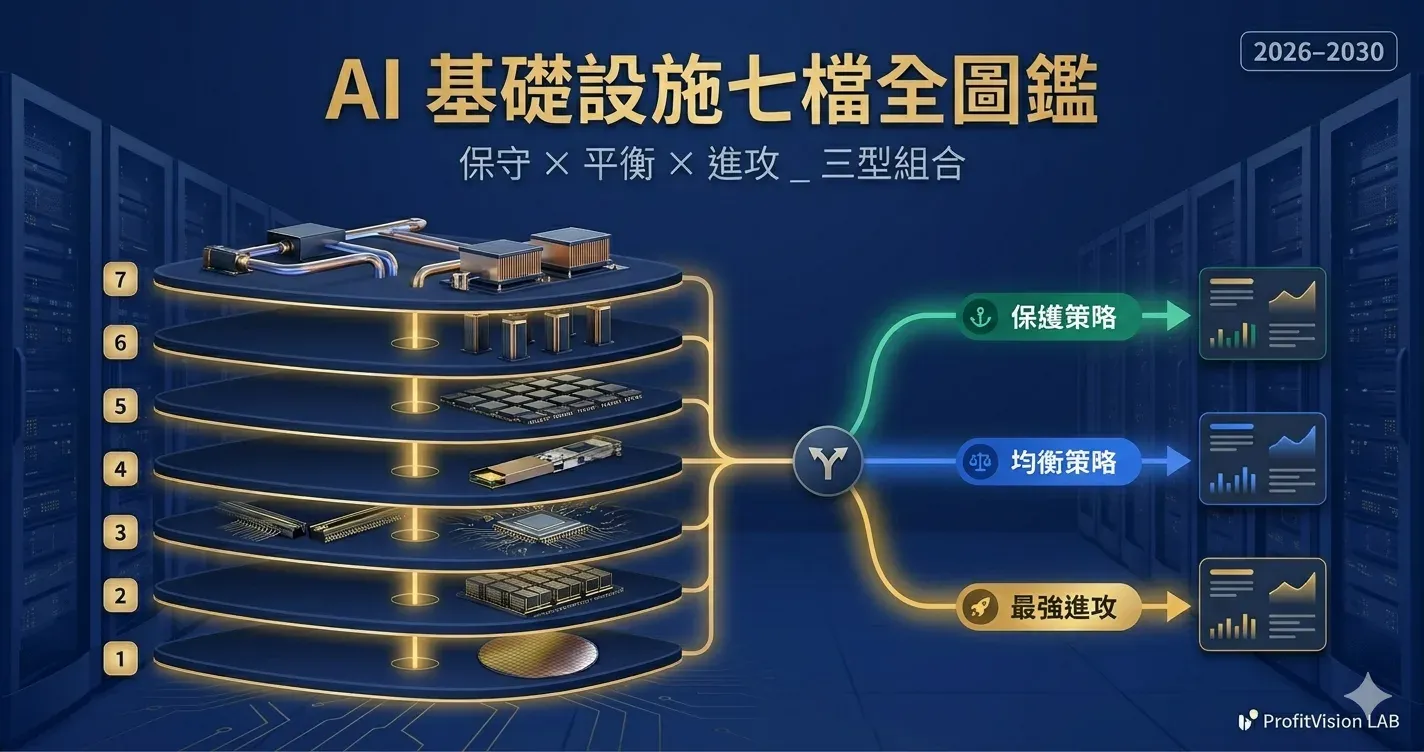
The decade-long wave has already begun. Seven candidates, three risk profiles — find the AI infrastructure allocation that's right for you
2026.05.01 | Shiba the Disciplined | ProfitVision LAB | Data in this research as of the 2026/5/1 close
Why Look at AI Infrastructure Now?
The premise for any long-term holding is: this industry's growth needs to last at least 5 more years. If AI infrastructure is just a two-year short-term frenzy, then any allocation is simply a bet on being the last one holding the bag. Before introducing individual stocks, let's confirm the length of the cycle with three key numbers.
Three Key Numbers to Gauge the Cycle Length
Number One: $660–690 billion. This is the combined 2026 capex of the five hyperscalers — Amazon, Microsoft, Alphabet, Meta, and Oracle — nearly double the $443 billion spent in 2025. Goldman Sachs estimates the 2025–2027 cumulative total will reach $1.15 trillion, more than double what was spent from 2022–2024. Cathie Wood's ARK Invest "Big Ideas 2026" report goes further, forecasting total AI infrastructure investment will reach $1.4 trillion by 2030.
Number Two: a 54–56% CAGR. This is the "2024–2028 AI accelerator chip revenue CAGR" TSMC gave at its 2026 Q1 earnings call. What's notable is that this number was revised upward — Chairman C.C. Wei explicitly stated during the call: "We're now moving from generative AI to agentic AI, and that's driving an explosion in token volume and compute demand." When the company with the clearest read on demand keeps revising its outlook higher, it means the cycle is nowhere near its peak.
Number Three: a 7–8 year investment cycle. In a CNBC interview in February 2026, NVIDIA CEO Jensen Huang stated bluntly that the current AI buildout is "the largest infrastructure project in human history," with roughly 7–8 more years of investment cycle ahead. Why so confident? Because he sees that deploying AI infrastructure is already generating cash flow for operators — this isn't a bubble-driven arms race, it's expansion backed by real economic returns.
The Bottleneck Has Shifted: From "Compute" to "Systems"
In 2023, the bottleneck in AI investment was "not enough GPUs," so NVIDIA alone captured most of the windfall. But the 2026–2030 bottleneck has changed:
| Bottleneck | 2023 Solution | 2026–2030 Solution | Corresponding Industry Position |
|---|---|---|---|
| Compute | Buy NVIDIA GPUs | NVIDIA + custom ASICs + advanced packaging | NVDA, TSM |
| Bandwidth | InfiniBand | 1.6T/3.2T optics, CPO, PCIe 6/7, UALink | FN, ALAB |
| Power | Traditional 12V/48V bus | HVDC high-voltage DC, smart power distribution | Delta Electronics, VRT |
| Cooling | Air-cooled fans | Direct liquid cooling, full-rack water-cooling modules | Auras, VRT |
| Manufacturing | 5nm/7nm | 3nm/2nm + CoWoS-L advanced packaging | TSM |
This is exactly why this research deliberately covers the five bottlenecks of "manufacturing, compute, bandwidth, power, and cooling" — not random diversification, but each one mapping to a real position in the AI infrastructure supply chain, each one an unavoidable link in the decade-long wave.
Chapter 2: The Seven-Layer AI Factory Stack | A Full Map of the 7 Candidates
Think of an AI data center as a factory — it needs "manufacturing equipment, a running production line, raw-material delivery, power supply, and a cooling system" to operate. These seven candidates map onto the seven critical layers of this AI factory:
There's a common standard behind choosing these seven: "an unavoidable step in the industry" — the AI factory cannot skip any of these links. Without TSM's manufacturing, AI chips can't be produced; without NVDA's platform, AI training can't happen; without ALAB's connectivity IP, in-server bandwidth can't scale; without FN's contract manufacturing, optical modules can't be mass-produced; without Delta Electronics / VRT's power systems, the data center can't run; without Auras's cooling, a 600kW rack would simply overheat and burn out.
But seven names doesn't mean you need to buy all seven — this is a "candidate pool," not a "shopping list." The next chapter briefly introduces each name's core characteristics, and Chapter 4 gives concrete allocation recommendations based on three risk-profile types.
Chapter 3: In-Depth Quick Look at the Seven Stocks
Each name is summarized from four angles — core positioning, latest data, the long-term case, and key risks — to quickly build a foundation for judgment.
① TSM (TSMC ADR) (NYSE: TSM / TPE: 2330)
Core Positioning: While everyone argues over who will win the AI race, TSMC is the one guaranteed winner — because every AI chip is manufactured in its fabs. NVIDIA's 60%+ of CoWoS capacity, AMD's MI series, Broadcom's custom ASICs, and Marvell's custom silicon all depend on TSM.
Latest Data (updated 5/1): 2026 Q1 revenue of $35.9 billion (+40.6% YoY), gross margin of 66.2% (well above the top of guidance), with HPC at 61% of revenue. Management directly raised its full-year 2026 revenue growth outlook from "close to 30%" to "over 30%." CoWoS capacity plans call for expanding from 35,000 wafers/month at the end of 2024 to 125,000–130,000 wafers/month by the end of 2026.
The Long-Term Case: 2nm is already in mass production, and A16 (1.6nm) enters mass production in H1 2027, putting it at least two generations ahead of Samsung and Intel; pricing power is proof of its monopoly position (3nm carries a 5% premium, CoWoS a 10–20% premium); at a forward P/E under 20x, it's the cheapest of the seven names.
Key Risks: Geopolitics (cross-strait tensions, the US-China tech war, CHIPS Act subsidy conditions); early-stage margin dilution from overseas fabs; a downturn in the AI demand cycle (no signal of one currently).
② NVDA (NVIDIA) (NASDAQ: NVDA)
Core Positioning: NVIDIA isn't just a GPU seller — it's the "platform company" that defines the entire AI technology stack. The CUDA ecosystem, NVLink interconnect, and Spectrum-X networking are all high-switching-cost lock-ins that customers can't easily escape.
Latest Data (updated 5/1): FY26 Q3 revenue of $57.0 billion (+62% YoY), with data center revenue of $51.2 billion (89.8% of the total). Visible orders for the Blackwell and Rubin platforms have reached $500 billion. Shares hit a 52-week high of $216.83 on 4/28, pushing market cap past $5.26 trillion — the highest-valued public company in the world. Forward P/E is 24.97x, with a median analyst consensus target price of $266.24 (implying +22.9% upside).
The Long-Term Case: The Vera Rubin platform enters mass production in H2 2026, with Rubin Ultra in H2 2027, keeping the product cadence a step ahead of customers' own capex planning; the software layer (CUDA, NIM, Omniverse) keeps deepening switching costs; the NVLink Fusion ecosystem locks even third-party custom ASICs into NVIDIA's revenue base.
Key Risks: Customer in-house development (Google TPU, AWS Trainium, Meta MTIA); continued insider selling (6.5 million shares sold over the past 12 months); policy risk (after the Supreme Court struck down Trump's blanket IEEPA tariffs in April, Trump pivoted to a proposed 15% universal tariff — worth tracking).
③ ALAB (Astera Labs) (NASDAQ: ALAB)
Core Positioning: A connectivity IP designer that only went public in 2024, but has already become the de facto standard for connectivity within AI racks. Its product line includes the Aries PCIe Retimer (at least one in every NVIDIA AI server), the Scorpio PCIe/Ethernet Switch, and the Smart Cable Module.
Latest Data (updated 5/1): Full-year FY2025 revenue of $852.5M (+115% YoY), Q3 Non-GAAP gross margin of 76.4%, Non-GAAP operating margin of 41.7%, and its first full year of substantial GAAP profitability (GAAP net income of $219.1M). Shares trade around $193 with a market cap of $32B and a forward P/E of 41.7x (TTM 126.3x). Q1 2026 earnings are due 5/5, the most important near-term catalyst in this portfolio.
The Long-Term Case: Management has publicly projected the TAM will grow 10x over 5 years to $25 billion; its protocol-neutral advantage (supporting PCIe, UALink, CXL, NVLink, and Ethernet simultaneously) makes it the safest choice for customers; Morgan Stanley named ALAB one of its three top AI chip picks for 2026, alongside NVDA and Broadcom.
Key Risks: Extremely stretched valuation (TTM P/E of 126x, forward P/E of 41x — the market has already priced in 3x EPS growth); customer concentration among hyperscalers (in-house development by any one of NVIDIA, AWS, or Google would hit its core business); competition between UALink and NVIDIA's NVLink Fusion standard; still a mid-cap stock, where a single piece of bad news could trigger a 30%+ drawdown.
④ FN (Fabrinet) (NYSE: FN)
Core Positioning: A precision optical-component contract manufacturer listed via Thailand operations — nearly all high-end optical transceivers are assembled in FN's facilities. NVIDIA, Coherent, and Lumentum are all major customers. As 1.6T and 3.2T optical networking becomes standard, FN is an unavoidable manufacturer.
Core Characteristics: A "manufacturing services" business model (gross margin of roughly 12%) — low margin but extremely sticky customers. FN doesn't need to lead on technology; it just needs to keep being "the contract manufacturer with the highest optical-module yield" to earn steady profit. FY25 revenue of roughly $3.3 billion, net margin of ~10%, ROE of roughly 16%, and zero debt.
The Long-Term Case: Benefits from the long-term trend of 1.6T → 3.2T optical-networking generational upgrades; better customer diversification than peers; a debt-free balance sheet; stable free cash flow.
Key Risks: Pure contract manufacturing means low margins and weak pricing power (unlike ALAB, which earns IP economics); geographic concentration in Thailand exposes capacity to political or natural-disaster risk; valuation has already moved from undervalued to a reasonable range (forward P/E of roughly 20x).
⑤ 2308 (Delta Electronics) (TPE: 2308)
Core Positioning: A global leader in high-efficiency power conversion — busbars, power whips, and rectifier modules inside AI racks are all Delta's strengths. As rack power draw rises from 30kW to 600kW, differentiation in power-conversion efficiency and density becomes magnified, and Delta is a long-standing partner in NVIDIA's rack reference designs.
Core Characteristics: Spans three pillars — power electronics, automation, and EVs — with AI server power the strongest growth driver from 2024–2027. 2025 revenue of roughly NT$480 billion, gross margin of roughly 28%.
The Long-Term Case: AI rack power is upgrading to 800V HVDC, with new designs lifting ASP and margins; certified by NVIDIA as one of the primary power suppliers for GB200/GB300 racks; its automation and EV businesses diversify away from single-theme AI risk.
Key Risks: Relative to VRT, it's a "component vendor" rather than a "whole-facility systems vendor" — as customer demand concentrates toward full-solution providers, component makers can see margins squeezed; Taiwan-market liquidity is less friendly to foreign investors; geopolitical risk is concentrated in Taiwan.
⑥ VRT (Vertiv) (NYSE: VRT)
Core Positioning: Every new AI data center adds another order to VRT's book. It offers an end-to-end "Grid-to-Chip" solution spanning power, cooling, and monitoring, and is a co-design reference-architecture partner for NVIDIA's GB200 NVL72 racks — nearly the de facto industry standard.
Latest Data (updated 5/1): Q1 earnings released 2026/4/22 beat across the board — revenue of $2.65 billion (+30% YoY), Adj. EPS of $1.17 (vs. an estimate of $1.02), Adj. operating margin of 20.8% (+430bps YoY). Full-year guidance was raised at the same time (the second raise in two quarters): FY26 revenue of $13.5–14.0 billion, Adj. EPS of $6.30–6.40. On 2026/4/30, it acquired Strategic Thermal Labs LLC, further strengthening its liquid-cooling technology.
The Long-Term Case: Backlog holding at a record $15B level, with a book-to-bill ratio consistently above 1.0; the liquid-cooling market is growing at a 25–40% CAGR; management's 2030 operating-margin target is 28–32% (vs. 22.3% currently); recurring service revenue provides sustained cash flow.
Key Risks: Elevated valuation (TTM P/E of roughly 70x); Schneider Electric has already reached rough market-share parity with VRT in liquid cooling; whether manufacturing capacity can keep up with the backlog is an execution risk.
⑦ Auras 3017 (TPE: 3017)
Core Positioning: Among Taiwan's "big three" cooling names (Chaun-Choung, Auras, Asia Vital Components), Auras is the one with the strongest integration capability. It has landed all four major customers — NVIDIA, AMD, AWS, and Google — making it one of the few Taiwanese cooling names with genuinely diversified customer exposure.
Latest Data (updated 5/1): March 2026 revenue of NT$18.017 billion (+111.72% YoY, +28.54% MoM); Q1 2026 cumulative revenue of NT$49.038 billion (+110.17% YoY). Analysts estimate full-year 2026 EPS of NT$54.82–96.52. However, the share price has already risen sharply from NT$1,370 at the time of v1 to a range of NT$2,030–2,520 by 5/1, a gain of 50%+. Forward P/E has risen from 17x to a range of 25–35x.
The Long-Term Case: Holds an initial 40–45% share of Google's TPU V8 water-cooling plates, with this single line of business estimated to contribute NT$10 billion in 2026 revenue; the 2027 TPU shipment outlook is optimistic (an estimated 3.7 million units, +76% YoY); its Vietnam plant expansion supports both the GB300 and TPU V8 product lines simultaneously.
Key Risks: The stock has already run up substantially, so the "cheap entry opportunity" has largely disappeared; customer concentration in AI servers; Chaun-Choung and Asia Vital Components are competing for the same orders; Taiwan-market liquidity is less friendly to foreign investors.
Chapter 4: Three Portfolio Allocations | Choosing the Risk Profile That Fits You
Each of the seven stocks has its own character, but readers have different risk appetites — retirees need stability, younger investors can tolerate volatility, and some fall somewhere in between. Below are three portfolio allocations; choose based on your own risk tolerance, investment time horizon, and overall asset allocation.
- All three cover the four bottlenecks of "manufacturing, compute, cooling, and power" — the difference is the mix of "growth vs. stability"
- You don't need to hold all seven — the conservative portfolio uses 4 names, the balanced portfolio uses 5, and the aggressive portfolio uses 6
- The weightings are a directional guideline and can be fine-tuned to your own capital size
- All three are meant to be bought and held for 3–5 years, not suited to short-term trading
① Conservative | "Core Holdings + Stable Cash Flow"
| Name | Weight | Role |
|---|---|---|
| TSM (TSMC ADR) | 40% | Foundational manufacturing, the cheapest-valuation anchor |
| NVDA (NVIDIA) | 30% | Compute core, highest certainty |
| FN (Fabrinet) | 15% | Steady cash flow, zero debt |
| 2308 (Delta Electronics) | 15% | High-AI-purity Taiwan name, growth and stability combined |
Design Logic: The core of the conservative portfolio is "choosing names with reasonable valuations, deep moats, and relatively low volatility." TSM's forward P/E <20x, NVDA's <25x, and FN's ~20x are the three most reasonably valued names in the portfolio; Delta Electronics adds a Taiwan AI theme without exaggerated growth or valuation.
Which Names Are Excluded: ALAB (extreme valuation), VRT (elevated valuation), and Auras (already rallied hard). These three have high growth potential but also high volatility, unsuited to the conservative profile.
Expected Return Range: +60–110% cumulative over 5 years, roughly 10–16% annualized. Downside risk is relatively small (roughly -15–20% in a bear market).
② Balanced | "Growth and Stability Together"
| Name | Weight | Role |
|---|---|---|
| TSM (TSMC ADR) | 30% | Foundational manufacturing |
| NVDA (NVIDIA) | 25% | Compute core |
| VRT (Vertiv) | 20% | Power & cooling systems vendor, strongest order visibility |
| 3017 (Auras) | 15% | Thermal integration, best customer diversification |
| FN (Fabrinet) | 10% | Steady cash flow |
Design Logic: The balanced portfolio builds on the conservative one by "replacing some of TSM with VRT and adding Auras to cover the cooling layer." VRT's valuation is elevated (70x P/E), but its Q1 earnings beat across the board with guidance raised twice, confirming growth momentum; Auras has already rallied, but the AI factory can't do without a cooling layer, and a 15% weight is a reasonable exposure.
Which Names Are Excluded: ALAB (highest valuation risk ahead of the 5/5 earnings release) and Delta Electronics (role overlaps with VRT, so it's omitted since VRT is already included).
Expected Return Range: +90–160% cumulative over 5 years, roughly 13–19% annualized. Downside risk is moderate (roughly -25–30% in a bear market).
③ Aggressive | "High Growth + High Volatility"
| Name | Weight | Role |
|---|---|---|
| NVDA (NVIDIA) | 30% | Compute core |
| ALAB (Astera Labs) | 22% | Connectivity IP, fastest growth |
| VRT (Vertiv) | 18% | Power & cooling systems vendor |
| TSM (TSMC ADR) | 15% | Foundational manufacturing, provides downside protection |
| 3017 (Auras) | 10% | Thermal integration |
| FN (Fabrinet) | 5% | Stabilizing allocation |
Design Logic: The aggressive portfolio moves ALAB (the connectivity IP designer) up to the second-largest position at 22%, since ALAB has the highest growth rate of the seven (FY2025 revenue +115%, gross margin 76.4%). NVDA remains the largest position at 30%, but TSM's anchor role is cut to 15%, freeing up room for the two high-beta growth names, VRT and ALAB.
Which Names Are Included: All six names except Delta Electronics, which is excluded because it overlaps with VRT and has more modest growth.
Expected Return Range: +130–250% cumulative over 5 years, roughly 18–28% annualized. Downside risk is high (roughly -40–50% in a bear market).
Comprehensive Comparison of the Three Portfolios
| Dimension | Conservative | Balanced | Aggressive |
|---|---|---|---|
| Number of holdings | 4 | 5 | 6 |
| Weighted forward P/E | ~22x | ~28x | ~32x |
| Weighted revenue growth | +30% | +38% | +45% |
| 5-year expected annualized return | 10–16% | 13–19% | 18–28% |
| Bear-market downside (20% probability) | -15–20% | -25–30% | -40–50% |
| Largest single position | TSM 40% | TSM 30% | NVDA 30% |
| Discipline required | Low | Medium | High |
Selection principles:
- Choose Conservative if AI exposure would exceed 30% of your total assets, you can't tolerate a 30%+ short-term drawdown, or this is your first time investing in the AI theme
- Choose Balanced if you already have a basic understanding of AI, can tolerate a roughly -30% bear-market correction, and want "growth and stability together"
- Choose Aggressive if you're young, have a 5+ year investment horizon, can accept a -50% bear-market correction, and treat AI as a long-term theme worth a heavy bet
Chapter 5: Entry Pacing and a Discipline Framework
Choosing an allocation type is only step one — more important is "how to build the position, how to track it, and when to adjust it." The biggest enemy of long-term holding isn't the market — it's your own emotions.
Staggered Entry: Avoid Going All-In at Once
Regardless of which portfolio type you choose, we don't recommend deploying your full target capital in one shot. Short-term market swings can be extreme, and a single entry could land you at a local high. We suggest splitting each stock's target weight into 3 staggered tranches:
| Tranche | Entry Timing | Position Share | Rationale |
|---|---|---|---|
| First tranche | Enter immediately (establish the position) | 40% | Avoid missing the trend, while keeping flexibility |
| Second tranche | On a pullback to the 50MA within 3–6 months | 35% | Wait for a technical correction before adding |
| Third tranche | After earnings season or a major event | 25% | Reserved for an unexpected good price |
Key Events to Track in May
Two major earnings events land in May 2026, and readers can adjust their pacing around them:
- If it beats: consider moving ALAB into the second tranche
- If it misses: hold off on ALAB entry and reassess whether to lower its weight
- If guidance holds at +30%+ growth: move NVDA into the second tranche
- If guidance is cut: hold off and reassess overall AI capex assumptions
Tracking Cadence: Establishing an Annual Review Mechanism
Exit Conditions: When Should You Cut Losses?
A long-term holding doesn't mean "never sell" — it means "don't sell unless there's a structural break." Set clear "exit conditions" to avoid panic-selling on short-term volatility:
- TSM: loses its N2/A16 process-node lead, or a major geopolitical escalation occurs (e.g. armed conflict across the Taiwan Strait)
- NVDA: a structural break appears in the CUDA ecosystem, or forward P/E rises above 50x
- ALAB: loses order share from NVIDIA or AWS, either of its major customers
- VRT: backlog shrinks by more than 20% for two consecutive quarters, or the book-to-bill ratio falls below 1.0
- Auras: loses its share of Google TPU V8 water-cooling business (falling from 40–45% to below 25%)
- FN: loses NVIDIA or a major optical-networking customer
- Delta Electronics: loses its certification as a primary power supplier for NVIDIA racks
A simple "short-term price drop of 30%" is not an exit condition — it's a moment to check whether the fundamentals have broken. If the fundamentals are intact, the decline is a buying opportunity; if the fundamentals have broken, cutting losses is disciplined execution.
Chapter 6: Options Overlay Strategies (For Advanced Readers)
For readers familiar with options-selling strategies, this portfolio can be further layered to enhance overall returns. This section is advanced content — readers unfamiliar with options can skip directly to Chapter 7.
Layering Principles
| Name | Recommended Strategy | Rationale |
|---|---|---|
| TSM, NVDA, Auras | Hold shares outright | Reasonable valuation, build a share position to capture long-term compounding |
| NVDA (partial) | Bull Put Spread to add on pullbacks | Higher volatility, seller-friendly |
| VRT, ALAB | Don't hold shares directly, sell puts to accumulate | Valuation is elevated — use put-selling instead of buying shares, use premium to lower the cost basis |
| FN, Delta Electronics | Hold shares outright | Lower volatility, not well suited to seller strategies |
General Principles for Seller Strategies
The core of an options-seller strategy is "exchanging premium for taking on downside risk." When an investor is bullish long-term but wants a "cheaper entry," a seller strategy is an effective tool. General principles:
- Delta 0.20–0.25: set the strike where the stock would need to fall meaningfully to be assigned
- DTE 30–45 days: the sweet spot for time-decay (theta) efficiency
- IV Rank ≥ 30: enough volatility premium for the seller to earn a reasonable return
- Set the strike below a key support level: technicals provide a margin of safety
- Exit conditions: close early at 50% of max profit, or cut losses at 1x the premium collected
- Avoid earnings week: event-driven volatility is too high, unsuited to selling
Options strategies require a concrete read on each name's volatility, technicals, and IV Rank. This section only offers general principles — for specific entry structures, readers should consult ProfitVision LAB's Options Trading System SOP series.
Chapter 7: Scenario Analysis | Where Will the Portfolio Be in Five Years?
The valuation of a long-term holding shouldn't be judged against next year, but against 3–5 years out. We use 2030 as the endpoint and run three scenarios. None of these scenarios predicts a single target price — they're relative projections only.
Core Assumptions Behind the Three Scenarios
| Scenario | Probability (subjective) | Core Assumptions |
|---|---|---|
| Bull "The AI Golden Decade" |
30% | AI capex keeps growing strongly through 2030, agentic AI is fully deployed, hyperscalers keep expanding, no major geopolitical shock |
| Base "Growth Slows but Continues" |
50% | Capex growth slows to 15–20% in 2027–2028, valuation multiples compress, leading companies' fundamentals keep growing |
| Bear "AI Overcapacity or Shock" |
20% | Capex turns negative in 2027–2028, a geopolitical shock hits, customer in-house development accelerates, valuations compress sharply |
How the Three Portfolios Perform Under the Three Scenarios
| Portfolio | Bull (30%) | Base (50%) | Bear (20%) | 5-Year Expected Cumulative Return |
|---|---|---|---|---|
| Conservative | +150% | +85% | -15% | +85% (~13% annualized) |
| Balanced | +220% | +115% | -25% | +118% (~17% annualized) |
| Aggressive | +310% | +155% | -45% | +162% (~21% annualized) |
Key Observations
Observation One: A Clear Risk-Return Trade-off. Moving from Conservative to Aggressive, expected annualized return rises from 13% to 21% (+8 points), while bear-market downside widens from -15% to -45% (+30 points). Every extra 1% of expected return costs 3.75 points of downside risk — that's the real face of a "risk premium".
Observation Two: All Three Beat the Broad Market. The S&P 500's long-term annualized return is roughly 10%, and Taiwan's TAIEX roughly 8–9%. Even the most conservative allocation (13% annualized) clearly beats passive index investing. This reflects the long-term alpha of AI infrastructure as a "structural theme."
Observation Three: The Bear Case Is the Real Test. A 30% bull probability + 50% base probability = an 80% chance the portfolio makes money, but the 20% bear-case probability is what determines "whether you can survive long enough for compounding to work." Choosing the right risk profile matters more than picking the right stock — pick the wrong profile, and you might sell during the bear case and get knocked out early.
Chapter 8: Conclusion and Execution Checklist
The Core View (in One Sentence)
The decade-long AI infrastructure wave has already begun, spanning seven layers — manufacturing, compute, connectivity, optics, power, power-and-cooling systems, and thermal management — each with unavoidable suppliers. A long-term holding isn't about "betting everything on the single strongest name" — it's about "choosing the portfolio type that fits your risk profile." Picking the wrong type hurts returns more than picking the wrong stock.
Bull Case
- Structural demand should last at least through 2030: hyperscaler 2026 capex of $660–690B, Goldman's 2025–2027 cumulative estimate of $1.15 trillion, ARK's 2030 estimate of $1.4 trillion.
- All seven names are "unavoidable steps in the industry": each layer is a link the AI factory can't skip, which is more robust than betting on a single name.
- VRT's Q1 earnings beat across the board, guidance raised twice: fundamentals were clearly confirmed after 4/22, and AI infrastructure order visibility is high.
- The three portfolios' expected annualized returns of 13–21% clearly beat the long-term average of the S&P 500 and Taiwan's TAIEX.
Bear Case
- Valuations across the board are elevated: the seven names' weighted forward P/E of 22–32x still carries a premium to the S&P 500, requiring sustained above-expectation growth to digest.
- Industry concentration is extremely high: all seven names are AI infrastructure — if the AI theme corrects systemically, the portfolio has no hedge.
- Geopolitical risk is concentrated in Taiwan: TSM, Delta Electronics, Auras, and FN are all exposed to cross-strait geopolitics.
- Customer concentration among hyperscalers: if hyperscaler in-house development accelerates, multiple names would be hit simultaneously.
Execution Checklist (Concrete Action Steps)
Choose Conservative, Balanced, or Aggressive based on "the share of your total assets this represents, the downside you can tolerate, and your investment time horizon." First-time AI-theme investors should start with Conservative, then move up to Balanced once they've built experience.
This portfolio suits idle capital you won't need for 3–5 years. We recommend at least $5,000 (roughly NT$160,000) to achieve reasonable per-stock granularity; Taiwan-listed positions are calculated separately.
1. First tranche: enter 40% of the target weight immediately
2. Second tranche: add 35% within 3–6 months on a pullback
3. Third tranche: add the remaining 25% after earnings season or an unexpected event
4. For ALAB and Auras (already rallied), consider a smaller first tranche and wait for a pullback to add more
1. Review the portfolio after each quarterly earnings report
2. Reassess weights annually, trimming and rebalancing when a position reaches 1.5x its target weight
3. Actively reassess when major events occur (geopolitical shifts, major AI capex revisions)
- Only sell when a name's long-term growth story fundamentally breaks (see the "Exit Conditions" in Chapter 5)
- A short-term 30% price drop is not an exit condition — it's a moment to check whether fundamentals have broken
- Trim and rebalance partially once a position reaches 1.5x its original target weight
Recommended Paths for Different Readers
| Reader Type | Recommended Path |
|---|---|
| First-time AI investors | Start with Conservative (TSM 40% / NVDA 30% / FN 15% / Delta Electronics 15%) to build a foundational understanding first |
| Already own NVDA but lack other names | Choose Balanced, adding VRT and Auras to diversify away from single-stock risk |
| Younger investors with a 5+ year horizon | Choose Aggressive, but only if you can genuinely tolerate a -45% bear-market correction without panic-selling |
| Retirees or conservative investors | Choose Conservative, and keep total AI exposure under 20% of overall assets |
| Readers familiar with options | Use Cash-Secured Puts or Bull Put Spreads on VRT and ALAB instead of buying shares directly |
Tracking Record
| Date | Event | Assessment |
|---|---|---|
| 2026/05/01 | Initial publication | Full atlas of 7 AI infrastructure long-term holdings, three portfolio allocations | ✅ Seven-name candidate pool + three portfolio types (Conservative / Balanced / Aggressive) |
Next Expected Update: After the major May 2026 earnings season concludes (after NVDA's 5/21 earnings)
Conditions That Would Trigger an Earlier Update:
- Any single name drops more than 15% in a single week
- A major revision (±10% or more, in either direction) to the full-year 2026 AI capex outlook
- A major geopolitical event (Taiwan Strait, US-China relations, export controls)
- A structural shift in the competitive landscape between NVIDIA's NVLink Fusion and ALAB's UALink
- A major fundamental change at any of the seven names (e.g. losing a major customer)
Data in this research is as of the 2026/5/1 close.
Data sources: TSMC's 2026 Q1 earnings call (4/16), NVIDIA FY26 Q3 earnings, Astera Labs FY2025 10-K filing, Vertiv's 2026 Q1 earnings (4/22), Auras's March revenue announcement (4/7), Goldman Sachs Research, CreditSights, ARK Invest Big Ideas 2026, Morgan Stanley Top Chip Picks 2026, RBC Capital, BofA, Yahoo Finance, StockAnalysis, GuruFocus, TipRanks, TradingView, Simply Wall St, Win Investment, CMoney, StatementDog, and other public data.