從裸賣 Put 到垂直價差:2026 Q1 操作風格演進實錄

從裸賣 Put 到垂直價差的真實操作演進。在川普關稅高波動環境下,以彈性出場原則操作 ALAB、CF、FN、GDX、ETN、NET 六個標的,13/13 垂直價差全勝,ALAB 裸賣 Put 單筆 -$758 是觸發風格轉變的直接原因。
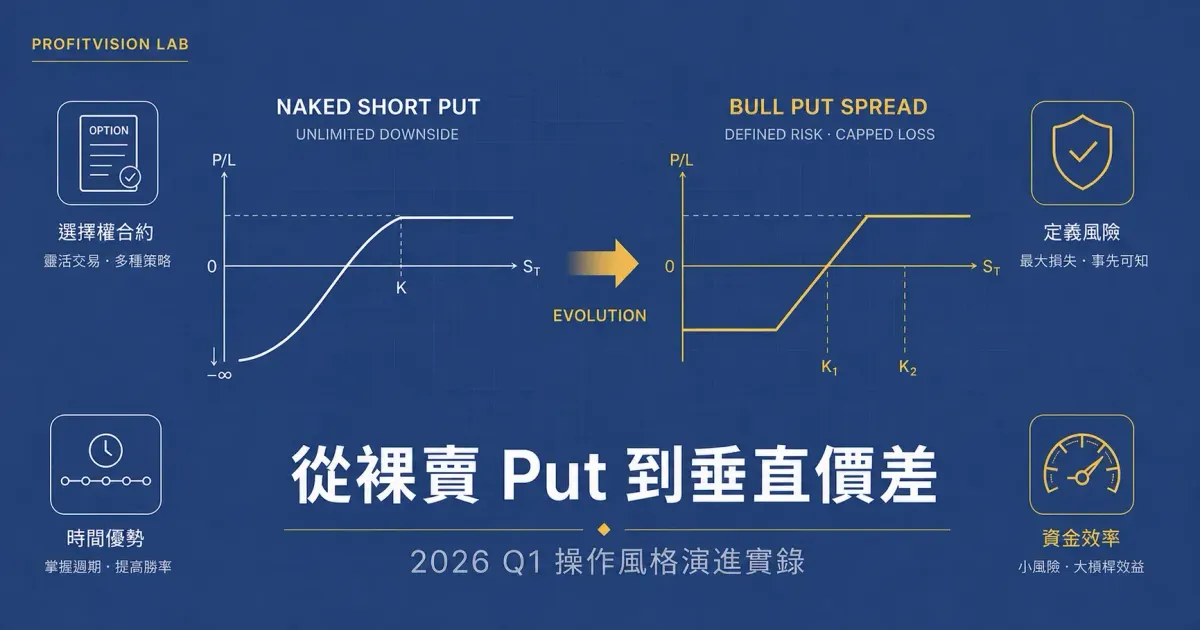
從裸賣 Put 到垂直價差:2026 Q1 操作風格演進實錄
從裸賣 Put 到垂直價差,交易風格演進
交易覆盤 | Trade Review

從裸賣 Put 到垂直價差
2026 Q1 操作風格演進實錄

📅 2026 年 1–4 月 📋 ALAB · CF · FN · GDX · ETN · NET ✍️ 柴柴行者 Shiba the Disciplined

選擇權賣方策略有兩種截然不同的形態:一種是裸賣 Put(Naked Short Put),理論上承受無限下方風險;另一種是垂直價差(Vertical Spread),透過同時買入一張保護性 Put,將最大損失鎖死在一個已知的數字之內。

這篇文章記錄了我在 2026 年第一季的操作風格轉變——從 1 月的裸賣 Put 模式,逐步演進為 3 月後以垂直價差為主的操作框架——並用六個真實案例(ALAB、CF、FN、GDX、ETN、NET)說明這個轉變的過程與成效。

裸賣 Put vs. 垂直價差:核心差異

❌ 裸賣 Put(舊做法)

  • 只賣出一張 Put,無保護
  • 收到較高的權利金
  • 下方風險理論上無限
  • 若股票崩跌,損失可能遠超預期
  • 佔用大量保證金(Cash-Secured)

✅ 垂直價差(新做法)

  • 賣出高履約價 Put + 買入低履約價 Put
  • 收到的淨權利金較少
  • 最大損失 = 價差寬度 - 淨權利金
  • 無論股票崩多深,損失有上限
  • 保證金需求低,資金效率高
核心思考: 價差策略並非要求更高的獲利,而是要求更精確的風險定義。每一筆交易進場前,你就知道最大損失是多少——這才是紀律框架的基石。

第一階段:ALAB 裸賣 Put(2026 年 1–2 月)

ALAB(Astera Labs)是 2025–2026 年 AI 基礎設施題材中波動最劇烈的半導體股之一。1 月初,股票仍在高位震盪,我選擇以裸賣 Put 策略收取時間價值。

成功的一面:靈活滾倉

在 1 月 6 日至 1 月 12 日之間,我對 13FEB26 145P 進行了兩輪操作,每一次都是快速進出,成功收取時間衰退:

合約動作時間損益說明
ALAB 13FEB26 145P(第一輪)賣開→買平1/6–1/7+$443股票小幅反彈,快速獲利
ALAB 13FEB26 145P(第二輪)再賣→再平1/7–1/12+$189繼續收割時間衰退
ALAB 20MAR26 140P賣開→買平2/6–2/9+$311股票回升,順利平倉

代價:一次爆倉的教訓

1 月 5 日,我賣出了 ALAB 06FEB26 160P,履約價接近當時的市場價格,Delta 偏高。隔天,ALAB 跳空大跌,160P 的權利金從 $10.67 跳漲至 $18.25,我被迫認賠出場:

合約賣出買平損益說明
ALAB 06FEB26 160P$10.67 / 手$18.25 / 手-$758跳空下跌,Delta 過高被燙到
💡 裸賣 Put 的風險結構

裸賣 Put 最怕的不是緩慢下跌,而是跳空缺口(Gap Down)。ALAB 這次跌幅超過 8%,完全越過了履約價,讓時間衰退的優勢瞬間歸零,反而變成 Delta 的受害者。若當初有買入保護腳(long put),最大損失就能被事先鎖定。

轉折點:3 月起全面轉向垂直價差

2 月底至 3 月初,我開始將新增部位全部改為垂直價差結構。這個改變帶來的不是更高的絕對報酬,而是更可預測的風險上限。以下是 2026 年 3–4 月的六個垂直價差案例:

📌 2026 Q1 操作背景:川普關稅下的高波動市場

2026 年第一季的市場環境極為特殊:川普政府的關稅政策反覆無常,市場情緒在短時間內劇烈擺盪。在這樣的環境下,我對垂直價差的獲利目標採取了彈性出場原則——沒有死守「等到 50% 最大獲利才平倉」的教科書規則。

有時市場突然反彈,達到 20% 目標獲利就果斷出場鎖利;有時股票在支撐位站穩、波動率下降,才持倉等到 50%。這背後有清晰的實務邏輯:

浮盈不是真盈。 在高波動市場裡,今天的 +30% 浮盈,明天一個關稅公告可能立刻變成 -20%。20% 落袋為安,是保住已賺到的錢,不是放棄獲利。不要跟錢過不去。

資金效率的乘數效應。 平倉後資金立刻釋放,可以立刻尋找下一個機會。死守一個 30% 浮盈的部位等 50%,不如平倉後再開一個新的高勝率價差。一季下來,多做幾筆比每筆做滿更重要。

彈性才是這個環境下的紀律。 不是沒有規則,而是規則本身就包含「視市況調整出場時機」這一條——川普投顧太難猜了,機械式地死守目標反而是把主動優勢拱手相讓。

案例一:CF Industries(CF)— Bull Put Spread

CF 是美國主要氮肥生產商,業務與農業週期高度相關,股價波動相對可預測。我選擇 Bull Put Spread,在技術支撐下方設置雙腳防禦。

到期日Short PutLong Put開倉日平倉日損益
17APR26$120(賣出)$115(買入) 3/123/27+$22.90
18JUN26$105(賣出)$100(買入) 4/174/23+$128.77

合計:+$151.67 — 兩輪操作全勝,最大損失均被鎖定在 $5 價差寬度內。

案例二:Fabrinet(FN)— 高股價垂直價差

FN 是光纖元件代工龍頭,股價高達 $490–$590,操作一般選擇權合約的資金需求極高。改用垂直價差後,保證金需求大幅降低,且每筆交易的最大損失清晰可見。(→ FN 基本面護城河深度研究

我在 3 月至 4 月間共進行了五輪 Bull Put Spread,均以快進快出為主要節奏:

到期日Short / Long Put開倉平倉損益結果
17APR26$530 / $5203/33/10+$115.60獲利
15MAY26(第一輪)$440 / $4303/173/20+$41.10獲利
15MAY26(第二輪)$480 / $4703/263/27+$72.40獲利
15MAY26(第三輪)$450 / $4403/304/8+$49.30獲利
18JUN26$590 / $5804/164/23+$30.80獲利

FN 合計:+$309.20 — 五輪全勝,展現了垂直價差在高股價標的的應用潛力。

案例三:GDX(黃金礦業 ETF)— 多頭價差搭順風車

2026 年 3 月,黃金受到避險需求帶動強勁上漲,GDX 同步走強。我在技術確認趨勢後,以 Bull Put Spread 做多,履約價設在支撐位下方:

到期日Short PutLong Put操作期間損益
15MAY26$75(賣出)$70(買入)3/20–3/23+$24.50

單輪操作,持倉僅 3 天即獲利出場。定義好最大損失($500 - 淨權利金)後,心理壓力顯著降低。

案例四:Eaton(ETN)— 工業股防禦型價差

ETN 是工業電氣龍頭,基本面穩健。3 月中旬市場震盪期間,我以垂直價差在技術支撐 $330 下方建立緩衝:

到期日Short PutLong Put操作期間損益
01MAY26$340(賣出)$330(買入)3/16–4/8+$146.00

案例五:Cloudflare(NET)— 雲端股 4 月反彈操作

4 月中旬市場出現技術反彈訊號,我選擇 NET(Cloudflare) 以 Bull Put Spread 參與:

到期日Short PutLong Put操作期間損益
18JUN26$160(賣出)$150(買入)4/14–4/16+$57.46

2026 Q1 垂直價差成績單

+$789價差策略淨損益
13/13已平倉價差勝率
$0最大單筆超額損失

相比之下,裸賣 Put 時期(ALAB 1–2 月)單筆最大虧損 -$758,而整體獲利需靠多次成功交易積累才能彌補。

結論:紀律不是關於獲利多少,而是風險是否已知

垂直價差不是更賺錢的工具,而是更可管理的工具。它的核心價值在於:

進場前就知道最壞情況 — 不會有「以為只虧一點,最後虧一大筆」的意外

保證金需求降低 — 相同資金可以同時持有更多不相關的部位,分散風險

心理壓力可量化 — 當你知道最大損失是 $500,你能用平靜的心態等待時間衰退

ALAB 160P 的 -$758 單筆損失,超過了後續所有垂直價差的總獲利。這個對比,是促成風格轉變最直接的原動力。

The Discipline of Options 核心: 選擇權賣方的優勢來自於時間衰退,但這個優勢必須建立在定義好的風險框架之上。垂直價差是讓你能夠長期留在場上的結構。

ENGLISH VERSION
Trade Review

From Naked Short Puts to Vertical Spreads:
A Q1 2026 Style Evolution

📅 January–April 2026 📋 ALAB · CF · FN · GDX · ETN · NET ✍️ Shiba the Disciplined

There are two fundamentally different modes of options selling: Naked Short Puts, where you sell a put with no downside protection and face theoretically unlimited risk; and Vertical Spreads, where you simultaneously buy a lower-strike put to cap your maximum loss at a known number before you even enter the trade.

This article documents my trading style evolution during Q1 2026 — from a naked short put approach in January, to a vertically-spread-first framework by March — illustrated through six real trades across ALAB, CF, FN, GDX, ETN, and NET.

The Core Difference

❌ Naked Short Put (Old Way)

  • Sell one put, no hedge
  • Higher premium collected
  • Unlimited downside risk
  • A gap-down can blow past strike
  • High capital requirement

✅ Vertical Spread (New Way)

  • Sell high-strike + buy low-strike put
  • Lower net premium received
  • Max loss = spread width - premium
  • Defined risk regardless of crash depth
  • Lower margin, better capital efficiency

Phase 1: ALAB Naked Puts (January–February)

Astera Labs (ALAB) is one of the most volatile AI infrastructure semiconductors. In early January, I was selling naked puts to collect time value as the stock was holding elevated levels.

The wins: tight rolling worked

On the ALAB 13FEB26 145P, I ran two rounds of short-put trades and exited both profitably through quick roll management (+$443 and +$189). The 20MAR26 140P added another +$311.

The lesson: the 160P blowup

On January 5th, I sold the ALAB 06FEB26 160P at $10.67 per contract. The next day, ALAB gapped down sharply — the 160P jumped to $18.25 and I was forced to close at a -$758 loss. One bad gap wiped out multiple successful trades.

💡 Why naked puts fail on momentum stocks

Naked puts are vulnerable not to slow declines, but to gap-down events. When ALAB dropped 8%+ overnight, the Delta exposure overwhelmed the time-decay advantage. A defined-risk spread would have capped this loss at the spread width before the trade even opened.

Phase 2: The Shift — Vertical Spreads from March Onward

From early March, every new position was structured as a vertical spread. The following five cases all show defined-risk, positive outcomes:

📌 Q1 2026 Context: Trading Through Trump Tariff Volatility

Q1 2026 was not a normal market environment. Trump administration tariff announcements created sharp, unpredictable swings that made textbook profit targets impractical. Rather than rigidly waiting for 50% of maximum profit on every spread, I adopted a flexible, market-responsive exit framework.

Some positions were closed at 20% of max profit when conditions shifted; others were held to 50% when the underlying held support and volatility compressed. Three reasons why this flexibility is the right call — not a compromise:

Floating profit isn't realized profit. In a tariff-headline market, a 30% floating gain can reverse to a loss overnight. Locking in 20% and moving on isn't leaving money on the table — it's protecting money already earned. Don't fight with profits.

Capital efficiency compounds across trades. Closing at 20% releases capital immediately for the next setup. Sitting in a position waiting for 50% while that capital is locked up means missing three other opportunities. Over a quarter, more closed trades at 20% can easily outperform fewer trades held for 50%.

Flexibility is the discipline in this environment. The rule isn't "always exit at 20%" — the rule is "read the market and exit at the right level for today's conditions." With Trump tariff risk unpredictable at every turn, mechanical rule-following is the real risk. Adaptive management is what keeps the edge.

CF Industries — Bull Put Spread, twice

Fertilizer producer, stable agricultural cycle, predictable support levels. Both spread rounds closed profitably: +$22.90 (April expiry) and +$128.77 (June expiry). Total: +$151.67

Fabrinet (FN) — Five rounds of Bull Put Spreads

High-priced optical networking manufacturer. Vertical spreads dramatically reduced capital requirements vs. naked puts. Five consecutive spread positions, all closed profitably: Total: +$309.20 (→ FN deep research: AI optical networking moat)

GDX — Gold miners ETF momentum trade

Gold's strong run in March 2026 carried GDX higher. Bull Put Spread at $75/$70, held 3 days, closed for +$24.50.

Eaton (ETN) — Defensive industrial spread

Spread below $330 technical support. Held through March volatility, closed for +$146.00.

Cloudflare (NET) — April rebound participation

Technical bounce signal in mid-April. Bull Put Spread at $160/$150, held 2 days, closed for +$57.46. (→ Cloudflare top-down deep research)

The Verdict: Defined Risk Wins Long-Term

Vertical spreads aren't more profitable per trade. They're more manageable. The three key advantages:

You know your max loss before entry — no surprise blowups
Lower capital requirement — more diversification with the same account
Quantifiable psychological risk — when max loss is $500, you can wait patiently for theta decay

The -$758 single loss on ALAB 160P exceeded the total profit from all five CF/FN/GDX/ETN/NET spreads combined. That one number drove the style change.

The Discipline of Options: The edge in options selling comes from theta decay — but that edge only compounds if you stay in the game. The Four-Layer Defensive Screen (四道防禦濾網) exists precisely to ensure that every position is one you can hold through temporary adversity without catastrophic loss.
⚠️ 本文所有交易記錄均為真實操作,僅供教育與記錄用途,不構成任何投資建議。選擇權交易涉及高度風險,過往績效不代表未來結果。All trades documented are real and for educational purposes only. Options trading involves substantial risk and past performance does not guarantee future results.