The Question Is Not Which ETF, But How Much: Position Sizing and the Age Method
2X ETF position sizing and life-stage allocation: how to size SSO and QLD, use core-satellite portfolios, rebalance, and shift from growth to income near retirement.
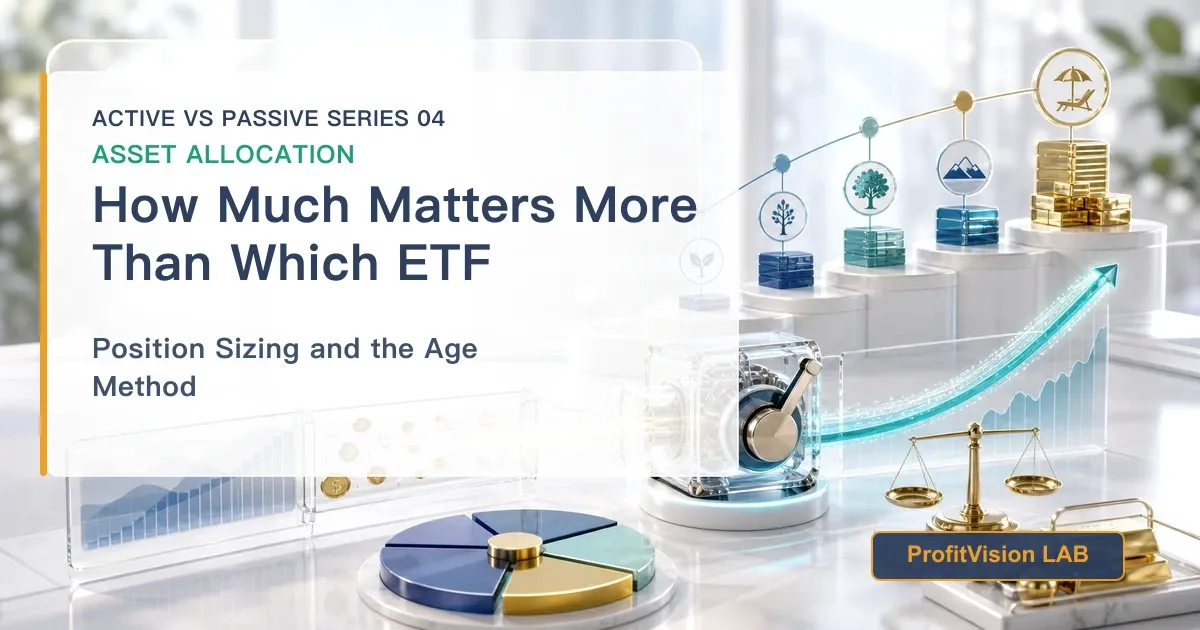
Position Sizing x Life Stage.
- The key question is not SSO versus QLD, but the size of the 2X ETF sleeve.
- Younger investors can use a larger growth satellite only with limits, reserves, and discipline.
- Near retirement, the role should shift toward income, NAV growth, and small cash-flow-funded 2X contributions.
Many investors studying 2X ETFs begin with the wrong question: SSO or QLD? The more important question is usually: how much?
The same QLD position behaves very differently at 5% of a portfolio and at 50%. One is a growth satellite. The other may dominate an entire financial life. The product is the same; the risk is not.
Why is 100% all-in on 2X ETFs dangerous?
Because 2X ETFs amplify returns, drawdowns, emotions, and mistakes. The problem with going all-in is not that it must fail. The problem is that all financial flexibility is handed to one highly volatile curve.
If the market enters a high-volatility range or a deep correction, there may be no reserve force, no rebalancing room, and no psychological breathing space. Even if the long-term direction eventually proves right, the investor may not survive to see it.
How should core and satellite assets be divided?
A healthier design is to keep 2X ETFs in the satellite sleeve. Core assets handle stability, diversification, cash flow, and psychological ballast. 2X ETFs amplify a portion of the growth trend.
This prevents the tool from becoming a belief system. A small part of the portfolio attacks; the rest defends, produces cash flow, and keeps the investor steady.
5%, 10%, 20%, and 30% are not just numbers
If a 5% 2X ETF position falls by half, the total portfolio impact is limited. If a 30% position falls by half, the whole portfolio is visibly hurt. This is not just arithmetic. It changes sleep, family conversations, and the ability to rebalance according to plan.
The age method: 2X ETF exposure should move with life stage
A young investor's largest asset is often not current capital, but time and future income. With salary cash flow, years of contributions, and time to repair mistakes, a younger investor can allow 2X ETFs to play a larger satellite role.
But higher exposure does not mean uncontrolled exposure. A larger 2X sleeve still needs a fixed limit, regular rebalancing, cash reserves, and a rule that short-term performance does not rewrite discipline.
The age method is not about mechanically assigning return targets by age. It is about adjusting risk capacity with life stage.
- Young accumulation stage: time and salary cash flow provide buffers, allowing a larger 2X growth satellite.
- Middle stage: family obligations and asset size rise, so leverage must be constrained by cash flow, mortgages, and reserves.
- Pre-retirement: the focus shifts from maximum return to income, NAV growth, and drawdown control.
- Retirement: use part of dividend cash flow to feed a small 2X engine instead of forcing retirement principal to absorb leverage volatility.
A higher 2X satellite can be reasonable if the investor has discipline, limits, and steady cash flow.
Income may be higher, but responsibilities are larger. Position size must respect reserves and family obligations.
Gradually reduce 2X exposure and shift toward income, NAV growth, and drawdown control.
Use part of dividends or excess cash flow for small periodic 2X contributions rather than risking the main retirement principal.
The closer you are to retirement, the lower 2X exposure should be
Near retirement, the biggest risk is not earning too slowly. It is one large drawdown disrupting the retirement timeline. Young investors can repair mistakes with income and time. Near-retirees may see withdrawals, lifestyle, and confidence affected.
Pre-retirement and retirement: income + NAV growth + small 2X engine
A retirement portfolio should not chase only high dividends, nor should it abandon NAV growth. A healthier framework combines income assets for cash flow, growth assets to protect purchasing power, and a small 2X sleeve as a growth engine.
If investors already have stable income-producing assets, they can rethink dividend reinvestment. Dividends do not always have to be automatically reinvested into the same asset. A portion of that cash flow can be dollar-cost averaged into 2X ETFs. The benefit is that retirement principal does not directly bear excessive leverage volatility, while cash flow continues to feed the growth engine.
- Income layer: provides spending cash flow and psychological stability.
- NAV growth layer: keeps assets growing and helps fight inflation.
- 2X growth engine: funded by part of dividends or excess cash flow, not by forcing core retirement principal into leverage.
Rebalancing turns 2X ETFs from speculation into allocation
Rebalancing changes the role of 2X ETFs. After strong rallies, trim back to the target. After planned declines, use reserves to restore exposure. This allows investors to act by rule instead of guessing whether the market is about to crash.
Without rebalancing, a successful 2X position can quietly become too large. Then one drawdown can break the whole plan. Discipline is not the enemy of return; it is the ticket that lets investors stay long enough to benefit from return.
Conclusion: use age to set the throttle
2X ETFs can make retirement life more beautiful, but only if they are fed by discipline rather than greed. Younger investors can let them play a stronger growth role. The closer investors move toward retirement, the more that role should return to a satellite position. After retirement, small cash-flow-funded contributions are healthier than asking the main principal to carry leverage volatility.
The real question is not whether SSO or QLD is best. It is where you are in life, how much you use, what cash flow supports it, and what rebalancing rule keeps it under control.
This article uses ProShares SSO and QLD product pages, SEC investor education, and FINRA leveraged and inverse ETP materials as references for product mechanics and risk language. Data verification date: 2026-06-07.