
What You Own Is Not Long-Term 2x: Daily Reset, Trend, and Volatility
U.S. 2X ETF playbook: understand daily reset, path dependency, volatility drag, and why SSO and QLD are tools for managing trend and volatility.
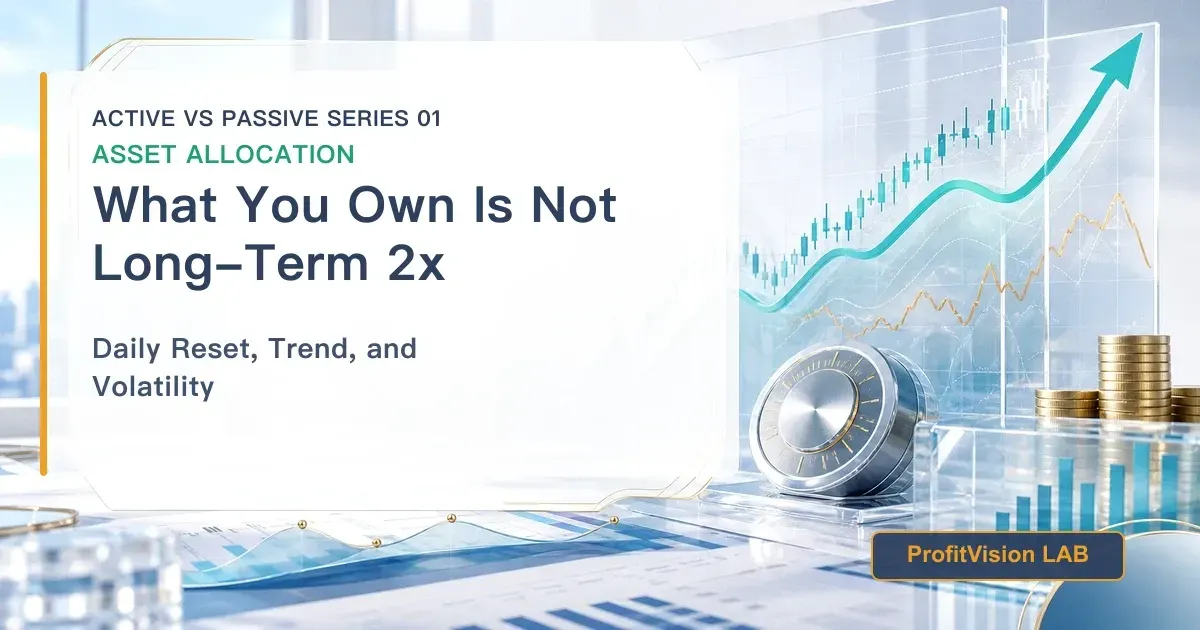
Daily Reset x Trend and Volatility.
- 2X ETFs seek 2x daily index performance, not a guaranteed long-term 2x outcome.
- Volatility is not always the enemy. Directionless, high-volatility chop is the most damaging regime.
- The core question is not "high risk, high return," but how to use leverage to manage trend and volatility.
If there is one misunderstanding that hurts investors in leveraged ETFs, it is this: the label "2X" sounds too intuitive. Many people see it and assume that if the index doubles over time, the ETF should return roughly twice that amount.
That is not what SSO or QLD promises. ProShares states that these funds seek 2x the daily performance of their underlying index, before fees and expenses. The word "daily" is not a technical footnote. It is the entire product.
Why does long-term performance not equal a straight 2x line?
The answer is compounding. Every trading day is reset into a new starting point. If the index rises on day one and falls on day two, the leveraged ETF may faithfully deliver close to 2x each day, while the two-day result can still differ meaningfully from "index return times two."
This does not mean the product is broken. It means the product is designed for daily leveraged exposure. SEC and FINRA investor education materials both warn that leveraged and inverse ETP returns over periods longer than one day can diverge from the stated multiple, especially in volatile markets.
Does this mean 2X ETFs cannot be held long term?
No. A more precise statement is this: long-term ownership of 2X ETFs requires a plan. Investors need a view on trend, position limits, rebalancing rules, and the emotional capacity to survive deep drawdowns.
When the market trends upward and volatility stays manageable, daily reset can allow leveraged beta to work powerfully. When the market chops sideways with repeated reversals, the same mechanism can turn noise into drag.
Is volatility a risk or an opportunity?
In 2X ETFs, volatility is a tool. Used well, it accelerates trend exposure. Used carelessly, it becomes a drag amplifier.
Volatility inside an upward trend can create rebalancing and staged-entry opportunities. Volatility inside a directionless range is more dangerous because the fund keeps resetting into a path that may grind away value without a decisive trend.
Why is sideways volatility the most dangerous regime?
Because the index may look almost unchanged, while the leveraged ETF suffers from the repeated up-down path. The investor may not be wrong about the broad direction, yet the path can still produce disappointing results.
This is why later pieces in this series will discuss tool switching. In a high-volatility range, an investor does not always have to hold the full 2X ETF position. Reducing exposure, holding cash or short-duration reserves, or using defined-risk options can sometimes be more rational than absorbing daily reset drag at full size.
How can volatility become manageable?
- Set a position limit: define the maximum share of total assets that can sit in 2X ETFs.
- Enter in tranches: avoid turning one entry point into the entire fate of the strategy.
- Rebalance regularly: trim leveraged exposure after strong rallies and restore discipline after declines.
- Keep reserves: use cash or short-duration bonds as a reserve force.
- Allow yourself to reduce exposure: when a trend turns into high-volatility chop, do not force the position to do a job it is not suited for.
Viewed this way, the core of 2X ETF investing is not the slogan "high risk, high return." It is a more precise framework: using leverage to manage trend and volatility.
Can Taiwan's 00631L experience be copied into U.S. 2X ETFs?
It can be studied, but not copied mechanically. Taiwan investors learned a lot from 00631L in a long bull market, yet U.S. 2X ETFs have different underlying indexes, currency exposure, tax treatment, fees, liquidity, and psychological pressure.
The first lesson of this series is simple: before asking whether SSO or QLD will go up more, ask whether you truly understand how daily reset, trend, and volatility will shape your long-term outcome.
This article uses ProShares SSO and QLD product pages, SEC investor education, and FINRA leveraged and inverse ETP materials as references for product mechanics and risk language. Data verification date: 2026-06-07.


Comments ()