The One Unsolved Weakness in Taiwan's Defense System
Across the entire debate on Taiwan's defense, missiles can be added, forces can be restructured, outlying islands can be transformed, and space intelligence can be integrated. But there is one threat for which Taiwan currently has almost no effective response — and the pace of improvement is far slower than the pace at which the threat is expanding:
PLA submarines.
The Air Force has budgeted NT$15 billion for a P-3C anti-submarine equipment system upgrade. Although the project has been initiated, the formal project approval process has still not been completed, drawing repeated attention from Defense Minister Wellington Koo. At the same time, the Navy's renewed request to purchase MH-60R Seahawk anti-submarine helicopters from the US has again been rejected, putting the military's overall ASW capability in the spotlight. (United Daily News, UP Media, June 2025)
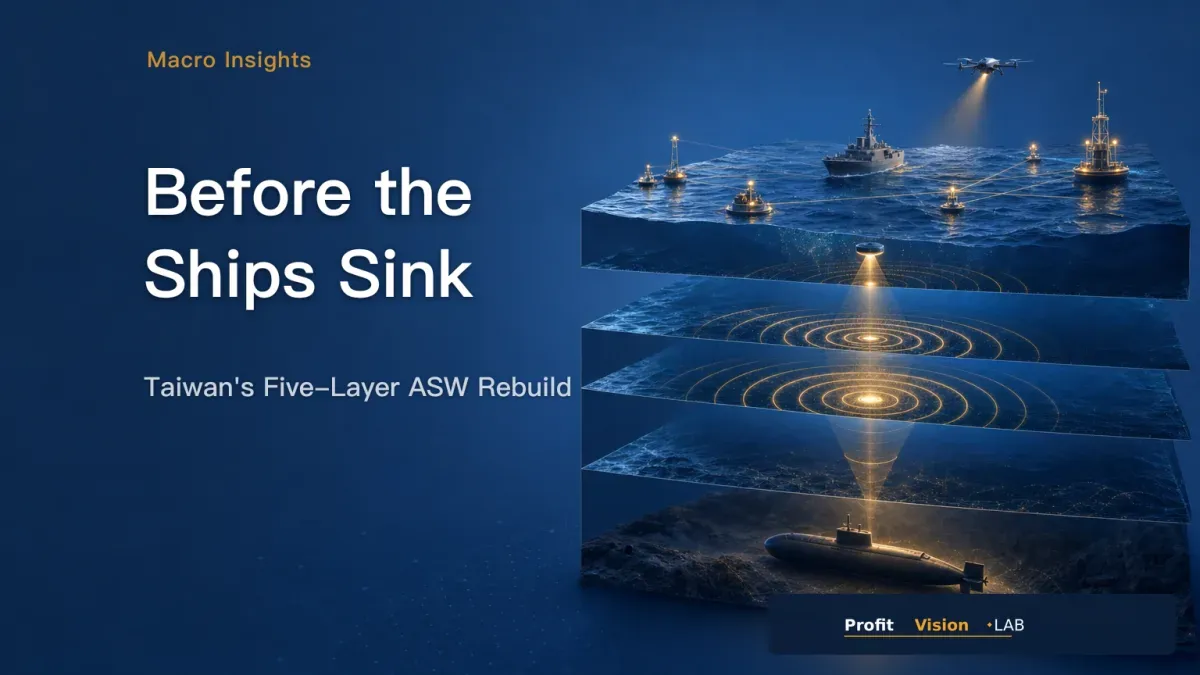
A five-layer rebuilding plan: fixed sonar arrays to hold the Bashi Channel → a generational leap to the P-8A Poseidon → the indigenous Yung Ying ASW variant filling the near-shore gap → a joint Taiwan-US UAV program for round-the-clock surveillance → a two-phase IDS program (multi-role attack submarines plus solid-state-battery ASW-dedicated submarines). Moving from "transparent below the waterline" to "full-spectrum, layered ASW" — this is a path to Taiwanese self-reliance that does not depend on US authorization.
An Honest Accounting of Taiwan's Current ASW Capability
Since 2013, Taiwan has taken delivery of 12 P-3C Orion anti-submarine patrol aircraft. Of the 12 aircraft, 8 are currently mission-ready. Fleet readiness has drawn scrutiny, reportedly because slow US delivery of spare parts has limited the number of sorties the fleet can fly. (United Daily News, January 2024)
The NT$15 billion P-3C rear-cabin upgrade project involves integrating equipment from multiple European and American suppliers, and the next phase of technical assistance from the US has not yet been finalized. Although the project has entered the pipeline, the formal approval process remains incomplete. (UP Media, June 2025) This bottleneck means Taiwan's P-3C detection equipment remains stuck at a previous generation's standard, unable to effectively counter the low-noise technology of the PLA's newest 039B/C Yuan-class submarines.
| ASW Layer | Current Equipment | Status | Core Problem |
|---|---|---|---|
| Fixed-wing air | P-3C × 12 (8 mission-ready) | Upgrade stalled | Outdated rear-cabin equipment cannot cope with AIP quiet submarines |
| Airborne helicopter | S-70C (M2) | Barely serviceable | A generation behind; MH-60R rejected again |
| Surface-ship ASW | Kang Ding / Cheng Kung frigates | Aging equipment | Towed-array sonar is aging, ASW torpedo range limited |
| Fixed underwater sonar | Partial deployment | Incomplete coverage | Bashi Channel is nearly blank |
| Indigenous submarine | IDS Narwhal | First vessel in testing | Mass-production vessels not until after 2027; insufficient numbers |
The Real Scale of the PLA Submarine Threat
Three Tiers of Threat
Tier one (highest threat): 039A/B/C Yuan-class conventional AIP submarines. Using air-independent propulsion (AIP) technology, these have been assessed by the US Navy as "among the quietest conventional submarines in the world." In the shallow waters of the Taiwan Strait (average depth 60 meters), the P-3C's detection range may shrink to just a few kilometers, meaning contact could occur only after the target is already within torpedo range. The Eastern Theater Command deploys an estimated 20 to 30 such vessels.
Tier two (strategic threat): Type 093-series nuclear-powered attack submarines (SSN). An estimated 6 to 8 are currently in service, equipped with YJ-18 anti-ship cruise missiles (220 km range, terminal supersonic speed). Nuclear propulsion means unlimited endurance, allowing these vessels to blockade Taiwan's eastern resupply lines in the deep waters of the Pacific for extended periods, or to intercept US reinforcement routes.
Tier three (nuclear deterrence): Type 094A Jin-class ballistic-missile submarines (SSBN). In June 2024, a 094A transited the Taiwan Strait on the surface — a clear political signal that the PLA is demonstrating a nuclear-deterrent presence around the Taiwan Strait, further complicating the escalation calculus of any conflict.
The Bashi Channel: The Biggest Geographic Gap in Taiwan's ASW System
The Bashi Channel (between the southern tip of Taiwan and Luzon in the Philippines) is roughly 380 km wide, with depths exceeding 5,000 meters, and is the route PLA submarines must transit when leaving the Sanya base on Hainan Island to reach the Pacific for long-range missions.
Should a PLA AIP submarine successfully transit the Bashi Channel, it could: sever Taiwan's only lifeline resupply route on the east coast; lie in wait off Taiwan's east coast, posing an underwater threat to reinforcing US and Japanese fleets; or prevent IDS submarines from sortieing to fight from bases in the east. Today, this 400-km-wide waterway has no fixed underwater sonar network coverage comparable to Japan's straits. This is the single largest structural gap in Taiwan's ASW system.
Overview of the Five-Layer Rebuilding Plan
Layer Two: The P-8A Poseidon — Since You Have to Ask Anyway, Go All the Way, and Use It for Thirty Years
The NT$15 billion P-3C upgrade itself cannot be unlocked without US technical assistance, meaning Taiwan has to approach the US regardless. This "political cost of asking" is fixed — since that cost has already been paid, the incremental cost of upgrading the request to a P-8A purchase is far smaller than the leap in capability it buys.
Capability Comparison: This Isn't an Upgrade, It's a Generational Leap
| Capability | Upgraded P-3C | P-8A Poseidon (Procurement) |
|---|---|---|
| Airframe era | 1960s airframe, still an old airframe after the upgrade | 737-800 (2000s), a modern platform |
| Maximum range | Approx. 5,200 km | 8,300 km (+60%) |
| Patrol combat radius | Approx. 1,900 km | 2,222 km, 4-hour on-station time over the target area |
| Flight speed | Approx. 650 km/h (turboprop) | 907 km/h, faster emergency deployment |
| Sonobuoys | 84 | 120+ |
| Torpedo delivery method | Must descend to low altitude, exposed to air-defense fire | HAAWC high-altitude release, glide-attack from a safe 30,000 ft |
| Data link | Can connect to Link 16 after upgrade | Native Link 16 plus integrated satellite communications |
| Parts supply | Original manufacturer has discontinued production; increasingly difficult | 737-800 commercial parts, global MRO network guaranteed for 30 years |
| Existing buyers | — | US, Japan, South Korea, Australia, India, UK, Germany, Norway, New Zealand, Singapore, Canada (11 countries) |
The P-8A's HAAWC (High Altitude Anti-Submarine Warfare Weapon Capability) deserves special mention: it can release a glide-kit-equipped Mk-54 torpedo from 30,000 feet (9,100 meters), letting the torpedo glide several kilometers through the air before entering the water to attack. The P-3C must descend to a specific low altitude to release its torpedoes, making it relatively easy to expose to enemy air-defense range. For Taiwan, this means the P-8A can strike from an altitude beyond the reach of PLA air-defense missiles, substantially improving aircrew survivability. (ETtoday, January 2019)
Doing the Cost Math: NT$15 Billion for an Upgrade vs. US$2 Billion for a Replacement
NT$15 billion is roughly US$470 million — the budget for the P-3C upgrade program. What that money buys: new rear-cabin electronics installed on an airframe that is already over a decade old; a parts-supply problem that will remain unresolved; and, in another 10 to 15 years, the same dilemma of another upgrade or retirement.
Estimated cost of procuring the P-8A: in 2009, India purchased 12 P-8Is for a contract value of roughly US$2.1 billion, or about US$175 million per aircraft. If Taiwan were to procure 8 to 12 aircraft, based on recent procurement prices of roughly US$180–200 million each, the total would run US$1.4–2.4 billion, or roughly NT$45–76 billion.
One
Two
This figure sounds much larger than NT$15 billion, but calculated over the full lifecycle cost:
- The P-8A airframe has a 25–30 year service life, with 737-800 parts drawn from a global commercial supply chain, keeping maintenance costs low and stable
- Even after an upgrade, the P-3C's airframe-aging problem will resurface in another decade, requiring another round of spending
- The P-8A's combat capability is 2–3 times that of an upgraded P-3C (range, speed, high-altitude torpedo delivery), creating far more patrol value per flight hour than the P-3C
Put simply: NT$15 billion keeps Taiwan's P-3C going for another 15 years, only to face the same problem again. US$2 billion lets Taiwan's ASW capability leap a generation and last 30 years. This isn't about which option is more expensive — it's about which option actually buys real strategic value.
Germany's Case: Even a Country with Airbus Chose the P-8A
In November 2025, Germany took delivery of its first P-8A. Germany, the home country of an Airbus shareholder with a complete European aerospace industry, still chose to purchase the P-8A from the US to replace its 8 P-3Cs, citing that the P-3C had "reached the limits of modernization, with parts no longer available." (TechNews, November 2025; Liberty Times, October 2019)
This same logic applies fully to Taiwan. Taiwan's P-3Cs were delivered in 2013–2015, meaning the airframes are already over 20 years old and face the same problem as US military P-3Cs: increasingly difficult parts supply and an upgrade ceiling that is nearly reached. If Germany — which does not rely on the US for its own security — still chose the P-8A, Taiwan, facing a far more severe threat environment, has no more room for hesitation.
"Determination to Self-Defend" as Diplomatic Leverage: Procurement as a Political Statement
This is the most underappreciated dimension of the entire P-8A argument.
One of the most core problems in Taiwan's defense is how to get the United States to take Taiwan's willingness to self-defend seriously, rather than treating Taiwan as merely "an object in need of protection." Both the Israeli and Ukrainian models clearly show that countries that actively invest in their own defense capability actually receive more support and better equipment terms from the United States.
Within this framework, the P-3C upgrade option and the P-8A procurement option send starkly different signals:
- The signal sent by the P-3C upgrade (NT$15 billion): "We want to maintain our existing capability — please help us patch up the old one." This is a dependency-framed request, and the US side can delay it, charge exorbitant fees for technical assistance, or perpetually say "still under discussion."
- The signal sent by P-8A procurement: "Taiwan is going to make a generational leap in ASW capability — United States, get on board." This is a proactive, Taiwan-funded defense upgrade, which is far harder for the US to refuse, because Taiwan is not requesting aid — it is signing a commercial contract.
Taiwan's defense must first demonstrate its own determination to self-defend before the alliance relationship can shift from "passively protected" to an "active partnership." Procuring the P-8A is the clearest statement of self-defense determination Taiwan can make in the underwater ASW domain.
The high-low mix logic: The P-8A handles the far, deep waters (south of the Bashi Channel, tracking Type 093 nuclear submarines in the deep Pacific); Layer Three's Yung Ying ASW variant handles the near-shore waters (the shallow Taiwan Strait, the first response to Yuan-class AIP submarines). The two divide the work, covering different water depths and threat types — complementary, not redundant. The P-8A signals Taiwan's determination to "hold this sea"; the Yung Ying signals Taiwan's capability to "build our own tools to defend it" — together, they form a complete statement of strategic self-reliance.
Layer Three: The Yung Ying ASW Subsonic Variant — An Indigenous Near-Shore Gatekeeper
The Yung Ying (AT-5) advanced jet trainer is mass-produced by AIDC, and Taiwan fully controls the airframe technology. Integrating an ASW package is a systems-integration task fully within the capability of NCSIST and AIDC:
- Nose-mounted radar pod: carrying a compact AESA surface-search radar (comparable to Italy's Selex ES solution, or developed by domestic research institutes)
- Tail-mounted MAD (magnetic anomaly detector): the same principle as the P-3C's, structurally simple, with NCSIST already possessing related technical accumulation
- Belly-mounted sonobuoy dispenser: up to 16–24 buoys, mixing passive and active types
- External weapons: two Mk-46/54 lightweight torpedoes, or one torpedo plus one drop tank (to extend range)
The Yung Ying has a standard fuel range of roughly 1,800 km, extendable to 2,500 km with an external drop tank — enough to cover the entire Taiwan Strait and the northern end of the Bashi Channel.
The most important logic: the Yung Ying itself is a trainer, with a large pilot base and a mature training pipeline. Training for ASW-variant crews can be layered directly onto the existing Yung Ying training pipeline, lowering the cost of building up personnel. Procurement volumes could reach 30–40 aircraft, far more than the P-8A, forming dense near-shore ASW coverage.
Layer Four: Maritime Patrol UAV — A Taiwan-US Joint Venture, the Sky Version of the Unmanned Surface Vessel Model
Taiwan's model for developing unmanned surface vessels (USVs) has already established a precedent: NCSIST sources key technology from US firms, Taiwanese manufacturers handle hull construction and systems integration, and the result is a product Taiwan can independently maintain. The maritime patrol UAV follows exactly the same framework:
| Role Division | Responsibility | Cooperation Mechanism |
|---|---|---|
| AIDC (Taiwan) | Airframe manufacturing (extension of the Ruei Yuan II platform) | Independently designed and manufactured by Taiwan |
| NCSIST (Taiwan) | Payload integration, data link, ground control station | Does not depend on US authorization |
| L3Harris (US) | AESA surface-search radar technology license | Licensed production or technology transfer |
| Raytheon (US) | Sonobuoy processing system | Licensed production or technology transfer |
| Joint ownership | Link 16/TTNT data-link integration | Jointly developed under the JV framework |
Target product performance: 20–30 hour endurance (compared to the P-8A's 4-hour on-station time) — coverage duration five times that of a single P-8A mission. A single loitering UAV can maintain continuous patrol during the time windows the P-8A cannot stay resident for, enabling round-the-clock surveillance rotation at the northern end of the Bashi Channel.
The strategic significance of the JV: Taiwan thereby gains complete design and manufacturing capability, no longer needing US FMS authorization to produce and maintain the system in the future, and can export it to friendly countries (such as the Philippines and Vietnam) — carrying both commercial and diplomatic value.
Layer Five: IDS's Two-Phase Development — From Multi-Role Attack to Dedicated Hunter-Killer
Phase One: Multi-Role Attack Submarines (8 Vessels, 2027–2035)
The IDS's first vessel, the "Narwhal," was launched in 2023, propelled by lithium iron phosphate batteries and equipped with Mk-48 heavyweight torpedoes and Hsiung Feng/Harpoon anti-ship missiles, with a mission focused primarily on engaging surface vessels. After the 8 vessels enter service in batches, the first 4 will be based in the east (Hualien/Suao) and the latter 4 in the west, forming the core of Taiwan's underwater anti-surface warfare capability.
Phase Two: Start Immediately — This Is Not Just Defense, It Is the Industrial Foundation Itself
Phase Two should not wait for Phase One to be fully completed before design begins. Design research for Phase Two should begin immediately in 2026, with the goal of having Taiwan launch a submarine every year, just as Japan does, so that shipbuilding industrial capacity keeps accumulating and technology continues to advance.
Japan's Maritime Self-Defense Force maintains a fleet of 22 submarines through a "continuous build" model — building one new vessel every two years while simultaneously retiring an old one — keeping the entire design, construction, and testing industrial chain continuously running. This is not just a question of submarine numbers, but of whether a country possesses sustained shipbuilding industrial capacity.
| Comparison | Stop-and-Restart Model | Continuous-Build Model (Japan/Taiwan's Target) |
|---|---|---|
| Talent retention | Talent lost during gaps; restarts require retraining | Engineers and technicians remain in place; experience compounds without interruption |
| Technical accumulation | Every restart re-solves the previous round's problems | Each new vessel improves on the last |
| Design capability | Design teams are hard to reassemble once disbanded | Design iteration continues; Phase Two is an evolution of Phase One |
| Supply chain | Suppliers shift to other business, weakening bargaining power at restart | Stable orders keep suppliers maintaining military-spec manufacturing capacity |
| Cost of restarting | Schedule delays plus cost overruns — a lesson South Korea's submarine program has learned | Diminishing marginal cost — the Nth vessel is cheaper than the first |
Taiwan's IDS Phase One decision process already offers a cautionary precedent: it took nearly a decade from project approval to the launch of the first vessel, and the debate and hesitation in between were themselves a drain on industrial capacity. Design research for Phase Two should begin now, without waiting for Phase One to be completed, because design and construction are different tasks that can fully proceed in parallel.
This is not just a question of the defense budget — it is a question of industrial foundation. Submarine manufacturing requires precision machining, materials science, electronics integration, and underwater acoustics engineering — capabilities that dissipate the moment construction stops, and the cost of rebuilding them far exceeds the cost of continuous investment. The cost of halting submarine construction was never just a few fewer submarines — it is the hollowing-out of the entire underwater industrial chain.
Three Core Technical Innovations of Phase Two: All Homegrown in Taiwan
Innovation One: ProLogium Solid-State Battery Propulsion
Taiwan's ProLogium is a global frontier company in solid-state battery technology, already partnering with major players such as Mercedes-Benz, and it built a plant in France in 2024. The significance of solid-state electrolyte technology for submarine propulsion:
| Comparison | Stirling AIP (German/Japanese Technology) | Liquid Lithium Battery | Solid-State Battery (ProLogium) |
|---|---|---|---|
| Energy density | Medium | High | Highest (+30–40%) |
| Safety | Medium (mechanical vibration) | Thermal runaway risk | Highest (non-flammable) |
| Noise | Present (mechanical vibration) | None | None |
| Technology source | Requires foreign licensing | Commercial-grade | Homegrown in Taiwan |
| Near-shore endurance | Over 14 days | 5–7 days | 7–10 days (sufficient) |
Taiwan's target endurance for near-shore operations is 7 to 10 days (departing Hualien → conducting missions in the Bashi Channel → returning to port for resupply), a target solid-state batteries fully satisfy — without the complex gas-management systems AIP requires, allowing a simpler overall ship design with a lower noise signature. The most critical strategic significance: it depends on no foreign licensing whatsoever, making it a core technology fully under Taiwan's own control.
Innovation Two: Towed-Array Sonar (The Decisive Difference)
Towed-array sonar (TASS) pulls the receiver clear of hull vibration interference, deploying it as a low-frequency receiving antenna hundreds of meters long. In the noisy, shallow-water environment of the Taiwan Strait, the detection range against modern AIP submarines can reach 10 to 20 times that of a bow-mounted spherical sonar — turning "a few kilometers" into "tens of kilometers." IDS Phase One has no towed array, making it nearly incapable of actively hunting a 039B in the Taiwan Strait. Once Phase Two adds one, it can maintain continuous tracking at ranges where the 039B has no idea it is being followed, waiting for the right attack window to open fire.
Innovation Three: The Three-Stage Supercavitating ASW Torpedo — Converting NTU and NTOU's Technical Reserves
A supercavitating torpedo works by generating a bubble-filled cavity around its nose that envelops the torpedo, allowing it to travel through the bubble rather than in direct contact with water, cutting drag by over 90% and reaching speeds above 200 knots. But the existing Russian Shkval has three fatal flaws:
Cannot turn to track maneuvering targets (the supercavitation bubble prevents control surfaces from contacting water)
Range of only about 15 km (rocket fuel is consumed too quickly)
Heavy vibration; the target submarine barely needs to maneuver, as it can detect the launch before it happens
Stage two: supercavitating dash, engaged within the final 15–20 km, at speeds of 100–150 knots
Stage three: after the bubble collapses, terminal active sonar activates for precise guidance to impact
Time from the target submarine detecting the torpedo to impact: 60–90 seconds, leaving almost no effective time to maneuver
Range: 0–15 km
Characteristics: silent, does not expose the firing submarine
Range: 15–30 km
Characteristics: bubble-enveloped, drag cut by 90%
Active sonar precisely locks on
Target reaction time: 60–90 seconds
Taiwan's Academic Technical Reserves — This Is Not Starting from Zero
· Cavitation dynamics (cavitator shape design)
· Cavitation stability computation (CFD numerical simulation)
· Hull-resistance experiments (towing-tank facilities)
· Underwater-vehicle systems integration (Ocean Center)
· Underwater propulsion systems integration
· Torpedo hydrodynamic shape design
· Underwater weapons systems research
· Marine hydrodynamics experimental facilities
· Existing lightweight torpedo R&D programs
· Jiupeng Base live-fire testing capability
· Underwater guidance-head development
· Solid propellant technology
Fluid-dynamics research at NTU's ESOE and at NTOU is precisely the academic foundation for supercavitation technology — cavitation dynamics, cavitator shape design, and underwater propulsion integration are disciplines that map directly onto the core technical breakthroughs Taiwan's three-stage torpedo needs. NCSIST is responsible for the final engineering conversion and live-fire testing, forming a complete chain from "academic reserve → engineering conversion → operational equipment," fully consistent with the argument laid out in this series' third installment, "Defense Assets on Campus."
The Funnel-Shaped Joint Operations of the Five-Layer System
| Layer | Input | Function | Output |
|---|---|---|---|
| Layer Zero: TASA SAR | Satellite pass | Detect surface wake / snorkel signature | Approximate bearing |
| Layer One: Fixed Sonar | Layer Zero bearing | Identify acoustic signature, confirm contact | Coordinates plus submarine type |
| Layer Two: P-8A / UAV | Layer One coordinates | Dispatch to confirm, drop buoys for precise localization | Target lock |
| Layer Three: Yung Ying ASW | Near-shore contact | Rapid dispatch, shallow near-shore tracking | Sustained contact maintenance |
| Layer Five: IDS-A | Target position | Underwater maneuvering approach, Mk-48 attack | Surface ship / submarine threat neutralized |
| Layer Five: IDS-B | Target position | Towed-array tracking, supercavitating torpedo hunter-kill | Enemy AIP submarine neutralized |
Every layer performs the function of "narrowing the search area for the next layer," rather than attempting to complete the full sequence from "detection" to "elimination" on its own. Most important is that Layer Five B's IDS Phase Two is the final hunter at the bottom of the funnel — the towed array maintains continuous tracking at a range the 039B is unaware of, and the three-stage supercavitating torpedo leaves the target only 60 to 90 seconds to react within the attack window.
SAR Satellite
Fixed Sonar
P-8A
Yung Ying ASW
UAV
IDS
Budget and Timeline Framework
| Layer | Item | Estimated Budget | Initial Capability |
|---|---|---|---|
| Layer Zero | TASA SAR satellite (already covered in Part Three) | — | 2028 |
| Layer One | Bashi Channel fixed sonar array | NT$8–12 billion | 2029 |
| Layer Two | P-8A Poseidon procurement (8–12 aircraft) | NT$35–50 billion | 2030 |
| Layer Three | Yung Ying ASW variant (30–40 aircraft, including R&D) | NT$18–25 billion | 2031 |
| Layer Four | Maritime patrol UAV (Taiwan-US JV, 24 units) | NT$5–8 billion | 2030 |
| Layer Five A | IDS Phase One production vessels × 7 | NT$140–180 billion | 2031–2035 |
| Layer Five B | IDS Phase Two design research + 4 vessels (immediate start) | NT$50–80 billion | 2026 design → 2032 construction start → 2035–2040 in service |
| Total | Approx. NT$256–355 billion | Full-spectrum ASW by 2040 |
Spread over 10 years, this comes to roughly NT$25.6–35.5 billion per year, or about 10–13% of the current defense budget. But considering that IDS Phase One was already planned, the actual incremental budget is roughly NT$116–175 billion, or NT$11.6–17.5 billion in new spending per year — about 4–6% of the budget. What most needs unlocking is political will, not money.
All the ground- and sea-based defense capabilities discussed in the first four parts of this series share a common premise: that resupply lines stay open, that ports remain usable, and that the eastern part of Taiwan's main island can serve as strategic depth.
If a PLA AIP submarine successfully establishes an underwater blockade in the Bashi Channel, all of these premises collapse. Missiles can deter surface fleets, but they cannot deter a quiet submarine beneath the waves.
Rebuilding the five-layer ASW system — especially IDS Phase Two's solid-state battery plus supercavitating torpedo — is not an addition to Taiwan's defense, but the missing baseplate that completes the entire defensive puzzle. The academic and technical reserves at NTU and NTOU are exactly the material for that baseplate.
Design research for IDS Phase Two should begin immediately, without waiting for Phase One to be completed. Taiwan's submarine program should launch a vessel every year, just as Japan does, so the shipbuilding industry's technical capacity keeps advancing, its talent pipeline stays unbroken, and its supply chain never hollows out. This is not just about defense — it is about the foundation of an industry. From the campus to NCSIST to the deep sea, this chain toward defense self-reliance is waiting only for the political will to connect it — and that connection needs to happen now, not later.
Data Sources and References
- United Daily News (June 2025): "P-3C Patrol Aircraft ASW Equipment Upgrade Project Delayed, Drawing Repeated Concern from Wellington Koo"
- UP Media (June 2025): "P-3C System Performance Enhancement Project Progress Delayed, Drawing Concern from Wellington Koo"
- Liberty Times Military Channel (May 2024): "Making the P-3C ASW Aircraft More Capable: Taiwan and the US Renew the 'Maritime Mission Support Center' Support Agreement"
- United Daily News (January 2024): "Air Force P-3C ASW Fleet Logistics System Fully Restored, 8 Aircraft Mission-Ready"
- UP Media (October 2025): "MH-60R and S-70 ASW Helicopter Procurement Cases Sent to US Navy, Both Lose Out"
- Naval Academic Bimonthly (2017): "An Analysis of Using the P-3C ASW Aircraft to Counter AIP Submarines," Ma Huan-dong and Chiang Chung-yen
- Wikipedia: "Type 039 Conventional Submarine" (Song-class/Yuan-class), "Type 09III Nuclear Submarine" (Shang-class), accessed 2026
- The Epoch Times (July 2024): "039 Submarine May Have Sunk; Recent Years See Multiple Chinese Submarine Incidents," including the 094A Taiwan Strait surface-transit incident
- Wikipedia: "VA-111 Shkval," "Supercavitation," accessed 2026
- Naval Technology (May 2024): "The Allure of Supercavitating Torpedoes"
- MDPI Applied Sciences (2021): "Cavitator Design for Straight-Running Supercavitating Torpedoes"
- Office of the President News (2017): "P-3C Takes Over and Enters Service; President: The Most Important Pillar of ASW Operations"
- ProLogium official website, solid-state battery technology overview, accessed 2026
- National Taiwan University Department of Engineering Science and Ocean Engineering (ESOE) official website, accessed 2026
- National Taiwan Ocean University Department of Systems Engineering and Naval Architecture, Department of Mechanical Engineering official website, accessed 2026
Foreign Legion → Part Two
Missile Expansion → Part Three
Space Integration → Part Four
Kinmen-Matsu Blockade → Part Five
ASW Rebuilding
Author: Chai Chai Ji Liang|This article is independent civilian research