Detection Stays Detection, Engagement Stays Engagement
The T-5 "Sea Watcher" carries no weapons at all, yet it is the nerve center of Taiwan's anti-submarine warfare. Via Link-22, it simultaneously drives an anti-submarine chain (drones dropping Mk-46 torpedoes) and an air-defense escort chain — detection stays detection, engagement stays engagement, completely separated. During gray-zone patrols, fire support is already online.
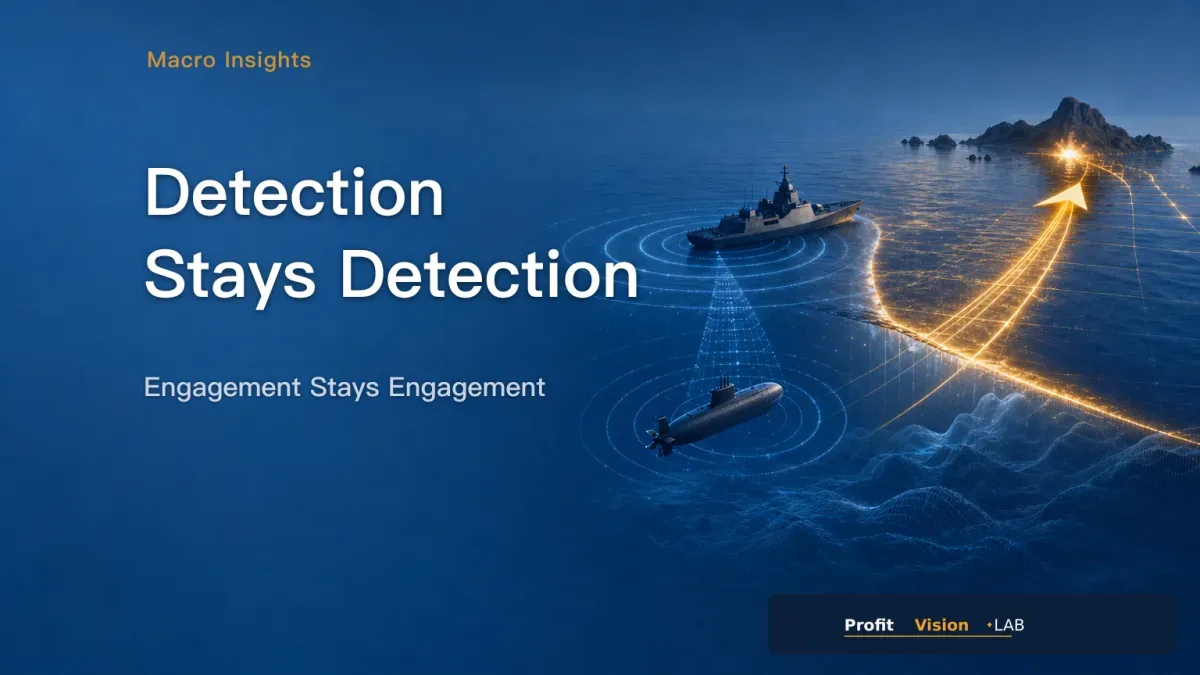
T-5 "Sea Watcher" and an asymmetric solution to undersea transparency in the Taiwan Strait — detection stays detection, engagement stays engagement, two kill chains each doing their own job, turning an unarmed aircraft into the nerve center of Taiwan's anti-submarine warfare.
Introduction: The Undersea Threat Is Taiwan's Most Overlooked Strategic Gap
Taiwan's current airborne anti-submarine capability relies mainly on a handful of P-3C Orion patrol aircraft that have been in service for more than thirty years. These aircraft still perform respectably, but the fleet is aging, maintenance costs are high, the fleet size is thin, and the airframe's own survivability in a high-threat environment is a genuine concern. The more critical problem is structural: a small number of expensive, large ASW aircraft is, by its very nature, a bottleneck that "cannot be mass-produced" when facing large numbers of dispersed, mobile undersea targets.
The "Project Sea-Watcher" proposed in this article — using the T-5 Brave Eagle as the command mothership and civilian-developed, expendable unmanned wingmen as the strike arm — is precisely an asymmetric solution designed for this bottleneck. It doesn't chase technical perfection; it chases always keeping eyes on the surface, and keeping what's below the surface from daring to show itself amid the uncertainty of the Taiwan Strait environment.
I. Threat Background: The Rapid Expansion of the PLA's Submarine Fleet
Over the past decade, the PLA Navy (PLAN) has completed a strategic shift from "coastal defense" to "active near-seas defense." Submarines are among the weapon systems most heavily invested in during this transformation, and among the clearest in strategic intent.
Overview of Active Frontline Submarines
| Class | Type | Characteristics | Threat Level to Taiwan |
|---|---|---|---|
| Type 094 Jin | SSBN (Ballistic Missile Nuclear Submarine) | Carries JL-2 intercontinental ballistic missiles, used for strategic deterrence | Medium (strategic level) |
| Type 093 Shang | SSN (Attack Nuclear Submarine) | High speed, long range, capable of anti-ship and anti-submarine operations | High |
| Type 039A/B Yuan | AIP Conventional Submarine | Equipped with Air-Independent Propulsion, extremely quiet, the greatest threat in the Taiwan Strait | Extremely High |
| Type 035 Ming | Conventional Submarine (Aging) | Older airframe, noisier, but still usable as a numerical supplement | Medium-Low |
Of these, the Type 039A/B Yuan class is the one Taiwan most needs to take seriously. Its AIP system allows the submarine to run continuously and silently underwater for more than two weeks without needing to snorkel and recharge, sharply raising the difficulty of traditional acoustic detection. The Yuan class's relatively low-profile periscope and precise degaussing design also make radar detection more difficult.
From a purely geographic standpoint, the deep waters east of Taiwan (the Pacific side) are the main operating space for nuclear submarines; the shallow waters of the Taiwan Strait and the southwestern approaches are the ideal environment for AIP submarines conducting blockades and cutting sea lines of supply. These two directions each require a completely different anti-submarine strategy. Sea-Watcher's design is aimed primarily at the latter — continuous patrol and rapid response in near-to-mid-range waters.
II. The Existing Predicament: The Structural Contradiction of the Traditional ASW Model
Three Structural Problems with the P-3C
Taiwan's P-3C Orion is an excellent Cold War-era maritime patrol aircraft design. Introducing the P-8 Poseidon is certainly a necessary upgrade path, but the P-8 is a high-end, all-around platform with a high unit cost and a limited fleet size — it cannot, by itself, solve the two structural pain points of "coverage density" and "persistent gray-zone presence," and this is exactly the gap Sea-Watcher is meant to fill. In the high-threat environment of 2026, the problems facing the P-3C are no longer technical — they are structural:
Too Few in Number to Sustain Continuous Coverage
Taiwan has no more than a dozen operational P-3Cs, and after accounting for maintenance cycles, the number that can be deployed simultaneously is limited. The demand for continuous patrol coverage of Taiwan's key surrounding waters far exceeds the ceiling this fleet can support.
A High-Value Target Whose Survivability in a High-Threat Environment Is Questionable
The P-3C is a propeller-driven aircraft with a top speed of about 750 km/h. In an environment where modern air-defense missiles and accompanying fighter capabilities have been dramatically upgraded, a single aircraft entering contested waters to conduct patrol, if intercepted by enemy fighters, has no ability to escape and little ability to defend itself. Losing one comes at an enormous cost.
The "Single-Aircraft Sense-and-Strike" Model Concentrates Risk
Traditionally, one large ASW aircraft integrates all functions — detection, localization, and attack. When that aircraft is in the vulnerable state of descending to attack altitude, it simultaneously loses its high-altitude surveillance advantage. Concentrating all functions in a single platform means the risk is concentrated in the same place too.
The essence of anti-submarine warfare isn't a contest of firepower — it's a contest of time and information. Whoever knows where the submarine is first wins the initiative. The problem is that today, Taiwan has a serious platform gap between "being able to find it" and "being able to hit it." — Core design logic of the Sea-Watcher system
III. Sea-Watcher's Core Architecture: A "1+N" Distributed Anti-Submarine System
Sea-Watcher's core design philosophy is "A guides, B fires" — detection and engagement are completely separated. The T-5 ASW variant is a pure sensing and command-and-control node that carries no weapons of its own; via Link-22, it simultaneously drives two independent kill chains: the anti-submarine chain, handled by unmanned wingmen dropping Mk-46 torpedoes; and the air-defense escort chain, handled by loitering strike aircraft or land-based/ship-based air-defense systems engaging any threats to the T-5. The two chains run in parallel without interfering with each other, and the T-5 stays at high altitude the entire time — never exposed, never firing.
T-5 Brave Eagle ASW Variant
- Platform Basis T-5 Brave Eagle ASW variant — built on the original design foundation, newly produced by AIDC, with the cabin and long-endurance configuration re-optimized specifically for the ASW mission
- Core Sensor Leonardo Seaspray 7500E V2 AESA radar (detects snorkels, periscopes, and other tiny targets)
- Data Link Link-22 — simultaneously distributes anti-submarine target data (→ drones) and air-threat data (→ air-defense engagement platforms)
- Armament None — carries no weapons of its own, reducing weight to maximize time on station
- Key Points of the Variant's Design Large-volume fuel tanks, EO/IR pod, mission computer, sonobuoy dispensing system
- Mission Spectrum [Peacetime] Pilot training →【Gray Zone】maritime surveillance and situational awareness →【Wartime】target designation, driving the dual kill chains, communications relay
Link-22 Networked Engagement Platforms
🎯 Anti-Sub Chain
- Strike Platform Civilian-developed expendable unmanned wingmen, which enter an attack run after receiving submarine data from the T-5
- Weapon 2 × Mk-46 lightweight torpedoes; the drone is not required to be recovered after dropping
- Design Philosophy "Rugged × expendable" — high-frequency, low-cost training, with losses accepted in wartime
🛡️ Air-Defense Escort Chain
- Air Escort Air Force strike aircraft already loitering in the battlespace, engaging incoming enemy aircraft using Link-22 data
- Ground Escort Land-based or ship-based air-defense fire systems, firing directly on air-threat coordinates relayed back by the T-5
- Core Logic The T-5 doesn't defend itself — it outsources air defense to networked firepower, and focuses entirely on finding the target
Why the T-5 Variant, and Not Another Platform?
The T-5 Brave Eagle's jet propulsion gives it a rapid-response capability the propeller-driven P-3C simply cannot match — the time from takeoff to arrival at a suspicious patch of water is dramatically shortened. This matters enormously in ASW: the window during which a submarine surfaces its snorkel to recharge is often only tens of minutes, and response speed determines the probability of interception.
Sea-Watcher doesn't take the simple route of "bolting a radar onto" an existing trainer aircraft — instead, it builds on the T-5's mature design as a foundation and newly produces a dedicated ASW variant. This distinction matters enormously from an engineering standpoint: a variant can be designed from the outset with the fuselage cabin space, fuel-tank volume, electrical architecture, and hardpoint layout re-planned specifically for the ASW mission, rather than being constrained by compromises forced by an existing trainer's configuration. Taiwan's active T-5 trainer fleet continues to serve as a training platform unaffected by this program.
Taiwan already has a mature T-5 production line, a ground maintenance system, and a pilot-training foundation — meaning the ASW variant can directly reuse a large amount of existing resources in logistics, training, and the parts supply chain, dramatically compressing the introduction timeline. If the fleet needs to expand quickly in wartime, ramping up production of the variant is far more flexible than introducing an entirely new platform. This strategy of "deriving from a common platform" is a standard path air forces around the world use to lower development risk and accelerate the formation of combat power.
IV. Key Technology Breakdown: The Seaspray 7500E AESA Radar
Anti-submarine warfare has one cold reality: 90% of your time is spent "searching," and less than 10% "engaging." This means the quality of the detection system almost single-handedly determines the success or failure of the entire system. Sea-Watcher's choice of the Leonardo Seaspray 7500E V2 as its core sensor is based precisely on this logic.
Seaspray 7500E V2 Technical Specifications
- Antenna Technology Active Electronically Scanned Array (AESA), no mechanical rotation, faster scan speed, more precise beam control
- Primary Capability Simultaneous multi-target tracking, detection of extremely small surface targets (periscopes and snorkels as small as 0.1 m² in cross-section)
- Sea-Clutter Suppression Advanced CFAR (Constant False Alarm Rate) algorithms, effective detection even in Sea State 4-8
- Frequency Band I/J band, optimized for small-target detection
- Platforms Currently in Service AW101 helicopters (UK, Italy, and others), multiple nations' maritime patrol aircraft, land-based radar systems
- Integration Difficulty Modular design, with size options compatible with the T-5's nose/belly bay (subject to engineering validation)
Why Not Develop the Radar Domestically?
NCSIST (National Chung-Shan Institute of Science and Technology) does have radar-development capacity, but for this system, we deliberately chose to procure a mature system off the shelf, for reasons of time cost. Developing an AESA surface-search radar with small-target detection precision equal to the Seaspray 7500E is estimated to require an 8-12 year development cycle, with no guarantee of reaching the same performance level.
The key to asymmetric warfare capability is "rapidly forming a capability." Spending a decade developing a radar is far less effective than directly importing mature technology and getting the entire kill chain in place within three to five years. Procuring the radar externally, building the platform domestically, and having drones developed by civilian industry — that division of labor is the single most important R&D-strategy principle of this system.
V. The Kill Chain: The "A Guides, B Fires" Process Running Two Chains in Parallel
Sea-Watcher's tactical process simultaneously drives two independent kill chains — the anti-submarine chain hunts undersea targets, and the air-defense escort chain clears air threats to the T-5. The T-5 is the nerve center of the entire network, and it always stays at high altitude — it never descends, and it never fires.
Rapid Arrival (the T-5's Jet Advantage)
Upon receiving intelligence of suspected submarine activity, the T-5 uses its jet propulsion to quickly reach the target waters. A submarine's exposure window while snorkeling to recharge is often only tens of minutes, so rapid response is the decisive factor in the probability of interception. Upon arrival, the air-defense escort chain activates in parallel — notifying strike aircraft already loitering in the air to take position, and putting land-based/ship-based air-defense systems on alert.
High-Precision Search (Seaspray AESA + Sonobuoys)
The T-5 searches along an elliptical or bow-shaped flight path at a safe altitude, with the Seaspray 7500E filtering out sea clutter to lock onto metallic signatures such as snorkels and periscopes; at the same time, it deploys a sonobuoy array for acoustic cross-fixing, establishing the submarine's precise position and velocity vector. Throughout, it stays at high altitude and never enters the enemy's short-range air-defense envelope.
Dual-Chain Data Distribution (Simultaneous Transmission via Link-22)
Once the target is confirmed, the T-5 executes two commands simultaneously via Link-22 — the anti-submarine chain: transmitting the submarine's precise coordinates to the accompanying unmanned wingman, tasking it to enter an attack run; the air-defense chain: transmitting the current air-threat picture to loitering strike aircraft and land-based/ship-based air-defense systems, which are responsible for intercepting any enemy aircraft attempting to interfere with the T-5. The two chains run in sync, neither waiting on the other.
Dual-Chain Engagement (Drone Drops Torpedo × Air-Defense System Fires)
Anti-submarine chain: the unmanned wingman descends to the Mk-46's optimal drop altitude and speed based on the transmitted data and releases the torpedo. The T-5 needs no coordinating maneuver and continues acting as a communications relay at high altitude. Air-defense chain: loitering strike aircraft or air-defense systems engage enemy aircraft based on the target data relayed via Link-22, forming an effective defense within the T-5's protective bubble. The T-5 itself takes zero engagement actions throughout.
Assessment and Continued Suppression (Radar + EO/IR Observation)
The T-5 uses its Seaspray radar and EO/IR pod to observe surface indicators after torpedo detonation (oil slicks, bubbles, debris) to assess the strike's effectiveness. If the target is still active, it immediately relays updated data to the next standby drone or calls in a follow-up vessel. The air-defense chain remains active until the T-5 safely withdraws or the mission is complete.
The Strategic Significance of "A Guides, B Fires": the T-5 Is Never the Target
A traditional ASW aircraft must descend to drop its weapon, and in that instant it simultaneously loses its high-altitude radar-coverage advantage, becomes exposed to air-defense fire, and has its sensor system briefly "blinded" — a triple vulnerability stacked together, at an extremely high cost.
Sea-Watcher's dual-chain design completely breaks out of this bind: the anti-submarine chain lets the drone take on the low-altitude, high-risk torpedo-drop mission, so the T-5 never descends; the air-defense chain lets external firepower take over airspace protection, so the T-5 never has to defend itself. The T-5's only job is to keep finding the target and keep transmitting data — it is always the hardest node on the battlefield to eliminate, because it never needs to expose itself.
VI. The R&D-Procurement Triangle: Foreign Purchase × Domestic Build × Civilian Momentum
The Sea-Watcher system uses a triangular division-of-labor strategy, letting each component be handled by whichever party is most efficient at it, avoiding the problems of "concentrated capacity, slow speed, and opaque cost" that come from letting NCSIST monopolize everything.
| Component | Strategy | Responsible Party | Rationale for Procurement/Development |
|---|---|---|---|
| Core Radar Seaspray 7500E V2 |
Foreign Purchase | Direct procurement from Leonardo S.p.A. (Italy) / Leonardo MW Ltd (Edinburgh, UK, the design and production unit) | A mature system, forms combat power immediately; in-house development would take 8-12 years with no guarantee of meeting the performance target |
| Command Mothership T-5 ASW Variant |
Domestic New Production | Aerospace Industrial Development Corporation (AIDC) | Builds on the T-5's mature design foundation, with the production line in Taiwan; the variant can be structurally optimized from the design stage for mission cabin space, fuel tank, and hardpoints, unconstrained by the existing trainer airframe |
| Data-Link Integration Link-22 |
Foreign Purchase / Joint Development | Joint integration with the US side | Link-22 is a NATO standard, supporting data distribution for both the anti-submarine chain and the air-defense escort chain simultaneously, with high interoperability with US forces |
| Anti-Sub Strike Platform (B) Expendable Unmanned Wingman |
Civilian Competitive Bidding | Taiwanese civilian aerospace manufacturers (open bidding among firms such as Thunder Tiger, AIDC, etc.) | Executes a low-altitude torpedo drop after receiving anti-submarine data from the T-5; a rugged, expendable design not requiring recovery in wartime, trading quantity for resilience |
| Anti-Sub Weapon Mk-46 Lightweight Torpedo |
Foreign Purchase | US Foreign Military Sales (FMS) system | The Mk-46 is already in service with Taiwan's navy, with a complete logistics and training system in place; carried on the unmanned wingman |
| Air-Defense Strike Platform (B) Loitering Strike Aircraft / Land-Ship Air-Defense Systems |
Existing Force Integration | Active-duty Air Force fighters + Navy ship-based air defense + land-based air-defense positions | No new procurement needed; engages based on air-threat data relayed via Link-22, covering the T-5's operating airspace. Fully activates existing firepower assets |
Why Does the Air-Defense Escort Chain Need Almost No New Procurement?
The air-defense escort chain is the most cost-effective part of this system — it doesn't require procuring any new platform, but instead integrates existing Air Force fighters, Navy ship-based air-defense systems, and land-based air-defense positions into a single command-and-control network via Link-22. The T-5 provides precise air-threat data, and these firepower assets, already standing by in the battlespace, engage directly based on that data without needing to search on their own, dramatically shortening response time. In other words, the cost of building the air-defense chain is mainly the Link-22 integration engineering, not new weapons procurement.
Why Open Anti-Submarine Drone Development to Civilian Bidding?
Taiwan's defense industry has long been concentrated at NCSIST, where development timelines are hard to predict, procurement costs are opaque, and technology iteration lags behind the civilian market. The unmanned wingman's specifications are relatively well defined (carrying 2 × Mk-46, damage-tolerant, expendable) — making it well suited to introducing a competitive commercial mechanism, letting multiple manufacturers submit proposals to be screened on both cost and performance.
Taiwanese domestic manufacturers (such as Thunder Tiger Technology) already have the ability to design mid-sized drones as complete systems, and a decade of rapid global iteration in civilian drone technology has continued to push the cost curve down. Open bidding not only accelerates development but also creates a "multi-source supply" resilience in wartime — the entire anti-submarine chain won't grind to a halt because of a single manufacturer's production bottleneck.
VII. Cost-Benefit: The Numerical Logic of Asymmetric Warfare
The core proposition of asymmetric warfare capability is: make the cost the enemy pays to eliminate you far exceed your cost to build it. Sea-Watcher is not meant to replace a high-end, all-around ASW platform like the P-8 Poseidon — the P-8 has superior deep-water combat capability and a full suite of onboard weapons, and remains an indispensable pillar of Taiwan's ASW system. What Sea-Watcher is meant to solve is the problem the P-8 cannot: numbers, coverage density, and persistent gray-zone presence. The two are complementary, not mutually exclusive.
Platform Cost Comparison (Rough Estimate)
| Item | New P-8 Purchase (Reference) | T-5 ASW Variant (Sea-Watcher) | Ratio |
|---|---|---|---|
| Per-unit procurement cost | Approx. US$200-250 million (including mission systems) | T-5 ASW variant new production + Seaspray integration, estimated at approx. US$15-20 million | Approx. 1/10-1/15 |
| Cost to expand strike capacity | Built into the airframe, inseparable | Each unmanned wingman estimated at US$2-4 million (including Mk-46) | N-fold expansion |
| Acceptable combat loss | Extremely low (each loss severely erodes combat power) | Drone losses don't affect the T-5's detection capability | Dramatically improved |
| Maritime coverage capability | Excellent for deep-water, blue-water operations; sustained near-seas patrol limited by fleet size | Can rapidly expand in number, filling near-seas coverage gaps | Complementary expansion |
| Gray-zone missions | A high-value asset unsuited to prolonged exposure in contested waters | Low-cost loitering, able to sustain a presence in contested waters | Sea-Watcher's advantage |
| Training and manpower | Requires senior pilots, high training cost | A lieutenant can fly it, building a talent pipeline | Peacetime-wartime integration |
Calculated at the same budget scale, the funds for procuring 1 P-8 could instead buy more than 10 T-5 ASW variants plus an initial stock of dozens of strike wingmen. This isn't about choosing which is "better" — it's about using the right tool for the right job: let the P-8 do what only the P-8 can do, and let Sea-Watcher fill in what the P-8 cannot.
VIII. Strategic Significance: Not Just Anti-Submarine Warfare, But a Shift in Military-Building Philosophy
The Three-Tier Mission Architecture of a Shared-Platform Variant: Training × Gray Zone × Wartime
The real value of the Sea-Watcher ASW variant lies in its ability to switch seamlessly across three mission scenarios of different intensity, rather than being a specialized platform useful only in wartime.
| Mission Tier | Scenario | The T-5 ASW Variant's Role | Advantage of the Long-Endurance Configuration |
|---|---|---|---|
| Tier 1 | Peacetime Training | Pilots accumulate real flight hours, data-link operating familiarity, and Seaspray operator training | Large-volume fuel tanks extend each training sortie's mission window, lowering the cost per flight hour |
| Tier 2 | Gray-Zone Surveillance | Conducts continuous surface surveillance in contested waters, tracking surface-vessel activity with the Seaspray radar; paired with an EO/IR pod for optical recording and intelligence accumulation on anomalous targets | The long-endurance configuration lets a single sortie cover a wide area of ocean and hold a long stare on a target, without needing frequent shift changes |
| Tier 3 | Wartime Anti-Submarine Operations | Commands N unmanned wingmen through the complete kill chain: search → localize → assign → attack → assess | The endurance advantage lets the mothership maintain command and coordination over the target waters for an extended period, without being forced to withdraw due to fuel limits |
Gray-zone missions are the tier of this system most easily overlooked, yet potentially the most frequently used. In the everyday state before conflict breaks out, what Taiwan needs isn't just the ability to detect submarines — it needs continuous situational awareness over its surrounding waters: which vessels are where, on what routes, and whether there is any anomalous behavior. The T-5 ASW variant's long-endurance configuration lets it maintain an effective presence and monitoring capability in contested waters at a relatively low sortie cost, while relaying real-time imagery back to the Navy's command center via Link-22 — meaning the buildup of "undersea transparency" doesn't wait to start until wartime, but begins accumulating in peacetime instead.
While the T-5 conducts a gray-zone surveillance mission, the air-defense escort chain is already on standby — loitering strike aircraft are in position, and land-based/ship-based air-defense systems are already integrated into the Link-22 network. This means that if the other side miscalculates or deliberately escalates and a sudden exchange of fire occurs, the T-5 isn't a lone, unarmed aircraft in contested waters — the firepower network behind it is available instantly, with no need to remobilize or wait for an authorization process to run its course. A gray-zone patrol is itself a live rehearsal of a fully warmed-up combat network — the moment a crisis erupts, the system is already in the right position.
The two variants share the same propulsion system and a large proportion of the same structural components and ground-maintenance procedures, keeping the logistics system's management complexity to a minimum. The training-conversion cycle for pilots transitioning from the trainer variant to the ASW variant can also be significantly shortened as a result — this is precisely the most direct dividend of the "shared-platform derivative" strategy for rapidly expanding capability in wartime.
A Lieutenant Can Fly It: Building an Air Force Talent Pipeline
Missions on traditional large ASW aircraft or high-performance fighters often require senior pilots, entailing high manpower cost and a long training cycle. The T-5 ASW variant's operational complexity, aided by a modern mission computer, lets pilots at the rank of lieutenant handle it — bringing three dividends in manpower planning.
| Dimension | Benefit |
|---|---|
| Lower Manpower Cost | No need to deploy senior pilots at the rank of major or above for routine surveillance patrols, freeing up valuable senior manpower for more complex missions (such as air superiority and strike) |
| Building a Talent Pipeline | Lieutenant pilots accumulate genuine mission experience on the T-5 ASW — gray-zone surveillance, Link-22 operation, sonobuoy interpretation — laying a solid foundation for advancement to higher-tier mission platforms and forming a clear career-development path |
| Retention Incentive | Young pilots are no longer just repeatedly cycling through training on trainer aircraft, but are flying missions with real strategic significance, boosting motivation to serve and professional identity, helping ease the Air Force's problem of losing junior pilots |
This system thus forms a complete talent pipeline: flight cadet → T-5 trainer → T-5 ASW variant (lieutenant, real missions) → advancement to a higher-tier platform after accumulating experience. The Air Force no longer relies solely on high pay to retain veterans — it retains newcomers through meaningful missions.
Cultivating Taiwan's Private Aerospace Industrial Chain
Handing the development of the strike wingman over to civilian enterprise is the most forward-looking piece of industrial policy in this system. Taiwan has built up considerable capability in the civilian drone sector, but that capacity has long been excluded from the high-barrier defense-procurement system. Sea-Watcher provides a structural entry point: setting clear military-grade requirements as the standard, letting private manufacturers compete, and using commercial logic to drive technology iteration and cost reduction.
Over the long run, this path can help Taiwan build a genuinely resilient "civilian defense-industry taskforce" — not dependent on a single monopoly supplier, with diverse sources of supply and the continuous-improvement momentum that competition brings.
The Strategic Deterrent Effect on the PLA
The logic of deterrence lies not just in possessing a strike capability, but in making the adversary believe that "acting within your operating area comes at a cost." A system able to sustain continuous near-seas patrol at an extremely low replacement cost for its losses may impose far greater psychological pressure on PLA submarine commanders than a well-equipped but thinly stretched traditional ASW fleet.
You cannot eliminate an adversary you "cannot afford to fight" — this is the core deterrence logic of asymmetric warfare.