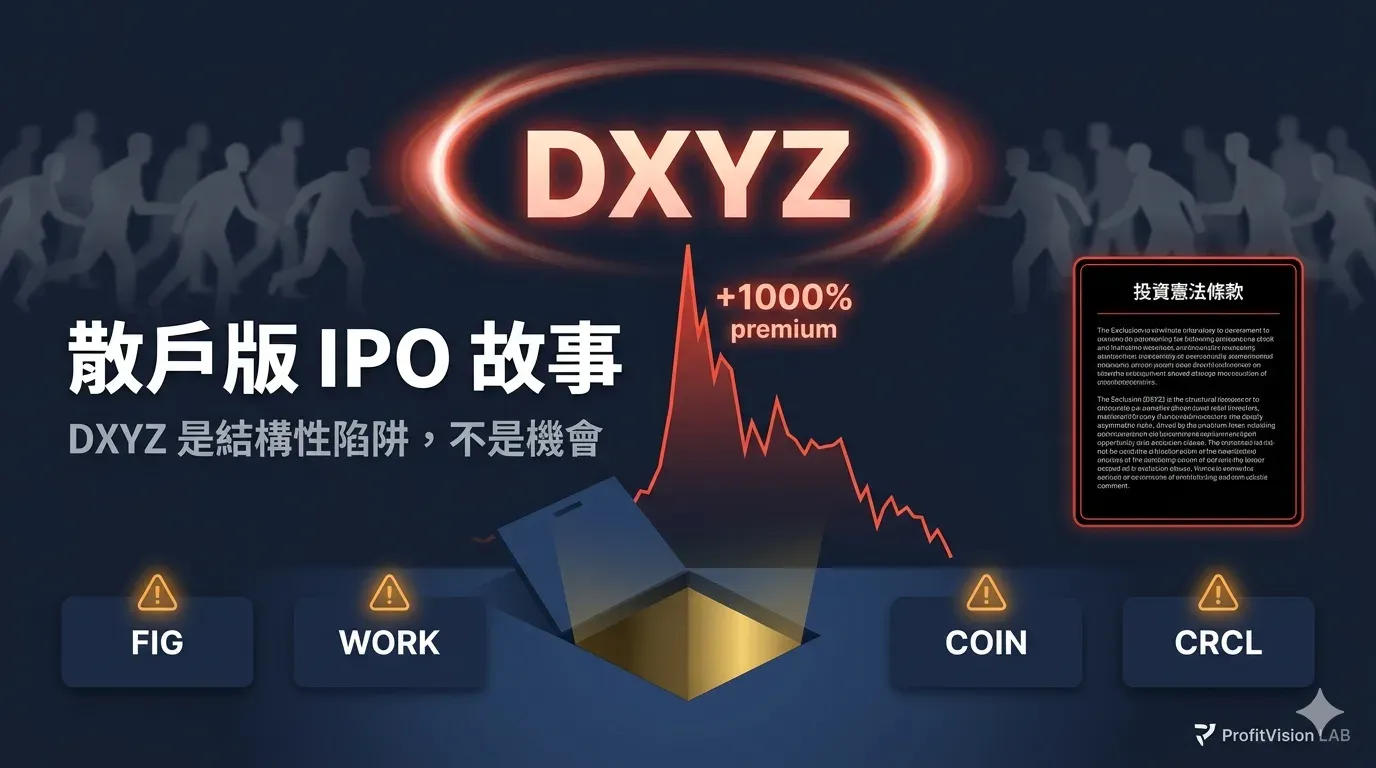
DXYZ was packaged as a way for retail investors to get in early on the growth upside of unlisted unicorns like SpaceX, OpenAI, and Stripe. I was tempted at the time — not out of greed, but because the story seemed logically "reasonable."
Background: What Is DXYZ, and Why Was I Drawn to It?
DXYZ (Destiny Tech100) presents itself as: a gateway for ordinary people into the private markets, a golden ticket before an IPO, a shortcut into disruptive innovation without having to become a VC.
This narrative is extremely appealing to anyone who understands tech trends and knows that stocks often surge hard after an IPO. It taps into a very real emotional gap — "why do those opportunities never come to me?"
The Real Problem: Three Critical Role Mismatches
Mismatch 1: Mistakenly Believing "I'm Also an Early Shareholder"
The real early shareholders are the founding team, Series A/B/C VCs, and the internal option pool. What you buy through DXYZ is:
a secondary-market residual position that has already passed through multiple layers of hand-offs, had its valuation inflated, and has extremely poor liquidity. In terms of capital structure, this is not remotely the same risk-reward tier.
Mismatch 2: Mistakenly Believing "IPO = My Moment to Cash Out"
An IPO isn't the retail investor's finish line — it's the early shareholders' "liquidity exit." The order of capital:
- Founders and VCs hold their shares for years
- Private-round valuations get pushed higher and higher
- The IPO price already reflects most of the growth
- Retail investors take over in the secondary market
- The lockup expires → original shareholders cash out
- The stock enters a long recovery period
Mismatch 3: Mistakenly Believing "I'm Buying Technology Growth"
DXYZ's return doesn't come from cash flow or operating profit, but from "whether some future IPO succeeds, and whether the market is willing to take it over at an even higher valuation." Fundamentally, it's a bet on:
"can I pass it off to the next person before someone passes it off to me."
History Has Already Given Us the Answer (FIG / WORK / COIN / CRCL)
FIG · Figma
Valuation Pushed Higher and Higher → Sharp Correction After the Failed Acquisition
The "retail early-access" narrative collapsed completely. After the Adobe acquisition fell apart due to regulatory barriers, the valuation plunged, leaving everyone who bought in on the "get in early" story with nowhere to exit.
WORK · Slack
A High-Profile IPO → A Long Stretch of Depressed Share Price
Acquired by Salesforce at far below its peak. Early VCs made a fortune, and secondary-market retail investors caught the falling knife. It never returned to anywhere near its offering-price high after listing.
COIN · Coinbase
Listed at the Peak of the Crypto World → A Textbook Cyclical Asset
Became a highly volatile sentiment-driven name, a textbook case of retail investors getting trapped. Listing right at the top of the crypto bull market perfectly transferred the highest risk to whoever got in last.
CRCL · Circle
The Stablecoin-Leader Narrative → SPAC Failure, Restructuring, a Massive Valuation Cut
Everyone who bought in at the private-market peak got buried. No matter how solid the stablecoin business is, it couldn't stop the systematic collapse of the valuation structure.
"An IPO isn't the 'start of growth' — it's the 'opening of the valuation plateau.'"
Putting DXYZ Into Its Correct Category
The Correct Definition
DXYZ isn't a technology ETF, and it isn't a private equity fund — it's a
"secondary-market narrative-arbitrage vehicle" packaged to look like an ETF. Its function is: to provide liquidity for original shareholders, and to transfer private-market risk onto secondary-market retail investors. If I participate, my actual position in the capital structure is:
"a potential holder of the last bag."
Institutional Conclusion: Three Mismatches
Conclusion 1 | Role Mismatch
Retail investors are not Series A/B/C shareholders — in this market, they have only risk, no advantage. You've stepped into a capital tier that fundamentally isn't yours, yet you bear all of its downside risk.
Conclusion 2 | Sequence Mismatch
The real golden growth period happens before the IPO. By the time retail investors can easily buy in and the media is hyping it up, the sweetest part is already over. "Made accessible to the masses" is itself a signal that "the growth phase has ended."
Conclusion 3 | Reward-Structure Mismatch
DXYZ's asymmetry runs in the wrong direction —
unlimited downside, upside that depends almost entirely on a single event, and a very poor median outcome. This is a reward structure inverted from what it should be: you take on VC-level risk without VC-level return potential.
The Real Alternatives
Option A | The Post-IPO "Second Growth Curve" Strategy
Companies 12-36 months after IPO, once the valuation has reset, the fundamentals have been proven out, and a new growth curve has kicked in. This is where the risk-reward ratio is actually best for retail investors. Wait for the market to finish correcting excessive expectations, and enter right as the real fundamentals are being confirmed.
Option B | Infrastructure ETFs (Don't Bet on a Single Story)
QQQ, CIBR, semiconductor ETFs, defense ETFs. You hold structural growth across an entire industry, rather than buying into the single-point narrative that "one particular private company will be huge someday." Diversification = protection = long-term survival.
Option C | Cash-Flow-Generating Growth Vehicles
SPYI, JEPI,
JEPQ, the wheel strategy, Covered Calls. You don't have to guess the future to live off cash flow every day. Structural income means I no longer depend on "waiting for a big rally" to realize a return.
One Final Word + A DXYZ-Specific Clause
"Whenever a security's main selling point is: 'you can get in early on the next great story,' you can call it with almost 100% certainty: it was designed to be sold to retail investors, not designed for them."
《 Permanent Exclusion Clause for IPO-Narrative Assets 》
Any financial product whose main selling point is "get in early on an IPO," "unlisted unicorn upside," or "retail investors can be early shareholders too" is classified, without exception, as a "role-mismatched asset", and is permanently excluded from my investment universe — regardless of whether it's packaged as an ETF, a fund, an SPV, or a token.
"
A real opportunity never needs to convince you that it's an opportunity.