
Broadcom AVGO Q2 FY2026: Record AI Revenue, Why Did the Market Sell?
Broadcom delivered record AI revenue, yet the stock sold off roughly 20% after earnings. This update explains the valuation reset, Google TPU share dilution risk, AI IPO capital reallocation, and the post-selloff valuation map.
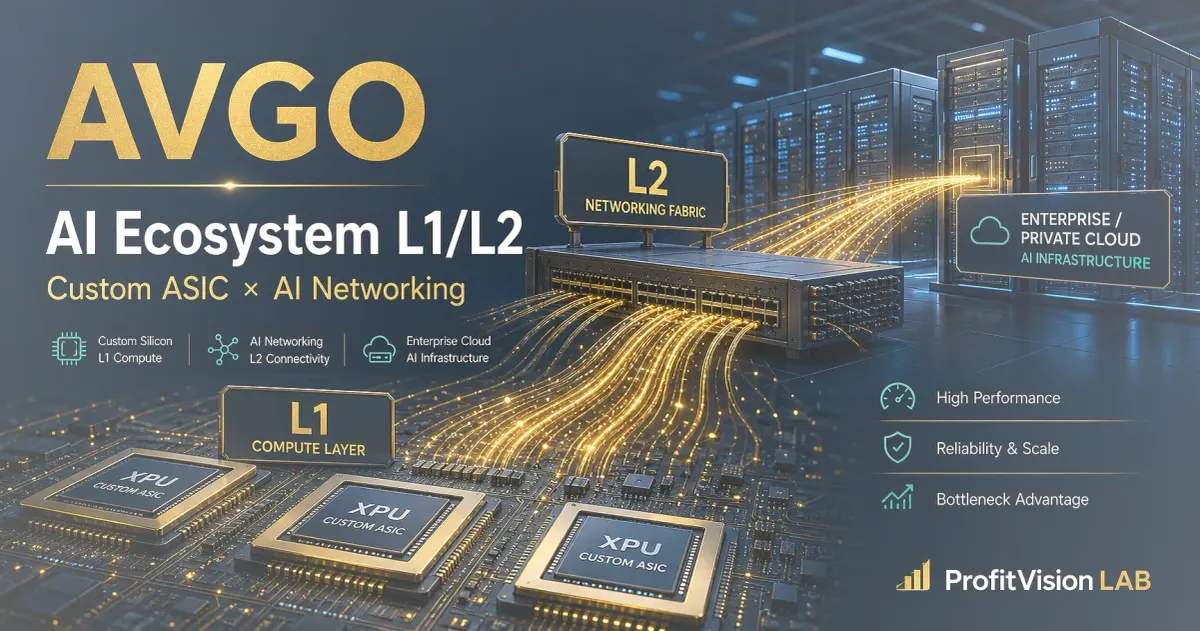

Broadcom AVGO Q2 FY2026: Record AI Revenue, Why Did the Market Sell?
The numbers were strong, but the stock fell roughly 20% in two sessions. This preview updates the AVGO L1/L2 AI infrastructure thesis with Q2 FY2026 results, Google TPU share dilution risk, the AI IPO capital-reallocation backdrop, and the valuation map after the selloff.
Executive Summary
AVGO is not a broken-fundamentals story. It is a valuation-identity reset: the market is testing whether Broadcom still deserves high-growth AI-leader multiples, or whether it should be repriced as a high-quality AI infrastructure compounder.
| Core Question | v2.0 Answer | Investor Implication |
|---|---|---|
| Did fundamentals break? | No. Q2 AI semiconductor revenue reached $10.8B, up 143% YoY, with FCF at 46% of revenue. | The selloff is not a classic earnings failure. |
| Why did the market sell? | Q3 AI guidance of ~$16B was strong, but below some buy-side expectations near $17.2B. | The market sold growth-slope disappointment, not absolute weakness. |
| What changed structurally? | Google TPU share dilution became the key long-term risk after Macquarie highlighted MediaTek / internal-sourcing pressure. | Forward EPS visibility may deserve a lower multiple. |
| What should investors watch? | Q3 AI actuals, Google share trajectory, non-Google XPU customers, and VMware FCF quality. | AVGO is investable, but entry discipline matters more. |
AVGO’s AI Position: Not Nvidia, Not a Traditional Chip Stock
Broadcom sits at the L1/L2 boundary of the AI ecosystem. Nvidia sells a general-purpose accelerated computing platform. AVGO is closer to a custom infrastructure contractor for hyperscalers: custom AI ASIC / XPU on one side, AI Ethernet and high-speed interconnect on the other, with VMware as a cash-flow base.
| Layer | AVGO Role | Investment Meaning |
|---|---|---|
| L1: Custom AI Silicon | Custom ASIC / XPU co-development for hyperscaler workloads such as Google TPU and Meta MTIA. | Captures cloud demand to lower GPU dependency and optimize performance per watt. |
| L2: AI Networking Fabric | Tomahawk, Jericho, AI Ethernet, NICs, optical connectivity, and high-speed I/O. | As AI clusters scale, the bottleneck shifts from chips to the connections between chips. |
| Enterprise Infrastructure | VMware private-cloud and hybrid-cloud stack. | Provides durable cash flow and an enterprise AI deployment bridge. |
| Capital Allocation | Hock Tan’s acquisition, repricing, and FCF-maximization system. | The management model is part of the moat, but succession remains a key risk. |
Q2 FY2026: Strong Numbers, Weak Surprise
The paradox: Broadcom delivered record AI revenue and top-tier free cash flow, yet the stock sold off because the AI guide was not strong enough relative to elevated expectations.
| Metric | Q2 FY2026 / Guide | Market Read |
|---|---|---|
| Total revenue | $22.19B, +48% YoY | Strong; modestly ahead. |
| AI semiconductor revenue | $10.8B, +143% YoY | Record level; confirms AI demand. |
| Non-GAAP EPS | $2.44, +54% YoY | Beat expectations. |
| Free cash flow | $10.26B, 46% of revenue | High-quality downside support. |
| Q3 total revenue guide | ~$29.4B, +84% YoY | Better than headline consensus. |
| Q3 AI semiconductor guide | ~$16.0B | Below some buy-side expectations near $17.2B. |
Google TPU Dilution Is the Real Structural Risk
Macquarie’s downgrade matters because it is about customer architecture, not one quarter. The concern is that Google may diversify TPU silicon sourcing through MediaTek and internal design work, reducing AVGO’s share of Google-related TPU design revenue over time.
| Timeframe | Potential AVGO Share in Google TPU Work | Interpretation |
|---|---|---|
| FY2026 | ~95% | Near-exclusive position; strongest version of the moat. |
| FY2027 | ~80% | MediaTek / internal alternatives begin to matter. |
| FY2028 | ~65% | Still meaningful, but no longer an exclusive-like relationship. |
The bullish counterpoint is also important: lower Google share does not automatically mean lower AVGO AI revenue if Meta, OpenAI, Anthropic, or other XPU customers scale fast enough. The issue is not immediate demand collapse; it is whether the market should pay the same multiple for a less exclusive growth path.
After the Selloff: Valuation Map
| Scenario | Trigger | Market Identity | Forward P/E Framework |
|---|---|---|---|
| Bullish Re-acceleration | Q3 AI revenue beats, FY2027 AI target gets revised upward. | AI growth leader | 35-40x+ |
| Base Case Reset | AI keeps growing, but slope stabilizes; VMware and FCF support quality-compounder status. | High-quality compounder | 28-35x |
| Stalwart Repricing | Google dilution is validated and AI guidance misses buy-side expectations for several quarters. | Mature quality stock | 18-27x |
The companion valuation-compression study shows that when high-growth leaders are repriced as quality stalwarts, P/E compression of 30-50% is not unusual. That does not make AVGO a sell; it means the entry multiple matters.
Three-Trillion-Dollar IPO Wave: Capital Reallocation, Not Fundamental Damage
SpaceX, OpenAI, and Anthropic entering public markets would not directly weaken AVGO’s business. The near-term risk is portfolio mechanics: passive funds and active AI allocations may need to redistribute capital across a larger public AI opportunity set.
| Effect | Short-Term Impact | Long-Term Impact |
|---|---|---|
| Nasdaq-100 / QQQ rebalancing | Potential mechanical selling from existing large constituents. | AI concentration may actually rise, but weights shift. |
| AI scarcity premium | Existing AI winners lose some scarcity value. | Valuation depends more on cash flow and customer durability. |
| AVGO vs new AI listings | Investors compare mature FCF with newer narrative optionality. | AVGO must prove it is both infrastructure-critical and growth-relevant. |
Risk Register: What v2.0 Adds
| Risk | v2.0 Status | Severity | Monitoring Point |
|---|---|---|---|
| Google TPU share dilution | MediaTek / internal design risk is now central to the bear case. | High | FY2027-FY2028 EPS visibility and customer mix. |
| AI guidance gap | Q3 AI guide is strong but below some elevated expectations. | Medium-High | Whether the gap repeats for 2-3 quarters. |
| VMware integration | Still a cash-flow base, but renewal and churn quality matter. | Medium | FCF margin, renewal rate, customer retention. |
| AI IPO reallocation | Not a business risk, but can amplify volatility. | Medium | QQQ weights, passive flows, IPO lockups. |
Preview Conclusion
AVGO remains one of the highest-quality AI infrastructure cash-flow stories, but it should no longer be analyzed with a simple “AI revenue up, stock should go up” framework. The correct question is whether the market will keep pricing AVGO as a high-growth AI leader, or reprice it as a high-quality compounder with more visible customer-concentration risk.
For investors, the next decisive data point is Q3 AI semiconductor revenue and management’s FY2027 AI target language. If the ASIC cycle re-accelerates, the growth premium can return quickly. If the Google dilution story strengthens, the 20% selloff may only be the first stage of valuation compression.
Comments ()