M-04 Primary Base: The Starting Point of Your Biggest Gains
Primary Base is the major early base of a Stage 2 advance, not an IPO-only setup. This article compares O’Neil and Minervini on Primary Base, VCP, Pivot Points, supply-demand structure and Base Count, explaining why the first base often creates the largest gains.
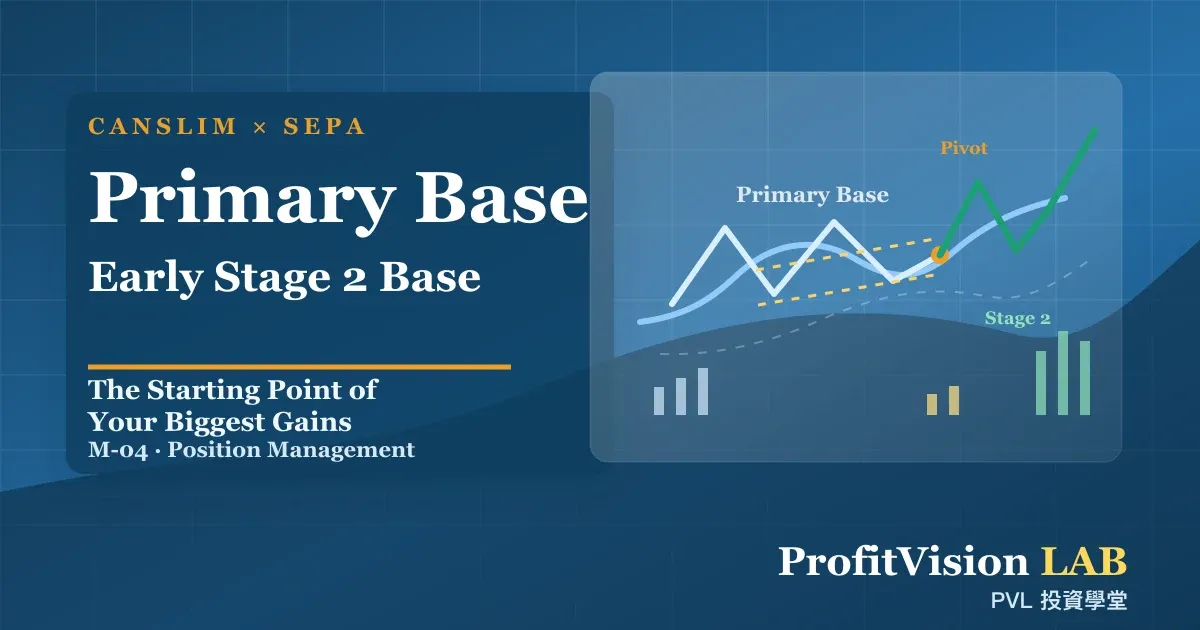
- The Primary Base is the major initial base of a strong stock during the early advance or early Stage 2 phase; it is not an IPO-only term
- Yahoo (YHOO) gained +7,900% in 29 months from its Primary Base breakout; Amazon (AMZN) gained +2,500% in 16 months
- O'Neil emphasizes weekly base structure and Pivot Points: cup with handle, double bottom, and flat base structures need time to form, and the breakout is the actionable signal
- Minervini adds SEPA filters: strong prior trend, VCP contraction, volume dry-up, and price above the 200-day moving average to confirm Stage 2
- The shared logic: a Primary Base needs prior strength, absorbed supply, tightening volatility, strong-volume breakout, and a low Base Count
Why the Primary Base Is Where the Biggest Gains Start
In technical growth investing, a Primary Base is best understood as a stock's major initial base: the stock first shows strength, then consolidates, absorbs supply, tightens volatility, and finally breaks out through a Pivot Point during the early advance or early Stage 2 phase.
Through Stan Weinstein's four-stage framework, the Primary Base usually appears as a stock transitions from Stage 1 accumulation into a Stage 2 advance. The first buyable base after an IPO is the classic example, but it is not the whole definition. A major transformation, industry cycle turn, or renewed fundamental acceleration can also create a Primary Base.
In Chinese, translating Primary Base as "first-issued base" can make it sound like an IPO-only idea. A more precise reading is: Primary Base means the main initial base of an emerging leader. The key is early advance / Stage 2 position, not listing date.
How Do O'Neil and Minervini Define Primary Base?
O'Neil and Minervini use different language, but the operating idea is similar: a stock that has already proven strength forms a high-quality early base, then breaks out through a clear Pivot Point.
William O'Neil: Pattern, Weekly Structure, Pivot
- Prior strength first: the stock must have already shown a meaningful advance before the base matters.
- Common structures: cup with handle, double bottom, flat base. Primary Base is not one shape.
- Time requirement: classic bases generally need at least about five weeks, and many high-quality bases take months.
- Depth: a common correction range is roughly 20%–30%, sometimes deeper in difficult markets.
- Buy point: the actionable signal is the breakout through the Pivot Point, often into new-high ground.
Mark Minervini: SEPA, VCP, Stage 2 Filter
- Strong prior trend: he wants major price progress before the base, often a substantial move over the prior 6–12 months.
- VCP contraction: volatility contracts as the base matures and supply is absorbed.
- Volume dry-up: pullbacks should occur on declining volume, showing reduced selling pressure.
- Trend filter: price should be above the 200-day moving average, confirming a long-term Stage 2 uptrend.
- Precise daily entry: he focuses on the specific pivot and risk/reward of the entry point.
| Comparison | O'Neil | Minervini |
|---|---|---|
| Trend filter | Emphasizes historical base structure, fundamental catalyst, and leadership traits | More explicitly relies on the 200-day moving average, Trend Template, and Stage 2 conditions |
| Base count | Prefers first- or second-stage bases; lower Base Count is safer | Also favors early bases, but may accept multiple bases in exceptional growth leaders if the setup is tight |
| Time frame | More often evaluates base maturity through weekly structure | More often uses the daily chart to refine VCP contraction and the exact pivot |
What makes the Primary Base special is not that its pattern is "prettier" than later bases, but that the underlying market microstructure is fundamentally different from every subsequent base. Understanding this difference is the key to identifying the next generation of YHOO and AMZN.
Historical Cases: Three Primary Bases That Changed Investors' Fortunes
These three figures are the core cases Minervini uses to illustrate the power of the Primary Base. What they share is not their historical backdrop (though all were in the internet era), nor one fixed chart shape, but the same cycle position: the stock was entering an early Stage 2 advance, the market had not fully priced the story, and the breakout moved into relatively clean overhead supply.
"The biggest gains come from getting in on the first base and then holding through the entire big trend. Investors who don't get in until the third or fourth base only get the scraps." — Mark Minervini
The Market Microstructure Advantage of the Primary Base
Why is the first base so often the strongest? This requires a supply-and-demand analysis — the core logic of the "S" (Supply and Demand) component in CANSLIM.
Primary Base: major early base
- Holder composition: Early holders from Stage 1 accumulation usually have a low cost basis and can wait for the Stage 2 advance.
- Institutional position: The first funds discovering the new story begin to add the stock to growth portfolios.
- Overhead supply: The advance has not yet become crowded, so trapped supply is relatively light.
Base 3–5: late-stage base
- Holder composition: Early holders are sitting on large gains, and some begin to take profits.
- Institutional position: Later capital enters at progressively higher average costs.
- Overhead supply: Each failed breakout leaves another wave of trapped buyers.
How to Identify a Primary Base
Identifying a Primary Base requires more than asking whether it is the first base or whether the company recently IPO'd. The full process starts with prior strength, then checks base structure, volume, long-term trend, and the Pivot Point:
Four Core Identification Criteria
| Criterion | Description | Importance |
|---|---|---|
| Strong prior trend | The stock must have already shown a meaningful advance; Minervini places particular weight on a strong 6–12 month move, while O'Neil also requires leadership characteristics | Core requirement |
| Base structure | Can appear as a cup with handle, double bottom, or flat base; classic bases generally need at least about five weeks and often correct roughly 20%–30% | Core requirement |
| VCP and volume dry-up | Minervini looks for volatility contraction, declining volume on pullbacks, and evidence that supply has been absorbed | Required condition |
| Stage 2 and pivot | Price should be above the 200-day moving average, confirming the long-term uptrend; the buy point is the breakout through the Pivot Point, not the middle of the base | Required condition |
YHOO Primary Base Case Study
Yahoo! Inc. IPO'd in April 1996 and was the most representative internet portal company of its time. Minervini's Master Trader Program materials document the complete move from its Primary Base in detail:
AMZN Primary Base Case Study
Amazon IPO'd in May 1997, positioning itself as "the world's largest bookstore" — but the market quickly saw potential far beyond that:
The Primary Base and CANSLIM's "N" Factor: A Deep Connection
In O'Neil's CANSLIM, "N" stands for New Products, New Management, New Highs. The Primary Base takes "N" to its most extreme form:
| Dimension of "N" | "N" in an Ordinary Stock | "N" in a Primary Base |
|---|---|---|
| New product | Existing company launches a new product line | A brand-new business model disrupting an entire industry |
| New high | Breaking out above a prior consolidation high | Completely open sky above (all-time high territory) |
| New management / new positioning | New CEO brings strategic change | The company enters a new capital-market narrative: IPO, new CEO, restructuring, new product line, or changed industry role |
| Valuation potential | PE recovering from undervalued to fair value | Full-range expansion from "unvalued" to "fully priced" |
Many investors want to buy on IPO day, but Minervini explicitly advises: wait for the Primary Base to form before entering. The reason is not that a Primary Base must wait for a fixed number of months. The issue is that early IPO trading usually contains lock-up supply, institutional accumulation, and liquidity repricing noise. Before that supply has been absorbed, volatility is high and predictability is low. A true Primary Base breakout is often the lower-risk, higher-conviction entry point.
Finding Primary Bases Today
The Primary Base is not a 1990s-only phenomenon. Minervini stresses that every technology revolution cycle produces its era's equivalent of YHOO and AMZN. The key is not the era — it's the structural characteristics:
- Recent IPO or major new story: Use MarketSurge or your preferred screener to build the search pool; 6 months to 3 years is a common screening window, not the definition
- EPS acceleration ≥ 25%: The fundamentals must have a concrete catalyst (not just a story)
- RS Rating ≥ 80: The stock must be a relative price leader, not merely the largest company in its sector
- Pattern contracting: VCP forming, with volume shrinking on pullbacks
- Institutional accumulation beginning: A/D Rating rising, number of institutional holders increasing
Primary Base Risks: Not Every Early Base Is the Next YHOO
Emphasizing the power of the Primary Base requires equally emphasizing its risks — because most early bases will not become YHOO or AMZN. Identifying which early Stage 2 bases are genuine Primary Base candidates requires meeting dual thresholds on both the fundamental and technical sides:
- New stories with no real EPS: No matter how compelling the story, without EPS acceleration the stock fails SEPA's fundamental threshold
- Entering before the pattern matures: Wait for the base to fully form; do not treat every early consolidation as a Primary Base
- Mistaking the "first pullback" for a Primary Base: The first decline in early Stage 2 may simply be market adjustment, not a buyable major base
- Lock-up supply not yet absorbed: If the IPO lock-up has not expired, large insider holdings may become future supply pressure
The Primary Base and Position Management
Why is the Primary Base covered in the "Position Management" (M series) rather than the "Stock Selection" (S series)? Because the Primary Base's most important function is giving you the conviction to hold longer.
When you know you entered on a Primary Base breakout — not the third or fourth base — your holding logic changes fundamentally:
- Minor pullbacks won't shake you (you know there's no overhead trapped supply pushing back)
- Mid-trend consolidations won't send you running (you know this could be a YHOO-style multi-leg advance)
- You'll be willing to set your profit exit at "pattern failure" rather than "I'm up 20%"
Building strong holding conviction at the Primary Base breakout is the foundation for the next few articles (M-05 Power Play, M-06 Sell Rules). Only when you believe you're at the early starting point of a major move do you have the psychological basis to "let profits run" rather than exiting too early.
- □ Confirm the stock has moved from Stage 1 into early Stage 2, and this is a major early buyable base rather than a later continuation base
- □ No significant overhead supply zone (stock near all-time highs)
- □ Base quality is sound: the shape can be cup with handle, flat base, or double bottom; two or more contractions and low-volume pullbacks improve the setup
- □ EPS growth ≥ 25% in each of the past two quarters, and accelerating
- □ RS Rating ≥ 80 (top-tier candidates ≥ 90)
- □ Institutional sponsorship increasing recently (A/D Rating B or above)
- □ Market in a Confirmed Uptrend
- □ Breakout-day volume ≥ 140% of average volume
Phase Three: Position Management & Exits (M Series)
M-01 Tennis Ball vs. Natural Reaction | M-02 Confirmation vs. Violation Signals | M-03 Failure Reset & Re-Entry | M-04 Primary Base (this article) | M-05 Power Play | M-06 Sell Signals & Topping Patterns | M-07 Risk Management & Position Sizing
- Primary Base: the first pattern formed off the lows — historically the highest success probability
- Base-on-Base: the prior base did not fully break out before a new base formed — does not count as entering a tired stage
- Exercise caution after Base 4–5: history suggests bulls tend to top within the first 3 bases, but this is a guideline, not a law
- Miscounting a Base-on-Base as a second base — inflating the count causes premature abandonment of strong leaders
- Directly applying a historical case's "which base failed" without accounting for the market environment at the time
- Declaring a stock has "too many bases" and exiting mid-bull-cycle
- Historical cases from different eras (1990s tech stocks) must account for their own market context — don't assume direct comparability
- When overall bull cycles shorten (faster bear-to-bull rotations), Base Count becomes less useful as a reference
- Base counting involves subjective judgment; different analysts may count the same stock differently