Decoding the $500 Billion: Taiwan Isn't Paying Protection Money — It's Buying a Seat at the Table Where Global Rules Are Set
Taiwan's $500 billion investment commitment to the U.S. has been framed by the media as "paying protection money." ProfitVision LAB proposes an alternative framework from a FinOps perspective: Taiwan is an institutional and capital integrator, not a financier. This report breaks down six strategic investment directions and the concrete investment implications for "control-shift-forward beneficiary stocks" in Taiwanese equities.
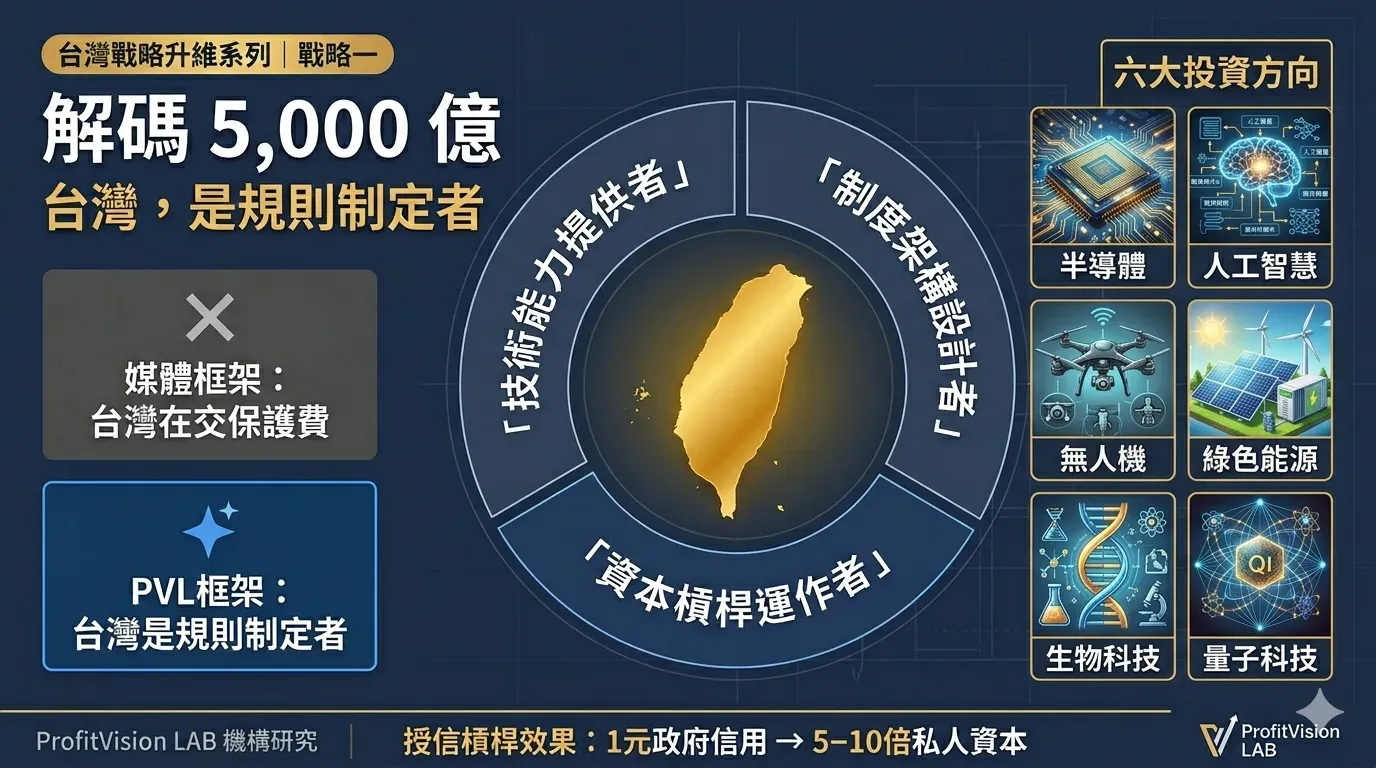
When Taiwan announced its $500 billion investment commitment to the United States, the media's framing got nearly everything wrong. ProfitVision LAB deconstructs this from a FinOps asset-operations perspective: this is not a diplomatic concession — it is the most sophisticated act of capital diplomacy in Taiwan's history.
In 2025, under tariff pressure from the Trump administration, Taiwan announced a $500 billion investment commitment to the United States. The dominant framing in media and public discourse has been: Taiwan is paying protection money, hollowing out its own industry, and being drained by the U.S.
That framing is wrong.
ProfitVision LAB proposes an alternative framework: Taiwan's role is not that of a "financier," but of an Institutional Capital Integrator. The $500 billion is not cash flowing out — it is national credit used as leverage to deploy Taiwan's technological strengths into the critical gaps of the U.S. supply chain, turning Taiwan's technical standards into global standards and Taiwan's engineers into irreplaceable decision-making nodes.
This report answers three questions: why is the media wrong? Which gaps should Taiwan's capital fill? What is the underlying financial logic of "control shift forward"? And it concludes with the concrete investment implications for Taiwanese equities.
1. The Question From Early 2025
In early 2025, the Trump administration announced reciprocal tariffs against multiple countries, with Taiwan among the first wave affected. Taiwan's government subsequently launched a series of negotiations, ultimately proposing an investment commitment framework toward the U.S. totaling $500 billion, covering both direct investment and credit-facility support.
The moment that number came out, public opinion was nearly unanimous:
"Taiwan is paying protection money."
"Taiwan's money is being taken by the U.S."
"This is offshoring industry — Taiwan will be hollowed out."
These narratives spread widely on social media and appeared in the commentary sections of numerous mainstream outlets.
ProfitVision LAB's position is: these narratives are almost entirely wrong. This isn't merely a misjudged conclusion — it's a fundamental misapplication of the analytical framework itself.
This report is not an endorsement of the Taiwanese government's decision-making. It's an attempt to build a more precise analytical framework, so that readers — whether policymakers, corporate decision-makers, or ordinary investors — can see the true nature of what's happening more clearly, and understand its implications for Taiwan's long-term strategic position.
2. The Media Framework's Fundamental Error
Let's place the mainstream media framework side by side with ProfitVision LAB's alternative framework:
The core error in the media framework is conflating "investment" with "expenditure." This is a fundamental failure of the analytical framework, not just a misreading of the specific numbers.
Expenditure: funds flow out in one direction, with no asset or control acquired in return. Buying weapons, subsidizing electricity prices, cash handouts to voters — these are expenditures; once the money is gone, it's gone.
Investment: funds flow out, but in exchange for an asset, control, or future cash flow. Deploying Taiwan's technical capability and capital at critical nodes of the U.S. supply chain buys standard-setting rights, a seat in decision-making, and long-term order flow and profit repatriation.
Credit Facility: national credit used as a guarantee to leverage-mobilize private capital. The Taiwanese government isn't directly disbursing $500 billion — it's providing a credit backstop that gives private companies and financial institutions enough confidence to commit to high-risk strategic positioning.
Once you reframe this $500 billion through the lens of "investment" and "credit facility," the entire narrative flips: this isn't Taiwan losing something — it's Taiwan actively acquiring something.
3. Taiwan's Role: Institutional and Capital Integrator
ProfitVision LAB positions Taiwan within this framework as a three-tier composite role:
This three-fold role combination means Taiwan, within the U.S.-Taiwan industrial cooperation framework, is not playing "the junior partner footing the bill," but "the integrator defining the rules." How big is that difference? Think of TSMC's position in Taiwan's foundry business — it's not the biggest buyer, nor the one with the most money, but it defines the standard for advanced process nodes, so that anyone who wants the most advanced chips has to go through it.
What Taiwan is aiming for within this U.S. investment framework is a similar standard-setting position — not through monopoly, but by becoming an irreplaceable technical and institutional node.
4. Why Credit, Not Direct Expenditure
In ProfitVision LAB's FinOps framework, the most common mistake in defense and strategic investment is treating "strategic asset construction" with the logic of an "annual expense."
South Korea's semiconductor financial-support model is a historical precedent for this exact logic. In the 1980s, the Korean government didn't directly fund fab construction — it provided long-term credit guarantees, backed by government credit, to Samsung and SK Hynix, enabling these companies to obtain ultra-low-rate, long-term financing from commercial banks for decade-plus, high-risk technology investments. The government spent not a single dollar directly on equipment, yet it gave rise to today's top two global memory manufacturers.
The U.S. defense industry's long-term order-based credit model is another precedent. Lockheed Martin, RTX, and Boeing Defense sustain high-intensity R&D spending not primarily because the government directly subsidizes R&D costs, but because the government provides multi-year (5–10 year) procurement framework contracts, allowing these companies to secure long-term financing in capital markets based on future order flow, sustaining continuous R&D investment.
Taiwan's $250 billion credit-guarantee pool logically combines these two models — using government credit as the first-loss absorber to channel private capital toward strategic nodes of U.S.-Taiwan industrial cooperation, while framework contracts ensure long-term order visibility, allowing participating companies to secure reasonable financing terms in capital markets.
5. Investment Isn't About Who's Stronger — It's About Whose Gap Gets Filled
This is the single most important strategic principle in the entire framework, and the key to Taiwan avoiding the trap of "paying money without gaining a voice."
In the context of U.S.-Taiwan industrial cooperation, one basic principle must be established first: Taiwan should not invest in industries where the U.S. already holds an absolute advantage dominated by existing giants.
The U.S. has overwhelming advantages in chip design (Nvidia, AMD, Qualcomm), platform software (Microsoft, Google, Amazon), and financial engineering (Wall Street). No matter how much capital Taiwan pours into these areas, it will only ever be a financial investor, gaining no decision-making power or standard-setting role.
Where Taiwan should truly deploy capital is in the critical links that the U.S. urgently needs but has not fully mastered, and where Taiwan holds a technical, institutional, or organizational advantage.
Principle One: Fill gaps, don't compete for strength — choose areas where the U.S. has demand but lacks Taiwan-style production capacity, and quickly establish an irreplaceable position, rather than competing head-on with U.S. companies on their home turf.
Principle Two: Prioritize dual-use technology — choose technology areas with dual-use (military and civilian) potential; these projects benefit from the dual support of commercial markets and defense procurement, giving high order visibility and strong political backing.
Principle Three: Control key connection points — aim for "connection points" in the supply chain rather than "endpoints." A connection point means multiple upstream and downstream players must go through you; once you hold that connection point, switching costs become extremely high for everyone involved.
6. Six Strategic Investment Directions — Benchmark Case Analysis
Based on the three principles above, ProfitVision LAB has identified the six most strategically significant directions for Taiwan's U.S. investment framework:
7. Control Shift Forward — The Core Thesis Most Prone to Misreading
Above the six directions sits a more fundamental strategic concept that needs to be clearly explained: Control Shift Forward.
Traditional supply-chain thinking holds: wherever you manufacture, that's where you have control. Taiwan manufactures in Taiwan, so Taiwan controls its own manufacturing capability. This thinking was correct in the twentieth century; under twenty-first century geopolitics, it is dangerous — because it concentrates all of Taiwan's advantages in a single geographic point that could be blockaded or attacked.
The logic of control shift forward is: deploy Taiwan's technical capability and capital at critical nodes of the U.S. supply chain, so that Taiwanese engineers and Taiwan's technical standards become an irreplaceable part of America's most critical industrial systems. That way, even if Taiwan's geographic location comes under pressure, Taiwan's "technological sovereignty" has already secured an unremovable position within the world's most important industrial system.
"You can blockade an island, but you cannot remove a technical node that has become deeply embedded in the world's most important industrial system. That is Taiwan's ultimate security guarantee." — ProfitVision LAB, 2026
Japan's automotive-industry footprint in the United States is the most successful historical case of this exact logic. Toyota didn't build plants in the U.S. merely to get around tariffs — it made the Toyota Production System the de facto standard of the U.S. auto industry, and made Toyota's engineers indispensable technical decision-makers inside America's largest auto plants. Today, no matter how U.S.-Japan relations shift, Toyota's position in the U.S. auto industry cannot easily be removed — because removing Toyota would mean removing a core piece of the U.S. auto industry's own capability.
What Taiwan needs to replicate within its U.S. investment framework is exactly this logic.
8. Directly Addressing the Objections
This framework will encounter several common objections, which ProfitVision LAB addresses directly here:
Objection One: "This is just dressing up protection money"
The defining feature of protection money is: you pay, and in exchange you get nothing more than the other party temporarily not harming you — no asset or control transfer of any kind. When a gang collects protection money, no one knows where it goes, and the shop owner gets no investment return whatsoever.
Taiwan's U.S. investment framework, by contrast, trades for: establishing a Taiwanese technical presence at critical nodes of the U.S. supply chain, securing endorsement of Taiwanese standards in U.S. capital markets, and gaining a seat as an industry stakeholder in U.S. policymaking. These are not "temporary safety" — they are calculable, long-term assets.
Objection Two: "Once the U.S. learns the technology, it will discard Taiwan"
This concern assumes Taiwan's technology can simply be "learned away." But if Taiwan's investment strategy is correct — investing in areas the U.S. needs but lacks the capability for — then these capabilities aren't a transferable body of knowledge; they're a complex system that requires Taiwan's entire supply-chain ecosystem to function.
TSMC's struggles in Arizona illustrate exactly this point: the U.S. can replicate TSMC's factory equipment, but it cannot replicate, in the short term, the manufacturing ecosystem and tacit knowledge Taiwan built up over thirty years. By the same logic, the technical nodes Taiwan establishes through investment in the U.S. are not an independently detachable technology package — their value is tied to a capability network anchored in Taiwan's overall ecosystem.
Objection Three: "Why not keep the money invested in Taiwan"
This question presumes that keeping Taiwan's capital invested at home and positioning strategic nodes in the U.S. are mutually exclusive choices. But that's a zero-sum-thinking trap.
Taiwan's outbound investment, particularly in positioning strategic nodes in the U.S., creates deep bundling between the U.S. and Taiwan industrial chains. That bundling has a direct, positive effect on the long-term order visibility and pricing power of Taiwan's core domestic industries — TSMC, ASE, and the precision-manufacturing ecosystem. This isn't "moving money out of Taiwan" — it's "using investment in the U.S. to reinforce the moat around Taiwan's core domestic industries."
9. The Three Layers of Meaning in Capital Diplomacy
Elevating the above analysis to a broader perspective, Taiwan's U.S. investment framework carries three layers of meaning that go beyond pure financial or industrial analysis:
First layer: commercial meaning — using capital to occupy critical gaps in the U.S. supply chain, in exchange for long-term order flow and a voice in technology decisions.
Second layer: institutional meaning — securing endorsement for Taiwan's technical standards within the U.S. industrial ecosystem, deploying Taiwan's "technological sovereignty" into an institutional space that exists beyond geographic defense.
Third layer: geopolitical meaning — raising the cost of attacking or isolating Taiwan beyond what any rational actor could bear. Once Taiwan's technical nodes are deeply embedded in America's most critical industrial systems, attacking Taiwan is no longer just "damaging Taiwan" — it's "damaging a core capability of American industry."
Taken together, these three layers form the complete strategic logic behind Taiwan's $500 billion U.S. investment commitment. The media has only seen the surface of the first layer, and drawn the wrong conclusion from it.
10. The Institutional Design Details Behind the $500 Billion
Having covered the strategic logic, we need to zoom in on the institutional design details of this $500 billion — because "the details determine whether the strategy can actually be realized."
The Financial Architecture of the Credit-Guarantee Pool
The core mechanism of the credit-guarantee pool design proposed by ProfitVision LAB is as follows:
The Taiwanese government (or a government-authorized sovereign fund) puts up $250 billion as a First Loss Piece. This means that if a guaranteed investment project incurs a loss, the government absorbs the first tranche of that loss before private investors are affected.
The key effect of this mechanism is: it dramatically lowers the barrier for private capital to enter high-risk strategic projects.Because in the worst case, the government has already absorbed the first blow, capping your downside. With this protection in place, private capital that would otherwise be unwilling to enter defense industry or early-stage infrastructure construction now has an incentive to participate.
Estimated leverage effect: if the government's first-loss design covers 20–25% of losses (i.e., if a project incurs a loss, the government absorbs the first 20–25%), private capital's willingness to participate rises substantially, potentially mobilizing 4–5x leverage. A $250 billion government guarantee could unlock $1.0–1.25 trillion in private capital — this is the real scale behind the "$500 billion" headline figure.
Order Visibility From Framework Contracts
Another important complement to the credit-guarantee pool is the multi-year framework contract.
The U.S. Department of Defense's procurement practice is to lock in technology and service suppliers through multi-year framework contracts (typically 5–10 years), then issue specific orders year by year within that framework. This mechanism gives suppliers enough order visibility to justify long-cycle technology investment and capacity buildout.
If Taiwan, within its U.S. investment framework, can secure a framework-contract arrangement built on the same logic — for example, confirming a five-year procurement framework for a specific unmanned-systems component category — then Taiwanese companies investing in that direction would gain a financial certainty similar to that of a U.S. Tier 2 defense contractor, with a valuation basis entirely different from ordinary manufacturing.
Timing the Entry Into Standard-Setting
Early in a supply chain's development, standards are often undetermined. Whoever enters first, and whichever technical pathway gets adopted, becomes the industry standard. Taiwan's timing on U.S. investment happens to coincide with the standard-undetermined period for emerging supply chains like unmanned systems, AI infrastructure, and advanced packaging — this is the optimal window for entry, not five or ten years later when trying to fight for a market whose standards have already locked in.
This window is expected to be most critical during 2026–2030. If Taiwan's investment establishes sufficient technical presence at critical nodes within these five years, Taiwan becomes a stakeholder that must be consulted in the subsequent standard-setting process, rather than a party that simply accepts standards after the fact.
11. Risks and Limitations of This Framework
ProfitVision LAB's analytical framework corrects the media's misreading, but that doesn't mean we believe Taiwan's U.S. investment framework is risk-free. Honest analysis requires presenting the risks directly.
Risk One: Political Interference Derailing the Strategy
The biggest execution risk for the credit-guarantee pool is political factors steering funds toward strategically suboptimal projects. The gap between "giving money to the right people" and "giving money to the politically convenient people" is a persistent tension under any democratic system. If the credit-guarantee pool's decision-making mechanism isn't sufficiently led by technocrats, it can easily degenerate into another patronage tool rather than a platform for strategic capital deployment.
Mitigation: institutionally, the credit committee should include independent industry-technical members (not political appointees), and establish strict "strategic gap-filling" criteria, so that every guaranteed project must pass the test of "is Taiwan filling a gap, not competing for strength."
Risk Two: Betting on the Wrong Technical Pathway
Unmanned systems, AI edge compute, advanced packaging — these are all areas where the technical pathway is still evolving rapidly. If Taiwan makes a heavy bet on one technical pathway and that pathway is superseded by a different breakthrough three years later, the investment in that pathway would lose substantial value.
Mitigation: maintain diversified positioning and avoid over-concentration in a single technical pathway; moreover, the "fill gaps, don't compete for strength" principle is itself a form of risk management — it fills structural gaps, not short-term competitive advantages tied to a specific technology, so the impact of technical-pathway evolution is smaller.
Risk Three: Discontinuity in U.S. Policy
The Trump administration pushed reciprocal tariffs; the Biden administration pushed the CHIPS Act — the policy direction of the next administration is far from predictable. If U.S. policy toward Taiwan makes a major pivot four years from now, the credit and capital Taiwan has already deployed could face the risk of the supporting policy disappearing.
Mitigation: choose to enter supply chains led by the private market, rather than projects entirely dependent on government procurement. AI infrastructure, semiconductor packaging, energy equipment — in these directions, commercial demand persists even if government policy shifts, so Taiwan's investment won't be wiped out entirely by a single election.
12. Conclusion: Refusing to Be Absent Is the Greatest Antifragility
$500 billion. This number has trapped too many people in the number itself, causing them to forget to ask the more important question: what is the cost of Taiwan choosing to be absent?
At this historical inflection point of global supply-chain restructuring, U.S.-China technology decoupling, and AI infrastructure construction, not participating doesn't mean safety. Not participating means Taiwan has no seat at all in this round of rule-rewriting. By the time the rules are finalized, Taiwan would find itself only able to find a place within a framework others have already set.
Proactively positioning, trading capital for strategic presence, and securing an unremovable place for Taiwan's technical nodes within the world's most important industrial systems — this is not merely a financial investment. It is one of the most important national strategic actions Taiwan will take in the twenty-first century.
ProfitVision LAB's position is: the media's framing is almost entirely wrong, but that doesn't mean this initiative is perfect. The truly important question isn't "should we invest" — it's "how do we invest in a way that makes Taiwan a rule-setter, not just the one paying the bill."
The answer to that question lies in the six directions, the credit-guarantee pool design, and the control-shift-forward logic laid out in this report.
Refusing to be absent is the greatest antifragility.
This isn't the endpoint of Taiwan's choice — it's the starting point. Every technical presence at a node in the U.S. supply chain is a step toward Taiwan actively shaping its own future. Every certified precision-manufacturing plant is an unremovable strategic position Taiwan leaves behind in this supply-chain contest.
The second installment of the Taiwan Strategic Ascension series will further unpack the concrete execution framework for U.S.-Taiwan industrial interlock — not stopping at the elementary level of "filling gaps," but analyzing, from the logic of supply-chain warfare, how Taiwan can build long-term structural advantage across seven irreplaceable nodes, along with the specific investment targets and entry timing associated with each node.
This is the first installment of ProfitVision LAB's "Taiwan Strategic Ascension Series." The core mission of this series is to translate Taiwan's top-level geopolitical and industrial strategy into a concrete framework investors can act on. Our readers are not only retail investors, but also corporate strategy decision-makers, policy thinkers, and anyone seriously thinking about Taiwan's next move. If this report has changed how you think about "the $500 billion," please share it with anyone still stuck in the "Taiwan is paying protection money" framing — because thinking with a more precise framework is the first step toward making better decisions.
The above is ProfitVision LAB's macro political-economic strategic analysis. In this section, we push the framework one level further, to answer the question most directly relevant to investors: if ProfitVision LAB's framework is correct, which Taiwanese stocks are the most direct beneficiaries of "control shift forward"?
1. Three Characteristics for Identifying "Control-Shift-Forward" Beneficiary Stocks
Not every Taiwanese stock with U.S. business exposure benefits from this framework. Stocks ProfitVision LAB identifies as beneficiaries need to have at least one of the following three characteristics:
Characteristic One: already in, or actively entering, the U.S. defense supply chain — Taiwanese companies that have obtained CMMC (Cybersecurity Maturity Model Certification), ITAR (International Traffic in Arms Regulations), or EAR-controlled program clearance face an extremely high barrier to entry but an equally deep moat. Once in, order visibility typically spans multiple government budget cycles (5–10 years), and the recertification cost of switching suppliers creates extremely high customer stickiness.
Characteristic Two: occupies a "connection point" position within the six strategic directions — not an end-point supplier, but a technical node that multiple upstream and downstream players must go through. Delta Electronics's position in data-center power supply (30%+ global market share), TSMC's monopoly in advanced packaging, and ASE's dominance in packaging and testing are all textbook examples of such connection points.
Characteristic Three: has a dual-use technology product line — the same technology platform serves both the commercial market and military applications. The valuation logic for these companies differs from a purely commercial company — military orders provide a baseline of order visibility (a floor), while commercial orders provide growth optionality (upside); stacking the two together makes financial performance far less volatile than a comparable single-market company.
2. A Map of Beneficiary-Type Stocks
3. A Paradigm Shift in Valuation Logic
ProfitVision LAB has an important caution about how to value these "control-shift-forward beneficiary stocks": they cannot be evaluated using a pure commercial-manufacturing valuation framework.
The appropriate valuation benchmark for a Taiwanese company entering the U.S. defense supply chain isn't a typical Taiwanese electronics manufacturer — it's a U.S. Tier 2 defense contractor, such as TransDigm, Heico, or Curtiss-Wright. These companies share common traits: high barriers to entry, high customer stickiness, long order cycles, and strong pricing power (because switching costs are extremely high) — so even amid broader market volatility, their valuations still command a significant premium.
Once a Taiwanese company completes CMMC certification and enters a long-term framework contract within the U.S. defense supply chain, its valuation basis upgrades from "manufacturing P/E" to "specialty-niche defense-contractor P/E." This upgrade, even with no significant change in financial metrics, can drive a 30–60% valuation re-rating.
3a. The "Non-Absence Premium" — A New Valuation Concept
ProfitVision LAB proposes a valuation concept absent from traditional financial-analysis frameworks: the Non-Absence Premium.
Traditional manufacturing valuation is based on existing orders, gross margin, and market share. But for a Taiwanese company entering the U.S. defense and strategic supply chain, its valuation should include another dimension: its "presence" itself is a scarce asset that no other company can replicate.
When a Taiwanese precision manufacturer achieves CMMC Level 2 certification and enters the U.S. Air Force's parts supply chain, it hasn't just "gained one more customer." Its presence means: the U.S. Air Force's maintenance program now depends on that company's supply chain; switching suppliers would require recertification, taking 18–36 months; during that window, no alternative supplier could step in. This "irreplaceability that arises purely from being present" is the Non-Absence Premium.
What this concept means for investors: when evaluating a Taiwanese company expanding its U.S. defense business, its current financial metrics may not yet fully reflect the total value of this irreplaceability. But as its tenure in the supply chain lengthens, its certification tier rises, and customer dependency deepens, this premium will gradually get priced in by the market. Identifying this premium in the early window before it's fully priced in is the central opportunity within the "Taiwan Strategic Ascension beneficiary stocks" investment framework.
4. ProfitVision LAB's Operating Stance
Within the The Four-Layer Defensive Screen framework, evaluating "control-shift-forward beneficiary stocks" requires special attention to the following:
Filter One (Ownership/Flow): watch whether foreign institutional investors are continuing to accumulate. Foreign accumulation in these names often precedes a shift in local-market recognition, making it the most direct indicator that "foreign capital has already spotted this framework." An A/D Rating consistently above B+, combined with a strengthening RS Rating, is usually a sign that foreign capital is beginning to seriously allocate.
Filter Two (Moat): beyond standard financial metrics like ROE and EPS, mil-spec certifications such as CMMC and ITAR compliance are the most important non-financial indicators of moat for these companies. Specifically confirm whether the company is actively advancing certification upgrades and whether it has already entered a U.S. procurement framework list. This kind of information usually requires reading the English-language version of earnings calls and annual reports — territory most retail investors don't dig into, which is precisely where the retail information edge lies.
Filter Three (Volatility): IV Rank needs to exceed 30% to provide enough room for options strategies. IV on these stocks typically spikes during geopolitical events, making that the best window to establish a Bull Put Spread — because panic sentiment gives options sellers rich premiums, and these companies tend to be among the first to rebound out of a panic.
Filter Four (Technicals): apply the standard approach, but pay special attention to how these stocks behave counter-cyclically during periods of cross-strait tension — they often hold up or even rally against the broader market trend, because that's precisely when the market realizes "Taiwan's defense-industrial and strategic supply-chain capability is scarce." This countertrend behavior is the most direct market signal confirming a stock's "control-shift-forward beneficiary" status.
This report represents ProfitVision LAB's analytical position on Taiwan's U.S. investment framework. This institution believes the mainstream media's interpretive framework for this issue contains a fundamental analytical error, and proposes the "institutional and capital integrator" alternative framework as a more precise analytical tool.
This report does not endorse any specific political position, nor does it constitute individualized investment advice.This institution's position is: understanding this framework allows investors to more accurately identify which Taiwanese stocks hold strategic asset value that the market has long underestimated, amid the deepening of U.S.-Taiwan industrial cooperation.
The next installment of the Taiwan Strategic Ascension series will provide an in-depth analysis of the six concrete directions of U.S.-Taiwan industrial interlock, along with the corresponding chain of Taiwanese equity targets for each direction.
© 2026 ProfitVision LAB · Shiba the Disciplined · I teach you how to think, not just what to do
Data sources: Bloomberg, Taiwan's Industrial Development Bureau, AIT public data, company financial reports, and publicly available research reports.