RNR Deep Dive: Catastrophe Modeling × Three Profit Engines, Delivering 25% ROE
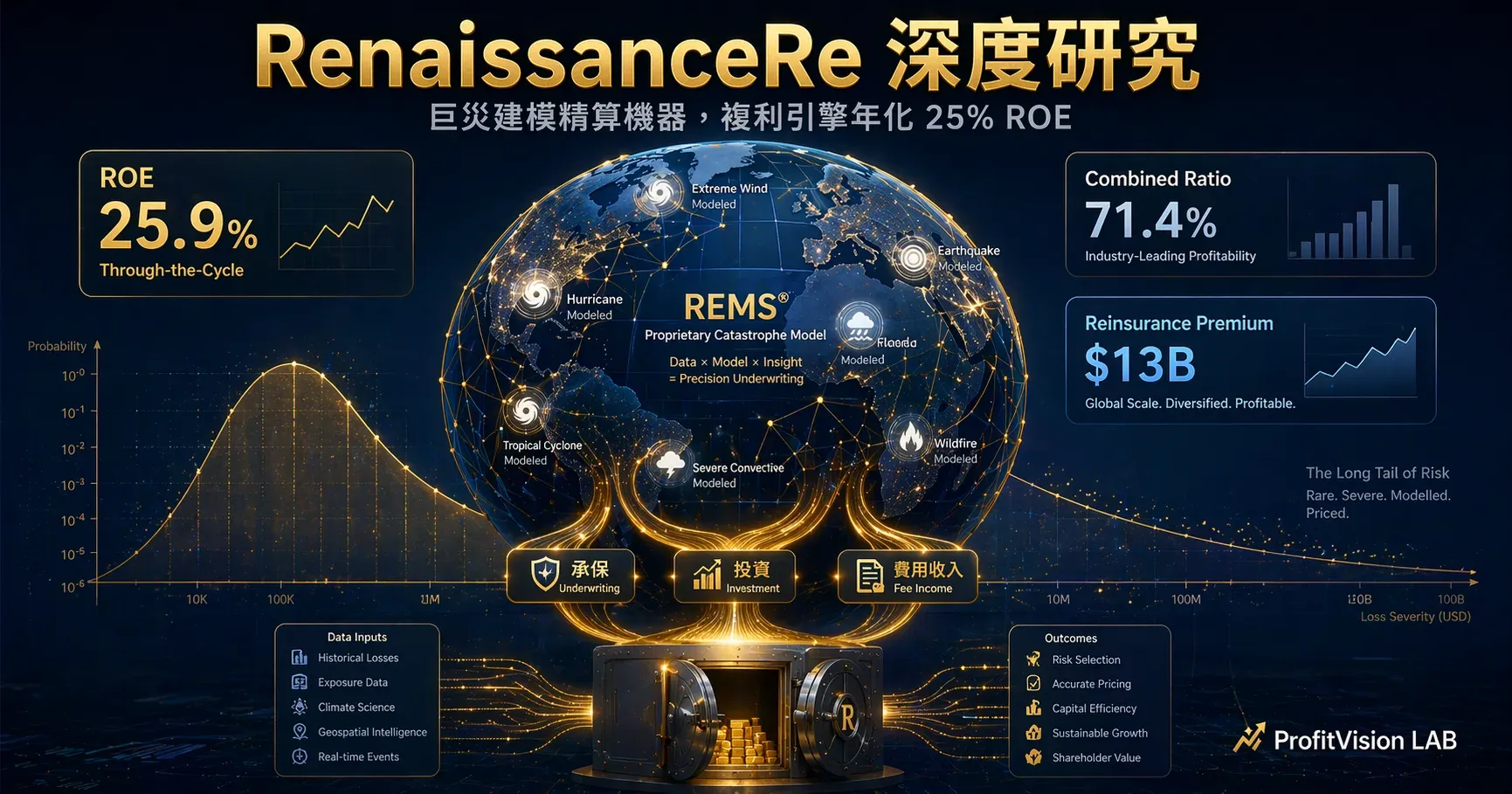
RNR is not an ordinary reinsurer — it is an actuarial machine. Powered by its proprietary REMS catastrophe model and three profit engines (underwriting + investment + fee income), it delivered 25.9% ROE and a 71.4% combined ratio in 2025. Its moat runs deep enough that peers struggle to replicate it.
Four-Layer Defensive Screen Quick Reference
| Screen Layer | Indicator | Status | Notes |
|---|---|---|---|
| ① Positioning | Institutional Buying / A/D Rating | ✅ Pass | High ROE and solid financials attract long-term institutional allocation |
| ② Moat | ROE / Competitive Advantage | ✅ Pass | ROE of 25.9%, with a strong REMS technology moat |
| ③ Volatility | IV Rank / Options Structure | ⏸️ Watch | Catastrophe events can trigger spikes in IV; caution warranted ahead of earnings |
| ④ Technicals | RS Rating / Trend Structure | ⏸️ Watch | Data pending; recent technical trend needs confirmation |
Chapter 1: Industry Landscape
1.1 Global Reinsurance Market Size and Structure
The global reinsurance market was approximately $320-350 billion in premiums in 2024, and is expected to keep growing at a 5-7% CAGR. The market is highly concentrated, with the top 10 reinsurers controlling more than 60% of market share. Rising catastrophe losses driven by climate change are pushing reinsurance pricing into a sustained "hard market," creating ongoing pricing opportunities for quality reinsurers.
1.2 The Reinsurance Value Chain and RNR's Positioning
| Layer | Representative Players / Type | RNR's Role |
|---|---|---|
| Source of Risk | Natural catastrophes (hurricanes, earthquakes, floods), man-made accidents | Assumes catastrophe risk, especially Property Catastrophe |
| Insurance Companies (Primary) | State Farm, Allstate, AXA, etc. | RNR's primary customers, who purchase reinsurance coverage from it |
| Reinsurance Brokers | Aon, Marsh, Gallagher (together 81.3% of RNR's premium) | The primary distribution channel; highly concentrated and stable relationships |
| Reinsurers | Munich Re, Swiss Re, Arch, RNR, Everest | RNR differentiates itself sharply through catastrophe-modeling technology |
| Capital Markets | Catastrophe bond (Cat Bond) investors, ILS investors | RNR manages third-party capital through its Capital Partners platform |
1.3 The Reinsurance Cycle: Soft Markets and Hard Markets
The reinsurance market is cyclical: after major catastrophes, rates rise, forming a "hard market"; when capital is abundant, rates fall, forming a "soft market." Since Hurricane Ian in 2022, the market has entered a hard-market cycle, and quality reinsurers like RNR have benefited substantially — evidenced by 2025 gross premiums written of $11.7 billion.
Chapter 2: Business Model and Moat
2.1 The Three-Engine Profit Architecture
RenaissanceRe's earnings are not one-dimensional but built from three complementary engines, forming a diversified and resilient cash-flow structure:
Engine One: Underwriting Income
This is the essence of reinsurance: collecting premiums from insurers and assuming a portion of their risk. Underwriting profit arises when premiums exceed claims paid. RNR's business is divided into two main segments:
- Property Segment: Covers hurricanes, earthquakes, floods, and fires. 2025 gross premiums written were $4.94 billion, of which catastrophe reinsurance accounted for 67%.
- Casualty & Specialty Segment: Includes general liability, D&O, medical malpractice, credit insurance, and marine/energy insurance. 2025 gross premiums written were $6.79 billion.
Engine Two: Investment Income
Premiums collected before claims are paid out form a massive float. RNR invests this capital in fixed-income securities, equities, commodity futures, private equity, and catastrophe bonds, prioritizing "capital preservation, liquidity, and stable returns." Investment income contributed $1.7 billion in 2025.
Engine Three: Third-Party Capital Management (Fee Income)
Through its Capital Partners platform (which includes the DaVinci, Fontana, Medici, Upsilon, and Vermeer funds), RNR manages third-party capital and earns management and performance fees. Fee income was $330 million in 2025, representing high-quality, capital-light earnings.
2.2 Core Moat: The REMS Risk Management System
RNR's hardest-to-replicate moat is its proprietary REMS (RenaissanceRe Exposure Management System), used for:
- Catastrophe risk modeling and precise pricing
- Portfolio aggregation
- Capital allocation optimization
REMS has accumulated 30 years of real-world data, allowing RNR to price risk more precisely than peers — forming a genuine "data moat."
2.3 Moat Strength Assessment
| Moat Type | Strength | Description |
|---|---|---|
| Technology Moat (Proprietary REMS Model) | Strong | 30 years of data accumulation, difficult for competitors to quickly catch up |
| Customer Relationship Moat | Strong | Aon, Marsh, and Gallagher consistently contribute 81.3% of premiums |
| Capital Management Moat | Moderate-strong | Flexible use of JVs, third-party capital, and Cat Bonds to quickly seize hard-market opportunities |
| Reputation Moat | Moderate-strong | Positioned by the industry as "the world's premier underwriter," with a high credit rating |
| Scale Moat | Moderate | Still smaller in scale than Munich Re or Swiss Re, but wins through niche depth |
Chapter 3: Competitive Landscape
3.1 Comparison of Major Competitors
| Company | Positioning | 2025 ROE | Core Strength | Differentiation |
|---|---|---|---|---|
| RenaissanceRe (RNR) | Catastrophe reinsurance specialist | 25.9% | REMS technology, precise pricing, capital flexibility | A technology-driven pure-play reinsurer with the highest ROE |
| Munich Re | World's largest reinsurer | ~18-20% | Largest scale, full line-of-business coverage | Scale advantage, but less flexible than RNR |
| Swiss Re | World's second-largest reinsurer | ~15-18% | Diversified business, global footprint | Diversified but with less catastrophe specialization than RNR |
| Arch Capital Group | Specialty insurance and reinsurance | ~20-22% | Strong underwriting discipline, aggressive growth | RNR's closest direct competitor |
| Everest Group | Property-casualty reinsurance | ~15-18% | Diversified global reinsurance portfolio | Larger scale than RNR but lower ROE |
| Hannover Re | German reinsurance giant | ~15% | Full line-of-business, solid financials | Conservative, with a lower degree of technological innovation |
3.2 Competitive Conclusion
RNR achieves an ROE well above the industry average through deep specialization in catastrophe reinsurance and its REMS technology edge. Its competitive strategy does not win through scale but through precise risk pricing and flexible capital management — expanding first in every hard-market cycle and pulling back cautiously in soft markets.
Chapter 4: Financial Resilience
4.1 Full-Year 2025 Financial Highlights
| Metric | 2025 Value | Assessment |
|---|---|---|
| Gross Premiums Written (GPW) | $11.7 billion | Strong growth |
| Net Income | $2.65 billion | Excellent |
| ROE (Return on Equity) | 25.9% | Far above the insurance-industry average |
| Book Value Per Share Growth | $195 → $247 (+26.2%) | Strong compounding momentum |
| Q4 Combined Ratio | 71.4% | Well below 100%, indicating strong underwriting profitability |
| Q4 ROE | 27.8% | Quarterly acceleration |
4.2 Earnings Structure Analysis (2025)
- Underwriting income: $1.3 billion (from precise pricing and strict underwriting discipline)
- Investment income: $1.7 billion (efficient deployment of float)
- Third-party capital management fee income: $330 million (capital-light, high quality)
4.3 Core Financial Metrics
| Metric | Value | Assessment |
|---|---|---|
| ROE (3-Year Average) | ~20%+ | Far above peers |
| Book Value Compound Growth Rate | ~20-25% CAGR | A core long-term investment metric |
| Combined Ratio | 71.4% (Q4 2025) | Well below 100%, indicating exceptionally strong underwriting profitability |
| D/E Ratio | Reasonable level | A typical leverage structure for the reinsurance industry |
| FCF / Float Utilization Efficiency | Excellent | Float is converted into stable investment income |
Chapter 5: Valuation and Scenario Analysis
5.1 Valuation Overview
RNR is typically valued using P/B (price-to-book) and ROE-relative frameworks, with high-ROE companies commanding a P/B premium. Management emphasizes that "Tangible Book Value Growth" is the most important performance metric, and it is also the factor most correlated with long-term share-price performance.
Bull Case
Accelerating global warming triggers more catastrophes, and rates remain in a sustained hard-market cycle. RNR leverages its REMS advantage to capture the best-quality risk first, keeping ROE at 25%+. The third-party capital management business expands, fee income rises as a share of revenue, and the valuation earns a technology-company-style premium.
Base Case
Reinsurance market rates soften moderately but remain at a reasonable level. REMS retains its precise-pricing edge, and ROE stabilizes in the 18-22% range. Book value continues compounding, shares are reasonably priced at 1.5-2.0x P/B, and long-term investors earn steady returns.
Bear Case
A super-catastrophe year (multiple Category 5 hurricanes stacking with a major California earthquake) triggers massive claims, causing net income to decline sharply or even turn negative for the year. The reinsurance market enters a deep soft market, with rates falling sharply. Climate models fail, causing REMS pricing errors that impair the core competitive advantage.
5.2 Key Metrics to Watch
- Book Value growth rate: The metric management values most, and highly correlated with share price
- Combined Ratio: Below 100% indicates the underwriting business itself is profitable — the lower, the better
- Reinsurance market pricing cycle: Watch for soft/hard market transitions — hard markets are the time to add exposure
Chapter 6: Conclusion and Tactical Recommendations
6.1 Core View
RenaissanceRe is a high-quality but cyclically volatile compounding machine. Its long-term investment value rests on four pillars: above-peer ROE, long-term compounding growth in book value, a REMS technology moat that is difficult to replicate, and a diversified three-engine earnings structure that spreads risk.
For investors who can tolerate short-term share-price volatility from catastrophe events and understand the nature of the reinsurance industry, RNR is a high-quality name worth a long-term position.
6.2 Key Bull/Bear Arguments
| Direction | Key Argument |
|---|---|
| Bull | Climate change is a long-term driver of hard markets; REMS's 30-year data accumulation is difficult to replicate; the three-engine diversified income spreads risk; management treats book-value compounding as the core KPI, keeping incentives highly aligned |
| Bear | A super-catastrophe year could trigger massive claims; climate models may underestimate the frequency and intensity of new extreme-weather patterns; channel concentration risk from the top three brokers accounting for 81.3% of premium; profit margins compress when the market enters a deep soft-market phase and rates fall |
6.3 Risk Disclosure
- Catastrophe Risk: A major hurricane or earthquake could cause a large single-quarter loss, but this is a normal cyclical fluctuation in the reinsurance business
- Climate Change: Traditional catastrophe models may underestimate the frequency and severity of losses from new extreme-weather patterns
- Soft-Market Cycle: When rates fall sharply, underwriting margins compress
- Channel Concentration: A strategic shift by the top three brokers could impact the source of premium
6.4 Options Strategy Notes
RNR is a high-quality financial stock with relatively controlled volatility, though catastrophe events can trigger sudden spikes in IV. Suitable options strategies include building a low-risk entry position via a Bull Put Spread structure after a pullback to technical support (DTE 30-45 days, Delta < 0.25). Ahead of peak catastrophe season (hurricane season, June-November), reduce Delta exposure and avoid a one-sided short-put position.
Tracking Log
| Date | Event | Assessment at the Time | Outcome |
|---|---|---|---|
| 2026.04.22 | Initial publication | ⏸️ Actively watching | — |
Investing involves risk; please evaluate carefully based on your own financial circumstances.
Data sources: SEC filings, company earnings reports, StockAnalysis, RenaissanceRe official materials, public data