This Week's Market Observation: After Nine Straight Weeks of Gains, a Major Inflection Point — the Market Starts Asking "Is Growth Fast Enough?"
AVGO's Q3 AI guidance of $16.0 billion missed the market's expected $17.2 billion, triggering a chain reaction across semiconductors — the Nasdaq fell 3.9% for the week, with QQQ's distribution day count approaching the warning line. CANSLIM screen: 1,176 stocks scanned, 53 passed, 0 Near Pivot passes — bulls under pressure, but support intact.
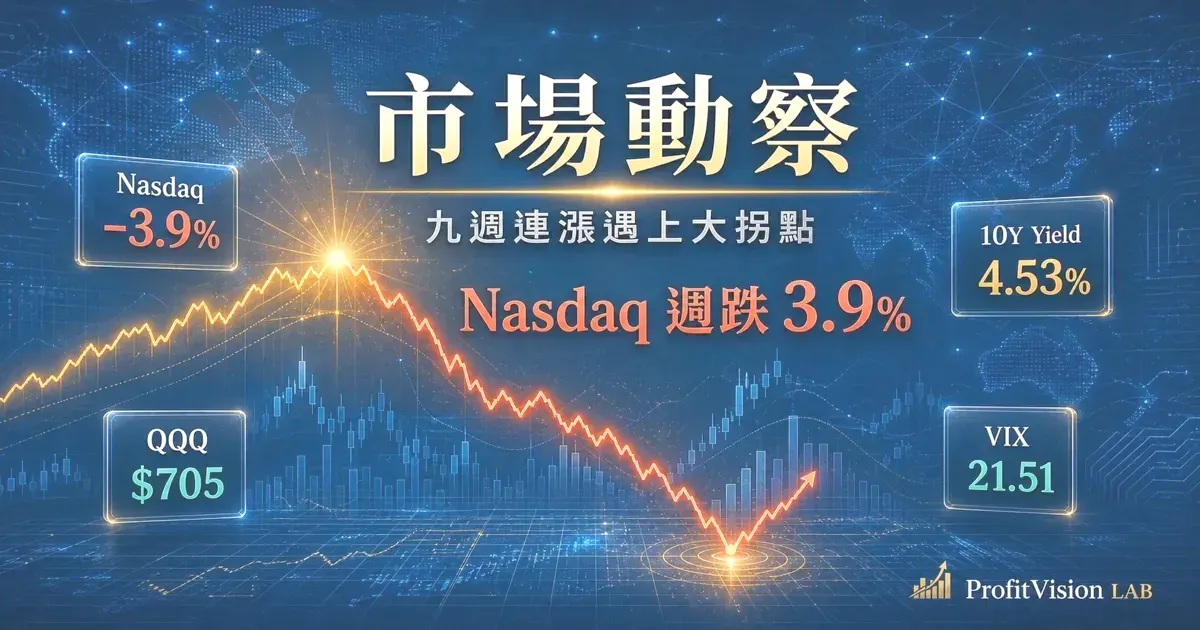
AVGO's AI guidance missed by $12 billion, triggering a chain reaction across semiconductors — Nasdaq fell 3.9% for the week, with bulls under pressure but support intact
- The first real test after nine straight weeks of gains: QQQ hit an all-time high of $746.16 on Monday, then closed at $705.06 on Friday — a nearly 6% drop in four trading days — triggering a downgrade of the broad-market status from "Confirmed Uptrend" to "Uptrend Under Pressure."
- Two triggers, one underlying logic: AVGO's Q3 AI guidance of $16.0 billion missed the market's expected $17.2 billion, and May nonfarm payrolls surprised to the upside at +172,000, pushing the 10-year Treasury yield above 4.5% — together these delivered the first serious test to the bullish assumption that "AI capital inflows aren't stopping."
- What sold off was the slope, not the fundamentals: AVGO's free cash flow is 46% of revenue, with a 3:1 book-to-bill ratio — the fundamentals have not collapsed. What the market sold was "the expectation of accelerating growth," not "growth itself." This distinction is the most important read of the week.
- Next week's watch item — SpaceX lists on 6/12: The largest IPO in history (a $1.75 trillion valuation), expected to join the Nasdaq-100 (QQQ) around July 6. The mechanical selling pressure countdown has already begun. Whether the semiconductor sector can stabilize before the SpaceX IPO is the most important short-term watch window.
1. Broad Market Trend: The First Real Distribution Day After Nine Straight Weeks of Gains
This week's market swing was the most violent of the past two months. On Monday, QQQ closed at an all-time high of $746.16, MRVL surged 33% after a public endorsement from Nvidia's founder, and the entire semiconductor sector looked like it had climbed to another level. But over the next four days, the story reversed.
On Wednesday (6/4), the chain-reaction selling pressure following Broadcom's earnings left the Nasdaq down a slight 0.09%, while the Dow still hit a fresh all-time high of 51,561 the same day — a sign that divergence was already forming. On Friday (6/5), May nonfarm payrolls came in at +172,000 — far above the market's expected 80,000 — unleashing broad-based selling in an already jittery market. The Nasdaq fell 4.18% in a single day (its worst since April 2025), the 10-year Treasury yield jumped to 4.53%, and the VIX spiked 40% in a day to 21.51.
Why did strong employment become bad news? Because payrolls that strong give the Fed no reason to cut rates, prompting the market to reprice the possibility of "rate hikes within the year." For tech stocks already sitting at elevated valuations, the yield's jump from 4.47% to 4.53% — just 6 basis points — combined with the sentiment shock from AVGO's earnings, was enough to send the entire trading session out of control.
One thing worth flagging in particular: the Follow-Through Day (FTD) from April 8 is still valid — the market has never triggered a confirmed "return to correction" signal. QQQ's distribution day count is currently approaching the warning line (4 days); if 1-2 more distribution days appear over the next two weeks, the broad-market status will be downgraded further. This is the most important thing to track next week.
2. Market Breadth: CANSLIM Screen Results — 53 Stocks Still Standing After the Panic
The mechanical screen run against each week's six MarketSurge lists is the most direct tool for measuring market breadth. This week's scan covered 1,176 stocks in total, with the following results:
104 passes, 53 unique names — against the backdrop of QQQ falling 3.9% for the week, this number is actually more resilient than the overall market mood suggests. What really deserves caution is the Near Pivot list: all 7 candidates this week failed to pass (0 passed) — meaning high-quality stocks have not yet reached an actionable technical position. The market is still searching for a new consensus price level, and chasing breakouts here carries a low probability of success.
📊 This Week's Cross-List Overlap Signal
Overlap across multiple lists is a proxy indicator for "full institutional endorsement." This week, the names that appeared simultaneously on 4 lists (William J. O'Neil / Near New High / Pullback to 10-Week / Minervini Trend) were: SIMO, TSM, MTSI, ADI — mainly semiconductor manufacturing and analog chip names, showing that the downstream layer of the AI infrastructure chain (not the GPUs themselves) continues to receive institutional endorsement.
Worth noting: AVGO still passed 3 lists (O'Neil / Near New High / Minervini) even after its steep decline, trading at $481.57, just -1.48% from its high, with an ROE of 31%. This shows that even though the stock crashed 20% in a single week, AVGO's institutional scoring structure did not break down — the sell-off was the market repricing the slope of guidance, not a deterioration of the fundamentals.
The most important breadth signal to watch this week: the Near Pivot list recovering from 0 to 5+ names would be the first sign that the market's technical structure is beginning to repair itself. The semiconductor group (MRVL, AMD, MU) suffered severe selling this week but all three remained on multiple lists; cybersecurity (led by PANW after earnings) and power infrastructure (VRT, STRL) held up relatively well — showing that capital has not fully retreated, but is being reallocated across different layers of AI infrastructure.
3. Week-over-Week Rotation: Who Got Dragged Down, and Who Held Up?
Sectors That Dropped Off the Lists: The AI Semiconductor Chain Reaction
The names that faced the heaviest pressure to drop off the watch lists this week were nearly all concentrated in the same industry chain. AVGO's guidance shortfall didn't just affect AVGO alone — it triggered a repricing across the entire AI semiconductor ecosystem:
- MRVL (Marvell Technology): down more than 16%. After surging early in the week on Nvidia's endorsement, AVGO's earnings guidance raised doubts about the growth slope of the entire custom ASIC space. MRVL, which is also deeply positioned in custom AI chips, is viewed as a direct peer and was dragged down alongside it.
- MU (Micron): down more than 13%. AVGO's guidance implied slowing XPU shipments, which directly affects HBM (High Bandwidth Memory) pull-in expectations — and Micron is the biggest casualty of that read-through.
- AMD: down more than 11%. The market is re-evaluating the shifting balance of market share between AI GPUs and custom ASICs, and amid heightened uncertainty, AMD's AI accelerator story is also seeing its valuation compressed.
The market's logic runs like this: if even Broadcom — with deep design wins at Google TPU and Meta MTIA — is guiding below expectations for Q3 AI, then the risk of a broader hyperscaler CAPEX slowdown isn't an AVGO-specific issue but a systemic signal. That puts every company with AI semiconductor exposure back under repricing pressure.
Sectors That Held Up Relatively Well: Cybersecurity x Power Infrastructure
What's worth recording this week is that two sectors showed relative resilience amid the heavy selling. Palo Alto Networks (PANW) rallied on strong results after its June 2 earnings report and held up relatively well even during the broad sell-off on June 5. VRT (Vertiv) and power infrastructure names also declined noticeably less than semiconductors — because AI's demand for electricity doesn't disappear just because AVGO's guidance disappointed; the direction of data center power buildout remains clear.
This rotation — "cybersecurity + power" holding up while "AI chips" sold off — sends investors a useful message: institutional capital hasn't left the AI theme, it's being reallocated across different layers of AI infrastructure.
4. Three Industry Themes: Where Does the Logic Still Hold After the Panic?
Theme 1: AI Power Infrastructure — Demand Doesn't Change Because of Chip Guidance
Data center power demand for AI is one of the most certain infrastructure themes: every GPU cluster and every XPU needs power, cooling, racks, and high-density power distribution. Demand at this layer comes from capital expenditure contracts, not quarterly chip guidance. Even though AVGO's disappointing Q3 AI semiconductor guidance rattled the market, data center operators' already-committed power procurement contracts won't be cancelled as a result.
Representative names: VRT (Vertiv) — AI data center thermal management and power supply; STRL (Sterling Infrastructure) — data center site engineering
Capital driver: Hyperscale cloud customers' combined FY2026 CAPEX commitments exceed $250 billion — this is locked-in capital spending, not market sentiment.
Theme 2: Cybersecurity — As the AI Attack Surface Expands, So Does Defense Spending
Every enterprise AI deployment brings a new attack surface. LLM applications, API exposure, and AI-generated phishing mean cybersecurity spending is growing in step with AI expansion. The advantage of cybersecurity stocks is that their growth logic doesn't depend on the growth slope of AI chips, but on enterprises' perception of AI risk — a more durable form of demand that isn't affected by quarterly guidance.
Representative names: PANW (Palo Alto Networks) — strong results this week after earnings, with standout relative strength; CRWD (CrowdStrike) — a leader in endpoint and cloud security
Capital driver: PANW's earnings this quarter demonstrated the pricing power of "security platformization" — customers are willing to pay a higher ARPU for an integrated defense platform, one of the clearest fundamental confirmations of the week.
Theme 3: Strong Employment x High Interest Rates — The Financial Sector's Contrarian Beneficiary
May's nonfarm payroll gain of +172,000 is a double-edged sword. It's negative for tech stocks (rate-cut expectations pushed back), but a hidden positive for banks and financials — wider spreads and improved balance sheet income. On the same day the Nasdaq tumbled, the Dow only dipped slightly (relatively resilient), with financials clearly outperforming. If employment stays strong, this rotation is worth tracking further once confirmed by technical signals.
Representative names: MCO (Moody's) — bond rating business benefits from a high-rate environment; large-cap banks (JPM / GS) — improving spreads
Capital driver: The longer the Fed holds rates high, the longer financial institutions benefit from net interest margin; but watch for the risk that credit losses could also widen if the economy shows cracks.
5. Preliminary Observations on Potential Names (Not Trading Recommendations)
ProfitVision LAB uses three preliminary metrics for individual stock assessment: PV Institutional Buying Strength (reflecting institutional order flow, 1st-99th percentile), PV Relative Strength (52-week return ranked as a percentile against the broad market), and PV Earnings Quality Score (a composite grade from A to E based on revenue growth, net margin, and return on equity). The names below are preliminary structural observations based solely on public data and do not constitute recommendations.
Business positioning: Sits at the L1/L2 boundary of the AI ecosystem — custom AI ASIC/XPU x AI Ethernet switching chips x VMware enterprise private cloud cash flow.
This week's event: Q2 FY2026 AI revenue of $10.8 billion (+143% YoY) was strong, but Q3 AI guidance of $16.0 billion missed the market's expected $17.2 billion, causing a roughly 20% cumulative decline over two days and wiping out approximately $320 billion in market cap.
PV Institutional Buying Strength remains in the strong zone in preliminary assessment, but short-term positioning pressure is significant. PV Relative Strength pulled back noticeably following this week's sell-off, with the stock technically breaking below its 50-day moving average; the 200-day moving average at $355 is the key support below. PV Earnings Quality holds at an A grade in preliminary assessment (FCF at 46% of revenue, EBITDA margin of 69%).
Theme linkage: AI infrastructure L1/L2 — this week's steep decline reflects the market repricing the "growth slope," not a breakdown in fundamentals. The consensus target price from 26 analysts is $490-511, roughly 32% upside from the current price of $386.
CANSLIM screen result (W23): AVGO still appeared on 3 lists (William J. O'Neil / Near New High / Minervini) even after its steep decline — Comp 99 | RS 91 | EPS 96 | A/D A+ | SMR A. ROE 31%, just -1.48% from its 52-week high. Technically, it contracted quickly after the drop rather than breaking structural support — a pattern fundamentally different from a fundamentals-driven breakdown.
Business positioning: An integrated cybersecurity platform for the enterprise AI era — Next-Gen Firewall, SASE, AI-SOC. Its platformization strategy keeps driving ARPU higher with strong stickiness.
This week's event: Rallied strongly after its June 2 earnings report, with Q3 FY2026 RPO (remaining performance obligations) growth accelerating — showing enterprise cybersecurity budgets are still expanding even as overall IT budgets stay under pressure.
PV Institutional Buying Strength remains strong in preliminary assessment, with noticeably strong buying after earnings. PV Relative Strength stayed in the upper-strong tier during this week's broad-market sell-off, suggesting institutions were relatively unwilling to sell. PV Earnings Quality reaches an A grade in preliminary assessment (Non-GAAP gross margin of 77%, strong free cash flow).
Theme linkage: An expanding AI attack surface driving non-linear growth in cybersecurity demand, decoupled from the volatility in AI chip growth slopes — one of the clearest defensive themes this week.
Business positioning: AI data center thermal management, precision air conditioning, uninterruptible power supply (UPS), and DC power distribution systems. Behind every AI compute cluster is Vertiv's power and cooling infrastructure.
This week's observation: Amid the AVGO earnings shock hitting the semiconductor sector, VRT showed relative resilience, since its demand comes from already-signed data center construction contracts rather than quarterly chip shipments.
PV Institutional Buying Strength remains in the strong zone in preliminary assessment, with the certainty of AI data center power demand supporting institutional holdings. PV Relative Strength sits in the strong zone in preliminary assessment. PV Earnings Quality reaches a B+ grade in preliminary assessment (gross margin continuing to improve, order backlog healthy).
Theme linkage: AI power infrastructure — this week's relative resilience shows institutional capital rotating from AI chips partly into the more certain power-side of demand.
Business positioning: The Falcon cloud-native endpoint security platform, built on a subscription (ARR) model with extremely high enterprise stickiness. Trust has been rebuilt since the 2025 outage crisis, and the company has accelerated its AI-SOC buildout.
This week's observation: Weakened along with the broad market, but its relative decline was noticeably smaller than AI semiconductors, with the cybersecurity sector as a whole showing defensiveness during the heavy sell-off. CRWD's AI security product line (Falcon AI, Charlotte AI) is becoming a new driver of ARR growth.
PV Institutional Buying Strength remains in the strong zone in preliminary assessment. PV Relative Strength held in the mid-to-upper tier this week. PV Earnings Quality reaches an A grade in preliminary assessment (Non-GAAP profitability accelerating for consecutive quarters, ARR growth trajectory stable).
Theme linkage: Security platformization x the expanding AI attack surface — with the lowest correlation to this week's biggest theme (AVGO's AI guidance), making it one of the most defensive names in this week's breadth report.
6. Indicators to Watch Next Week
Watch item 1: Whether the broad market can produce an accumulation day, easing pressure from the distribution day count. QQQ's distribution day count currently stands at about 4, just 1-2 days from the warning line for "the market entering distribution." Any low-volume rally accumulation day next week would lower the odds of a further downgrade; conversely, if more heavy down days appear, the market status will need to be formally adjusted to "Uptrend Under Distribution" or even "Correction Underway."
Watch item 2: SpaceX (SPCX) lists on Nasdaq on June 12. The largest IPO in history (a $1.75 trillion valuation, raising $75 billion) arrives next Thursday. It's expected to join the Nasdaq-100 (QQQ) around July 6. The mechanical selling-pressure countdown has already begun — existing index constituents like AVGO will face rebalancing pressure to proportionally trim their weightings (AVGO's estimated impact: $17-20 billion). This signal adds extra short-term pressure to tech sentiment but has no bearing on the long-term structural story for AI infrastructure.
Watch item 3: Whether the Near Pivot list can rebound from zero. The most critical signal from this week's CANSLIM screen: all 7 Near Pivot candidates failed, with 0 passing — meaning high-quality stocks have not yet reached an actionable technical position. If Near Pivot recovers to 5+ names next week, it will show the market building new consensus at this valuation level and improve the odds of successful breakouts; if it stays at 0-2 names, the market is still digesting the move, and watching rather than chasing remains the better approach.
The most important conclusion this week isn't "the market fell" — it's that "the question the market is asking has changed." From "Is AI investment actually happening?" to "Is AI's growth slope fast enough?" — this upgrade in the level of the question marks this bull cycle entering a more mature stage. Mature doesn't mean over, but it's no longer an era where any AI-related name can rally effortlessly.
Further Reading
- Deep dive: AVGO Deep Research v2.0: Record AI Revenue, So Why Did the Market Sell?
- Series research: Arista Networks (ANET): A Deep Dive into the AI Ethernet Ecosystem
- Series research: Palo Alto Networks (PANW): Researching the Platformization of AI-Era Cybersecurity
- Framework reading: Microsoft's (MSFT) "Four Faces" Framework: Deconstructing a Composite Enterprise Moat