Larry Culp: The Man Who Broke Up GE Came From the Master of "Combining"
Larry Culp split century-old GE into three — yet he came from Danaher, the world's greatest serial-acquisition machine. How the DBS discipline he learned there was carried into a dying GE: stop the bleeding, rebuild lean, then complete the century three-way split.
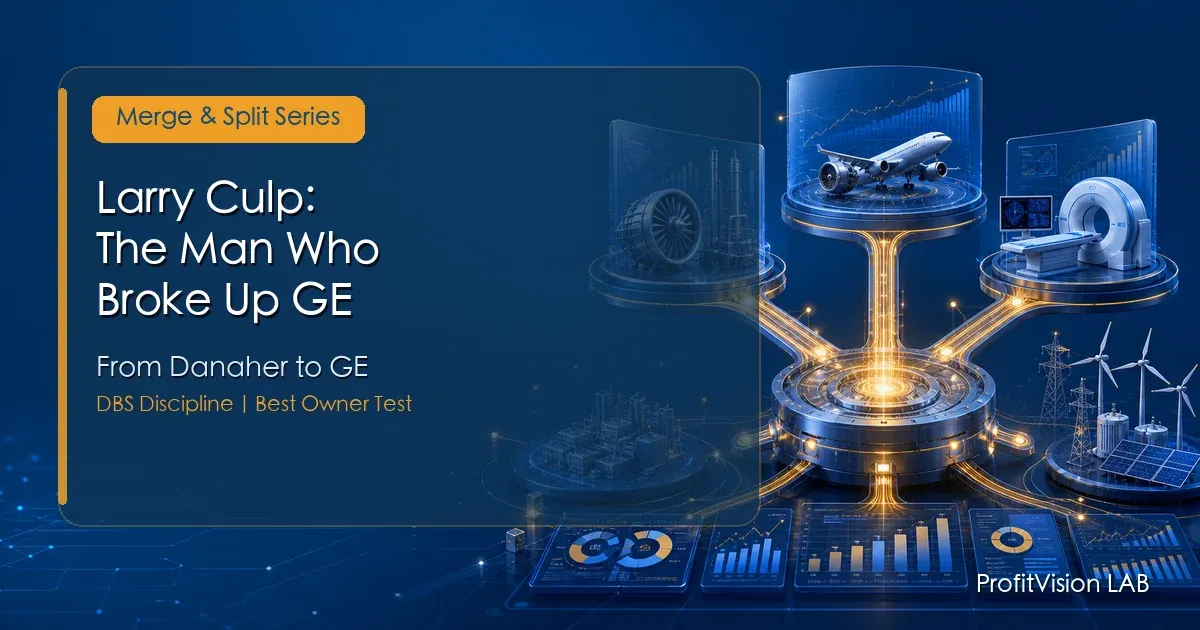
Larry Culp: The Man Who Broke Up GE Came From the Master of "Combining"
Core thesis: Larry Culp, the CEO who split GE (GE) into three, came from Danaher (DHR) — the world's greatest serial-acquisition machine. What he learned there wasn't a trick; it was a discipline: the Danaher Business System (DBS) and the best owner test. Parachuted into a dying GE in 2018, he ran a three-step playbook — stop the bleeding (sell assets, cut debt) → rebuild (lean operations) → refocus (the century three-way split) — turning a company with hundreds of billions in debt and a one-cent dividend into three focused, independently re-rated companies. His career proves that combining and splitting were never opposing beliefs — they are the same capital allocator's two different wrenches.
Why Does One CEO Deserve a Deep Dive?
Every merger and every spin-off is ultimately a call made by a person. And in one of the most consequential corporate turnarounds of recent years, no one deserves closer study than Larry Culp.
The reason is an almost poetic contrast: the man who broke up the century-old GE empire came from the very company most famous for stitching businesses together — Danaher. At Danaher, he grew the company through one disciplined acquisition after another. At GE, he grew value through one calm divestiture after another. Same person, same criterion, playing "combine" at one company and "split" at the other.
Understand Culp, and you understand something bigger: combining and splitting were never opposing philosophies. They are simply two different levers the same capital allocator pulls, depending on the situation.
Where He Came From: Danaher, the "Stronger by Combining" Compounding Machine
To understand Culp, you first have to understand Danaher. It isn't a household name, but in the world of capital allocation, it's a legend — a compounding machine built on "serial acquisitions plus disciplined integration." Its long-run shareholder returns have, for decades, stood shoulder to shoulder with Berkshire's, making it one of the few companies the market agrees is "great at M&A."
Its origin story is capital allocation in miniature: founded in 1984 by brothers Steven and Mitchell Rales, named after a creek they passed on a fishing trip — Danaher Creek. The brothers started out buying industrial companies with a leveraged-buyout mindset, then landed on something more powerful: don't just hold what you buy — upgrade it with your own management system. That system became the now-legendary DBS.
Culp joined Danaher in 1990 and became CEO in 2001, at around 38, staying until 2014. Over his roughly fourteen years at the helm, Danaher's revenue and market value both grew roughly fivefold, turning a mid-sized industrial conglomerate into a giant worth tens of billions of dollars.
💡 What You Should Know | What Is DBS (Danaher Business System)?
DBS: Lean Manufacturing Upgraded Into an Operating System for Acquisitions
DBS grew out of Toyota's lean production system, but Danaher upgraded it from a "factory management tool" into a full "operating system for running and integrating businesses": data-driven, continuous improvement (kaizen), and hard performance discipline applied to every unit. Every company Danaher acquires gets this management DNA layered on top, and efficiency and margins get squeezed out step by step.
Danaher's edge was never just "buying cheap" — it was "making what you bought worth more after you bought it." That's the positive-case textbook example of the best owner test: relentlessly asking one question — "Am I the best owner of this business?"
And Danaher's DNA never had just "combine" written into it — "split" was always there too. When the group grew too large and different businesses needed different rhythms, it split decisively: in 2016 it spun off its instruments and tools business as Fortive (FTV); in 2019 it spun off dental as Envista (NVST); in 2023 it spun off water quality and product testing as Veralto (VLTO). One spin-off after another, each piece newly focused and newly re-rated by the market. One company, using DBS with one hand to keep combining, and discipline with the other to keep splitting.
The Empire He Inherited Was Dying
On October 1, 2018, Culp became GE's chairman and CEO — the first outsider to lead the company in its 100-plus-year history since its founding in 1892. Every CEO before him had climbed the ranks from inside. That GE, for the first time ever, reached outside for a leader tells you exactly how bad things had gotten.
Crisis Item | Condition |
|---|---|
Dividend | Cut twice from $0.12/quarter down to just one cent |
Power division | Bet wrong on the gas-turbine cycle; took roughly a $22 billion goodwill impairment in 2018 |
GE Capital | Booked a roughly $15 billion reserve shortfall in long-term-care insurance |
Stock price | Collapsed from roughly $30 a few years earlier into the single digits |
The Dow | Removed in June 2018 from the index it had been a founding member of for over a century |
What Culp inherited wasn't a good company that needed a tune-up — it was an engine leaking oil everywhere, at risk of stalling out entirely, still carrying over $100 billion in debt. The question in the market then wasn't "can GE be great again," it was "will GE survive at all."
Three Steps: Stop the Bleeding, Rebuild, Refocus
Culp's playbook was simple — and extremely disciplined.
① Stop the BleedingSell assets, cut debt, buy time to survive
→
② RebuildInject DBS-style lean management into GE
→
③ RefocusThe century three-way split, each piece re-rated
① Stop the Bleeding: Sell the Right Assets, Cut the Right Debt
The first move in any firefight is cash and time. Culp launched a string of decisive divestitures — but he sold with method, and every deal echoed the best-owner logic.
Year | Move | Result |
|---|---|---|
2019 | Combined GE Transportation, its locomotive business, with rail leader Wabtec (WAB) via a spin-merge | GE received roughly $2.9 billion in cash; shareholders received Wabtec shares tax-free |
2020 | Sold GE's BioPharma business back to Culp's own former employer, Danaher | Roughly $21.4 billion — one best owner handing an asset to another best owner |
2021 | Merged the aircraft-leasing business GECAS with industry leader AerCap | Roughly $30 billion in scale, ending the GE Capital burden that had dragged on the group for years |
Notice his method: there was almost no fire-sale panic. A mediocre operator, needing cash urgently, dumps assets in a panic. Culp turned every single "split" into a deal that was relatively favorable to shareholders. Over a few years, GE shaved off well over $100 billion in debt, finally pulling its balance sheet out of intensive care.
② Rebuild: Injecting DBS Into GE's Bloodstream
After the bleeding stopped came the recovery. Culp brought the DBS discipline he'd spent a career honing at Danaher and injected it, piece by piece, into GE's operations — walking the factory floor, staring at real production data, using continuous improvement to solve concrete waste and bottlenecks, rather than dressing up the numbers with financial engineering from headquarters. What he wanted was for GE's remaining core businesses — especially its crown jewel, jet engines — to become lean, healthy, and able to generate cash on their own again.
A business that's structurally weak won't fly, no matter how cleanly you spin it off. You have to get every piece healthy first — only then does the "split" that follows actually mean something.
③ Refocus: The Century Three-Way Split
Once the balance sheet was repaired and the core businesses were strong again, Culp finally arrived at the moment this whole story had been building toward — splitting GE into three.
Timing | New Company | Focus |
|---|---|---|
Early 2023 | GE HealthCare (GEHC) | Medical imaging and diagnostics |
2024 | GE Vernova (GEV) | Energy and the grid (renewables + power) |
2024 (parent retained) | GE Aerospace (GE) | Jet engines (Culp stayed on to run it) |
Three companies, each with the right management, the right shareholders, the right valuation. The market voted with the share price: the sum of the three pieces was worth far more than the old "does-everything" empire ever was — and GE Aerospace, the piece Culp personally stayed on to run, has been one of the strongest-performing industrial stocks since going independent. A century-old company that was a few years from being written off completed one of the great modern turnarounds — through disassembly.
Culp's full arc: stop the bleeding first to buy survival time, then rebuild to make the business genuinely healthy, and only then refocus by letting each piece fly on its own — the order can't be reversed. This is a complete, deliberate capital-allocation logic, not improvisation.
Is This a System, or a Single Person?
The most dangerous question for any "serial combiner" is this: is the magic a system that can be inherited, or is it locked inside one gifted person's head? Does it survive once the founder leaves?
For Broadcom (see our separate deep dive in this series), that's a genuine concern. For Culp himself, the answer splits in two: the "operational lean" playbook (DBS) he brought into GE is teachable and replicable — it's a system. But the judgment behind "what to buy, what to sell, when to stop" — that capital-allocation instinct — still leans heavily on his own personal experience and discipline.
Danaher's Culp vs. GE's Culp: The Same Criterion
Line up his two chapters side by side and you'll see something striking — on the surface, one is "combining" and the other is "splitting," but underneath, it's the exact same principle.
Dimension | Danaher Years (2001–2014) | GE Years (2018–) |
|---|---|---|
Primary move | Combine (serial M&A, growing bigger) | Split (sell assets, three-way breakup) |
Tool used | The same one: DBS lean management + the best owner discipline | |
The criterion | If I buy this, can I make it worth more? | If I keep this, am I still its best owner? |
What it really is | Capital allocation — keeping every asset where it belongs most | |
So "combine" and "split" were never in conflict inside Culp. At Danaher, when M&A created value, he combined boldly. At GE, when a breakup released value, he split calmly. What changed was the action. What never changed was the ruler he measured against — the best owner test.
Three Lessons
✅ Three Transferable Lessons
- Capital-allocation discipline is a portable skill. Culp transplanted Danaher's DBS and best-owner thinking wholesale into a completely different company. Good capital allocation isn't one genius's flash of insight — it's a discipline that can be learned, systematized, and replicated across companies.
- An outsider CEO can sometimes be exactly the medicine needed to break old habits. That GE, for the first time in a century, was willing to bring in an outsider is itself telling — insiders are often trapped by old culture and old loyalties. Whether an organization can tolerate a disciplined outsider willing to cut is a real test of governance maturity.
- The hardest part is letting go of pride. Everything Culp sold and split off was something GE once took enormous pride in. Admitting "I am no longer the best owner of this business" takes real honesty and real courage.
Conclusion: The Best "Splitter" Trained in the School of the Best "Combiner"
Larry Culp is a reminder that the best capital allocators were never "serial acquirers" or "serial spinners" by identity — they're simply unusually honest about where value actually lives. He learned the discipline of combining at Danaher, and demonstrated the courage of splitting at GE. Running through both, the entire time, was the same calm question: "Am I the best owner of this business?"
Frequently Asked Questions
Q: Who is Larry Culp, and how is he connected to GE and Danaher?
Larry Culp was CEO of Danaher (DHR) from 2001 to 2014, and in 2018 became the first outside chairman and CEO in the 100-plus-year history of GE (GE). He brought the capital-allocation discipline he built at Danaher into a GE that was then close to collapse, leading both the subsequent asset divestitures and the 2023–2024 three-way split.
Q: How is DBS (the Danaher Business System) different from ordinary lean management?
DBS grew out of Toyota's lean production system, but Danaher upgraded it from a mere "factory management tool" into a complete "operating system for running businesses and integrating acquisitions": every unit is run with data, continuous improvement, and strict performance discipline, and this management DNA is systematically layered onto every newly acquired company to squeeze out efficiency and profit.
Q: How bad was GE's financial condition before Culp took over?
In 2018, GE's dividend was cut twice down to just one cent; its Power division took roughly a $22 billion goodwill impairment; GE Capital booked a roughly $15 billion reserve shortfall in long-term-care insurance; the stock collapsed from around $30 into the single digits; and GE was removed from the Dow Jones Industrial Average, an index it had been a founding member of for over a century.
Q: What's the biggest risk or limitation of Culp's "combine and split" capital-allocation model?
The model leans heavily on the individual judgment of the decision-maker — the instinct and discipline behind "what to buy, what to sell, when to stop" is still hard to fully systematize or hand down to a bench of successors. For any executive running a serial program of combining and splitting, "does this still work once this person is gone" remains an open question worth watching.
⚠️ This analysis is for research and informational purposes only and does not constitute investment advice, nor an accusation or evaluation of any company or individual.
Larry Culp, GE (GE / GEHC / GEV), Danaher (DHR), Wabtec (WAB), AerCap, and other companies discussed are analyzed based on public filings and media reports; some figures, dates, and ownership percentages are approximate and subject to change; past performance does not guarantee future results.
Data sources: public filings, company disclosures, media reports (as of June 2026). Investors should independently verify all information and assess their own risk tolerance, financial situation, and investment objectives.