ProfitVision LAB | Asset Allocation · Options Systems
📌 Article Summary
- Most investors look at their account and focus on "how much did this one position make." But once you start using LEAPs, PMCC, rolling premium collection, and volatility strategies, you can no longer treat your account as a pile of scattered positions — you have to see it as a self-running cash flow engine
- Split the account into three layers: the Stable Layer (VEEV, CF, GDX) handles defense and Theta income, the Growth Layer (FN, NET) rides the trend, and the Volatility Layer (IBIT) harvests panic premium — but its weighting must be kept in check
- What you're actually earning isn't one kind of return, but three: Delta (trend), Theta (time), and IV (volatility); understanding this division of labor is what lets you build a cash flow system with clearly defined roles
- Not every trade has to be a winner — the whole system just needs to keep producing cash flow
Stop Looking at Your Account as a Pile of Positions — Start Seeing It as a Cash Flow Machine
The most common problem with how people invest usually isn't a lack of skill — it's that they're looking at their account the wrong way.
The average person opens their brokerage screen and sees a row of tickers. Someone more experienced sees sector allocation. But someone a level above that sees something else entirely: role assignments.
That difference matters enormously. When you see your account as a pile of positions, you keep asking: Will this one go up? Did that one lose money? Should I bail now?
But when you see your account as a cash flow system, you start asking different questions: What role does this position play in my portfolio? Is it here to collect stable premium? To ride a trend? To harvest high IV during panic? If this position isn't making money today, is it still doing its job for the system as a whole?
That's the starting point of the Cashflow Map. My definition of this framework is simple:
The goal isn't for every trade to be profitable — it's for the whole system to keep producing cash flow. That sentence sounds plain, but it will fundamentally change how you operate. You stop hunting for the next hot stock and start thinking about how different assets, with different characteristics, can each complete their own mission across different market environments.
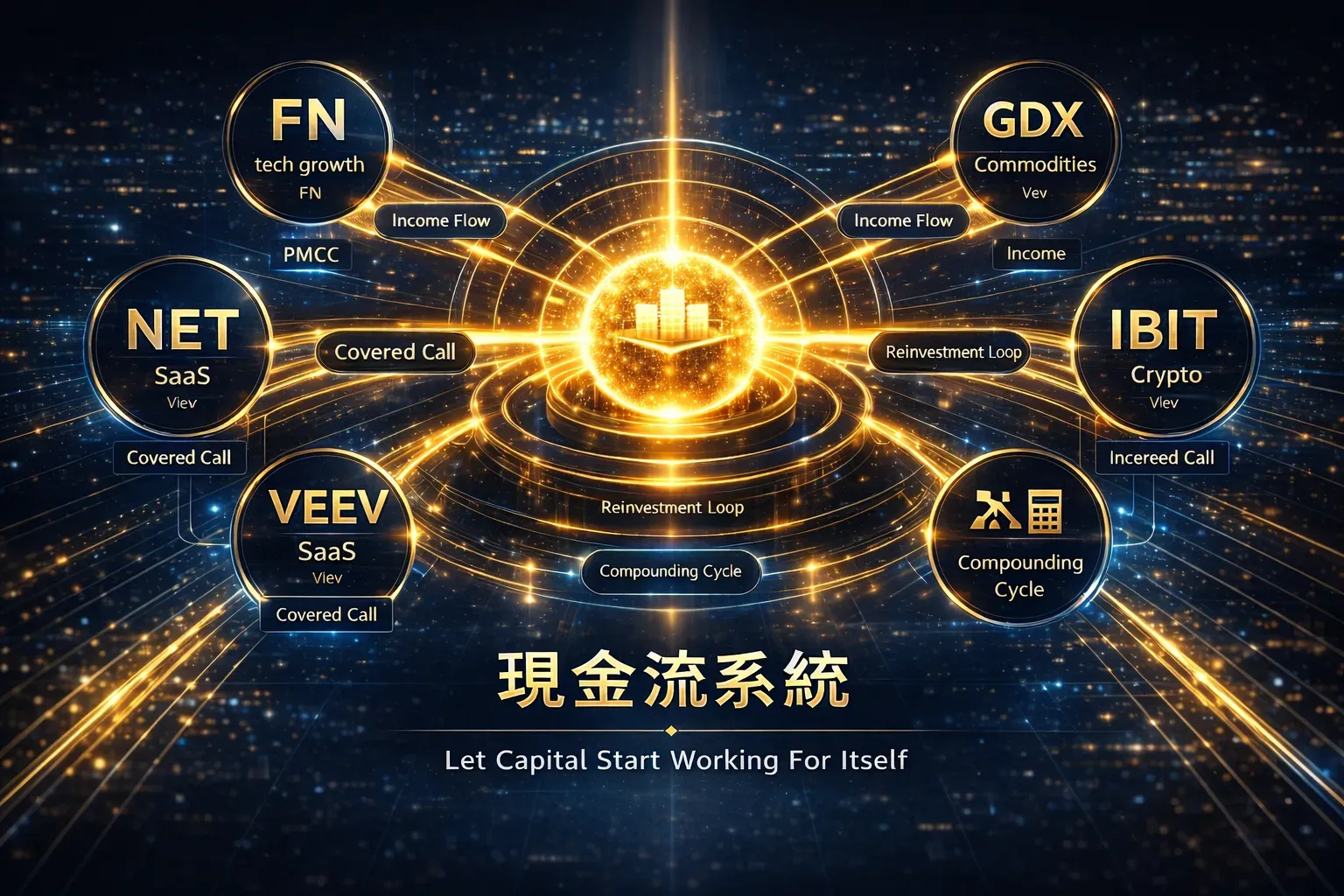
The Overall Architecture: Splitting the Account into Three Cash Flow Engine Layers
To make an account stable and executable, I think the most practical approach is to split the whole system into three modules: the Stable Layer, the Growth Layer, and the Volatility Layer.
Layer 1
Stable Layer
Base Engine: defense, steady cash flow, and psychological stability
VEEV · CF · GDX
This layer isn't about explosive gains — it's about being predictable, steady in rhythm, and relatively unlikely to spiral out of control. Its main source of return is Theta — steadily collecting premium to provide the base cash flow for the whole account. When the market gets choppy, this layer keeps your entire portfolio from swinging wildly along with sentiment.
Layer 2
Growth Layer
Growth Engine: participate in the trend, amplify returns
FN · NET
The main course here was never the premium — it's the trend itself. Returns come from both Delta (participating in price direction) and Theta (collecting time value without breaking the structure). What you're most afraid of in the Growth Layer isn't collecting a little less Call premium — it's locking yourself out of a major upward leg.
Layer 3
Volatility Layer
Volatility Engine: harvesting panic premium (weighting must be restrained)
IBIT
The main source of return is IV + Theta. When the market gets fearful and uncertainty rises, option premiums fatten up, and this layer's job is to harvest that. It's very lucrative, but also the most dangerous. The point was never to bet big — it's knowing when to act, how to get in and out quickly, and keeping this layer's weighting under 20% of the overall portfolio.
These three layers aren't diversification in the usual sense — they're a cash flow system with clearly divided labor. The Stable Layer keeps you steady, the Growth Layer pulls you forward, and the Volatility Layer harvests premium during panic. Combined, they turn an account from a pile of scattered holdings into a system that actually runs.
What Are You Actually Earning? Not Just Price Appreciation — Three Kinds of Income
Comes mainly from LEAPs. As the underlying rises, the long-dated Call appreciates along with it. Getting stock-like directional exposure with far less capital is the core of capital efficiency.
Comes mainly from Short Calls. As long as time passes and the underlying doesn't run away from you, you get to keep collecting time value into your account. This makes "time" work in your favor.
Comes mainly from high-volatility underlyings. When the market panics and expected volatility rises, options get more expensive. What you're selling isn't just time — it's uncertainty itself.
You used to earn only price appreciation — now you earn trend, time, and volatility all at once. Once you truly understand this, sideways markets are no longer boring, because you're still collecting Theta; panic is no longer just stress, because you know IV is fattening up; and rallies are no longer just chase risk, because you have a LEAP already along for the ride.
PMCC Parameters: Each Layer Is Designed Differently
| Layer |
Ticker |
LEAP Delta |
Short Call Delta |
DTE |
Core Logic |
| Stable |
VEEV / CF / GDX |
0.70–0.80 |
0.20–0.30 |
30–45 days |
Prioritize stable premium collection, not upside breakout |
| Growth |
FN / NET |
0.80–0.85 |
0.15–0.25 |
20–30 days |
Preserve more upside room — collecting a bit less premium is worth it |
| Volatility |
IBIT |
0.85–0.90 |
0.15–0.20 |
14–21 days |
Deep ITM protection, close out at 30–50% profit |
How to Run the Stable Layer: The Job Isn't Excitement — It's Steadiness
The Stable Layer has two core objectives: first, steady premium collection; second, steady emotions. It won't get you excited every day, but it gives you a relatively safe base to stand on while other positions swing wildly.
🛡 Defensive growth base
VEEV serves pharmaceutical, biotech, and medical device companies, and switching costs for its CRM and clinical data platforms are extremely high. That's exactly what the Stable Layer needs: predictable revenue, high customer stickiness, and low correlation with the tech cycle. When the Growth and Volatility layers come under pressure, VEEV's relative stability keeps your confidence in executing the whole system intact.
LEAP Delta ≈ 0.75 | Short Call Delta ≈ 0.25–0.30 | DTE 30–45 days
⚙️ Cyclical cash flow base
CF doesn't spike like a growth stock, and it doesn't run wild like a crypto asset. It tracks agricultural cycles and natural gas costs, so its volatility is relatively predictable. When IV sits at a reasonable level, PMCC on CF can generate a fairly steady stream of time-value income, making it one of the most consistent cash flow bases in the account.
LEAP Delta ≈ 0.75 | Short Call Delta ≈ 0.25 | DTE 30–45 days
🥇 Hedge module — steadying the rhythm when market stress rises
GDX isn't always your top earner, but when overall market stress rises and capital rotates toward safety, it tends to provide a cushion for the account. Its IV structure rises during panic periods, improving premium-collection terms, while the underlying's direction has low correlation with equities.
GDX during high-IV periods is one of the highest-value premium-collection windows in the entire system.
LEAP Delta ≈ 0.75 | Short Call Delta ≈ 0.25–0.30 | DTE 30–45 days | Rising market stress → higher IV → better premium-collection terms
How to Run the Growth Layer: The Job Is to Catch the Trend, Not to Sell Yourself Out of It
The Growth Layer is the easiest place to make mistakes. Because premium on growth stocks looks so juicy, many people can't help but sell Short Calls too close and too aggressively — and then a breakout happens and the whole move has nothing to do with them.
So I've always believed the first principle of running PMCC on the Growth Layer is: it's not about maximizing premium collected, it's about not missing the trend.
🚀 Growth accelerator — riding the medium-term trend, must not get locked out
FN sits at the core of precision manufacturing in the AI infrastructure supply chain, building high-speed optical modules for customers like Nvidia and Cisco. Its defining trait is high customer concentration — once AI capex accelerates, orders can scale up quickly and the stock can move in sudden jumps. That's exactly why FN's Short Call needs to be especially conservative. You're not here to collect stable premium — you're waiting for this line to break out. If the Call is sold too close, and the major upward leg comes, you're left as a spectator.
LEAP Delta ≈ 0.82 | Short Call Delta ≈ 0.20 | DTE 20–30 days
When the trend breaks out: close the Short Call immediately, don't hold on stubbornly
🏗 Long-term bull growth asset — the job is to stay on board for the long run
NET's moat comes from its global network of nodes — zero-trust security, CDN, and AI gateway all run on the same network, making customer migration extremely costly. It's not a short-term momentum stock — it's a quality long-term uptrend.
The biggest mistake: selling the Call too close and too aggressively, and ending up with the long-term bull run having nothing to do with you. NET's job isn't to make you happy every month — it's to keep you on board for the long haul.
LEAP Delta ≈ 0.80 | Short Call Delta ≈ 0.18–0.22 | DTE 21–30 days
Better to collect less than to cap the upside
How to Run the Volatility Layer: IBIT Isn't a Steady Premium-Collection Tool — It's a Volatility Arbitrage Tool
On the surface, IBIT is an ETF, but at its core it's a volatility vehicle. It won't give you the steady rhythm of the Stable Layer, nor the smooth trend of a long-term bull stock. What it gives you is high IV, high sentiment, and high risk. That's exactly why its real value isn't "steady" — it's "expensive."
When the market grows uncertain and sentiment turns tense, IBIT's options tend to get especially fat. What you're selling then isn't just time — it's uncertainty itself.
⚡ Harvesting panic premium — weighting must be restrained; it can't be allowed to hijack the account
IBIT is the most lucrative but also the most dangerous module in the entire system. When crypto-market sentiment turns intense, its IV can expand to the point where short-dated Short Calls offer far better economics than the Stable Layer's underlyings. But once this kind of asset carries too much weight, the whole system gets hijacked by its volatility — the rhythm the other five modules built up can all get thrown off by a single day of huge swings.
The right mindset is: you're not collecting steady premium here — you're harvesting panic premium. Move in and out fast, and keep the weighting light.
LEAP Delta ≈ 0.85–0.90 | Short Call Delta ≈ 0.15–0.20 | DTE 14–21 days
⚠️ Recommended to keep this under 20% of the overall portfolio so it doesn't dominate the account's mood
Putting the Six Tickers Back Into Their Roles: Not Six Trades, but Six Functional Modules
If you put FN, NET, VEEV, CF, GDX, and IBIT into your Cashflow Dashboard, you'll see they shouldn't be treated as six separate trades — they should be treated as six functional roles:
- FN is the growth accelerator, riding the medium-term trend, but must avoid getting locked out by a Short Call sold too close
- NET is the long-term bull growth asset, tasked with staying on a quality uptrend for the long haul rather than squeezing premium out of it aggressively
- VEEV is the defensive growth base — a highly sticky life-sciences SaaS name that gives the Stable Layer a quality anchor during market turmoil
- CF is the cyclical cash flow module — hard to spiral out of control, and can be the most consistent premium-collection rhythm in the account
- GDX is the hedge module — not always the top earner, but potentially a key asset for steadying the rhythm when market stress rises
- IBIT is the volatility engine, tasked with collecting panic premium during high IV, but its weighting absolutely must be restrained so it doesn't hijack the account's overall mood
The goal isn't for every position to be a big winner — it's for the whole system to steadily produce cash flow.
Weekly Maintenance Isn't About Trading More — It's About Preventing Risk From Building Up
Whether this system can keep running doesn't depend on how good your analysis is — it depends on whether you have a consistent rhythm. Checking in once a week isn't about making you fiddle with things daily — it's about keeping risk from quietly piling up until it's out of control.
1
Has the Short Call reached 50% profit? — Premium decay is usually fastest over the first 50%; after that, gains slow while risk rises, so closing early is often more efficient.
2
Is the Short Call approaching in-the-money? — If it's nearing ITM, you're losing upside room; consider closing it out or Rolling Up rather than pretending not to notice.
3
Is the underlying showing a strong trend? — Especially important for FN, NET, and IBIT. PMCC's biggest mistake isn't a small loss — it's getting locked out of a major move.
4
Is the LEAP's remaining time below 9 months? — Start planning a roll below 9 months, and definitely act below 6 months — don't wait until the Theta and Gamma characteristics have already deteriorated.
5
Is IV rising? — Especially for IBIT and GDX. IV directly affects whether the premium you're currently selling is worth it, and whether now is the right time to act.
VIX, IV, and Premium-Collection Timing: You're Not Predicting Direction — You're Waiting for the Market to Get Expensive
⚡ IV Sets Your Timing for Action
📈
When VIX rises — the market gets expensive, this is a collection window
Option premium fattens up. IBIT and GDX benefit most directly. But a rising VIX usually accompanies falling prices, so the mark-to-market on FN's and NET's LEAPs may come under pressure — that's not an exit signal, it's a moment to confirm whether the Short Call strike still makes sense.
📉
When VIX is low — premium is thin, be more conservative on the Growth Layer
Premium thins out, and it's not worth selling away upside room for a small amount of premium. FN and NET's Short Calls need even more restrained strikes when IV is low — better to skip selling than to lock down a trend.
🎯
The Rule of Thumb
Collect premium when IV is high, stay conservative when IV is low. A rising VIX doesn't necessarily mean a decline — it just means the market has gotten more expensive. Sometimes the market isn't trying to scare you — it's paying you more.
Three Iron Rules of Risk Control: Not an Add-On, but a Survival Baseline
Once a LEAP's remaining time drops below 6 months, both its Theta and Gamma characteristics start to deteriorate. The rule is simple: start planning below 9 months, act without exception below 6 months. This applies to all six tickers, no exceptions.
Especially on FN and NET, once price action starts to strongly break away from its usual rhythm, you cannot stubbornly hold the Short Call to the end. The small amount of premium you were reluctant to give up by closing it often costs you a much bigger upward move. The Growth Layer's Short Calls should always be more conservative than the Stable Layer's.
As tempting as IBIT is, it can never become the core of the account. Once this kind of asset carries too much weight, the whole system gets hijacked by its volatility — the rhythm built by VEEV, CF, and GDX can be thrown off by a single day of huge swings. The healthier approach is to keep it under 20% of the overall portfolio, letting it provide excess income without letting it dictate the account's rhythm.
The Real Value of This System Isn't Excitement — It's the Ability to Execute It for the Long Term
Once this Cashflow Map starts running, the first thing you'll notice isn't necessarily returns — it's a psychological shift.
You'll be less afraid of pullbacks, because you know you're not only betting on direction. You'll be less anxious, because every position has a role. You'll also trade less impulsively, because you know you're executing rules, not emotions.
Your return structure will change too. You're no longer relying on one big directional win — instead, the LEAP participates in the upside, the Short Call collects time, and high-IV periods provide extra income. Returns from a system like this won't necessarily be thrilling every single day, but they'll feel more like a steady stream than fireworks.
You're not trading stocks — you're running a cash flow machine. Don't ask which way the market will move; ask whether your system can handle any way it moves. Not every trade needs to be perfect — the whole system needs to be right over the long run.
FN and NET are no longer just growth stocks — they're trend modules; IBIT is no longer just a high-volatility ETF — it's a volatility-premium module; and VEEV, CF, and GDX are no longer just supporting characters — they're the essential base that maintains rhythm and survival room.
What truly lets you last and earn steadily was never a single miracle trade — it's a system that can run through different market environments. The value of the Cashflow Map lies in letting you upgrade from "guessing where the market goes next" to "no matter where the market goes, I have a module and a rule for it."
That is the true starting point of maturity in cash flow thinking.
#PMCC
#PremiumCollectionStrategy
#ImpliedVolatility
#CashFlow
#USEquityOptionsStrategy
#FN
#NET
#VEEV
#IBIT
#GDX
Disclaimer: All content in this article is for research and educational purposes only and does not constitute investment advice. The individual stocks and ETFs mentioned are used solely to illustrate concepts and do not represent any buy or sell recommendation. Options trading carries significant risk and may result in the loss of your entire principal. Investors should make their own judgments and bear the corresponding risk based on their own risk tolerance.