Accenture (ACN) Deep Research: The Biggest Beneficiary of the AI War, the Indispensable Partner for Enterprise Transformation
Accenture isn't selling software — it's selling the implementation capability that makes AI actually work. While every enterprise talks about digital transformation, ACN is the one turning plans into reality, with a moat built on a repeatable delivery system.
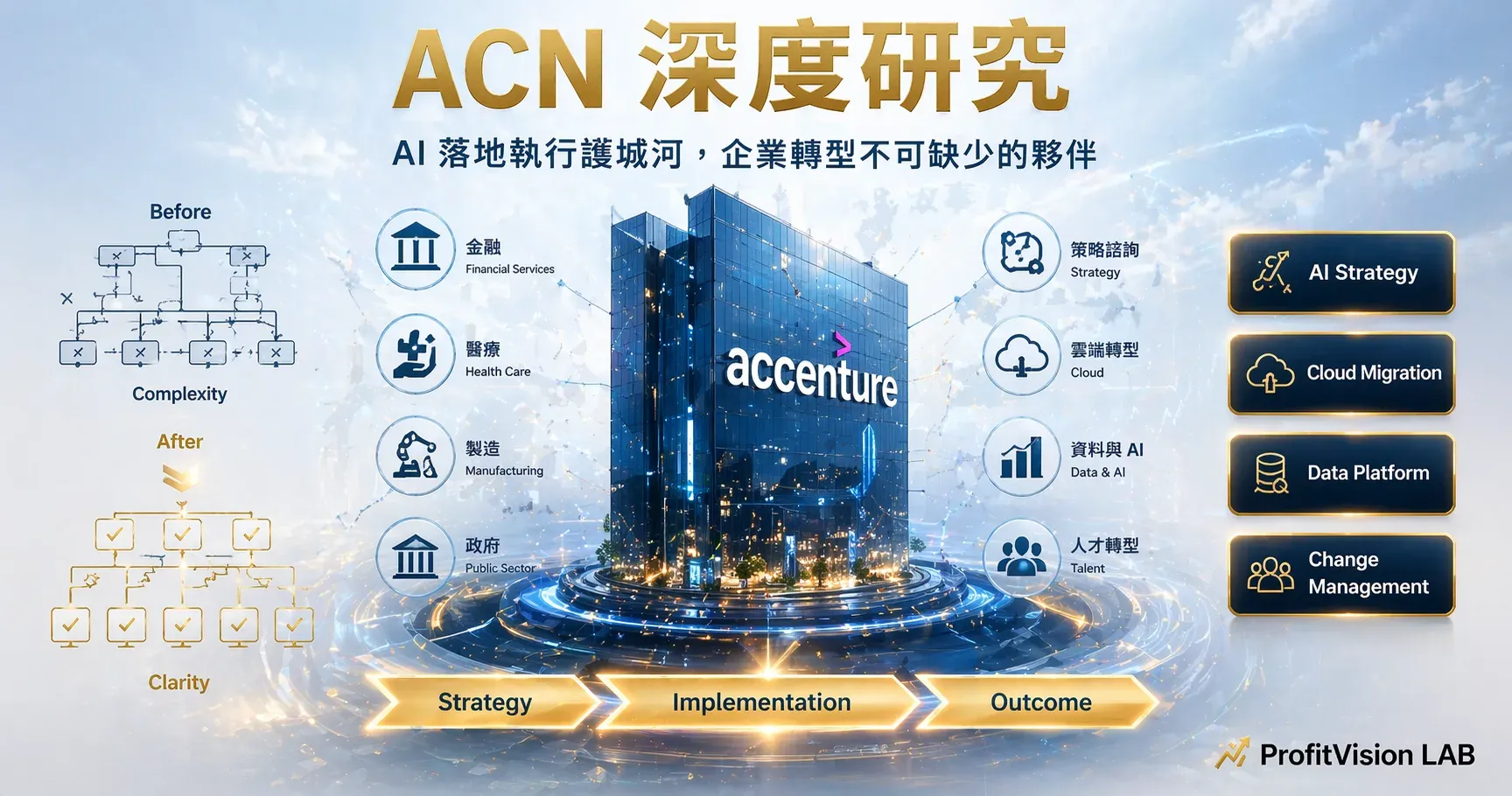
Accenture is the "largest general contractor" for enterprise AI deployment. As companies move from proof-of-concept to full-scale rollout, the real bottleneck isn't the model — it's systems integration and process redesign. With deep consulting capability, a massive AI talent base, and a cross-platform ecosystem, ACN is one of the few firms that can bridge ERP, CRM, and cloud architecture into a single integration hub. As AI investment shifts from narrative to cash flow, ACN sits at the very center of that transition.
The fundamental moat is deep — ROE of 38–40%, an all-time-high H1 bookings, and AI now mainstream to the business. The only obstacle is that the technical picture hasn't reclaimed the 50-day moving average; we're waiting for chip-flow confirmation before assessing entry.
In 2026, every Fortune 500 CEO claims to be "adopting AI." The problem is: it's easy to say, extremely hard to do. ChatGPT is a consumer tool you can just use. Enterprise-grade AI adoption is completely different — you need to wire AI into existing ERP systems, CRM databases, and factory-floor IoT sensors, while staying compliant with dozens of regulations like GDPR, SOX, and HIPAA. You need to retrain tens of thousands of employees to change how they work. You need to redesign dozens of cross-departmental core business processes without interrupting the existing business.
Only a handful of companies in the world have this capability, and Accenture is the most comprehensively qualified among them. The market knocked ACN down 28% on the thesis that "AI efficiency gains will hurt demand for consultants." That logic makes a fundamental mistake: AI won't make enterprises need Accenture less — the complexity of AI makes them need Accenture more.
Chapter 1: Industry Map
1.1 The Global IT Services and Consulting Market
IT services and management consulting is one of the largest professional-services markets in the world, with a total size approaching $1.4 trillion, and it is accelerating further on the back of AI-driven transformation. According to IDC's forecast, the AI consulting services market will reach roughly $500 billion by around 2030, with enterprise digital-transformation spending as the single largest driver. Accenture's management estimates that over 85% of C-suite executives plan to increase AI investment in the next 12 months, and "how to actually make AI work" is precisely the question they're willing to pay handsomely to answer.
| Market | Size | Growth Driver |
|---|---|---|
| Global IT services and management consulting | Approaching $1.4 trillion | AI-driven transformation wave |
| AI consulting services (2030 forecast) | $500 billion | Enterprise digital-transformation spending |
| C-suite planning to increase AI investment | Over 85% | "How to actually make AI work" |
1.2 The AI-Driven "Paradigm Shift": From Feature Adoption to Full Reinvention
Enterprise AI adoption is moving from Phase One (proof-of-concept, standalone pilot projects) into Phase Two (full cross-departmental integration and process redesign). Accenture's research data makes the scale of this shift clear:
2.5x faster revenue growth | 2.4x higher productivity | 3.3x higher success rate in scaling AI applications
1.3 The Game Logic of the AI Era: The "Strategy × Execution" Integration Gap
The traditional IT services industry has a structural split: strategy consultants (McKinsey, BCG) advise but don't execute; technology outsourcers (TCS, Infosys) execute but lack strategic depth. The complexity of AI adoption has turned this split into the single biggest cause of enterprise failure — strategy and execution disconnected from each other.
Accenture's core competitive strength is precisely filling this gap. Its "Reinvention Services" model integrates strategy, technology, operations, and marketing technology into a single end-to-end service unit — one of the few companies in the market that can deliver "from the CEO's boardroom to production go-live" as one continuous chain. In January 2026, Gartner published its first "Magic Quadrant for Digital Technology and Business Consulting Services," naming Accenture a Leader.
Chapter 2: Business Model and Moat
2.1 The Synergy System Across Five Business Segments
Accenture's business is organized into five segments — Communications, Media & Technology; Financial Services; Health & Public Service; Products; and Resources — providing deep cross-industry coverage that avoids heavy dependence on any single business cycle.
2.2 Revenue Mix: Balancing Consulting vs. Managed Services
| Business Line | Q2 FY26 Revenue | YoY | Characteristics |
|---|---|---|---|
| Consulting | $8.9 billion | +3% | High value-add, high pricing power; the ticket into the client relationship |
| Managed Services | $9.2 billion | +5% | 3–5 year long-term contracts; high stickiness; AI tools improve delivery efficiency |
2.3 Fixed-Price Contracts: A Financial Signal of Quality Confidence
A detail the market broadly overlooks: in FY2025, roughly 60% of Accenture's business ran on fixed-price contracts, up 10 percentage points from three years earlier. Fixed-price contracts mean clients are willing to accept a set cost and let Accenture bear the delivery risk. Behind that willingness is a high degree of trust in Accenture's ability to complete complex projects on time and on budget.
2.4 The M&A Factory: A Systematic Machine for "Buying" Capability
| Metric | Data |
|---|---|
| Average acquisitions completed per year | 30–50 |
| Acquisitions completed in FY2024 | 46 |
| FY2026 acquisition budget | $5 billion |
| Share of deals negotiated exclusively | 75% |
| Primary acquisition targets | AI and data science capabilities |
2.5 The Four Moat Pillars
In IT services, Accenture's brand is the one consistently ranked number one. That is a "permanent pass" into the highest decision-making levels of large enterprises. When a multinational's CDAO or CTO is running a $500 million AI transformation project, Accenture is almost always among the top two names on the shortlist.
Switching providers isn't just signing a new contract — it means having hundreds of unfamiliar consultants start learning the business from scratch, absorbing at least 12–24 months of efficiency loss along the way. Accenture's top 100 clients have an average relationship tenure of over 10 years, with many exceeding 20 years.
As of the end of 2025, Accenture had over 85,000 AI and data professionals. It can simultaneously deploy 5,000 AI engineers with specific industry expertise across 30 countries for a single global client.
Deep partnerships with Microsoft, AWS, Google Cloud, Salesforce, ServiceNow, SAP, Snowflake, and NVIDIA make Accenture the "neutral best-of-breed integrator."
Chapter 3: Competitive Landscape
| Company | Positioning | Strengths | Weaknesses | AI Capability Assessment |
|---|---|---|---|---|
| Accenture (ACN) | Integrated strategy + execution | Scale, brand, ecosystem; 85,000+ AI professionals | High cost; moderate growth rate | ★★★★★ Leader |
| McKinsey / BCG | Pure strategy consulting | Top-tier brand; C-suite influence | No execution capability; limited scale | ★★★☆☆ Strategy layer |
| TCS (Tata) | Primarily IT outsourcing | Low cost; large scale; Indian talent advantage | Lacks strategic depth; weaker brand | ★★★☆☆ Execution layer |
| Infosys | IT services + digital transformation | Cost advantage; fast-growing digital services | Brand recognition lacking; weak strategy-consulting capability | ★★★☆☆ Execution layer |
| IBM Consulting | Technology + consulting | Technical depth; enterprise AI tooling (WatsonX) | Aging brand; execution efficiency below ACN | ★★★☆☆ Competitor |
| Deloitte / PwC | Accounting + advisory | Strong financial advisory capability; client trust | Weak technical execution; IT integration not a core focus | ★★☆☆☆ Niche |
Chapter 4: Financial Resilience
4.1 Balance Sheet: A Rare Combination of Zero Debt and Ample Cash
| Financial Metric | Data (FY2026 Q2) | Interpretation |
|---|---|---|
| Cash balance | $9.4 billion | Ample; no substantial long-term debt |
| ROIC | ~31.4% | Far above the market average of 11.1% |
| ROE | 38–40% | World-class level |
| FCF / net income ratio | 1.2x | More than a dollar of real cash behind every dollar of reported earnings |
| Share of fixed-price contracts | ~60% | Up 10 percentage points from three years ago |
4.2 AI Monetization Milestones
| Timing | Milestone |
|---|---|
| Full-year FY2024 | $3.0 billion in new GenAI bookings |
| Full-year FY2025 | New GenAI bookings surpassed $10.0 billion (+233% YoY) |
| Q1 FY2026 | New Advanced AI bookings of $2.2 billion, up nearly 100% YoY |
| From Q1 FY2026 onward | AI has permeated nearly all business lines and is no longer disclosed separately — a sign it has become mainstream |
4.3 Q2 FY2026 Highlights and Concerns
- $43.0 billion in H1 new bookings, with a record $22.1 billion in Q2 alone
- A record 41 clients with single-quarter bookings over $100 million
- Full-year FCF guidance raised to $10.8–11.5 billion
- Asia-Pacific grew 10% YoY, demonstrating the growth potential of geographic diversification
- AI and data professionals exceeded 85,000, surpassing the target
- Q3 revenue guidance of $17.5–18.2 billion, below some analysts' expectations
- U.S. federal government contracts (AFS) affected by DOGE cuts, roughly a -1% impact for the full year
- Local-currency growth of 4% remains modest, with no sign of acceleration yet
4.4 Recession Resilience: Three Protective Walls
First wall — contract stickiness: Multi-year fixed-price contracts prevent revenue from collapsing within a single quarter; the $43.0 billion in H1 FY2026 new bookings provides over 12 months of revenue visibility.
Second wall — the recession resistance of AI spending: Even as enterprises lay off staff, AI transformation spending remains a priority they protect, because it is directly tied to competitive survival. This is fundamentally different from traditional IT outsourcing, which tends to get cut first in a downturn.
Third wall — shareholder-return mechanism: $9.4 billion in cash reserves plus over $10 billion in annual free cash flow give management ample room to sustain dividends and buybacks, providing a "cushion" for the stock price.
"We delivered a record second-quarter bookings of $22.1 billion, including a record 41 clients with quarterly bookings over $100 million, continuing to take market share in a highly competitive market." — Julie Sweet, Q2 FY2026 earnings call (March 19, 2026)
Chapter 5: Valuation and Scenario Analysis
Three Long-Term Growth Axes
Axis One: Capturing Share in the AI Consulting Market
Per IDC's forecast, the AI consulting market will reach $500 billion by 2030. Accenture's management is targeting at least 20–30% market share, implying potential AI-related annual revenue of $10–15 billion — over 15% of the company's current total revenue.
Axis Two: Geographic Expansion
Asia-Pacific delivered 10% local-currency YoY growth in Q2 FY2026, far outpacing the Americas' 3% and Europe/Middle East/Africa's 2%. India, Japan, and Australia are particularly worth watching.
Axis Three: Valuation Re-rating
Accenture has long been valued by the market under the framework of an IT services company (20–25x P/E), but as the share of its AI business keeps rising, its business model is converging toward "AI platform" and "enterprise technology infrastructure" — and should command a higher valuation multiple.
Bull Case
AI consulting demand accelerates faster than expected; GenAI booking growth continues at FY25's 233% pace; Asia-Pacific expansion contributes over 15% of revenue; the valuation framework re-rates from IT services to AI platform (P/E rises to 30–35x)
Base Case
Local-currency growth holds at 4–6%; AI business keeps growing but at a normalizing pace; FY2026 FCF guidance of $10.8–11.5 billion is met; valuation stays within the historical range of 22–27x P/E; DOGE impact is limited
Bear Case
Macro conditions deteriorate, IT budgets cut by more than 15%; AI efficiency gains genuinely displace some consulting demand; federal contract losses widen; growth stalls and valuation compresses to 15–18x P/E
Current share price range $255–270 | Forward P/E of roughly 19–21x, near the historical valuation low, providing an ample margin of safety.
Chapter 6: Conclusion and Tactical Recommendations
Four-Layer Defensive Screen Assessment
| Screen Layer | Evaluation Item | ACN Result | Verdict |
|---|---|---|---|
| Chip Flow | Institutional ownership, A/D Rating | Has not reclaimed the 50MA; A/D Rating still needs to recover | Watch |
| Moat | Brand, switching costs, talent, ecosystem | All four pillars hold up; ROE 38–40% | Clear |
| Volatility | IV Rank, options structure | IV Rank 40–55%; conditions suit a Bull Put Spread | Clear |
| Technicals | Moving averages, trend confirmation | Shares have not reclaimed the 50MA (around $290–295) | Awaiting confirmation |
Bull Case vs. Bear Case Summary
| Dimension | Bull Case | Bear Case |
|---|---|---|
| AI demand | Enterprise AI adoption accelerates, demand beats expectations | AI efficiency gains genuinely displace some consulting work |
| Revenue growth | Local-currency growth accelerates to 8–10% | Growth stalls at 2–3%; government contracts keep shrinking |
| Valuation | Re-rated as an AI platform, P/E 30x+ | IT-services discount compresses further, P/E 15–18x |
| Options strategy | Bull Put Spread, Short Put $240–250 | Wait for technical confirmation before entering |
Tactical Recommendations
- Short term (0–6 weeks): Wait for shares to reclaim the 50MA (around $290–295) and for the A/D Rating to recover to B or above before assessing entry
- After technical confirmation: Consider a Bull Put Spread structure, with the short put set at the $240–250 long-term support zone, capturing premium at the current 40–55% IV Rank
- Long-term fundamentals-driven investors: At the current $255–270 share-price range, the forward P/E of roughly 19–21x is near the historical valuation low with an ample margin of safety — scaling in gradually can be considered
"The market belongs to those who survive the longest." Waiting for technical confirmation is the bare minimum of discipline one owes a company with a 40% ROE.
Tracking Record
| Tracking Date | Share Price | Key Data | Rating | Next Focus |
|---|---|---|---|---|
| 2026/03/30 | $255–270 | H1 bookings $43.0B; FCF guidance $10.8–11.5B; AI business now mainstream | Actively Watching | Whether the 50MA is reclaimed; Q3 FY2026 earnings |
Investing involves risk; please evaluate carefully based on your personal financial situation.
Data sources: SEC filings, company earnings reports, StockAnalysis, public data | This article is part of ProfitVision LAB's Deep Stock Research series #ACN, data as of 2026/03/26.