The Wisdom of Doing Nothing: How "Simplifying" My Process Made My Trading More Efficient
The hardest part of trading isn't entering a position, and it isn't exiting one — it's doing nothing at all. This article shares my three pre-trade filters: Is the risk manageable? Is there room to recover if I'm wrong? Can I sleep soundly tonight? Once you learn to set boundaries, the market's grip on you starts to fade.
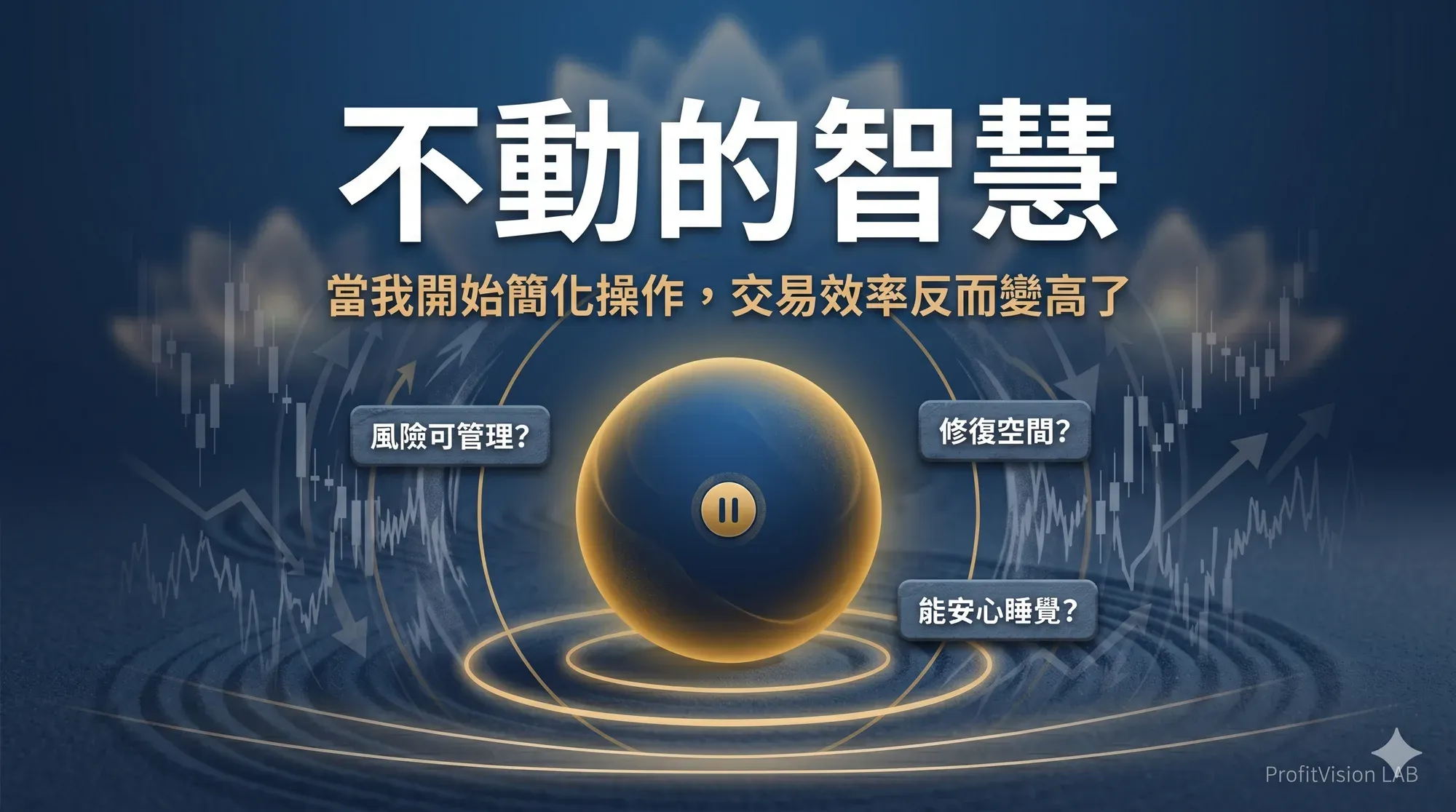
True freedom is being able to choose not to act."
I used to feel that standing still meant wasting an opportunity.
Later I realized: it's acting recklessly that wastes your life.
If you ask me what's hardest in trading today, I'd say: it's not entering, and it's not exiting — it's doing nothing at all.
I. "Doing Nothing" Used to Feel Like Failure
For a long time, I had a bias against inaction. Back then, I thought standing still meant: Am I not aggressive enough? Am I missing the move? Do I lack conviction?
Spend enough time in the market and you get swept up in a certain mood — as if you should always be doing something. But that restlessness doesn't come from opportunity. It comes from fear.
The real turning point came when I started asking a different question.
I used to ask: "Can I trade right now?"
Now I ask instead: "If I trade right now, will it disrupt my life?"
That single shift in the question automatically eliminated many trades that had once looked "reasonable."
II. Three Filters Before Every Trade
Before I trade now, I only look at three things. Not gut feel, not predictions — just these three questions:
If the answer to any one of these three questions is no, I don't act. Not because I can't, but because I choose not to.
III. Doing Nothing Preserves Flexibility for the Future
I later came to understand that when you choose not to act, you're actually doing three things at once:
The Triple Meaning of Doing Nothing
① Preserving Capital
Money you haven't deployed is ammunition for the next real opportunity. One reckless trade can cost you the next three best ones.
② Preserving Mental Space
Every position occupies your attention and emotional bandwidth. Doing nothing keeps you clear-headed, so you can spot the next opportunity that's actually worth taking.
③ Preserving the Freedom to Choose Next Time
The market is here every day, but your judgment isn't guaranteed to be. By staying still, you're protecting your most valuable asset — the quality of your decision-making.
IV. Doing Nothing Isn't Conservatism — It's a Boundary
Boundaries are the single most important thing I've learned in years of trading.
It's not that I can't tolerate risk — it's that I know which kind of risk I don't want to take on. That "don't want to" isn't avoidance. It's maturity.
Once you start respecting your own boundaries, the market's grip on you weakens, and trading becomes simpler as a result.
Because you no longer need to explain every fluctuation, find a reason for every candle, or rationalize your own anxiety.
Once you know that not acting is an option, a lot of temptation simply loses its power.
Conclusion: For Those Who Still Find "Doing Nothing" Hard
If you find yourself itching to trade even when you clearly don't see a good opportunity — or feeling more anxious precisely because you're doing nothing —
that doesn't mean trading isn't for you. It means there's one thing you haven't gotten used to yet:
Trading is meant to optimize your life, not to fill an emptiness.
Those who can hold still have usually already come a long way.
Not every opportunity deserves your action, but every time you choose to do nothing, you strengthen your trading character.
All content in this article is for educational and research purposes only and does not constitute investment advice or a solicitation to buy or sell. Investing involves risk; please evaluate carefully based on your own financial circumstances.
Think with me, not just trade with me.
© 2026 ProfitVision LAB · All Rights Reserved