A 2026 Landscape Analysis of US Real Estate: As the Market Splits, Whose Moat Runs Deepest?
Under high-rate pressure, the US housing market is splitting apart: the luxury market and the entry-level market are diverging, and the moats separating homebuilders are widening sharply. The financial constitutions and market positioning of four leaders — DHI, LOW, LGIH, and BLDR — will determine who survives the downcycle.
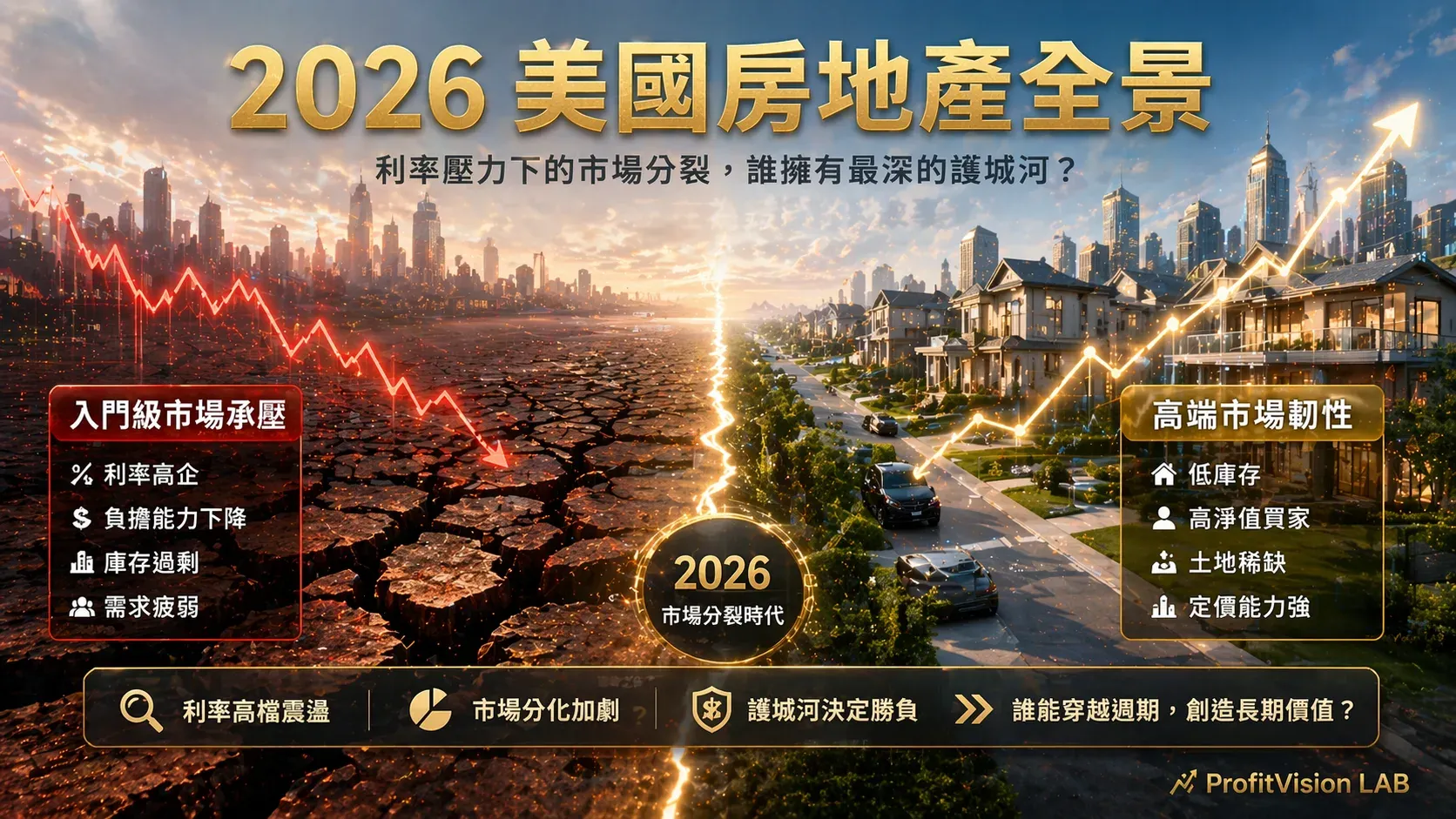
With 2026's high-rate plateau, the US housing market has entered an era where "stock picking is king." The era of "buy it and profit" is over. What's being tested now is: which companies' business models can still generate real cash into a headwind?
DHI subsidizes rates through its own mortgage arm and props up the stock with continuous buybacks, making it the builder with the most staying power right now; LGIH's inventory buildup has created enormous stored potential energy, waiting for a tailwind from lower rates; LOW, through its acquisition of FBM, is breaking into the Pro market, with essential repair-and-remodel demand propping up cash flow; and BLDR's digital quoting volume serves as a leading thermometer for the entire industry chain — the day it accelerates is the starting point for positioning.
1. Upstream and Downstream: Who Holds Pricing Power?
Across the US real estate supply chain, every link operates on its own traffic logic.
Natural gas/lumber/steel → BLDR (building-materials supplier) → DHI / LGIH (homebuilders) → LOW (retail + Pro) → end consumers/contractors
Upstream — BLDR (Builders FirstSource): Efficiency Is the Real Moat
BLDR is no longer just a lumber supplier. Through its digital quoting platform and prefab components, it has compressed the "quoting cycle" to a third of what a traditional contractor takes. In today's labor-shortage environment, this "efficiency flow" translates directly into contractor stickiness.
Midstream Homebuilders — DHI vs. LGIH: The Battle for First-Time Buyers
| Company | Core Strategy | Competitive Advantage | Current Constraint |
|---|---|---|---|
| DHI (D.R. Horton) | Economies of scale + rate subsidies | Its in-house lending arm, DHI Mortgage, can subsidize the market rate of 6.5% down to 5.5% — something small-to-mid-size builders can never replicate | Slowing growth as the market waits for rates to come down |
| LGIH | Precision marketing + converting renters into buyers | A "rent-to-own" conversion strategy targeting renters, with an extremely high ROI; its customer-acquisition cost and conversion logic are unique in the industry | Inventory buildup under high rates; lengthening cash-conversion cycle |
Downstream Retail — LOW (Lowe's): Essential Repair Demand Is the Last Line of Defense
With new-home starts stalling, the average age of existing US housing stock — a staggering 40 years — has become LOW's least-questioned moat. More critically, LOW's $8.8 billion acquisition of Foundation Building Materials (FBM) formally pushes it into the Pro market (professional contractors). This means LOW's revenue mix is shifting from weekend DIY customers buying paint to a B2B business with steady order flow and average tickets more than 5x higher than consumer purchases.
Wherever the flow goes, the profit follows. Right now flow is shifting from DIY → Pro (LOW), and from existing homes → new homes (DHI) — these two axes determine who makes money in 2026.
2. A Deep Dissection of the Business Models: Where Is the Moat?
LOW's Pro-Market Strategy: the Logistics Barrier of the "Last Mile"
LOW's core transformation isn't simply adding a sales channel — it's rebuilding the entire service chain. Through FBM's 370 supply locations spread across the country, LOW can now offer same-day delivery of materials like drywall and steel framing. For a contractor who "can't afford to wait on a job's timeline," this delivery-time guarantee matters far more than a price discount.
The nature of this logistics network is: once built, it's extremely expensive to copy. A competitor looking to replicate it needs more than capital — it needs to rebuild relationships and locations city by city, warehouse by warehouse. This is a genuine moat.
DHI's Asset-Light Approach: Land Options as a Textbook in Risk Management
DHI's core financial wisdom boils down to one sentence: control the land, don't own the land.
It controls more than 75% of its land reserves through "land options." In simple terms:
- When the market is good → exercise the option, develop as planned
- When the market is bad → walk away from the option, losing only a small deposit while the balance sheet stays clean
Compared with peers carrying billions of dollars in land loans through downturns, DHI's financial staying power is clearly stronger in every cycle. Combined with DHI Mortgage's rate-subsidy capability, DHI isn't playing the traditional developer's high-stakes bet — it's playing a precise game of capital turnover × interest-spread management.
LGIH's Efficiency Evolution: the Logic of a Coiled Spring
Back in 2020–2021, when 30-year fixed rates sat at 3%, LGIH was the efficiency king of the industry. ROE briefly broke 30%, because it had standardized homebuilding the way an iPhone gets manufactured — customer pays, gets the keys, moves in, with the entire process compressed to the extreme.
But once rates rose to 6.5%, that same "build first, sell later" model turned into a financial shackle. Completed finished inventory piled up as sales velocity slowed, days of cash conversion lengthened, and paper profits stopped translating into cash in hand.
It's more like a compressed spring — the lean organizational structure is still there, and the "rent-to-own" marketing flywheel is still there. Once rates start coming down, the built-up inventory will convert to cash quickly, and that rebound momentum is exactly the stored potential energy that makes LGIH so intriguing.
3. A Deep Cash-Flow-Statement Showdown: DHI vs. LGIH
"Profit is an illusion; cash is the truth." — the first principle of financial analysis
DHI: a Cash-Flow-Driven Buyback Machine
| Financial Metric | Value (Q1 2026) | Interpretation |
|---|---|---|
| Operating cash flow (OCF) | $854 million | Up 32% YoY, strong internal cash generation |
| Share buyback volume | $670 million | Funded by its own cash, not leverage |
| Annual buyback authorization | $2.5 billion | Buyback firepower strengthens as the stock falls |
| Free cash flow (FCF) | Consistently positive | Growth not dependent on external borrowing |
LGIH: Liquidity Pressure from Inventory Buildup
| Financial Metric | Value | Interpretation |
|---|---|---|
| Physical inventory | $3.5 billion | A large amount of capital is locked in finished homes |
| Liquidity source | $330 million | Mainly reliant on a bank revolving credit line |
| Interest coverage ratio (ICR) | 2.8x | Still in a safe zone, but with limited room |
| Inventory turnover | < 0.8x | Once hit 1.5x at its peak; cash is stuck inside houses |
Turnover falling from a peak of 1.5x to below 0.8x directly reflects the predicament of "cash stuck inside houses."
But with an ICR of 2.8x, LGIH isn't at risk of insolvency — its problem is "cash moving slowly," not "on the verge of collapse."
4. A Full-Landscape Assessment of the Four Companies for 2026
| Company | Potential Energy | Momentum (Trend) | Financial Staying Power | Key Points to Watch |
|---|---|---|---|---|
| DHI | High | Medium-high | Strong | In-house lending subsidies + buyback support; land-option risk management |
| LOW | Medium-high | Medium | Strong | Essential repair demand + FBM's entry into the Pro market; B2B transformation |
| LGIH | Very high (a compressed spring) | Weak (waiting for a tailwind) | Medium (ICR 2.8x) | Inventory buildup creating high potential energy; waiting for a rate-cut catalyst |
| BLDR | Medium-high | Medium (awaiting acceleration) | Medium-strong | Digital quoting volume as the industry chain's thermometer; prefab methods boosting efficiency |
5. The Hidden Logic of Supply-Chain Coordination
These four companies aren't independent stocks — they're different nodes on the same supply chain. Understanding this chain's coordination logic is the key to truly "using BLDR's thermometer to size your DHI position":
1. BLDR's digital quoting volume accelerates (leading indicator, 1–2 months ahead)
↓
2. Homebuilders' new starts pick up (DHI/LGIH begin accelerating construction)
↓
3. Homebuilders' earnings improve (orders, closings, gross margin rise)
↓
4. LOW's Pro business accelerates (remodel and repair demand after new homes are completed)
This entire chain boils down to one core signal: BLDR's digital quoting volume. It's the "thermometer" for the whole supply chain.
6. Execution Framework and Conclusion
A Dual-Track Approach: Stability + Offense
Stable Allocation (suggested 60%)
DHI + LOW
DHI's share buybacks provide a clear downside floor — even if the market weakens in the short term, the company's "self-buying behavior" forms a natural cushion. The benefits of LOW's FBM integration should start showing up in gross margin in the second half of 2026, and the stickiness of its Pro customer base is a long-term stabilizing factor in its quarterly results.
Offensive Allocation (suggested 40%)
LGIH + BLDR (with strict entry discipline)
LGIH: don't blindly buy the dip around $40. Wait for earnings and watch for "an inflection point in net inventory decline."
BLDR: track the growth rate of digital-platform quoting volume. If it accelerates, that's a leading signal of a homebuilder demand recovery, 1–2 months ahead of earnings.
Risk Warning
- The Fed keeps rates high longer than the market expects, further pressuring housing demand
- LGIH's inventory keeps building, cash flow deteriorates, and ICR falls below 2x
- LOW's FBM integration fails, and Pro-market expansion falls short of expectations
- DHI's buyback pace weakens, loosening its support structure
"The market belongs to whoever survives the longest."
US real estate in 2026 isn't short on good companies — it's short on companies with enough staying power in a high-rate environment.
DHI's staying power comes from the strength of its cash flow and disciplined buybacks; LOW's staying power comes from essential repair demand and its B2B transformation; LGIH's staying power still holds on paper, but it needs rates to give it an outlet to release that potential.
Wherever the flow goes, the profit follows. Cash is the truth, buybacks are conviction, and inventory turnover is the clock.
Tracking Record
| Tracking Date | Company | Key Metric | Rating | Next Focus Area |
|---|---|---|---|---|
| March 24, 2026 | DHI | OCF $854M (up 32% YoY); $2.5B buyback authorization | Steady hold | Q2 FY2026 new-order volume; land-option exercise rate |
| March 24, 2026 | LOW | FBM integration progress; Pro customer stickiness | Steady hold | FBM's gross-margin contribution; timing of the 2026 H2 impact |
| March 24, 2026 | LGIH | Inventory $3.5B; ICR 2.8x; turnover < 0.8x | Watching, waiting for a tailwind | Net-inventory inflection point; signals of a rate-policy pivot |
| March 24, 2026 | BLDR | Digital quoting volume $7B annualized | Tracking the thermometer | Whether digital-quoting growth accelerates; Q2 earnings |
Investing involves risk; please assess your own financial situation carefully.
Data sources: SEC filings, company financial reports, StockAnalysis, and public records | This is original research by ProfitVision LAB, with data current as of March 29, 2026.