Ubiquiti (UI): Brand x Community x ODM — the Lowest-Cost Flywheel Machine
Ubiquiti is not a networking company — it's an asset-light brand company whose technology asset is its software stack, whose marketing engine is its community, and whose moat is its global distribution network. Manufacturing is fully outsourced to Taiwanese ODMs, letting it generate $3 billion in annual revenue and a 30% net margin across 180 countries with just 850 employees and near-zero marketing spend. This article dissects the entire flywheel machine value chain by value chain, and discusses which industries this business model could be transplanted into.
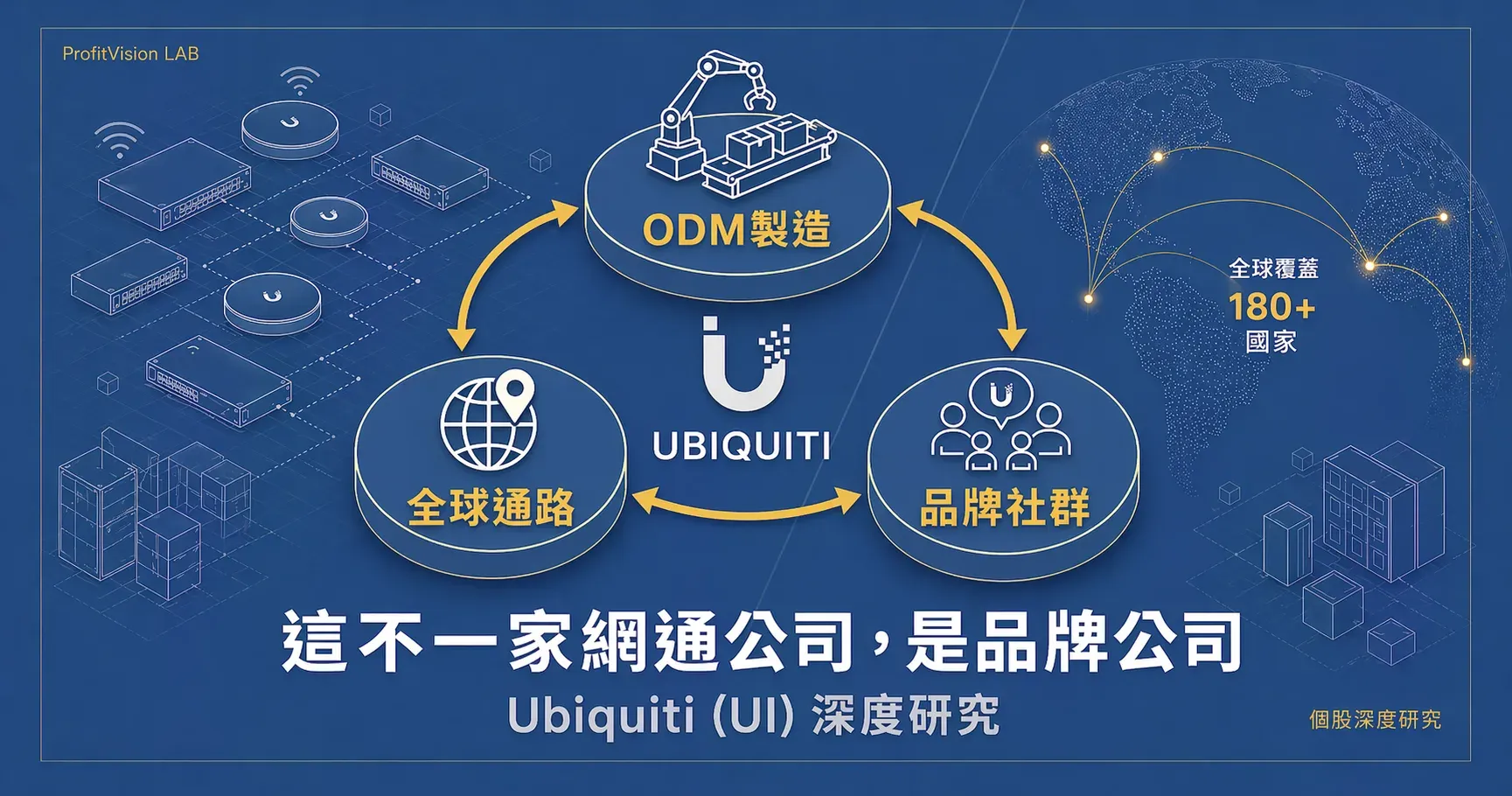
Ubiquiti (UI) Deep Dive: This Is Not a Networking Company — Deconstructing a Flywheel Machine That Replaces Every Traditional Cost with "Brand + Community + ODM"
This article is a complete record of a reasoning process. Through layers of challenge and correction, we ultimately clarified what Ubiquiti really is, where its moat truly lies, which risks are real, and which merely sound plausible while being false premises.
- Reframing: What Kind of Company Is Ubiquiti, Really?
- Chapter 1: The Industry Map — the Structural Advantage of the "Golden Middle Layer"
- Chapter 2: A Full Value-Chain Dissection — the "Outsourcing Philosophy" Across Five Stages
- Chapter 3: A Correct Inventory of Technology Assets — What's a Real Moat, What's a False Premise
- Chapter 4: The Competitive Landscape — Who Could Actually Break This Flywheel?
- Chapter 5: Financial Resilience — a Counterintuitive Profit Machine
- Chapter 6: The Founder and Governance — Why 90% Ownership Isn't Necessarily Bad
- Chapter 7: Valuation Scenario Analysis
- Chapter 8: The Real Risks — Four Attack Points, Asked and Answered
- Chapter 9: Conclusion and Options Tactical Recommendations
- Extended Discussion: Which Industries Could This Business Model Be Transplanted Into?
Ubiquiti is not a networking company, and it is not a technology company — it is a company that uses a software stack as its technology asset, community as its marketing engine, and a global distribution network as its moat, an asset-light brand company through and through. Manufacturing is fully outsourced to Taiwanese ODMs, and most of the hardware design is outsourced as well; the company retains only software, brand, and channel. Founder Robert Pera (Chinese-American, descended from Taiwanese immigrants) owns roughly 90% of the company, and with just 850 employees and a near-zero marketing budget, generates $3 billion in annual revenue and a 30% net margin across 180 countries. This figure is virtually unmatched among global hardware companies. The market niche it chose — enterprise-grade capability at consumer-grade pricing — has two natural barriers above and below: Cisco's cost structure prevents it from cutting prices to attack from above, and TP-Link's community image prevents it from attacking upward into brand trust. The moat isn't in the technology — it's in the twenty-year path dependence of a flywheel built on "democratizing high-end networking equipment through community." At the current price of ~$690, the valuation premium is reasonable but already sits in the middle of the base-case scenario, making it suitable for a Short Put selling strategy on pullbacks, with strict position-size discipline.
⚡ Four-Layer Defensive Screen Quick Reference
| Filter | Metric | Data (April 2026) | Result |
|---|---|---|---|
| Filter 1: Institutional Flow | A/D / RS / institutional activity | Founder owns ~90%, float ~10%; institutions have been accumulating recently; only 2 covering analysts; RS strong | ⏸️ Actively watching |
| Filter 2: Moat | Net margin / EPS growth / model strength | Net margin ~30% (top of the industry), TTM EPS $14.69, Q2 FY2026 +22% YoY, deep community moat | ✅ Pass |
| Filter 3: Volatility | IV Rank / Beta / liquidity | Thin float leads to wide options bid-ask spreads; IV swings on news; position size must be strictly controlled | ⏸️ Actively watching |
| Filter 4: Technicals | Price trend / 52-week position | Stock ~$690, near its 52-week high; strong post-earnings action, analyst target $753 | ⏸️ Actively watching |
Reframing: What Kind of Company Is Ubiquiti, Really?
Before diving into any financial figures or competitive analysis, this question must be answered first. Because if the frame is wrong, every subsequent analysis will be skewed.
Most people's first label for Ubiquiti is "networking equipment company." That label isn't wrong, but it leads people to compare Ubiquiti against Cisco, HPE, and Juniper within the same analytical framework — comparing technical specs, R&D spend, patent counts, and standards-body influence. Compared this way, Ubiquiti looks "underqualified" on every front: only about 200 patents, no participation in IEEE working groups, no enterprise direct-sales team, and almost no customer support to speak of. Using this framework, you'd conclude "this is a second-tier hardware company grabbing market share on low prices" — and that conclusion would be badly wrong.
The correct frame is built like this:
Ubiquiti's hardware is designed and manufactured by Taiwanese ODM makers. This isn't a small slice outsourced — the entire manufacturing chain is outsourced. Taiwan has a large number of networking ODM makers, in a brutally competitive red-ocean market with plenty of suppliers and ample capacity, able to absorb orders of any size. These ODM makers survive on taking orders — they need brand customers like Ubiquiti, not the other way around. This market structure means Ubiquiti carries almost no dependency risk on the manufacturing side.
What does the ODM do? Hardware design, PCB layout, RF tuning, antenna integration, supply-chain management, and production testing. What does Ubiquiti do? Write firmware, write UniFi OS, define product specs, build community, manage brand, and ship globally.
This division of labor is exactly the same as Nike's relationship with Vietnamese shoe factories. Nike doesn't make shoes — the factories make shoes. Nike does brand, design language, athlete endorsements, and retail channels. Nobody calls Nike a "shoemaking company," because shoemaking is merely its logistics, not its essence.
The same logic applies here: calling Ubiquiti a "networking company" is wrong. Its essence is an asset-light brand company whose technology asset is a software stack, whose marketing engine is community, and whose channel moat is a global distribution network — which just happens to operate in the networking-equipment lane.
This reframing carries three immediate analytical implications:
First, evaluating its competitiveness shouldn't ask "how strong is its hardware technology," but rather "how deep is its brand trust and community ecosystem." Second, evaluating its risk shouldn't look for "vulnerabilities at the manufacturing and technology end," but rather "how erodible is brand trust, and how transferable is the community." Third, its valuation can't be framed with a hardware-company lens or a pure-software-company lens — the closest analogy is a an asset-light brand company: gross margin constrained by hardware costs, but with an extremely thin expense structure, because marketing and customer support are both carried by the community.
Ubiquiti's know-how comes down to just three things: ① its software and firmware stack (UniFi OS, UISP, the AirMAX protocol implementation); ② the accumulated trust of its community and brand (twenty years of building a "cheap but not cheap-feeling" perception among IT engineers worldwide); ③ its distributor network spanning 180 countries. Manufacturing, hardware design, and technical standards — none of these appear on Ubiquiti's list of core competencies.
Chapter 1: The Industry Map — the Structural Advantage of the "Golden Middle Layer"
The market position Ubiquiti chose isn't just "a gap ignored by the big players" — it's structurally advantageous for Ubiquiti specifically, and that advantage strengthens over time rather than eroding.
The Market's Three-Layer Structure
The global networking-equipment market splits clearly into three layers: at the top are large enterprises and telecom carriers served by Cisco, HPE, and Juniper, where contracts run into the millions of dollars, technical-support SLAs are standard, and purchasing decisions are driven by IT committees and procurement departments — this market is roughly $50–60 billion; at the bottom are home consumers served by TP-Link, Netgear, and Amazon Eero, with products positioned as "plug and play" that don't need VLANs or multi-site management; and squeezed in the middle is a huge population long ignored by both ends — small and medium businesses worldwide, wireless ISPs, hotels, schools, multi-unit residences, and ISPs in emerging markets. What this group needs is "enterprise-grade reliability and features at consumer-grade pricing and ease of use" — and before Ubiquiti came along, this combination barely existed.
The Two Natural Barriers of the "Golden Middle Layer"
The middle layer Ubiquiti occupies isn't just an abandoned gap — it has two structural barriers above and below that make it hard for competitors to enter:
The barrier above: the big players can't cut prices. Cisco Meraki's cost structure is built on a massive direct-sales team, an SLA-fulfillment system, factory-certified engineers, and global support centers. These fixed costs push its pricing floor far above Ubiquiti's. The more fundamental issue is brand contradiction: if Cisco launched a "no SLA support, cheap but roughly similar-featured" sub-line to chase the SMB market, its existing enterprise customers would immediately ask — what am I getting for the premium I'm paying? Once that question is asked, the brand premium at the top of the market starts to unravel. So Cisco's "staying out" isn't oversight — it's a rational choice, and one that will persist, because changing it would mean destroying its own core market.
The barrier below: a consumer brand's image can't attack upward. TP-Link holds the top share of the global low-to-mid-end router market, and its technical capability and cost advantage are real. Its Omada commercial line is catching up to UniFi in features, and its pricing is often even lower. But there's one thing TP-Link can't replicate in the near term: brand perception within the global IT engineer community. The impression that "TP-Link is the router you buy your mom for the house" is deeply entrenched in IT-professional communities like Reddit's r/sysadmin and r/networking. Reversing that image isn't something product features catching up can solve — it requires time to rebuild trust within the community, and that process is measured in years, not months.
These two barriers together constitute a structural competitive moat, and their strength grows as Ubiquiti's community expands — the bigger the community, the deeper the brand perception, and the harder both barriers become to cross.
The Unique Dynamics of "Customer as Community Member"
Ubiquiti's middle-layer market has another feature hard to replicate elsewhere: the decision-maker, the user, and the community member are the same person.
In the large-enterprise market, the purchasing path is: IT department evaluates → procurement committee approves → finance signs off. The engineer actually using the equipment and the person who ultimately signs the purchase order are often different people, and the core work of sales is influencing the signer, not the user. This is why Cisco needs a massive enterprise sales team — their job is managing relationships and the procurement decision process, not just demonstrating product features.
In Ubiquiti's target market, the SMB's IT admin, the WISP's technical lead, the school's network manager — they research, decide, and deploy themselves, with no procurement committee to convince. This makes word-of-mouth propagation extremely efficient: both the recommender and the recommended are technical people, and their trust in each other is built on real technical evaluation, not sales pitches. "I've run this for three years, never had a VLAN issue, and firmware updates go smoothly" carries far more persuasive power among peers than any advertising budget could buy.
Six Target Markets and Their Estimated Size
| Market Segment | Core Need | Estimated Global Size | Ubiquiti's Penetration Depth |
|---|---|---|---|
| Small and medium businesses (SMB) | Enterprise-grade features, no subscription fees, manageable with minimal IT staff | $150–200B (equipment) | Moderate, accelerating |
| WISP (Wireless ISPs) | Long-range outdoor coverage, high reliability, low cost | $30–50B | Very deep, ~48% share |
| Hospitality | Full-property coverage, one-time purchase, no annual fees | $50–70B | Moderate, ongoing penetration |
| Education institutions | Wide-area coverage, centralized management, limited budgets | $40–60B | Low-to-moderate, growing fast |
| MDU / multi-unit residences | Building-wide unified management, owners averse to annual fees | $20–30B | Low, emerging |
| Emerging-market infrastructure | Reliable but extremely low-cost broadband access equipment | Huge, hard to quantify | Deep, strong first-mover advantage |
These six markets share one common trait: highly dispersed long-tail customers, low IT-service needs, and price sensitivity. That's precisely the group large vendors are least willing to enter and least equipped to serve — and precisely the scenario where Ubiquiti's business model shines. Current annual revenue of $3 billion, against the combined TAM of the markets above, implies penetration below 6% — the growth runway remains extremely long.
The emerging-markets segment deserves special mention. India, Southeast Asia, Africa, and Latin America are home to billions of people who still lack reliable broadband. Local ISPs in these regions simply can't afford Cisco's pricing, while consumer-grade equipment can't support commercial deployment. Ubiquiti isn't taking someone else's customers here — it's creating a market that didn't previously exist. This market's potential size is the hardest to quantify and most likely to be underestimated by analysts — and Ubiquiti's international revenue share, consistently above 60%, is the financial expression of that potential.
Takeaway: Ubiquiti's choice of market is itself a moat design. It deliberately chose a middle layer that "large vendors think isn't worth entering, and small vendors lack the technical ability to serve" — a layer protected by structural barriers above and below, with a huge potential scale.
Chapter 2: A Full Value-Chain Dissection — the "Outsourcing Philosophy" Across Five Stages
Understanding how Ubiquiti turns a 40% gross margin into a 30% net margin requires looking clearly across the entire value chain, at every stage's choices, and at the cumulative expense-compression effect of those choices stacked together.
Stage 1: R&D and Design — a Two-Layer Structure, Community Crowdsourced Input
Ubiquiti's R&D isn't a "large research institute" model — it's a refined two-layer structure. The first layer is a small internal core of engineers responsible for the lowest-level firmware architecture — UniFi OS's core logic, the AirMAX TDMA protocol implementation, UniFi Protect's video processing, and the technical definition of specs for ODM products. The second layer is community-crowdsourced demand input: the Feature Requests section of community.ui.com, where IT engineers worldwide submit feature ideas and vote on each other's, forming a free, high-quality, real-time market-research engine.
The quality of these suggestions far exceeds ordinary consumer surveys. The people submitting them are IT engineers actually running Ubiquiti in production environments, and their requests typically come with detailed technical specs, use cases, and problem descriptions — closer to technical proposals in quality. What Ubiquiti's product team sees isn't a vague "wish it were better" but input at the level of "in a 200-AP campus scenario, channel width needs to auto-adjust based on interference, and the management interface needs to display a real-time interference heat map."
The result: R&D expense as a share of revenue has consistently run below 3–4%, versus roughly 13–15% at Cisco and roughly 18% at Juniper.
Stage 2: Manufacturing — Fully Outsourced to Taiwanese ODMs, Fabless All the Way
Ubiquiti owns no factories at all. All hardware manufacturing is entrusted to ODM makers in Taiwan and Vietnam, using mature chipsets from Broadcom, Qualcomm, and MediaTek rather than in-house silicon. Taiwan's ODM makers (widely believed to include Wistron NeWeb and Accton Technology, among others) handle everything from design specifications through hardware design, PCB layout, RF tuning, antenna integration, and production testing.
There are a few important industry realities to understand regarding ODM selection. Taiwan's networking ODM industry is an extremely competitive red-ocean market with many suppliers and ample capacity — plenty of makers can take on orders of any scale. This market structure favors Ubiquiti: ODM makers need brand customers like Ubiquiti, so the dependency isn't asymmetric. More importantly, brand owners and manufacturers each occupy their own specialized turf, and crossing into the other's territory is self-destructive — if an ODM maker launched its own competing brand directly, it would lose every existing brand customer; if the brand owner built its own factory, it would destroy the very foundation of asset-light efficiency. This clearly bounded division of labor is stable, not fragile.
Financial implication: annual capital expenditure stays under $20–30 million, less than 1% of revenue. Nearly all profit is real free cash flow.
Stage 3: Brand and Marketing — Near-Zero Traditional Expense
Ubiquiti's sales and marketing expense has consistently stayed below 1–2% of annual revenue. The same metric at Cisco is roughly 22%, and at HPE roughly 18%. This gap isn't because Ubiquiti gave up on marketing — it's because it found a near-free substitute.
Three organic channels carry the entire marketing load: word of mouth within IT engineer communities (Reddit, Spiceworks, forums); the YouTube and blog ecosystem (hundreds of creators making Ubiquiti tutorials, never paid by the company, sustained by traffic and subscriptions); and low pricing itself — when a UniFi AP costs a quarter to a fifth of a comparably specced Cisco Meraki unit, the price-performance gap becomes the most powerful advertisement of all, with the numbers speaking for themselves.
The combined efficiency of these three channels far exceeds anything paid advertising could achieve, for a reason rooted in credibility: IT engineers know that recommendations within the community come from peers' real hands-on experience, not marketing copy — which drives disproportionately high conversion rates.
Stage 4: Distribution — Globally Dispersed Authorized Resellers, No Direct Sales
Ubiquiti has no enterprise direct-sales department; products are sold through thousands of authorized distributors worldwide, covering 180+ countries. Ubiquiti collects payment from only a handful of top-tier wholesalers, with inventory and local-sales risk borne by distributors — keeping the company's accounts-receivable complexity extremely low.
One claim about an "information blind spot" needs correcting: earlier analyses said that because Ubiquiti sells through distribution, it "doesn't know who ultimately uses its equipment or in what scenario" — this is an oversimplification. In reality, Ubiquiti has three data channels: deployments using the UniFi Cloud console continuously report device status, firmware version, and network topology statistics back to Ubiquiti's servers; bug reports and feature requests on the community forums come with detailed usage-scenario descriptions — real reports with names and context attached; and activation of UniFi accounts and UISP licenses is tied to identifiable customer identities.
But there's an important coverage gap: a large number of deployments use self-hosted local controllers, never touching the cloud, leaving Ubiquiti with zero visibility into them. This is very common among security-sensitive institutions and advanced users — often the very customer segments with the largest deployments. So the more precise statement is: Ubiquiti has data, but coverage is uneven — cloud users are visible, while the largest local deployments are hardest to reach. It's also worth noting that, to date, there's little sign the company is using this data for any sophisticated commercial-intelligence analysis — a matter of willingness, not capability.
Stage 5: After-Sales Support — a Three-Layer Community Self-Service Ecosystem
Ubiquiti offers almost no paid factory-direct technical-support contracts. Users facing problems have three paths: the first layer, real-time peer support on the community.ui.com forums, with millions of threads covering nearly every scenario, often with response quality exceeding traditional vendors' first-line support, because the responders are actual practitioners; the second layer, a library of tutorial content built by hundreds of YouTube creators, from beginner setup to advanced deployment, available 24/7 in multiple languages; the third layer, official documentation (help.ui.com), the last line of defense but the slowest to update — the community usually provides answers faster than official documentation.
This three-layer structure keeps customer-support costs near zero, while also setting a clear market ceiling: any customer requiring a "factory-guaranteed SLA" — large hospitals, financial institutions, government agencies — is structurally unservable by Ubiquiti. This isn't a weakness — it's the boundary of the market positioning, and that boundary is itself part of the moat: Ubiquiti doesn't serve markets requiring SLAs, so Cisco has no reason to cut prices to steal its market.
The Decisive Difference in Expense Structure
SG&A + R&D as a Percentage of Revenue
This expense gap explains everything: a 40% gross margin (a reasonable level for a hardware company) → minus ~8% SG&A+R&D → nets a roughly 30% net margin. Cisco's gross margin is 62%, but after subtracting 42% in expenses, its net margin ends up lower. Ubiquiti achieves a higher net margin with a lower gross margin, purely on the strength of its overwhelming expense-side advantage.
The Flywheel Effect: Why This System Keeps Accelerating
Low pricing → a massive user base → an active community (self-service support + feature feedback + word of mouth) → extremely low expenses → high net margin → the ability to sustain low pricing → back to the start
The key insight of this flywheel is: low pricing isn't just a marketing tactic — it's a systematic investment in keeping the community active. If Ubiquiti raised prices to chase a higher gross margin, its user base would shrink, community activity would decline, word of mouth would weaken, and it would eventually need to spend more on traditional marketing — offsetting the benefit of the higher gross margin. Pera deeply understands this logic, and has never seriously entertained a strategic pivot "upmarket." This judgment hasn't wavered in twenty years — and that consistency is itself a powerful long-term signal.
Takeaway: The core of Ubiquiti's business model is outsourcing all four of a traditional company's cost centers — marketing, customer support, R&D input, and manufacturing — to the community or to ODMs, using low pricing as the systemic fuel that sustains this system. The compounding expense compression across all five stages produces an expense structure rare in the industry — and this is the real source of the 30% net margin.
Chapter 3: A Correct Inventory of Technology Assets — What's a Real Moat, What's a False Premise
This chapter requires particular honesty. The first draft of this analysis raised two "technology risks" that, on closer examination, turned out to be wrong — wrong because of a misjudgment of where Ubiquiti sits in the industry value chain. Recording this correction process in full is more valuable than presenting an answer that merely "sounds right."
Clearing Away Two False Premises First
The first draft wrote: "Ubiquiti doesn't participate in IEEE 802.11 working groups; if a major shift in wireless standards occurs in the future, it could face incompatible product design roadmaps." This claim is wrong, and it's wrong because of a misjudgment of its position in the value chain. Ubiquiti sits at the third layer of the value chain — it buys Qualcomm and Broadcom chips to build products. Qualcomm and Broadcom are the core participants in IEEE 802.11 working groups; they implement the standards into silicon. Once WiFi 7 was finalized, Broadcom released chips supporting MLO, Ubiquiti bought that chip, flashed it with UniFi OS, and the product was done. The technical risk of standards evolution is absorbed by the chipmakers — Ubiquiti is a consumer of standards, not an implementer of them. This mirrors Apple's exact position — Apple doesn't participate in IEEE, but every iPhone generation supports the latest WiFi standard, because Broadcom's WiFi module already handles it. Ubiquiti doesn't need to, and shouldn't, participate in standard-setting — this is a deliberate division of labor, not a strategic oversight.
The first draft continued: "Ubiquiti is highly dependent on a small number of chipmakers; if a chipmaker prioritizes supply to Cisco, Ubiquiti could end up with second-tier allocation." This is also wrong, and it's wrong because it applies the framework of a high-end semiconductor oligopoly to analyze the networking-chip market. Networking chips (WiFi AP chips, switch chips, router SoCs) sit in a brutally competitive red-ocean market — Broadcom, Qualcomm, MediaTek, Marvell, and Realtek are all fighting over the same pie. A chipmaker's business logic is to sell to as many customers as possible — they're courting Ubiquiti for orders, not the other way around. The 2021–2022 component shortage was a systemic anomaly caused by a global pandemic, not a structural problem stemming from Ubiquiti's weak bargaining power. Under normal market conditions, the supply side of networking chips favors Ubiquiti — it isn't a weakness.
Once these two false premises are cleared away, Ubiquiti's real technology assets become much clearer.
Real Technology Asset 1: The AirMAX TDMA Protocol
Standard 802.11 WiFi uses a CSMA/CA (listen-before-talk) mechanism, which creates a "hidden node problem" in long-range outdoor scenarios with many simultaneous clients — clients positioned in different directions relative to the base station can't hear each other, yet both assume the channel is free, causing simultaneous transmission and collisions, spiking retransmission rates, collapsing throughput, and making latency wildly unstable. This is the biggest headache WISPs face at scale.
Ubiquiti's AirMAX uses TDMA (time-division multiple access), with the base station centrally allocating each client's transmission time slot to eliminate collisions, giving throughput, latency stability, and coverage range in dense multi-point scenarios that far exceed standard 802.11. More importantly, AirMAX is Ubiquiti's proprietary protocol — not an open standard. This means a WISP using AirMAX base stations must also use AirMAX-compatible client devices — that is, Ubiquiti's own equipment. Once a WISP builds AirMAX infrastructure, all subsequent client-device purchasing is locked into Ubiquiti's ecosystem, creating a powerful technical switching cost. This explains why Ubiquiti maintains roughly 48% market share in the WISP market, and why that share is fairly stable.
Worth noting, WiFi 6/7's OFDMA technology has, by design, partially solved the hidden-node problem, somewhat narrowing AirMAX's technical advantage over standard 802.11. Ubiquiti is actively evolving its UISP platform toward WiFi 6, and how it maintains differentiation under the next generation of standards is a technical evolution worth continuing to watch.
Real Technology Asset 2: The UniFi OS Software Stack
UniFi OS is Ubiquiti's most core, least ODM-replaceable asset. It's a unified management platform spanning product lines — networking (APs, switches, routers), security (cameras, NVRs), access control (locks, card readers), and telephony (VoIP) all managed under one interface. This depth of integration is hard for competitors to replicate, because it requires years of continuous software engineering investment and deep coordinated design across every hardware product line.
UniFi OS's moat is built on three levels: feature depth (VLANs, QoS, multi-site management, automatic RF optimization); interface design (widely regarded as intuitive and easy to use, accessible even to non-senior engineers); and cross-product-line integration (one controller manages every Ubiquiti device — switching to a competitor means abandoning this integrated ecosystem). This is a genuine switching-cost moat.
Real Technology Asset 3: Antenna Design Engineering Capability
Ubiquiti's antenna R&D team has a distinctive background — several core engineers came from telecom base-station antenna design. They brought telecom-grade engineering thinking into outdoor directional antenna design: pursuing higher gain, narrower beamwidth, and better cross-polarization isolation, while also working hard on miniaturization and cost control. The NanoBeam, NanoStation, and similar product lines have long delivered antenna performance unmatched at their price point — this is the technical foundation for Ubiquiti's continued advantage in the WISP long-range connectivity market. These antenna designs have earned multiple US patents, forming defensive protection.
A Correct Reading of the 202 Patents
Ubiquiti holds roughly 202 patents at the USPTO — a low-to-moderate number by networking-industry standards. However, under the frame of "a brand company, not a technology company," this number should be evaluated differently: we shouldn't ask "is 202 patents enough to launch a licensing offensive" (the answer is no), but rather "is 202 patents enough to protect the core differentiating technology from being directly copied." The answer to this question is yes — several implementation aspects of the AirMAX protocol and the antenna designs are protected, and ODM makers won't (and don't need to) infringe on these patents, because their commercial interest lies in continuing to manufacture for Ubiquiti, not in launching a competing brand.
A more worthwhile question here: of the 202 patents, how many were filed by Taiwanese ODM engineers and assigned to Ubiquiti, and how many are Ubiquiti's own engineers' work? Patent assignment is common in ODM partnerships — the brand owner takes ownership, the ODM takes the manufacturing contract. The ratio is impossible to determine from outside, and it remains a permanently open question stemming from Ubiquiti's limited disclosure.
The Real Technology Risk: Scarcity of Software Delivery Capacity
Once the false premises are cleared away, the truly worthwhile technology-side risk surfaces — and it has nothing to do with the upstream layer (chips, standards). It sits inside Ubiquiti itself.
Ubiquiti runs an ever-expanding product line — UniFi Network, UniFi Protect, UniFi Access, UniFi Talk, UISP — with just 850 people, and each line has its own firmware release cadence, with user demand for new features continuously accumulating. Complaints about firmware quality on the community forums have never gone away: a beta firmware breaking VLAN routing that took three weeks to fix; a UniFi Protect update causing timestamp errors in recorded playback; a long list of Known Issues in the release notes. This isn't a chip or standards problem — it's a problem of thinly stretched software staffing: the pace of product-line expansion has outrun the ceiling engineering headcount can support, and technical debt is accumulating. If this problem keeps worsening, negative word of mouth about declining firmware quality could spread quickly through the community — and the community is precisely Ubiquiti's core marketing channel. This is a direct threat to the foundation of the business model.
Takeaway: Ubiquiti's technology moat is concentrated in the AirMAX protocol (technical lock-in for the WISP market), UniFi OS (cross-product-line switching costs), and antenna design (performance advantage). Absence from standards bodies and weak chip bargaining power are false premises. The real technology risk to monitor is internal to Ubiquiti: whether its software engineering headcount can keep pace with product-line expansion.
Chapter 4: The Competitive Landscape — Who Could Actually Break This Flywheel?
The core question in a competitive-landscape analysis isn't "who's competing with Ubiquiti" — it's "who has the ability to simultaneously replicate brand trust, community ecosystem, and pricing power, all three at once."
| Competitor | Primary Threat Scenario | Threat Level | Barrier It Can't Overcome |
|---|---|---|---|
| TP-Link Omada | SMB office WiFi, cheaper pricing, catching up on features | High (most direct) | Brand image within the IT community ("home router" perception is hard to reverse); lacks an AirMAX-class solution for the WISP market |
| Cambium Networks | WISP market, also offers fixed wireless broadband solutions | Medium | Pricing higher than UI; community ecosystem far weaker; targets larger WISPs that need SLAs, a segmented customer base |
| MikroTik (Latvia) | Advanced WISP and homelab users, highly flexible RouterOS | Medium | RouterOS has a steep learning curve, hard for non-engineers; UI's management interface is friendlier to non-technical users |
| Cisco Meraki | Enterprise market, occasionally pushes down into SMB | Low | Cost structure keeps pricing from dropping to UI levels; subscription-fee model is unpopular with UI's target customer base |
| HPE Aruba Instant On | HPE's entry-level line targeting SMB | Low to medium | Weak community ecosystem; AI-driven RF optimization marketing is enterprise-focused; no WISP product line |
| Amazon Eero / Google Nest | Home mesh, occasional commercial variants | Very low | Positioned for consumers, lacking VLANs, multi-site management, and other SMB-essential features; IT engineers don't seriously evaluate them |
TP-Link Omada: the Threat Most Worth Taking Seriously
TP-Link Omada is currently the only competitor worth seriously evaluating on pricing, features, and scale simultaneously. It's backed by large-scale Shenzhen manufacturing and extremely low costs, the Omada line has iterated features quickly over the past three years, its cloud-management interface's usability has been improving, and its pricing typically runs 20–30% below UniFi. In a pure "office WiFi refresh" scenario, an IT buyer who doesn't care about community and only looks at specs and price may increasingly lean toward Omada.
However, Omada faces two barriers it can't overcome in the near term. First, community image: within IT communities like Reddit's r/sysadmin and r/networking, TP-Link's brand perception is still "a home product." Reversing this impression doesn't require product improvement — it requires accumulating real positive usage stories within the community, which is a function of time and can't be accelerated with a marketing budget. Second, the WISP market: Omada has no AirMAX-equivalent long-range outdoor wireless solution, giving it almost no competitiveness in Ubiquiti's single largest customer base — WISPs.
Geopolitical Factors: a Potential Negative Catalyst for TP-Link
Between 2024 and 2026, the US Congress and Department of Commerce have continued discussing whether to restrict TP-Link from US government procurement and critical infrastructure, citing potential Chinese supply-chain security concerns. If this restriction is finalized, Ubiquiti (a US company) is the most direct beneficiary, particularly in government procurement, education (E-rate subsidies), and critical-infrastructure scenarios. This policy risk is a negative catalyst for TP-Link and a positive catalyst for Ubiquiti — worth continued tracking.
The Real Competitive Conclusion
Replicating Ubiquiti's business model requires all three things at once: low enough pricing (to attract users), deep enough technical-community trust (to make the community willing to promote it organically), and a complete enough software stack (to give the product enough switching cost). No single one of these three is hard on its own, but achieving all three simultaneously at Ubiquiti's level requires more than a decade of accumulated path-dependence — and that accumulation only becomes harder to catch up to with each passing day. Ubiquiti's moat isn't some technical barrier that can be breached — it's the momentum of a flywheel that has already been spinning across 180 countries for twenty years.
Takeaway: TP-Link Omada is the most genuine competitive threat, but constrained by its community brand image and absence from the WISP market, it can't fully shake Ubiquiti's market position in the near term. A potential US government restriction on TP-Link is a positive catalyst for Ubiquiti worth continued tracking.
Chapter 5: Financial Resilience — a Counterintuitive Profit Machine
| Metric | FY2022 | FY2023 | FY2024 | FY2025 | FY2026E |
|---|---|---|---|---|---|
| Revenue ($M) | $1,687 | $1,930 | $1,929 | $2,569 | $3,000+E |
| YoY growth | +37% | +14% | -0.1% | +33% | +17%+E |
| Gross margin | ~37% | ~38% | ~39% | ~40% | ~40%E |
| Net margin | ~24% | ~25% | ~26% | ~29% | ~30%E |
| EPS (Basic) | $5.87 | $7.02 | $7.50 | $12.89 | ~$16.58E |
| Quarterly dividend | $0.60 | $0.60 | $0.60 | $0.80 | $0.80 |
| Employee count (est.) | ~900 | ~900 | ~850 | ~850 | ~850 |
Revenue per Employee: the One Number That Says It All
Based on FY2025 figures, roughly 850 employees generated $2.57 billion in annual revenue — about $3 million in revenue per employee. The same metric is roughly $600,000 at Cisco and roughly $300,000 at HPE; even pure software companies known for high efficiency rarely exceed $1 million. Ubiquiti's revenue-per-employee is five times Cisco's — the single most direct financial expression of how efficiently the entire business model is designed.
The FY2024 Trough: Lessons from a Supply-Chain Shock
FY2024 (the fiscal year ending June 2024) saw essentially flat growth (-0.1%), the lowest point in recent years. This directly stemmed from the delayed effects of the 2021–2022 global chip shortage — shipment delays during the shortage led customers to temporarily switch to competitors, and some of those orders never fully returned. This is the real cost of the fabless model under an extreme supply-chain crisis. However, FY2025's strong rebound (+33%) proves that brand stickiness and the community moat are enough to support a rapid recovery under normal conditions.
The Quality of the 30% Net Margin: an Issue Worth Facing Honestly
FY2025's 29.9% net margin looks impressive, but analysts have noted an unusually high share of non-cash items within it. Amortization, share-based compensation, and FX gains/losses were particularly prominent adjustment items this fiscal year, making the "cash quality" of the net margin lower than the headline number suggests. Ubiquiti's minimal-disclosure approach makes this issue difficult to fully verify from the outside — the auditors see the complete books, but public investors don't get enough detail. This doesn't mean anything is wrong with the books, but it does mean the sustainability of the 30% net margin deserves a question mark, and shouldn't simply be extrapolated forward from FY2025 without adjustment.
Debt Structure: High Leverage Is a Deliberate Choice
Ubiquiti's balance sheet has long carried a high level of debt, mainly from Pera's repeated use of company borrowing over the years to fund share buybacks, shrinking share count to boost EPS. Under a controlling-ownership structure, this maneuver carries manageable risk, but leverage still needs continued monitoring, especially in a high-interest-rate environment.
Takeaway: The financial figures strongly validate the efficiency of the business model, but caution is warranted regarding the "non-cash component" of FY2025's net margin, and the fabless model's vulnerability to supply-chain crises has already been demonstrated.
Chapter 6: The Founder and Governance — Why 90% Ownership Isn't Necessarily Bad
Heavy founder ownership concentration is typically viewed as a governance risk, but in Ubiquiti's case, this issue needs to be fundamentally re-examined through the lens of agency theory.
Robert Pera, the Man
Robert Pera, born in 1978, is a Chinese-American whose parents were Taiwanese immigrants, now roughly 47 years old — right at the prime of both his life and career. After earning an electrical-engineering degree from UC San Diego, he joined Apple as a wireless hardware engineer. In 2005, with $30,000 of personal savings, he founded Ubiquiti, initially developing wireless equipment in his home garage, spreading rapidly through word of mouth in amateur wireless-networking communities. In 2012 he bought the NBA's Memphis Grizzlies for roughly $350 million. He still holds roughly 88–90% of Ubiquiti's equity — a rare case of ultra-high ownership concentration among US-listed companies.
His management philosophy has stayed consistent for twenty years: minimize organizational size, near-zero marketing spend, never charge subscription fees, never build enterprise direct sales. These principles can look stubborn from the outside, but at every key decision point, his persistence has been vindicated by the financial numbers after the fact.
Why High Ownership Isn't a Bad Thing
Corporate-governance literature has a core concept called the principal-agent problem: shareholders want long-term value maximized, but management's compensation structure and tenure pressures often push them toward decisions that shortchange shareholders — boosting short-term EPS to hit bonus targets, making acquisitions that look good for personal image but do nothing for the company, or suppressing R&D spend to flatter current earnings at the expense of long-term competitiveness.
With Pera holding 90%, the agency problem nearly disappears. Every decision he makes, he bears 90 cents of the consequences himself. He doesn't need to please quarterly analysts, doesn't need to make short-sighted decisions to look good for the stock during a fixed term, and doesn't need to manage Wall Street's EPS expectations. His personal wealth and the company's long-term performance are the same thing — a freedom of thinking shared by Buffett at Berkshire, Bezos at early Amazon, and Jensen Huang at Nvidia — because their wealth is deeply tied to their company's fate, they have both the reason and the motivation to make truly long-term-correct decisions.
Two institutional safeguards are also worth noting. Compliance with SEC rules: every one of Pera's stock trades requires a Form 4 filing, and all material events fall within legally required disclosure frameworks — the rules of the game are clear. Audited by accountants: despite its lean disclosure, Ubiquiti's full books are audited annually by an independent auditor, and the auditor's professional liability underwrites the basic credibility of the financial figures — lean disclosure is a style choice, not evidence of a problem with the books.
The Founder Risks That Actually Warrant Assessment
Once we clear away the false risk of "ownership concentration," two real founder-related risks warrant assessment:
First, the durability of his judgment. For a company heavily dependent on one founder's individual vision, the biggest risk isn't the governance structure — it's the quality of that person's judgment itself. Pera is roughly 47 now, right in the prime of life, showing no signs of declining energy or vision. Is he on the right track? Does he maintain clear-eyed judgment about the industry? For now, the answer appears to be yes — twenty years of decision quality (consistently refusing subscription fees, consistently refusing enterprise direct sales, consistently keeping the organization lean) is a verifiable track record, not luck. This assessment needs continuous updating over time, but age itself isn't a risk factor at this stage.
Second, forced stock sales triggered by liquidity pressure. Pera is also the owner of the Memphis Grizzlies. An NBA team's day-to-day operations require substantial capital, but franchise valuations have appreciated significantly over the past decade — it's a high-value, illiquid asset, not a bottomless money pit requiring constant infusion. The more specific trigger point worth watching: if Pera has ever pledged UI shares as collateral for personal loans, a sharp drop in the stock price could trigger a margin call. With only 10% float, a decline under this scenario could far exceed what normal market logic would suggest. Large Form 4 stock-sale filings are the only visible early-warning signal, and investors should track them regularly.
Ubiquiti's 90% founder-ownership structure means, for minority shareholders: you're not buying a company with a full governance apparatus — you're co-owning a business model alongside Robert Pera. As long as Pera's judgment stays sound, this structure is extremely favorable to minority shareholders (interests are fully aligned). Its underlying risk isn't "a controlling shareholder harming minority shareholders" — it's that "this company essentially is this one person, and without him, everything changes."
Takeaway: Given Pera's demonstrated good judgment, 90% ownership is, on balance, a governance structure with more upside than downside — the agency problem disappears, allowing genuine long-termism. What genuinely warrants monitoring is Pera's personal financial health (via Form 4) and the durability of his judgment — not the false premise that "ownership is too concentrated."
Chapter 7: Valuation Scenario Analysis — What Are You Buying at Around $690?
At market prices as of April 2026, TTM P/E is roughly 47x; FY2026E forward P/E is roughly 42x. For comparison, Cisco trades at ~15x and HPE at ~9x. Whether Ubiquiti's valuation premium is justified needs to be assessed through scenario analysis.
Within the "asset-light brand company" frame, Ubiquiti has no perfect comparable. Hardware companies don't command this valuation, and it isn't a pure software company either. The closest analogy is a high-end consumer-brand company, a category that typically commands a 35–50x P/E while sustaining a high net margin. The rarity of a 30% net margin among hardware companies gives Ubiquiti's valuation premium fundamental support, but growth still needs to keep delivering.
| Scenario | Core Assumptions | Justified Multiple | Corresponding Price Range | What Current Pricing Implies |
|---|---|---|---|---|
| 🐂 Bull | WiFi 7 upgrade demand surges; TP-Link is restricted in the US; FY2027 EPS reaches $20+; net margin holds at 30% | 50–55x | Calculated at 50–55x under bull-case assumptions (exact figures vary by assumption) | The bull case is not yet fully priced in |
| 📊 Base | FY2026 EPS of $16.58 achieved; growth of 17–20%; no major deterioration in the community ecosystem | 38–45x | Calculated at 38–45x under base-case assumptions | Current price sits roughly in the middle of the base-case range — reasonably valued |
| 🐻 Bear | TP-Link accelerates share erosion; deteriorating firmware quality sparks community backlash; the founder sells shares unexpectedly | 25–32x | Calculated at 25–32x under bear-case assumptions | Significant valuation compression under the bear case — risk needs strict management |
Current pricing sits in the middle of the base case — not exactly cheap, but not yet frothy either. Among the bear-case triggers, unexpected founder stock sales are the least predictable, because with only 10% float, the market's capacity to absorb heavy selling pressure is extremely limited, and a gap-down could be far larger than in a normal scenario.
Chapter 8: The Real Risks — Four Attack Points, Asked and Answered
Good analysis isn't just finding arguments to support a conclusion — it means actively seeking out the strongest counterarguments and honestly assessing their force. This chapter lays out the four strongest attack points and answers them without dodging.
The argument: Cisco Meraki charges $300–600 per AP per year in subscription fees — over five years, total revenue from a mid-sized enterprise deployment is 3–5x what Ubiquiti earns. Every Ubiquiti unit sold ends the customer's revenue contribution until the next refresh cycle. Could this "per-customer revenue ceiling" eventually constrain R&D investment, letting Ubiquiti fall behind in the pace of technology evolution?
Asked and answered: This attack has some force, but it's overstated. Ubiquiti's target customers fundamentally don't want to pay subscription fees — "buy it once, no subscription lock-in" is one of the core promises that has made Ubiquiti successful in this market; changing it would destroy the flywheel's fuel. More fundamentally: Ubiquiti's subscription-revenue ceiling only becomes a disadvantage in the "large enterprise market" — a market that was never its target to begin with. Its low expense structure has already compensated for the missing subscription revenue, and the 30% net margin is conclusive counter-evidence. But there is a real long-term concern: if "AI-driven intelligent network management" becomes an essential differentiating feature in the future, and that feature requires ongoing cloud-compute investment, the hardware-revenue model won't be able to support that R&D cost — forcing a choice between compromising and charging subscription fees (damaging community trust) or giving up on that feature direction (falling behind technically). This is a structural issue that would only surface in 5–10 years, not something to worry about tomorrow.
The argument: In 2021, Ubiquiti suffered a security breach (a former employee accessed the system, stole source code, and attempted extortion), and the company's initial public statements were widely criticized as understated. That same year's supply-chain crisis caused massive order delays, and some WISPs switched to Cambium during the wait, with some never returning. This suggests: the community's propagation efficiency runs stronger in reverse — negative word of mouth spreads faster than positive word of mouth.
Asked and answered: This is one of the strongest attack points, and one of the hardest to rebut. Even so, hindsight shows the community's resilience was stronger than expected, thanks to the buffering effect of switching costs: a WISP with dozens of UniFi devices and years of AirMAX infrastructure faces a switching cost to Cambium that isn't just money — it's retraining, abandoning an accumulated community knowledge base, and years of firmware-tuning experience. This layer of switching cost gives the community a natural stickiness buffer after negative events. But that buffer isn't infinite — if similar security incidents or firmware-quality deterioration keep recurring, the buffer will eventually run out, and once community trust collapses, rebuilding it happens far slower than the collapse itself. This is the one risk that could fundamentally threaten the core of the business model, and it warrants the highest priority for ongoing monitoring.
The argument: Ubiquiti's culture, strategy, and core principles are heavily concentrated in Pera alone. There's no public information about a second-tier management team, no succession plan, and Pera is simultaneously an NBA team owner, so the possibility of distraction is real. If Pera faces liquidity pressure (Grizzlies operating capital, collateral on personal loans), an unexpected large-scale stock sale could cause dramatic volatility in a thinly floated stock in a very short time.
Asked and answered: Two dimensions need to be separated. Institutional dependency risk (what happens to the company without Pera): some concern is warranted, but Ubiquiti has operated for twenty years, and its product lines and community ecosystem have considerable self-sustaining momentum — the company won't collapse the day Pera disappears. The more likely scenario: without Pera, Ubiquiti would become a "more ordinary" networking-equipment company, starting to add subscription fees and introduce direct sales — a process that could be positive for shareholders (a valuation re-rating) or negative (losing the essence of the business model). The risk of a liquidity-pressure-triggered stock sale: the Memphis Grizzlies, as an NBA asset, has appreciated significantly in value — it's a high-value, low-liquidity asset, not a continuously bleeding money pit. The real thing to monitor is Form 4 stock-sale filings, and any sign that UI shares are being used as collateral for personal loans. This risk is real but has a low probability of triggering — and if it does trigger, the impact would be nonlinear.
The argument: 850 people running an ever-growing product line (Network, Protect, Access, Talk, UISP), each with its own firmware-release cadence and mounting feature demands. Complaints about firmware quality on the community forums have never gone away, the release-notes' Known Issues list keeps growing, and some beta-version problems take weeks to fix. Has the pace of product-line expansion already exceeded the ceiling the engineering headcount can support?
Asked and answered: This is currently the most underrated internal risk in the market, and it directly threatens the foundation of the business model. Ubiquiti's marketing engine is its community, and a negative firmware-quality experience within that community translates directly into negative word of mouth — a loop where "the core of the business model is eroded by its own execution problems." There are two solutions: expand the engineering team (raising expenses and somewhat hurting net margin), or shrink the product line (giving up growth opportunities). Neither fits Pera's style, so this tension may persist. Investors should keep tracking sentiment indicators on the community forums as a leading indicator — community complaints about deteriorating firmware quality often show up before the financial numbers do.
Ranking the four attack points by severity: the community's double-edged sword (highest) > founder liquidity pressure (moderately high, low-probability but high-impact) > software delivery scarcity (moderate, continually accumulating) > subscription-fee ceiling (low, a long-term structural issue).
Chapter 9: Conclusion and Options Tactical Recommendations
Core Thesis (in One Sentence)
Ubiquiti is a rare masterpiece of business-model design worldwide — not because its technology is so strong, but because it found a way to outsource every one of a traditional company's cost centers — marketing, customer support, R&D input, manufacturing — to the community and to ODMs, while using low pricing as the fuel that sustains this system, letting the flywheel spin for twenty years and keep accelerating. The essence of the moat isn't any single technology — it's the momentum of the flywheel itself. Any competitor looking to replicate it must first answer: "How do you build a community of a million IT engineers, across 180 countries, willing to do your marketing and customer support for free?" There's no easy answer — and it gets harder with each passing day.
① The WiFi 7 refresh cycle is starting: an equipment-replacement wave is underway across SMBs and hospitality worldwide, and Ubiquiti's UniFi line remains the preferred choice on cost and features — every refresh cycle represents a fairly certain wave of orders.
② TP-Link's geopolitical negative catalyst: if the US government restricts TP-Link from critical-infrastructure procurement, Ubiquiti is the most direct beneficiary, with E-rate education-subsidy purchasing likely to swing heavily toward UI.
③ Emerging-market penetration is only in its middle innings: the WISP market in India and Southeast Asia is expanding rapidly, and Ubiquiti's UISP platform has almost no comparably priced-and-performing alternative — the long-term growth runway remains extremely long.
① Nonlinear risk from a community sentiment shift: continued firmware-quality deterioration or another major security incident could turn the community from a marketing engine into a negative amplifier, with a reversal speed that's hard to control.
② A liquidity trap from an unexpected founder stock sale: a large-scale Form 4 sale filing, combined with a thin float that leaves the market's absorption capacity extremely limited, poses a non-negligible gap-down risk.
③ Continued accumulation of software-delivery pressure: an 850-person engineering team facing an expanding product line — if firmware-quality problems worsen to the point of affecting the core product (UniFi Network), the community moat could be eroded from within.
Options Tactical Recommendation (Bull Put Spread)
The following is a conceptual framework and does not constitute any specific trading recommendation. Specific strike prices, expiration dates, and position sizes should be determined based on your own account size, risk tolerance, and prevailing market IV conditions, or by consulting a duly licensed investment advisor.
| Strategy Direction | Conceptual Framework | Evaluation Logic |
|---|---|---|
| Bull Put Spread | When the price pulls back near the lower edge of the base-case valuation range, consider participating via a Bull Put Spread structure, with specific strike prices determined by your own risk controls | The base-case valuation range offers a margin-of-safety reference; the logic for holding if assigned needs personal confirmation |
| Position risk control | Recommend no more than 3–5% of the overall portfolio in a single underlying | The thin float makes extreme-event impact nonlinear, so position size must be strictly controlled |
| Stop-loss trigger condition | Reassess the position logic once the price breaks below the bear-case valuation range | A bear-case scenario means the market has lost confidence in the base-case assumptions, requiring a reassessment of founder risk and the competitive landscape |
| Entry-timing reference | Wait for a pullback with elevated VIX (richer IV), and avoid opening a position when founder-related news is unclear | Premium income from a Bull Put Spread is relatively more attractive in a high-IV environment |
Upgrade/Downgrade Trigger Conditions
Research-rating upgrade conditions: TP-Link is added to a US procurement ban list; FY2026 full-year EPS beats expectations and FY2027 guidance is raised; Pera publicly commits not to sell shares for a defined future period.
Research-rating downgrade conditions: a large-scale Form 4 sale filing appears; the share of negative firmware complaints on community forums rises significantly and persists for more than a quarter; Ubiquiti announces a subscription-fee model for a major product line (signaling a shift in the business model).
Extended Discussion: Which Industries Could This Business Model Be Transplanted Into?
Having fully deconstructed Ubiquiti's business model, a natural follow-up question emerges: could this flywheel of "replacing cost with community" be replicated in other industries? Answering it requires first understanding the preconditions for the model to work, then evaluating candidate industries one by one.
Five Preconditions for the Model to Work
1. Industrial IoT Sensors
🏭 Transplantability: Medium-High
Industrial IoT sensors (temperature, pressure, vibration, power monitoring) have long been a market dominated at a heavy premium by Siemens, Honeywell, and Rockwell Automation. Industrial sensors routinely cost several thousand dollars each, while their core function can often be achieved with a module costing a few hundred dollars.
The best transplant scenario is automation monitoring aimed at small-to-medium factories — this group is ignored by large players for exactly the same reason Ubiquiti's SMB networking market was ignored. Technically skilled factory engineers have ample ability to share solutions in a community, and problems are highly standardizable. The closest current examples to this direction are Particle Industries (industrial IoT dev boards) and Blues (Notecard), which have active developer communities but haven't yet reached Ubiquiti's scale effects. The main obstacle: functional-safety requirements in certain industrial scenarios (IEC 61508) mean some critical use cases can't accept community support as a substitute for factory-direct SLAs — the scenario boundaries need to be carefully drawn.
2. Non-Critical Medical Auxiliary Devices
🏥 Transplantability: Medium (requires strict scenario separation)
This category requires strict separation: life-sustaining or diagnostic critical equipment (ventilators, ECG machines) is entirely unsuited to the Ubiquiti model; but home health-monitoring devices (blood pressure monitors, glucose meters, pulse oximeters) are a different matter.
Pricing for home devices has long run inflated, and large players' (Omron, Philips) management software is widely criticized by users as hard to use and data-locked. A company adopting the Ubiquiti model could offer: low-cost hardware (ODM manufacturing) + open APIs (integrating with Home Assistant, Apple Health) + a quantified-self community. Withings and AliveCor (KardiaMobile) have made some progress in this direction, but neither has fully replicated Ubiquiti's expense-compression logic.
3. Smart Home and Security (Highest Transplantability)
🔒 Transplantability: High — and Ubiquiti Is Already Doing It
Smart-home hardware is the area easiest to transplant Ubiquiti's model into — Ubiquiti itself is already doing it. The UniFi Protect security-camera line uses the exact same business model (one-time hardware cost, local management, no cloud subscription fee) and has already captured meaningful share in the security market.
In the broader smart-home market, Home Assistant's open-source ecosystem is already the world's largest smart-home platform, and its community perfectly meets the Ubiquiti-model preconditions — technically skilled users, high community engagement, and a strong self-service inclination. What's missing is a hardware maker entering the way Ubiquiti did: low cost, high quality, full Home Assistant integration, and no subscription fee. The closest example today is Reolink (highly cost-effective IP cameras, with a community), but it hasn't yet reached a fully realized flywheel model.
4. Agricultural Tech Hardware (Greatest Potential in Emerging Markets)
🌾 Transplantability: Medium-High (greatest potential in emerging markets, but the hardest to execute)
Precision-agriculture sensors and control systems (soil-moisture sensing, irrigation automation, weather monitoring) sit in an extremely distorted pricing market. Precision-ag solutions from large players like John Deere routinely cost tens of thousands of dollars, putting them completely out of reach for small-to-medium farms. This mirrors the WISP-market story exactly — large players price high, small farms can't afford it, and the market gap is enormous.
The main challenge is community-building: forming a farmer community is far harder than forming an IT engineer community. IT engineers naturally have the motivation and habit of sharing technical knowledge online; farmers generally don't, and global differences in language and culture make maintaining a unified community platform extremely difficult. The most viable path may be seeding local communities in specific countries (India, Brazil) through agricultural-university extension agents, agtech communities (like FarmHack), and NGOs, before expanding further.
5. Studio-Grade Professional Audio Equipment
🎙️ Transplantability: Medium (a near-analog already exists)
The professional mixing-interface and microphone-preamp market has long been dominated at a heavy premium by brands like Neve, API, and Universal Audio. Focusrite's Scarlett line successfully captured a large mid-tier user base with mid-range pricing and community support — by far the most complete analog of the Ubiquiti model in the audio-equipment space. RME and MOTU also have active forum communities with a high degree of user mutual support.
The core challenge is the subjectivity of audio gear: whether "sound" and "tone" are good depends heavily on personal perception, making it hard to standardize — community Q&A reusability is far lower than in networking equipment ("VLAN setup steps" can be copied; "the warmth of a preamp" is hard to describe in words and reuse). This lowers the efficiency of the community knowledge base, slowing the spin of the flywheel.
Which Industries Are Entirely Unsuited to This Model?
Heavily regulated critical equipment (aircraft parts, nuclear equipment, critical medical devices): regulatory requirements mandate factory certification and SLAs — community support isn't a legally acceptable substitute.
Highly customized, low-repetition scenarios (large-scale industrial automation system integration): every customer's needs are unique, solutions can't be reused within a community, and the knowledge base can't achieve scale benefits.
Emotionally driven consumer goods (fashion brands, luxury goods): competitive advantage in this category is built on emotional connection and brand premium — a low-price strategy would actually damage brand image, and consumer communities have far less motivation to share knowledge than technical-professional communities.
Three Key Factors for a Successful Transplant
First, igniting the seed community. The first turn of the flywheel is the hardest. Ubiquiti's seed users were early WISP communities and homelab enthusiasts, who engaged deeply during the product's early days, forming the germ of a community culture and knowledge base. Replicating this model requires first finding the corresponding "seed group" and getting them deeply involved in product iteration before scaling up promotion. This process can't be accelerated with a marketing budget — it requires 2–5 years of genuine investment.
Second, long-term consistency in the pricing commitment. Low pricing isn't a tactic — it's a systemic investment. If the promise of "buy it once, no subscription" is ever broken, community trust collapses far faster than it was built. Pera hasn't wavered on this commitment in twenty years, and that consistency is itself the foundation of community trust.
Third, the depth of the ODM partnership. A company replicating Ubiquiti's model needs an ODM partnership that goes beyond finding the cheapest manufacturer — it requires a long-term, deep design collaboration, where the ODM's engineers deeply understand the brand owner's product philosophy and can proactively offer engineering suggestions beyond the spec sheet. This depth of collaboration takes time to build — it can't be established through price comparisons alone.
The essence of the Ubiquiti model is "using community to democratize access to high-performance technology products." It succeeded in the networking-equipment industry because that industry simultaneously has two traits: existing large players are severely overpriced, and the target user group (IT engineers) has one of the strongest technical-community cultures around. Any industry with both traits has fertile ground for transplanting the Ubiquiti model. Industrial IoT, non-critical medical devices, smart home, and agtech all possess these two traits to varying degrees, making them worth watching closely as the next possible birthplace of a "Ubiquiti moment."
📋 Tracking Record
| Date | Event | Judgment | Outcome |
|---|---|---|---|
| April 24, 2026 | Deep-dive research published, stock at ~$690 | ⏸️ Cautiously constructive, waiting for a better entry point | — |
📌 Next expected update: after FY2026 Q3 earnings + progress on US TP-Link policy
⚡ Early-update trigger conditions: ① a large-scale Form 4 sale filing; ② US government TP-Link restrictions are finalized; ③ community firmware-complaint share deteriorates significantly; ④ WiFi 7 refresh orders accelerate (readable from quarterly revenue)
© 2026 ProfitVision LAB · Shiba the Disciplined · Think with me, not just trade with me.
Deep-dive edition · No word-count cap · This article is a complete record of a dialectical reasoning process
This analysis is for research reference only and does not constitute investment advice. Ubiquiti (UI), due to its thin float and highly concentrated founder ownership, carries liquidity and information risks beyond those of a typical stock; please assess carefully according to your own financial situation and risk tolerance. Options trading involves the risk of losing the entire premium.
Data sources: Ubiquiti SEC filings (10-K, 10-Q), Justia USPTO, StockAnalysis, GuruFocus, MarketBeat, Seeking Alpha, and public records. Data as of April 2026.