Filling Gaps, Not Fighting Strength: Six Strategic Investment Directions for Taiwan-US Industrial Interlocking
The Ukrainian battlefield has already proven it: 21st-century war isn't decided at the front line — it's decided in the supply chain. Taiwan's irreplaceable position across six industrial nodes — unmanned systems, offshore wind, energy storage, industrial water, low-earth-orbit satellites, and advanced packaging — is the concrete execution framework for Taiwan-US industrial interlocking. The real-world feedback loop of the Taiwan-Poland-Ukraine drone triangle is turning this framework from a strategic blueprint into reality.
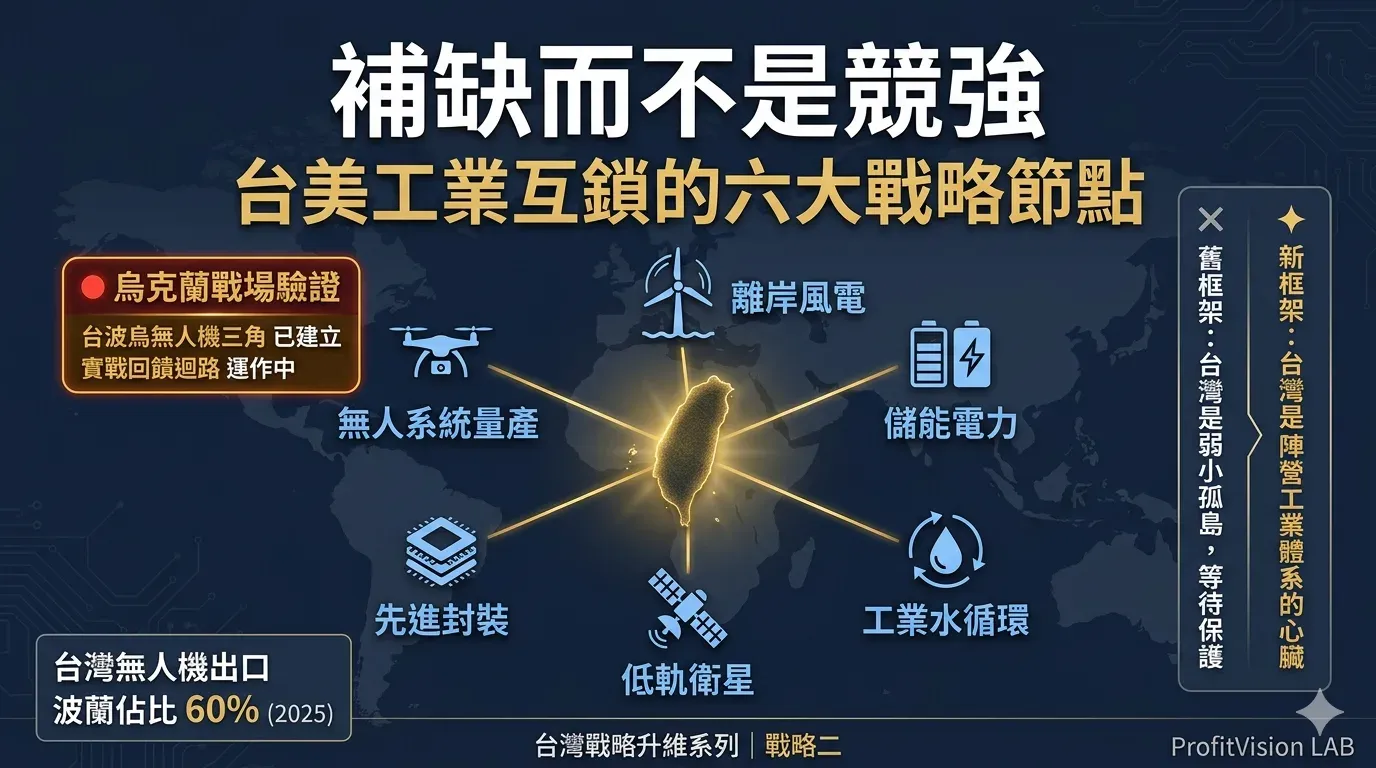
21st-century war isn't decided at the front line — it's decided in the supply chain. The Ukrainian battlefield has delivered the clearest lesson yet: sustained industrial output capacity is the decisive strategic advantage. Taiwan's position in this supply-chain war isn't passive waiting — it's actively establishing an irreplaceable industrial presence across seven critical nodes.
This report is Part 2 of the "Taiwan Strategic Ascension" series, building on the framework from Strategy 1 (decoding the NT$500 billion) with a deep dive into the concrete execution layer of Taiwan-US industrial interlocking.
Core thesis: the biggest mistake in Taiwan-US industrial cooperation is "fighting for strength instead of filling gaps" — trying to compete in areas where the US already holds an absolute advantage, rather than establishing Taiwan's irreplaceable position in the segments the US needs most but lacks most.
This report identifies six "industrial interlocking nodes" that Taiwan should prioritize, plus a strategic principle that runs through all of them: System Control matters more than financial return — whoever holds system control ultimately captures the best long-term financial return too. Each node is followed by an "Investor's Perspective" that translates the strategic logic into concrete Taiwan-stock investment pathways.
1. The Lesson from Ukraine: The Supply-Chain War Is the Real War
In February 2022, Russia believed it could take Kyiv within seventy-two hours. That judgment was based on Russia having more tanks, more aircraft, more soldiers.
Two years later, Russia still hadn't taken Kyiv. Not because Ukraine had more weapons than Russia, but because Ukraine's industrial resilience, combined with supply-chain support from Western allies, let Ukraine sustain continuous weapons consumption and resupply.
Lesson 1: Industrial drone production speed > the performance of any single drone
Ukraine produced more than 50,000 low-cost drones per month in 2024. Russia's air-defense systems couldn't consume them at an equal rate. Industrial mass-production capacity — not the technical performance of any single platform — decided this drone war.
Lesson 2: Starlink let dispersed forces fight in coordination
Low-earth-orbit satellites provided battlefield communications, letting Ukrainian forces maintain a connected command chain after Russia destroyed conventional communications infrastructure. The resilience of communications infrastructure is the most underrated decisive factor in modern warfare.
Lesson 3: Russia's precision-missile stockpile hit a structural shortage after 6 months
Russia's missile stockpile at the outset of the war depleted rapidly under high-intensity consumption. Russian industrial production speed fell far short of consumption speed, forcing Russia to turn to Iranian drones and North Korean artillery shells. Industrial resupply speed is the real long-term strategic advantage.
These three lessons point to the same conclusion: 21st-century warfare is no longer a comparison of "whose weapons are more advanced" — it's a competition of "whose industrial system can keep producing under extreme pressure."
This has fundamental implications for Taiwan. Taiwan's security strategy shouldn't only ask "how many weapons does Taiwan have" — it should ask: "How fast can Taiwan's industrial system resupply consumption, and under what conditions? Does Taiwan's supply chain have enough resilience to keep operating under external shock?"
2. Six Industrial Foundations of the Future Battlefield
Modern combat power no longer depends on the performance of a single weapons platform — it rests on six mutually reinforcing industrial foundations. ProfitVision LAB calls these six foundations "the infrastructure layer of modern warfare":
Compute foundation
Decision-making soul
Platform body
Operating bloodstream
Nervous system
Resilience limit
Taiwan's standing across these six foundations isn't equal. Taiwan holds a near-monopolistic position in semiconductors (①) and precision manufacturing (③); it holds a critical-node position in specialty materials science (⑥); and it is rapidly building new capabilities in energy (④) and communications (⑤).
The strategic design of Taiwan-US industrial interlocking is precisely to find, across this six-layer architecture, where Taiwan's and the US's respective strengths and gaps lie, and to build a division of labor based on complementarity rather than competition.
3. Taiwan-US Structural Complementarity — A Division of Labor Between Brain and Base
Taiwan and the US have a natural structural complementarity in their industrial systems — ProfitVision LAB calls this the "brain and base" division of labor:
This complementary relationship means the best model for Taiwan-US cooperation isn't "Taiwan does contract manufacturing for the US" — it's "Taiwan builds an irreplaceable technical presence in the segments the US lacks most, while using America's brain (algorithms, certification systems, capital markets) as a multiplier for Taiwan's technical capability."
This is a "military-grade version of the Fabless + Foundry division of labor" — the US is the design house (Fabless), Taiwan is the manufacturing floor (Foundry), but with a key difference: in this division of labor, Taiwan isn't merely a passive executor — it has established active standard-setting authority at key manufacturing nodes.
4. Six Industrial Interlocking Nodes — A Detailed Analysis
Based on the structural complementarity above, ProfitVision LAB identifies six industrial interlocking nodes Taiwan should prioritize. Each node's selection follows the three principles laid out in Strategy 1: fill gaps rather than fight for strength, prioritize dual civil-military use, and control the critical connection points.
The Ukrainian battlefield has already proven it: low-cost, mass-producible unmanned systems deliver more utility in modern warfare than expensive premium weapons platforms. A $400 drone can disable a $4 million tank. This "asymmetric mass-production logic" is reshaping the priorities of defense procurement worldwide.
America's strength lies in the "brain" of unmanned systems: Shield AI's autonomous decision system (V-BAT), Anduril's Lattice AI command-and-control platform, Saronic's autonomous navigation for unmanned surface vessels — these are world-leading autonomy technologies.
But America's gap is in the "base": low-cost, high-quality, rapidly scalable mass-production capability for unmanned-system hardware. America's precision-manufacturing cost structure means it cannot produce consumable unmanned systems at Ukraine-style scale and speed.
Taiwan's advantage at this node is all-encompassing: an ecosystem of precision electronics manufacturing (components, PCBs, electro-optics, communications modules), a fast-iteration engineering culture, and a mature network of SME suppliers. Taiwan can become the "local mass-production partner" for American unmanned-systems design companies — the US handles the algorithms and autonomous-control systems, Taiwan handles putting those systems into mass-producible hardware.
More importantly, Taiwan is the only place in the "non-China supply chain" capable of building this mass-production capacity in the near term. China holds an overwhelming advantage in the global unmanned-systems market (DJI), but within the US-led security alliance system, Taiwan is the only alternative to replace China.
These strategic nodes aren't just theory on paper — Taiwan's drone industry has already established the most valuable thing in the world on the Ukrainian battlefield: a real-world combat feedback loop.
Since 2025, Poland has surged to become Taiwan's largest drone buyer, absorbing about 60% of Taiwan's drone exports in the first eight months of 2025, worth $32 million — up from near zero in 2024. Going from zero to $32 million within a single year has stunned the market. Polish manufacturers (FlyFocus, WB Electronics, Farada) play a role that goes beyond buyer — they're also a "transit hub": Taiwan's drone components and finished units reach the Ukrainian front line via Poland.
This "Taiwan-Poland-Ukraine triangle" supply chain matters to Taiwan far beyond financial return: Taiwan's engineers are getting real-time feedback from the most authentic battlefield in the world — which motor fails first under electromagnetic interference? Which flight-control logic remains most stable under GPS-denial conditions? Which materials degrade fastest under high humidity? The answers to these questions can only be obtained on a real battlefield — no lab test can fully simulate them.
The structure of this loop: manufactured in Taiwan → transited through Poland → combat-tested on the Ukrainian front → battlefield data fed back to Taiwanese engineers → next-generation model improvements → shipped again. Each cycle brings Taiwan's drone technology closer to "combat-validated," letting Taiwan's R&D capability keep pace with the fastest-evolving real battlefield demands.
Taiwan's concrete actions are also moving fast: Thunder Tiger has obtained US military Blue UAS certification and has fully de-risked its flight controllers, motors, and key chips away from Chinese supply, while completing an AI vision-navigation system to overcome electromagnetic jamming; AIDC has built a plant in Arizona, expecting small-batch production by the end of 2026, bringing Taiwan-US defense-industrial cooperation onto US soil. The Ministry of National Defense is also releasing procurement tenders worth NT$50 billion for 48,750 units between 2026–2027, providing domestic order visibility that supports manufacturers' confidence to invest in capacity.
Significance for the US: what the US military needs most isn't just drone hardware, but a "non-China supply chain with a combat-validation track record." Taiwan is currently the only global drone source that simultaneously possesses "advanced ICT manufacturing capability" + "mutual trust within the democratic bloc" + "a real-world Ukrainian battlefield feedback loop" — this has already upgraded Taiwan's status in the US military's non-China supply-chain planning from "candidate" to "priority partner."
Taiwan's offshore-wind policy is usually framed by the media as "energy transition." ProfitVision LAB's read: offshore wind is the single most important policy tool for Taiwan to build "maritime industrial control capability."
Building and operating offshore wind farms requires accumulating capabilities such as: heavy marine manufacturing, subsea cable-laying and maintenance, long-term operations and maintenance (O&M) of offshore platforms, precision positioning technology for marine engineering, and construction and logistics capability in harsh sea conditions. The strategic applications of these capabilities extend far beyond power generation itself.
Every offshore wind farm built in the waters around Taiwan is a potential node in a maritime sensor network — one that could integrate underwater sonar, surface radar, and aerial sensors into a real-time intelligence network covering the Taiwan Strait and East China Sea.
The "maritime O&M capability" accumulated from operating these wind farms can be converted directly into logistics-support capability for offshore unmanned bases. Taiwan's wind-farm operators are, without quite realizing it, training a cohort of engineers and logistics personnel with long-term maritime O&M capability — strategically priceless.
America's interest: America's maritime sensing and surveillance capability in the Pacific needs forward nodes along the First Island Chain. As Taiwan's maritime industrial capability improves, it gives US-Taiwan maritime-intelligence-sharing cooperation a more substantive foundation.
The power demands of the modern battlefield are growing exponentially: unmanned systems need power, electronic-warfare equipment needs power, AI decision systems need power, communications nodes need power. A modernized front-line combat base now has power needs approaching that of a small town.
Under the framework of Distributed Operations — which the Ukrainian battlefield has validated as the mainstream mode of modern warfare — every dispersed combat unit needs independent energy resilience. Without energy resilience, distributed operations are just distributed vulnerability.
Taiwan's advantage in energy storage and power systems runs deep: Delta Electronics ranks among the global top three in power-conversion technology with over 30% market share; Taiwan has a distinctive technical track record in lithium-battery materials (cathode/anode materials, electrolytes); Techman Robot has real-world application cases in precision automated battery-module assembly.
Taiwan can pursue two directions simultaneously: first, domestic energy resilience — building Taiwan's own closed-loop capability in the event of an external energy-supply disruption; second, exporting energy-storage technology to the US — the US has enormous demand in grid modernization and front-line-base power resilience, and Taiwan's power equipment and systems-integration capability is a natural fit to fill this demand.
A single 12-inch fab at TSMC consumes roughly 150,000 tons of industrial water per day, a significant portion of which must reach "ultra-pure water" grade — several dozen times purer than distilled water. Any external disruption to the water supply, or any water-quality contamination, could force a fab to shut down.
This isn't a hypothetical risk. During central Taiwan's 2021 drought, TSMC's Taichung fab faced water-supply pressure and only kept operating through emergency reallocation. A deliberate attacker wouldn't need to destroy a fab — merely contaminating or disrupting the water supply could plunge Taiwan's semiconductor industry into crisis.
Taiwan's strategic goal is to build a "closed-loop industrial water-recycling system": municipal wastewater → industrial-water reclamation and treatment → ultra-pure water regeneration → fab use → wastewater recovery → recycle. Once this loop is established, Taiwan's semiconductor industry's dependence on external water sources could drop by 40–60%, significantly reducing vulnerability to any form of water-based attack.
Taiwan has the capability to develop this technology on its own, and to export it to any country wanting to build fabs in water-scarce regions (Arizona in the US being a textbook water-scarce environment). Water usage at TSMC's US fab is becoming a focal point of concern among US policymakers, and Taiwan's industrial water-recycling technology has clear commercial and strategic value in this context.
SpaceX's Starlink performance on the Ukrainian battlefield has completely transformed how militaries around the world assess low-earth-orbit satellites strategically. After Russia destroyed conventional communications infrastructure, Ukraine relied on Starlink to maintain front-line command communications. Starlink terminal equipment became one of the front line's most important strategic supplies.
This validation tells everyone: low-earth-orbit satellite communications has upgraded from "commercial convenience" to "strategic necessity." Any country without a seat in this system faces a severe information disadvantage in future conflicts.
Taiwan doesn't need to, and isn't capable of, building its own low-earth-orbit satellite system (SpaceX has thousands of satellites — Taiwan can't match that). But Taiwan can secure an irreplaceable position in this system's infrastructure layer:
Ground-station components: low-earth-orbit satellites require a dense network of ground stations, and Taiwan is globally competitive in manufacturing the relevant electronic components (RF modules, antenna arrays, server hardware).
Satellite hardware components: Taiwan's precision-manufacturing capability can enter the hardware supply chain of the satellites themselves — solar-panel controllers, propulsion-system electronics, communications modules. Global low-earth-orbit satellite deployment plans (SpaceX, Amazon Kuiper, Eutelsat) will need to launch tens of thousands of satellites over the next decade — a massive and continually growing procurement need.
Strategic significance: securing a seat in the low-earth-orbit satellite infrastructure layer ensures Taiwan has its own backup channel into the global information network, so Taiwan's information sovereignty doesn't depend entirely on the goodwill of any single country.
The US CHIPS Act has invested more than $40 billion in rebuilding domestic chip-manufacturing capability. But this plan has a rarely discussed structural blind spot: chip manufacturing is only part of the semiconductor supply chain — advanced packaging is the last mile that turns a silicon wafer into a usable product.
TSMC can manufacture chips in the US, but without advanced packaging capability nearby, those chips need to be shipped back to Taiwan for packaging, then shipped back to the US for use. This "transpacific round trip" is an unacceptable vulnerability in any scenario requiring supply-chain security.
Taiwan's advantage in advanced packaging is structural: ASE Technology Holding holds over 50% of the global packaging-and-testing market; TSMC's CoWoS (Chip on Wafer on Substrate) is the advanced-packaging technology most needed for AI chips today, and TSMC nearly monopolizes it; Siliconware Precision's Fan-Out packaging technology makes it a primary supplier to Apple and Qualcomm.
In the process of rebuilding its domestic semiconductor supply chain, advanced packaging is the segment America lacks most and Taiwan has the greatest advantage in. Taiwan building packaging capacity in the US isn't just a financial investment — it routes the last mile of America's semiconductor supply chain through a Taiwanese technology node, the purest expression of "controlling the critical connection point."
5. A Taiwan-Evolved Version of the Israel Model
Why does the Israel example matter so much? Not because Israel and Taiwan share similar geopolitical circumstances (though they do), but because Israel offers a validated, successful example of this strategic cycle.
Israel's core insight is: survival necessity is innovation's most powerful driver. Being surrounded on all sides forced Israel to maximize every dollar of R&D investment. This "innovation with no way back" gave rise to Check Point (firewalls), CyberArk (privileged-access security), and Mobileye (autonomous driving) — all classic examples of military R&D spilling over into commercial markets.
Taiwan's advantage: Taiwan has a far more robust industrial foundation than Israel — Taiwan's precision-manufacturing ecosystem is something Israel simply doesn't have. Israel is a "brain-type" small nation; Taiwan is a "brain + base" composite small nation. This means a Taiwan version of the Israel model can go broader and deeper.
Taiwan's industrial base runs thicker than Israel's. Israel's Check Point, CyberArk, and Mobileye are software and sensor companies that spun out of military R&D into commercial markets. Taiwan's spillover pathway is broader: Taiwan's precision-manufacturing ecosystem means the civil-military spillover doesn't happen only at the software layer — it happens across the entire hardware manufacturing chain, from materials to processing to assembly to testing. Every military-grade upgrade at each stage simultaneously raises the quality and reliability of civilian applications, forming an upward competitiveness spiral for Taiwan's manufacturing sector as a whole.
"Taiwan's version of the Israel model isn't just commercializing military R&D — it's militarizing the entire precision-manufacturing ecosystem, making Taiwan's industrial civilization itself the strongest form of deterrence." — ProfitVision LAB, Taiwan Strategic Ascension Series
6. System Control — A Strategic Asset More Important Than Financial Return
This chapter presents the report's core viewpoint, and also the concept hardest to capture within a conventional financial-analysis framework.
ProfitVision LAB's core thesis is: in positioning Taiwan-US industrial interlocking, System Control should take priority over short-term financial-return considerations — not because financial return doesn't matter, but because nodes that hold system control ultimately also capture the best long-term financial returns.
System Control refers to an industrial node's influence over the operation of the whole system, reflected in three dimensions:
① Unbypassability — the system cannot function properly without this node
② Standard-setting authority — this node's technical specifications become the standard that upstream and downstream players must adapt to
③ Knowledge gatekeeping — the technical knowledge required to enter this node takes long-term accumulation and cannot be quickly replicated
A node with system control naturally enjoys: high pricing power (because switching costs are extremely high), long order cycles (because re-qualifying a new supplier is enormously costly), and a persistent technology premium (because the knowledge gatekeeping keeps competitors perpetually behind).
Taiwan's positioning across the six nodes is, in essence, all about securing system control: advanced packaging is the connection point of the semiconductor supply chain; unmanned-systems mass production is the base of the US defense-industrial chain; offshore wind is an accumulation of maritime industrial capability; the low-earth-orbit satellite supply chain is the physical foundation of the information nervous system.
The financial return from these nodes may look unremarkable in the short term — long certification cycles, large upfront investment, and time needed to build up orders. But once system control is established, these nodes' pricing power and order visibility enter a trajectory far above ordinary manufacturing.
7. A Taiwan Version of the Supply-Chain War
Stringing these six nodes together, we see a complete "Taiwan supply-chain strategic map":
On land: precision manufacturing (unmanned-systems mass production, advanced packaging) + industrial water recycling (supporting semiconductor production)
At sea: offshore wind (accumulating maritime industrial capability) + low-earth-orbit satellite ground stations (information nodes)
In energy: energy storage and power resilience (supporting distributed operations) + industrial energy closed-loops
Together, these six nodes form Taiwan's "second line of defense" — not artillery and missiles (that's the first line), but making any adversary calculate, before attacking Taiwan, the consequences of destroying at a stroke Taiwan's irreplaceable position across six different types of global industrial systems.
This isn't something Taiwan is building alone — it's Taiwan, through industrial interlocking with the US, embedding its own irreplaceability into the world's most important industrial systems. And the depth of that embedding is the strength of the deterrence.
8. Three Execution Challenges for Taiwan's Version of Industrial Interlocking
ProfitVision LAB doesn't just present a strategic vision — it also confronts execution-level challenges honestly. Each of the six Taiwan-US industrial interlocking nodes has real obstacles that must be overcome in practice.
Challenge 1: Certification Cycles Too Long, Deterring Taiwanese Companies
Certification to enter the US defense supply chain (CMMC, ITAR, MIL-SPEC) is a long and expensive process. CMMC Level 2 certification requires a company to build a complete cybersecurity management system, coordinate with external audits, and the whole process typically takes 18–36 months, costing anywhere from a few million to tens of millions of NT dollars.
For Taiwan's small and medium enterprises (many precision-manufacturing hidden champions are SME-scale), this certification cost is a real barrier to entry. Taiwan's government and industry organizations (such as the Metal Industries Research & Development Centre and the Industrial Technology Research Institute) should establish a "certification subsidy and acceleration program" so Taiwanese companies with the potential to enter the US defense supply chain don't abandon this window of opportunity due to certification cost.
Challenge 2: Talent Gap — Training Military-Grade Engineers Takes Time
Mil-Aero Grade precision manufacturing requires engineers familiar with military-grade quality-management systems (AS9100, MIL-STD). Taiwan's current talent training in this direction lags far behind market demand. Companies like AIDC and Bao-i Technology, which have already entered the US military-grade supply chain, both report that cultivating engineers' military-grade quality awareness is one of the biggest challenges.
This challenge requires a long-term talent-cultivation program: incorporating military-grade quality-management modules into university and graduate-school curricula; companies partnering with military-certification bodies to provide on-the-job training; and government subsidy programs for technical exchange visits to US defense-industrial manufacturers.
Challenge 3: Geopolitical Uncertainty Makes Private Capital Conservative
Most Taiwan-US industrial-interlocking investments are long-cycle (taking 5–10 years to see their full strategic benefit). But long-cycle investment requires a certain confidence in the stability of the future political environment. Uncertainty over the Taiwan Strait situation applies a significant discount when private capital makes long-cycle positioning decisions.
This is precisely where the "credit guarantee pool" mechanism proposed in Strategy 1 matters most — government credit backing can absorb part of the discount private capital applies to geopolitical uncertainty, making private capital willing to participate in strategic positioning with a longer time horizon. Without this mechanism, relying on market forces alone, the pace of building out Taiwan-US industrial interlocking will fall far short of strategic needs.
9. 2026–2030: The Critical Five-Year Window
ProfitVision LAB believes 2026–2030 is the most critical time window for Taiwan-US industrial interlocking. Missing this window doesn't mean there will never be another opportunity, but the difficulty and cost of entry will rise significantly.
Three reasons:
First: the peak of major investment from the US CHIPS Act and defense-industrial restructuring falls within these five years — large government funds are flowing in, drawing private investment along with them, and the shape of the supply chain will largely be set within this window. Taiwanese companies that enter early get a seat in the "definition period"; those that enter late must accept specifications defined by others.
Second: the period during which unmanned-systems supply-chain standards remain undefined ends within these five years — the Ukrainian battlefield has accelerated global militaries' definition of unmanned-system procurement specifications. Once NATO standards and US military standards are set, the supply-chain landscape will solidify quickly. If Taiwan establishes a mass-production platform within this window, it becomes a direct participant in standard-setting; otherwise, it becomes a passive executor.
Third: the main deployment period for the low-earth-orbit satellite supply chain falls within these five years — the main satellite-launch plans for SpaceX Starlink Gen 2, Amazon Kuiper, and Eutelsat OneWeb are concentrated in 2026–2030. These five years are the peak period of demand for satellite hardware components, and the optimal window for Taiwanese precision manufacturers to enter this supply chain.
ProfitVision LAB's Window Assessment
2026–2030 isn't just a window of opportunity — it's a time-limited window of opportunity. Once the existing supply-chain landscape solidifies across the six Taiwan-US industrial interlocking nodes, the cost of entry for latecomers will rise multiplicatively.
What this means for investors: now is the best time to identify "window-period beneficiary stocks" — not after these companies' financial metrics fully reflect their strategic position, but right now, while their strategic position is still forming and their financial metrics haven't yet been fully priced.
10. From Supply-Chain Interlocking to a Security Community
Let me zoom the analysis out to the highest level, to explain clearly why these six industrial nodes, taken together, matter to Taiwan far more than their individual financial value.
Taiwan has long been described as a "vulnerable small island beset by crisis" — geopolitical tension, military threat, diplomatic isolation. This narrative leads many people to view Taiwan as "a problem waiting to be resolved" rather than "an actor actively shaping its own future."
The strategy of Taiwan-US industrial interlocking offers a fundamental narrative shift:
Taiwan is not a fragile small island in need of protection. Taiwan is a strategic actor that has actively chosen to embed its industrial capability deeply into the world's most important industrial systems. The irreplaceable position Taiwan has built across six industrial nodes is not merely defensive (raising the cost of attack) — it is also proactive (giving Taiwan a leading role in the evolution of the global industrial system).
The depth of this industrial presence will ultimately build a "security community" that transcends any bilateral treaty — not because some great power has promised to protect Taiwan, but because Taiwan and the core industrial systems of the democratic bloc have formed an organic interdependence, such that any attack on Taiwan is equivalent to an attack on the entire system.
Ukraine's story tells us: supply-chain resilience is a more reliable foundation of security than any diplomatic guarantee.
Taiwan's choice is to build this resilience proactively, rather than wait for someone else's protection.
This is Taiwan's most powerful answer.
This is the Taiwan version of the supply-chain war — not fighting a war, but building an industrial civilization that makes war not worth waging.
If Taiwan's industrial-interlocking strategy is successfully executed, by 2045 it will complete Taiwan's identity transformation from "a semiconductor island that needs protection" to "the indispensable heart of the democratic bloc's industrial system." This transformation won't happen overnight — it will be built step by step through sustained technology accumulation, certification upgrades, and supply-chain deepening across the six nodes.
For Taiwanese companies, this is a process of trading technical capability for long-term standing — not through scale, not through low cost, but through irreplaceable precision technical capability at key nodes, making any attempt to route around Taiwan in supply-chain restructuring more costly than maintaining cooperation with Taiwan. For investors, this is an opportunity to identify and hold beneficiary stocks before system control is fully formed — using the right framework to see valuation upside that others can't, while financial metrics have not yet fully reflected the strategic position. For Taiwan as a society, this is the most powerful strategic choice for converting Taiwan's industrial advantage into long-term security and prosperity — and the concrete execution path for Taiwan's historic leap from "passively awaiting protection" to "actively shaping the order."
Part 3 of the Taiwan Strategic Ascension series will take a deep dive into the "Third Silicon Shield," starting from the Israel model — as the defense industry develops along Israel's model, how can Taiwan convert security spending from a burden on the expense ledger into a long-compounding asset on the balance sheet?
ProfitVision LAB translates the six industrial-interlocking nodes into a concrete map of Taiwan-stock investment targets. This isn't a stock recommendation — it's a supply-chain positioning analysis identifying which Taiwanese companies are, or will be, building system control at these six nodes.
Before getting into specific targets, one conceptual premise needs to be established: the investment logic for industrial-interlocking beneficiary stocks fundamentally differs from that of ordinary growth stocks. An ordinary growth stock's valuation is driven primarily by its projected three-year EPS growth rate. An industrial-interlocking beneficiary stock's valuation is driven primarily by "the speed at which system control is forming" — a metric that almost never appears on a financial statement and must be assessed indirectly by tracking certification progress, contract types, and depth of customer penetration. This is precisely why most market participants systematically underprice this category of stock — and precisely where the opportunity to identify alpha lies.
1. Mapping the Six Nodes to Taiwan-Stock Supply Chains
| Node | Beneficiary Category | Representative Companies | System-Control Indicator |
|---|---|---|---|
| Unmanned-systems mass production | Dual civil-military precision manufacturing | AIDC, Thunder Tiger, Ichia Technologies | CMMC certification progress, share of US defense orders |
| Offshore wind / maritime industry | Marine engineering and energy equipment | CSBC Corporation, Century Iron & Steel, CS Wind | Depth of accumulated maritime industrial capability, tenor of government BOT contracts |
| Energy storage / power resilience | Power equipment and energy storage | Delta Electronics, China-American Hydraulics, Shihlin Electric | Scale of US grid contracts, military power-system certification |
| Industrial water recycling | Industrial water treatment | Taiwan Hitachi, Boschung (water-treatment equipment) | Grade of ultra-pure water technology, penetration among semiconductor-fab customers |
| Low-earth-orbit satellite supply chain | Satellite components and networking | Accton Technology, Wistron NeWeb, related RF-component makers | SpaceX/Kuiper supplier certification, share of satellite-component shipments |
| Advanced packaging / heterogeneous integration | Packaging & testing leaders | ASE Technology Holding, Siliconware Precision, King Yuan Electronics | CoWoS capacity allocation, progress of US fab construction |
2. CMMC Certification Progress Is the Most Important Non-Financial Indicator
Among these six nodes, those that enter the US defense supply chain (unmanned systems, defense applications of advanced packaging) all require passing CMMC (Cybersecurity Maturity Model Certification). This certification is almost never mentioned in Taiwanese companies' financial reports or earnings calls, but it's the most important leading indicator for judging whether "system control is forming."
ProfitVision LAB recommends investors add "CMMC certification progress" to their research checklist. Any Taiwanese company announcing it has passed CMMC Level 2 certification should be read as an important valuation-upgrade trigger event — it means the company has formally crossed the threshold into an "irreplaceable node," and its order visibility and customer stickiness enter an entirely different trajectory from that point on.
3. Offshore Wind's "Delayed Manifestation" Investment Logic
The offshore-wind node has a distinctive investment logic: the accumulation of maritime industrial capability shows up on financial statements with a delay — capability invested today may not fully show up in orders and gross margin for another three to five years.
This often leaves offshore-wind-related Taiwan stocks in an awkward spot on most investors' radar — "looks overvalued right now, and the future payoff is too far away." But from ProfitVision LAB's system-control framework, this "delayed manifestation" is itself the opportunity — because the market prices the present, but system control takes time to form, and when the accumulated capability crosses a critical threshold, financial performance can suddenly accelerate, right around when the market is just beginning to understand it.
4. Common Traits of "Industrial-Interlocking" Beneficiary Stocks
Beneficiary stocks across the six nodes share several common financial traits worth watching for when screening:
Gross-margin trend matters more than the absolute level: in the early stage of entering a strategic node, these companies' gross margins may be compressed by high upfront investment costs, but the trend keeps improving. Watch the direction of gross margin, not the current number.
Order visibility spans multiple fiscal years: Taiwanese companies that enter the US defense supply chain or long-term infrastructure contracts typically have order visibility spanning multiple fiscal years. This can be confirmed in the "order visibility" section of earnings calls, and it's a more important long-term investment indicator than EPS.
Capex accelerates while ROE holds up: entering a new strategic node requires substantial capital expenditure (plant construction, certification, talent). But if ROE stays above 15% during a period of accelerating capex, it signals the company has enough pricing power to cover its investment — the most direct financial evidence of moat depth.
This report builds an analytical framework for the "supply-chain war" starting from the lessons of the Ukrainian battlefield, and identifies Taiwan's irreplaceable position across six industrial interlocking nodes. Core position: Taiwan's security is ultimately grounded in the irreplaceability of its industrial systems, not merely the number of weapons it holds.
The next installment in the Taiwan Strategic Ascension series (Strategy 3) will focus on the most controversial and most misunderstood topic: the "Third Silicon Shield" — as the defense industry develops along the Israel model, how can Taiwan's security spending shift from "expense" to "long-term compounding asset," and what does this concretely mean for Taiwan stocks?
© 2026 ProfitVision LAB · Shiba the Disciplined · Think with me, not just trade with me.
Data sources: public intelligence from the Ukrainian battlefield, SpaceX public disclosures, official documents from the US CMMC certification framework, company financial reports, and public research reports.