Sovereign Fund × Sovereign AI: Taiwan Capital's Next Move
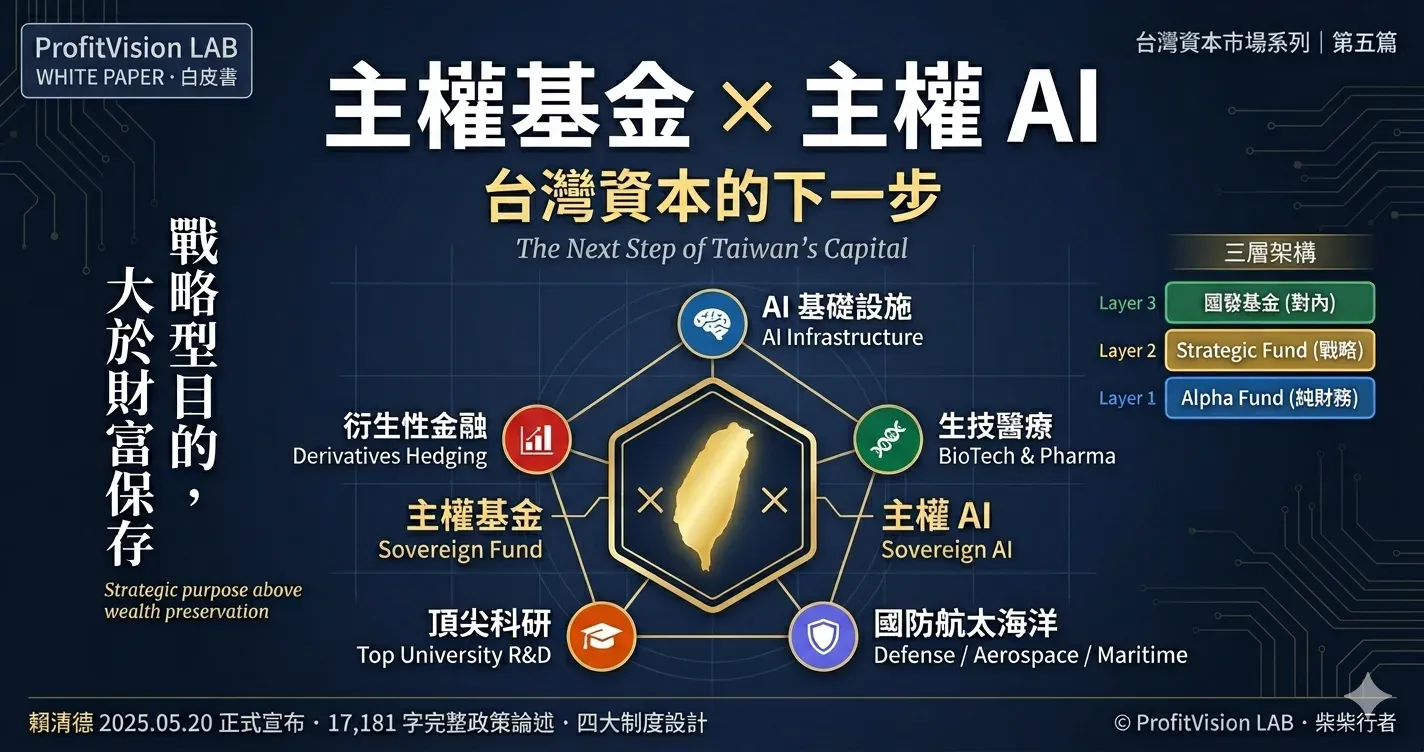
On May 20, 2025, President Lai Ching-te formally announced the creation of a sovereign wealth fund, opening a new chapter in Taiwan's capital strategy. This white paper lays out the full picture: a dual-track framework of an outward-facing sovereign fund and an inward-facing National Development Fund, a four-layer logic for leveraging diplomacy, five strategic investment directions (AI infrastructure, biotech and healthcare, defense/aerospace/maritime, top-university research, and derivatives-based hedging and income generation), and a self-sustaining engine design that lets the fund generate its own returns. Strategic purpose matters more than wealth preservation — and when the strategy succeeds, industrial opportunity and wealth follow naturally.
Norway turned its oil wealth into a $1.9 trillion future fund. Singapore turned city-state capital into global influence. Taiwan holds $570 billion in foreign reserves, the world's most critical AI supply chain, and a newly announced sovereign fund plan. What happens next depends on how Taiwanese people choose to see this moment.
On May 20, 2025, President Lai Ching-te formally announced that Taiwan will establish a sovereign wealth fund. This is not merely a fiscal-policy statement — it is a historic opportunity for Taiwan, as the core nation of the global AI supply chain, to convert its technological edge into lasting capital influence. This article proposes a complete framework: how Taiwan's sovereign fund should be designed, where its capital should come from, how its overseas investments should be chosen, and how its profits should flow back into Taiwan's infrastructure, R&D, national health insurance and social welfare, and childcare environment — so that Taiwan's wealth truly works for its future generations.
In his one-year-in-office address, President Lai Ching-te formally announced that Taiwan will establish a sovereign wealth fund — a national-level investment platform to invest in the AI era.
National Development Council Deputy Minister Kao Sian-kuei identified three funding channels: foreign reserves (borrowing the GIC model, deployed on a repayable basis), fiscal surplus, and bond issuance. Central Bank Governor Yang Chin-long expressed support for establishing the fund, but insisted that foreign reserves be used on a repayable basis to safeguard monetary-policy independence, and that dedicated legislation be enacted first.
This announcement turns this article from "advocacy" into "analytical support" — Taiwan's direction is now set; the question is how to execute it better.
1. One Question, One Comparison
Norway is a small country of 5.4 million people, with GDP of roughly $550 billion — somewhat larger than Taiwan's.
In 1969, Norway discovered oil in the North Sea.
Had Norway chosen to spend all of its oil revenue — subsidizing domestic consumption, keeping taxes low, and making life better for the current generation — today's Norway would, at best, be a Nordic country that once had oil income, fading back into ordinariness once the fields ran dry.
Instead, Norway made a different choice: channel all oil-related surpluses into a sovereign fund that invests exclusively in overseas assets, permit only 3% of expected returns to be drawn each year for fiscal spending, and never touch the principal.
Today, the Government Pension Fund Global (GPFG) holds $1.9 trillion in assets — the largest sovereign fund in the world — owning roughly 1.5% of all publicly listed companies globally. Every Norwegian, on average, holds a share of the fund worth more than $320,000.
A small nation of 5.4 million people, through a rigorously disciplined long-term investment framework, converted a non-renewable oil windfall into a perpetual-motion machine capable of creating wealth for unlimited generations.
Taiwan's question now is: does Taiwan have its own "oil"?
The answer is: yes — and it is harder to replace, and more durable, than Norway's oil.
Taiwan's "oil" is its technological edge in the AI supply chain.
2. Taiwan's Oil Will Not Run Dry
Norway's oil will eventually run out — that was one of the original motivations for building a sovereign fund: convert wealth into a permanent financial asset before the resource is exhausted.
Taiwan's situation is different, and better:
Taiwan's technological edge will not run dry. It deepens with every new generation of engineers, every process iteration, and every clustering effect of new industries. TSMC had a technology moat in 2000, a technology moat in 2010, and an even deeper moat in 2026 — and the pace at which that moat deepens outstrips the pace at which any competitor can catch up.
In other words: Taiwan does not need to race against resource depletion to justify a sovereign fund. The rationale for Taiwan's sovereign fund is to convert a technological edge that continually generates excess returns into long-term capital that can be invested in the future.
4th largest globally, top-tier on a per-capita basis
#1 globally, from just 5.4 million people
~NT$2 trillion
a stable funding base
share of total fiscal revenue
1 in every 5 dollars of government revenue comes from the sovereign funds
3. Three Reference Models: Norway, Singapore, South Korea
Taiwan doesn't need to figure this out from scratch — three of the closest global reference models to Taiwan's own conditions already exist.
From these three reference models, one important conclusion emerges: Taiwan more closely resembles Singapore's model than Norway's.
Norway's sovereign fund is a purely "savings-type" vehicle — preserving oil wealth through purely passive global diversification while avoiding any impact on Norway's own economy. Singapore's GIC and Temasek are closer to "strategic-type" vehicles — combining long-term wealth management with active investment in emerging technologies that advance Singapore's own strategic interests.
Taiwan has an advantage that Norway lacks entirely and Singapore doesn't fully possess either: Taiwan itself sits at the core of the AI supply chain, giving its sovereign fund an information edge in judging technology investments that no other sovereign fund can match.
4. Sovereign AI — Taiwan's Second Card
Before discussing the investment directions of Taiwan's sovereign fund, one larger concept needs to be clarified first: Sovereign AI.
Sovereign AI is a concept that has emerged in recent global policy discussions — it refers to a nation's ability to control its own AI infrastructure (compute, data, models, talent) without depending on a single foreign tech company, preserving digital sovereignty in the AI era.
Taiwan holds a unique dual role in this concept:
This means: Taiwan is the one unavoidable supplier behind every sovereign AI plan on Earth. That position should be converted into strategic capital advantage, not merely manufacturing revenue.
Taiwan's sovereign fund can be the core capital vehicle for building Taiwan's own sovereign AI capacity — investing in domestic AI startups, building a national AI compute reserve, and training the next generation of AI engineers.
Sovereign fund plus sovereign AI is a mutually reinforcing combination: the sovereign fund's investment returns provide long-term capital for building sovereign AI; and improved sovereign AI capability, in turn, gives the sovereign fund deeper insight when judging AI-related investments.
5. Designing the Sovereign Fund's Capital Loop — and Its Dual-Track Framework with the National Development Fund
A well-designed sovereign fund is not just about "taking money, investing it, and making more money." It should form a capital loop that benefits multiple layers of Taiwanese society simultaneously. Below is the design framework I propose:
Sovereign Fund vs. National Development Fund — Two Complementary Pieces of Taiwan's Capital Puzzle, Outward and Inward
When it comes to the sovereign fund, one question keeps coming up in Taiwan: "We already have the National Development Fund — why do we need a sovereign fund too?" Unless this question is clearly answered, every subsequent discussion loses focus.
On May 20, 2025, in his one-year-in-office address, President Lai Ching-te put it in a single sentence: "Externally, establish a sovereign fund; internally, upgrade the function of the National Development Fund." These are not two competing funds — they form a dual-track capital framework of "outward sovereign fund × inward National Development Fund" — each clearly positioned, functionally complementary, together forming two pieces of Taiwan's capital-strategy puzzle.
ProfitVision LAB presents the differences between the two funds across five key dimensions below:
| Dimension | Sovereign Fund (Outward) | National Development Fund (Inward) |
|---|---|---|
| Mission direction | Invest abroad in international markets and key AI-era target markets | Support domestic industry innovation and transformation |
| Investment targets | Overseas AI infrastructure, allied-nation strategic industries, international supply-chain nodes | Domestic startups, SMEs, critical technologies, industrial reinvention |
| Fund size | Referencing Norway/Singapore models, expanding to hundreds of billions of dollars over the long term | Currently around NT$200+ billion, function currently being upgraded |
| Strategic purpose | Diplomatic leverage × technology sovereignty × long-term capital returns | Industrial reinvention × domestic employment × local innovation ecosystem |
| Success metrics | Depth of international influence, efficiency of capital repatriation, number of allied-nation ties | Startup valuation growth, commercialization of domestic technology, industry-upgrade case studies |
Why Does Taiwan Need Two Pieces, Not One?
Because these two puzzle pieces answer two fundamentally different questions.
The National Development Fund answers: "How does Taiwan's domestic industry move up the value chain?" — this requires patient, long-term capital, deep understanding of the local startup ecosystem, and the risk-absorption capacity to tolerate the high failure rate of domestic startups. Over the past thirty years the National Development Fund has supported early-stage TSMC, UMC, and the biotech industry — no other institution can replace this inward-facing role. Lai Ching-te defined this role as "industrial reinvention" — not merely subsidies, but evolving the National Development Fund into a strategic catalyst for Taiwan's domestic innovation ecosystem.
The sovereign fund answers: "How does Taiwan secure a strategic position in the global order of the AI era?" — this requires an entirely different set of capabilities: international capital operations, cross-border investment decisions, diplomatic sensitivity, and strategic vision over global AI infrastructure. This is a role the National Development Fund's organizational DNA cannot bear — it must be carried out by a new institutional platform.
Forcing both missions onto a single fund means neither is done well — either domestic support gets diluted, or overseas investment gets hijacked by domestic political pressure. Designing an "outward × inward" dual-track architecture is the most rational governance design for Taiwan's capital strategy.
A Virtuous Cycle Between the Two Tracks
More importantly, the two funds are not siloed from each other — they can form a mutually reinforcing virtuous cycle:
The sovereign fund invests in overseas AI infrastructure, gaining equity stakes and technology partnerships; those technology ties flow back into Taiwan, and the National Development Fund can use these international connections as a base to help domestic startups keep pace with the global AI wave. Conversely, the domestic technology capability the National Development Fund cultivates gives the sovereign fund stronger negotiating leverage when investing abroad — "Taiwan isn't just bringing money, Taiwan can bring technical capability too."
This is exactly why "outward" and "inward" should not be zero-sum, but rather mutually multiplicative. The sovereign fund gives the National Development Fund's domestic support an international stage; the National Development Fund gives the sovereign fund's overseas investments a domestic technology foundation. Without either one, the other's effect is greatly diminished.
ProfitVision LAB Key Insight
On May 20, 2025, Lai Ching-te formally announced the establishment of a sovereign fund, currently led by the National Development Council in coordination with the central bank and Ministry of Finance, with dedicated legislation to follow. This is the first time any Taiwanese president has explicitly made a sovereign fund a formal national policy — a historic turning point in Taiwan's capital strategy shifting from a "defensive posture" to an "expansionary posture."
Once the dual-track framework is legislated, Taiwan's capital map will upgrade from "single-point support via the National Development Fund" to a dual-engine architecture of "outward sovereign fund × inward National Development Fund" — a national-level capital-institution restructuring not seen in twenty years.
6. Reinvesting in Taiwan — Making Wealth Work for the Next Generation
The ultimate purpose of a sovereign fund is not to add another number to the government's books, but to give Taiwan's next generation a better place to live.
Below are four priority directions for reinvestment:
Sovereign-fund research investment can fill the gap that private enterprise R&D leaves open — long-cycle, high-risk, frontier research with no near-term commercial prospects is exactly the kind of area enterprises can't shoulder but nations must invest in. Israel's Yozma Program is the best reference: state capital seeded private venture capital and gave rise to Israel's tech-startup ecosystem.
Sovereign-fund returns are the most natural supplementary funding source for the long-term stability of NHI finances. This isn't a short-sighted subsidy — it's using Taiwan's technological wealth to safeguard Taiwan's social wealth, so that every Taiwanese, rich or poor, can continue to enjoy world-class healthcare.
Sovereign-fund returns can fund, at scale: generous birth subsidies, universal public childcare, family-friendly workplace policies, and measures to bring housing prices into a reasonable range. This is not short-term vote-getting — it is a long-term investment in Taiwan's talent supply, because Taiwan's technological edge ultimately needs people to carry it forward.
These infrastructure investments don't only serve Taiwan's AI industry — they directly raise the quality of life for Taiwanese people. Stable power, fast networks, convenient transportation — these are prerequisites for Taiwan to remain attractive to top global talent.
7. The Hardest Obstacle to Overcome — Political Independence and Responding to Objections
The greatest risk to Taiwan's sovereign fund isn't market risk — it's political risk.
Taiwan's democratic system is one of its most precious assets, but it also creates a fundamental governance challenge for a sovereign fund: when election pressure exists, politicians have strong incentives to interfere with the fund's investment decisions — to make it "prop up the Taiwan stock market," "invest in industries tied to voter interests," or "announce flashy returns right before an election."
Norway's solution is to make the entire system "dumb" enough to resist political temptation: the 3% fiscal rule, overseas-only investment (avoiding any impact on domestic asset prices), a strict ESG exclusion list, and fully public, transparent disclosure of holdings — these rules leave no room for any politician to manipulate the fund.
Singapore's solution is to let Temasek operate independently under company law, with the Minister of Finance as the sole shareholder who does not interfere in management, while the fund submits to top ratings from Moody's and S&P, letting the market serve as the oversight mechanism.
What Taiwan needs is a hybrid solution combining both models:
| Design Element | Specific Approach | Purpose |
|---|---|---|
| Legal independence | Enact dedicated legislation so the fund is not bound by the Budget Act or the State-Owned Enterprise Management Act | Give the fund sufficient operational flexibility and a long-term horizon |
| Governance independence | More than half of board members are independent professionals with terms spanning election cycles | Prevent changes of ruling party from disrupting investment strategy continuity |
| Disbursement rule | Modeled on Norway's 3% fiscal rule, an annual cap on disbursement set as a fixed share of expected long-term returns | Ensure the principal keeps accumulating rather than being drained by short-term political demands |
| Investment transparency | Publish full holdings details annually (following Norway's GPFG), and submit to external credit ratings | Let the market and citizens serve as the most effective oversight mechanism |
| Conflict-of-interest avoidance | Explicitly prohibit investment in enterprises directly tied to Taiwan government procurement or subsidies | Prevent the fund from becoming a tool for the government to subsidize favored industries |
Directly Addressing the Objections
The debate over Taiwan's sovereign fund has run for years, and the objections are genuine and deserve a direct response:
Taiwan's Sovereign-AI Strategic Positioning
Let me make the "overseas investment" component of the sovereign fund more concrete. To generate maximum strategic value, part of Taiwan's sovereign fund should be allocated toward a direction no other sovereign fund can pursue but Taiwan can: strategic equity investment across the AI supply chain.
When Taiwan's sovereign fund invests in a US AI chip-design startup, it isn't merely a financial investment — it is positioning for Taiwan manufacturing's future customers. Investing in a Southeast Asian AI application company isn't merely diversification — it is building a sales channel for Taiwan's AI hardware in emerging markets. Investing in a European semiconductor equipment maker isn't merely portfolio diversification — it is reducing Taiwan manufacturing's dependence risk on specific equipment suppliers.
This "strategic investment" logic resembles Temasek's early investments in Singapore Telecom, Singapore Airlines, and DBS Bank — looking not only at financial returns but at the contribution to Singapore's overall strategic interests. Taiwan's sovereign fund can apply the same logic to systematically position itself at key nodes across the global AI supply chain.
Taiwan's Sovereign Fund's Unique Advantage: An Information Edge in the AI Supply Chain
The world's largest sovereign fund — Norway's GPFG — judges its TSMC investment based on public financial statements and research reports. Taiwan's sovereign fund, when investing in AI supply-chain-related targets, has the industrial insight of Taiwan's entire semiconductor ecosystem behind it.
Which US AI chip-design startup's technology roadmap is more likely to reach mass production? Which packaging technology could become mainstream in three years? Which thermal-solutions company's technology pipeline is most likely to enter Nvidia's next-generation systems?
Taiwan's engineers and industry professionals can answer these questions better than any outside investment institution. Converting that judgment capability into an investment edge for the sovereign fund is the core differentiator of Taiwan's fund relative to every other sovereign fund.
Norway sells oil to make money and reinvests it in the world. Taiwan makes money from technology, then uses its technological judgment to invest in the most important tech opportunities.
8. Leveraging Diplomacy — The Four-Layer Logic of Sovereign Fund × Sovereign AI
Return to the original text of Lai Ching-te's May 20, 2025 address: "Led by the government, in coordination with private enterprise, positioning globally to connect with the AI era's key target markets."
The key word in that sentence isn't "sovereign fund" — it's "connect." The true strategic significance of the sovereign fund and sovereign AI lies not in financial returns, but in how they let Taiwan actively "connect" with the global order through capital and technology — this is precisely the most underrated, most leveraged tool Taiwan has on the diplomatic stage.
ProfitVision LAB breaks this "leveraging" logic down into four layers, from surface to depth:
Layer 1: Investment as Diplomacy — Building a Shared Community of Interest
When Taiwan's sovereign fund invests in another country's AI infrastructure, semiconductor startups, or critical energy facilities, Taiwan is upgraded from an "external buyer" to a "local shareholder." Shareholder status brings regular information rights, a board seat or observer seat, and real influence over commercial decisions. This creates a deeper structural connection than any embassy, representative office, or courtesy diplomatic visit ever could. The invested country's relevant industries, government ministries, and legislators will engage with Taiwan continuously through routine business — and these interactions themselves become a stable, long-term diplomatic foundation.
Layer 2: Breaking Through Diplomatic-Recognition Limits — Building Substantive Ties with Non-Allied Nations
Taiwan currently has only 12 formal diplomatic allies, but maintains substantive relationships with more than 170 non-allied countries. Under the traditional diplomatic model, these substantive relationships lack institutionalized depth. A sovereign fund provides an entirely new tool — equity relationships exist naturally, without requiring diplomatic recognition. When Taiwan's sovereign fund holds equity in a major industry in a non-allied country, a substantive connection forms between the two countries that transcends formal diplomatic status. That connection is immune to pressure from Beijing, because commercial equity is a legally protected property right. Vietnam, India, Indonesia, Saudi Arabia, Malaysia, Mexico — countries without diplomatic relations with Taiwan but of strategic importance — could all form bilateral relationships more substantive than formal diplomacy, through sovereign-fund investment.
Layer 3: CPTPP Accession Leverage — Using Capital to Break Through Political Barriers
The biggest obstacle to Taiwan joining the CPTPP (Comprehensive and Progressive Agreement for Trans-Pacific Partnership) isn't that Taiwan fails to meet the economic criteria — it's political pressure from China on member states. But if Taiwan's sovereign fund holds substantive equity investments across multiple CPTPP member states (Japan, Vietnam, Malaysia, Mexico, Canada, Chile), those member states, when voting to support Taiwan's accession, would no longer merely be "supporting Taiwan" — they would be "protecting their own shareholder interests." Investment creates self-interest for the invested country — this is the diplomatic tool most capable of cutting through political pressure. CPTPP is just one example — the same logic applies to any regional economic bloc beyond RCEP, and to any bilateral trade-agreement negotiation.
Layer 4: Every Sovereign-AI Program in the World Needs Taiwan's Chips — From Passive Supplier to Active Investment Partner
This is Taiwan's most unique and most underrated strategic lever. More than 40 countries have already announced sovereign AI programs — India, Saudi Arabia, the UAE, Singapore, South Korea, Germany, France, the UK, Brazil, Japan — and every single one of these sovereign AI programs fundamentally requires large volumes of Nvidia-class AI chips, nearly all of which are manufactured at TSMC. Taiwan is the common point of need for every sovereign AI program on Earth. Under the traditional model, Taiwan is a passive supplier — taking orders, manufacturing, shipping, collecting payment. But if Taiwan's sovereign fund actively invests in these countries' AI infrastructure, the relationship shifts from "I sell you chips" to "I am a shareholder and partner in your AI future." Every invested country's dependence on Taiwan extends from "chip procurement" to "shared AI development community" — this is the most effective path for converting technological influence into political influence.
Why This Is the Concrete Path to the Ultimate 2045 Strategy
This four-layer logic is not an abstract theoretical framework — it is the concrete execution tool for the "shared prosperity among allies" vision described in the finale of the "Strategic Ascension" series.
Part four of the Strategic Ascension series proposed three diplomatic tools: "cross-shareholding, technology interlocking, and mutual standards recognition." The combination of sovereign fund and sovereign AI is the concrete realization of the "cross-shareholding" layer. When Taiwan's sovereign fund holds strategic equity in AI infrastructure across 20-plus countries, becomes a semiconductor manufacturing joint-venture partner in 5-plus countries, and co-invests in AI startups across 10-plus democratic-bloc countries — this equity network itself becomes the most reliable foundation for Taiwan's long-term security.
This is more reliable than any count of diplomatic allies, any military alliance commitment, any diplomatic relationship. Because: diplomatic ties can be severed, commitments can change, but when you are a major shareholder in another country's critical industry, that relationship cannot easily be cut off by either side — because cutting it off means both sides hurt themselves.
A Concrete Scenario: Taiwan in 2030
Let's concretely imagine what Taiwan would look like in 2030 if this four-layer logic is successfully executed between 2026 and 2030:
Taiwan's sovereign fund holds 5–10% stakes in multiple AI-infrastructure companies in India. India's AI development each year involves direct participation from Taiwanese shareholders. When handling border issues with China, the Indian government cannot ignore the fact that "Taiwan is a major shareholder in India's AI industry."
Taiwan's sovereign fund co-establishes a "Middle East AI Infrastructure Fund" with Saudi Arabia's Public Investment Fund (PIF), jointly investing in AI compute centers across the Middle East. The Taiwan–Saudi relationship is upgraded from "Taiwan sells chips to the Middle East" to "Taiwan and Saudi Arabia jointly developing the Middle East AI market." Saudi Arabia's positions on Taiwan at the UN and within the OIC (Organisation of Islamic Cooperation) become friendlier, driven by this deep economic relationship.
Taiwan's sovereign fund holds strategic equity in a laser-defense startup in Lithuania, a drone-systems manufacturer in Poland, and a precision-manufacturing plant in the Czech Republic. Political support from Eastern Europe is no longer merely an ideological stance of "democracy versus authoritarianism" — it becomes a substantive relationship of "protecting our shared commercial interests."
None of this is fantasy — this is what Japan, Singapore, Norway, and Saudi Arabia's sovereign funds are already doing. The only difference is: this time, it's Taiwan's version.
President Lai Ching-te's formal announcement of the sovereign fund on May 20, 2025 marks a truly strategic leap in Taiwan's capital institutions. What matters most isn't the phrase "outward investment" itself, but the fact that the sovereign fund opens an entirely new diplomatic toolbox — letting Taiwan, for the first time, use equity and capital to systematically expand its substantive influence over the global order.
The combination of sovereign fund and sovereign AI means Taiwan is no longer merely a chip supplier in the global AI era — it becomes a shareholder in AI infrastructure, a partner to allied nations, and a participant in setting global rules. This is the ultimate meaning of upgrading Taiwan's capital strategy.
A Citizen's Case
This series has, from its first installment until now, been talking about Taiwan's capital markets, Taiwan's hidden champions, and Taiwan's sovereign fund. Let me close by stating my case in the most direct language possible.
Singapore's Lesson: How a Sovereign Fund Becomes a Multiplier of National Competitiveness
Singapore's case is the reference model most worth studying deeply for Taiwan, because Singapore and Taiwan share so much in common: small nation, highly export-oriented economy, lack of natural resources, technology and talent as core competitiveness, and a democratic (or quasi-democratic) political system.
Singapore's sovereign funds aren't merely "taking money and investing it to make more money" — they are a core component of Singapore's national competitiveness strategy. In 2025, the net investment return contribution from Singapore's sovereign funds (GIC + Temasek) reached S$27.1 billion, or 18.5% of total fiscal revenue — one in every five dollars of government revenue comes from sovereign-fund investment returns. This ratio lets the Singapore government maintain high-quality public services, low tax rates, and large-scale R&D investment even without raising taxes.
More importantly, Temasek's investment strategy is "strategic": it holds Singapore Airlines, DBS Bank, and Singapore Telecom not simply because they're good financial investments, but because these enterprises are important vehicles for Singapore's external competitiveness. Temasek's capital gives these enterprises the confidence to pursue long-term internationalization, rather than being swayed by short-term shareholder pressure.
What Taiwan can learn: a sovereign fund isn't merely an "investment institution" — it can become the long-term capital backstop for Taiwan's key strategic industries. When Taiwan's hidden champions face pressure to be acquired by foreign capital, the sovereign fund can step in as a domestic strategic shareholder, ensuring these critical technology assets remain in Taiwan.
The Most Important Lesson from Norway: A Letter to Future Generations
Norway's sovereign fund has a core concept in its public messaging that translates roughly as: "We are the trustees managing this wealth on behalf of future generations."
This framing fundamentally changes the behavioral logic of the fund's managers. They are not accountable to the current government's election pressures, nor to short-term return league tables — they are accountable to Norwegians not yet born, the Norwegians who will inherit this fund fifty years from now.
This concept of the "cross-generational trustee" is the core spirit Taiwan most needs to internalize when designing its sovereign fund. If Taiwan's sovereign fund is positioned from day one as "a trustee institution managing wealth for Taiwan's next generation" rather than "just another government investment account," its governance structure, investment decisions, and transparency requirements will naturally move in a better direction.
Taiwan's technological wealth — TSMC's moat, the market share of its hidden champions, the irreplaceability of the AI supply chain — was built over decades by this generation of Taiwanese engineers and entrepreneurs. The next generation of Taiwanese has a responsibility to inherit it, and a responsibility to keep growing it after inheriting it.
The sovereign fund is the most powerful institutional tool for this process of "inheritance and stewardship."
9. What Norway's $320,000 Per Capita Tells Us — A Taiwan Version of the Math
Let me run a rough but illustrative calculation.
Norway's population is 5.4 million, its sovereign fund is worth $1.9 trillion, giving roughly $320,000 per capita. It took Norway about thirty years, from its first disbursement in 1996 to today's scale.
If Taiwan started in 2026 with $30 billion (roughly 5% of its foreign reserves), assuming a long-term annualized return of 8% (between Norway GPFG's 6.3% and Singapore GIC's 9.4%), the fund's size after thirty years would be approximately:
(USD, 2026)
(midpoint of Norway's 6.3% and Singapore's 9.4%)
(USD, excluding additional contributions)
(based on a population of 23 million)
If additional contributions continue each year (tax surpluses, trade surpluses, etc.), the actual size would be far higher.
A $302 billion fund, under the 3% disbursement rule, could distribute roughly $9 billion (about NT$270 billion) per year for public-interest investment in Taiwan. That amount is more than double Taiwan's entire 2025 education budget, or roughly 70% of annual National Health Insurance spending.
This isn't fantasy — it's the arithmetic of compounding. Norway did this math thirty years ago, and then executed it faithfully for thirty years.
Taiwan now stands at the same decision point.
10. Concrete Recommendations for Taiwan's Policymakers and Investors
This article isn't only for general readers — it's also for anyone who might have a hand in legislating and designing Taiwan's sovereign fund. Below are five concrete recommendations:
Recommendation 1: Legislation before scale — the sovereign fund's starting size isn't what matters most; the quality of the legislation is. A small fund with airtight political-independence protections, clear investment discipline, and high transparency requirements is worth more in the long run than a large fund lacking these protections. Pass high-quality dedicated legislation first, then expand scale gradually.
Recommendation 2: Norway-style governance, Singapore-style investment — for governance, adopt Norway's strict fiscal rule and political-independence design; for investment, allow a Temasek-like strategic-investment logic, particularly leveraging Taiwan's information edge in the AI supply chain.
Recommendation 3: Explicitly write "strategic AI supply-chain investment" into the fund's mandate — this is the differentiating position of Taiwan's sovereign fund relative to every other sovereign fund. Explicitly authorize the fund to make strategic equity investments in key targets across the global AI supply chain, and clearly define the boundaries of "strategic" to prevent this authority from being abused.
Recommendation 4: Legally mandate the return flow of profits — write into the legislation that a fixed share of the fund's annual returns (for example, one-third of the annual disbursement amount) must be invested in specific public-interest areas in Taiwan (health insurance, childcare, R&D, infrastructure), with an independent audit mechanism ensuring the funds are used as legally intended.
Recommendation 5: Build a citizen-participation mechanism — let every citizen in Taiwan clearly know how much money the sovereign fund holds, where it's invested, how much it earned each year, and where the money went. Following the standard of Norway's GPFG annual reports, build a Taiwan version of a sovereign-fund transparency framework, ensuring every decision the fund makes happens in full daylight.
Taiwan has the world's most critical AI supply chain, the world's seventh-largest stock market, the world's fourth-largest foreign reserves, and a formally announced plan to establish a sovereign fund.
Taken together, these assets represent a historic opportunity for Taiwan to build wealth for the next generation. But the opportunity won't realize itself — it requires Taiwanese people, including policymakers and ordinary citizens, to push it in the right direction with clear-eyed understanding.
In designing the sovereign fund, what matters most isn't the starting size, but the quality of the institutional architecture — how high the political independence is, how strict the investment discipline is, how thorough the transparency is. A well-designed $10 billion sovereign fund is worth more to Taiwan in the long run than a poorly designed $100 billion one.
As for the direction of reinvestment, what matters most isn't which direction has the highest short-term payoff, but which investment lets Taiwan's next generation live better on this island, with more choices, and more willingness to stay and carry Taiwan's technological civilization forward.
Sovereign fund plus sovereign AI is Taiwan's most systematic path for converting today's advantage into tomorrow's wealth.
This isn't the government's business alone — it's the business of every citizen in Taiwan. Because, ultimately, the returns of this fund belong to every Taiwanese person.
A Sovereign Fund Is Already Investing in Taiwan — Norway's Story
Here's a fact every Taiwanese investor should know: the world's largest sovereign fund is already investing heavily in Taiwan.
Norway's Government Pension Fund Global (GPFG), worth $2.2 trillion, is the world's largest sovereign fund, managed by NBIM, a division of Norway's central bank. As of the end of June 2025, its Taiwan-stock holdings include:
| Holding | Market Value (approx.) | Significance |
|---|---|---|
| TSMC | $17.4 billion | Norway's largest Taiwan-stock holding; monopolistic moat in AI chip manufacturing |
| Foxconn | $920 million | World's largest AI server assembler, core GB200 supplier |
| MediaTek | $870 million | ASIC chip design, core of AI edge computing |
| Delta Electronics | Currently held | World's largest data-center power supplier, AI power solutions |
| Auras Technology | Currently held | AI server thermal solutions, Nvidia-certified supplier |
| Eclat Textile | Recently added | 70% global share in functional textiles, a hidden-champion representative |
| Others | — | Approximately 497 Taiwan-listed holdings total, spanning semiconductors, electronics, manufacturing, and finance |
Norway's sovereign fund's Taiwan-stock holdings are the most direct outside assessment of Taiwan's industrial competitiveness — it tells you, in cold hard cash, that Taiwan's hidden champions are already core holdings of the world's largest investment institution.
Even more notable, the Norwegian fund's positioning has extended from AI hardware (TSMC, Foxconn) to AI thermal solutions (Auras Technology), and further to hidden champions (Eclat Textile). This isn't random — it's an institution with deep understanding of the breadth of Taiwan's supply chain, systematically positioning itself for excess returns across Taiwan's entire manufacturing ecosystem.
The world's largest sovereign fund is already telling you Taiwan's value with a $17.4 billion position. Taiwan's own sovereign fund is only just about to be established.
Put these two facts together, and the conclusion isn't "foreign capital likes Taiwan, so Taiwan should build a sovereign fund" — it's that the smartest long-term capital in the world has already understood Taiwan's irreplaceability, and Taiwan itself is finally about to use the power of national capital to convert that irreplaceability into greater long-term wealth.
Practical Takeaways for Taiwan Investors
Bringing this article's macro argument down to the level of personal investing yields several concrete takeaways:
Takeaway 1: The Establishment of Taiwan's Sovereign Fund Is a Medium-to-Long-Term Positive Signal for Taiwan Stocks
Once the sovereign fund is established and begins operating, it will become a long-term stable buyer of Taiwan stocks — not a short-term market-propping tool like the National Stabilization Fund, but a genuine long-term institutional investor. This will improve the investor composition of Taiwan's stock market, reduce short-term volatility, and make Taiwan stocks more attractive to foreign capital.
The existence of Singapore's GIC and Temasek is one important source of Singapore's capital-market stability. If Taiwan's sovereign fund is well designed, it will have the same effect.
Takeaway 2: Sovereign AI Development Strengthens the Long-Term Investment Logic for Taiwan's Supply-Chain Hidden Champions
If Taiwan genuinely moves toward an "AI compute infrastructure export" path, the beneficiaries aren't just TSMC and Foxconn — it's the entire AI hardware ecosystem, including Delta Electronics' power supplies, Auras Technology's thermal solutions, Elite Material's copper-clad laminates, and Hiwin's precision transmission components.
This is a theme of "Taiwan's entire supply chain re-rating," not a single-company story. Investors holding 0052 (a Taiwan tech ETF) effectively hold broad exposure to this theme.
Takeaway 3: Watch the Legislative and Design Process of the Sovereign Fund
How much influence Taiwan's sovereign fund ultimately has will depend heavily on the quality of its design — starting scale, funding structure, independence safeguards, and defined investment scope. If well designed, it will be a long-term positive catalyst for Taiwan's capital markets. If poorly designed (too small a scale, too much political interference, too narrow an investment scope), its impact will be very limited.
As a citizen and investor in Taiwan, following this legislative process and voicing an expectation for high-quality design in public discourse is a more important long-term investment behavior than any single stock trade.
A Citizen's Hope
Taiwan has debated a sovereign fund for forty years. It is finally happening.
My hope for this isn't "let the government invest and make me money" — it's this:
Taiwan has a window, in these early decades of the AI era, where thirty years of accumulated technological advantage places it at the most critical node in the global supply chain. This window won't stay open forever, but while it's open, if Taiwan can build a Norway-style permanent wealth mechanism that converts this technology rent into cross-generational social investment — better infrastructure, stronger health insurance, a more family-friendly childcare environment, fairer wealth distribution — then Taiwan's next generation will grow up in an environment better than the one this generation had.
This isn't a dream — it's engineering.
Norwegians did it. Singaporeans did it.
Taiwanese people have AI hardware, the world's seventh-largest stock market, $570 billion in foreign reserves, and 13.26 million investors diligently putting money into the market every month.
What we have is already enough.
What's needed now is a design good enough, and execution serious enough.
This article is a citizen's letter of expectation.
11. ProfitVision LAB's Four Institutional Upgrade Recommendations — Making the Sovereign Fund Truly Executable
The preceding sections addressed broad direction, but what truly determines the sovereign fund's success or failure is institutional detail. ProfitVision LAB proposes four concrete institutional design recommendations — together, these four recommendations ensure the sovereign fund doesn't just "get established," but truly becomes a national strategic capital platform that operates effectively, stays stable over the long term, and avoids becoming a political tool.
Split into three to four sub-funds, outsourced to top global investment institutions via international open tender, rebalanced dynamically every five years
Preventing concentration of individual power (avoiding a Ho Ching-style concentration of power as seen in Singapore) and partisan interference
Profits flow back to every worker's individual account, building a nationwide profit-sharing mechanism
Directly converting the sovereign fund's financial success into Taiwan's diplomatic soft power
Recommendation 1: Five Strategic Investment Directions — a Fund-of-Funds Structure, with Strategic Purpose Prioritized Over Wealth Preservation
Before detailing the sub-funds, one foundational principle must first be established: Taiwan's sovereign fund is a "strategic" fund, not a "wealth-preservation" fund.
This distinction is critical. Norway's sovereign fund operates on a core logic of "generational transfer of oil wealth" — because Norway is already a wealthy country, its sovereign fund's primary task is to "preserve existing wealth and pass it to the next generation." But Taiwan's position is entirely different: Taiwan does not stand at a point of "having already accumulated great wealth that needs preserving," but at a critical turning point defined by three overlapping historical opportunities — global geopolitical realignment, the redrawing of the industrial map in the AI era, and supply-chain de-risking away from China. What this era demands of Taiwan is not "preservation," but "using capital to secure a future strategic position."
Core Thesis
Strategic purpose outweighs wealth preservation.
As long as the strategic goals are achieved — Taiwan securing key nodes across the five global battlegrounds of AI, biotech, defense, academia, and finance — industrial opportunity and long-term wealth will follow naturally. Conversely, if Taiwan chases only wealth while abandoning strategic positioning, it will ultimately fail to hold onto even that wealth — because a nation without strategic standing has capital that is forever subordinate to someone else's.
Based on this core thesis, the sovereign fund ProfitVision LAB designs adopts a Fund-of-Funds (FoF) structure — dividing the total size into five sub-funds, each corresponding to one of the most important strategic battlegrounds for Taiwan's next 30 years. Each sub-fund is outsourced via international open tender to top global investment institutions, fully leveraging world-class professional judgment to make up for the limited scale of Taiwan's domestic financial talent pool.
| Strategic Direction | Strategic Mission and Investment Targets | Possible International Managers | Allocation |
|---|---|---|---|
| ① AI Infrastructure & Technology Sovereignty | Invest in global AI compute centers, allied nations' sovereign AI programs, AI application platforms, and next-generation semiconductor equipment. Upgrading Taiwan from an AI chip supplier to an AI infrastructure shareholder. | Blackstone Infrastructure, Brookfield, Stonepeak, DigitalBridge | 25% |
| ② Biotech, Healthcare & Pharmaceuticals | Invest in leading global biotech companies, gene therapy, precision medicine, vaccine platforms, and new-drug development. Build strategic equity in the global biotech map while directly connecting Taiwan's domestic biotech industry with top international startups. | OrbiMed, Flagship Pioneering, Arch Venture Partners | 20% |
| ③ Defense, Aerospace & Maritime | Invest in non-China defense-tech supply chains, unmanned systems, low-earth-orbit satellites, marine engineering, and aerospace components. Echoing the Taiwan-US industrial interlocking and "Third Silicon Shield" frameworks from parts two and three of the "Strategic Ascension" series, using capital to bind Taiwan into the core of the democratic bloc's defense-industrial base. | Shield Capital, Lux Capital, America's Frontier Fund | 20% |
| ④ Top-100 University Research Programs | Sponsor and take stakes in frontier research programs and spin-off startups at the world's top universities (MIT, Stanford, Caltech, ETH, Oxford, Cambridge, and others). This is an institutional design that "buys early access to knowledge with capital" — letting Taiwan's engineers and researchers gain access to breakthrough technology earlier than other countries. | Through university tech-transfer offices and alumni venture funds (e.g., MIT The Engine, Stanford StartX) | 15% |
| ⑤ Derivatives-Based Hedging & Income Generation | Use options, structured products, and fixed-income derivatives for fund-wide risk hedging and income enhancement. This is the key design that lets the sovereign fund "grow on its own" — through income-generation and hedging strategies, the fund generates a portion of its cash flow each year internally, without requiring continuous injections from the national budget. | Bridgewater, Millennium, Citadel, AQR, and other top global hedge funds | 20% |
The design logic behind these five strategic directions can be understood on three levels:
Level one — the first four directions are the most important strategic battlegrounds for Taiwan's next 30 years. AI is the commanding height of technology sovereignty; biotech and healthcare is the next trillion-dollar industry and also one of Taiwan's most underrated competitive strengths (Taiwan's medical standards rank among the world's best, and its biotech startup energy is abundant but lacks national-level capital support); defense-aerospace-maritime is an industrial base Taiwan must build given the severity of geopolitical risk; and top-university research is the root of long-term technological leadership. All four directions serve the overarching thesis of "securing Taiwan a strategic position in the next generation's global order" — this is not diversification for its own sake, but allocation for strategic positioning.
Level two — the fifth direction is the fund's "self-sustaining engine." Using derivatives for risk hedging and income generation gives the sovereign fund its own blood-generating capacity. This is a design most sovereign funds overlook but that is extremely critical: if a long-term fund depends entirely on injections from the national budget, political risk is ever-present — a change of ruling party, a budget cut, and the fund stalls. But if the fund can generate sufficient cash flow each year from its own allocation (even if only 5–8% of total size), it gains fiscal independence — a sustainable operating foundation immune to political cycles. This is the key dividing line between a "true sovereign fund" and "just money on the government's books."
Level three — dynamic rebalancing every five years. The rebalancing criteria are deliberately designed to weigh both policy-goal achievement and future growth potential equally, rather than simply chasing the past five years' financial performance:
- Policy-goal achievement — has this sub-fund's investment substantively advanced Taiwan's strategic goals (depth of allied-nation ties, thickness of technology sovereignty, equity penetration into the AI/biotech/defense map)? Looking only at financial figures risks misjudging the real value of "strategic investment." An investment may look unremarkable on the balance sheet, but if it earns Taiwan a board seat at a critical European biotech company, that strategic value far exceeds its book return.
- Forward-looking growth assessment for the next five years — the iron law of capital markets is that "past performance does not predict the future." The core judgment in rebalancing must be a forward-looking assessment of the next five years' industry, technology, and geopolitical landscape, not an extrapolation of the past five years' trajectory.
This combination of five strategic directions + FoF structure + dynamic rebalancing avoids both the real-world bottleneck of "domestic financial talent unable to support institutional-grade global investment" and the rigidity risk of "long-term performance stagnating within a single management institution," while ensuring every dollar of the fund serves Taiwan's long-term strategic interests rather than self-indulgent pursuit of financial returns alone.
When AI has a Taiwanese shareholder, biotech has a Taiwanese board member, defense-aerospace has a Taiwanese joint-venture partner, top-university labs have a Taiwanese sponsor, and financial markets have the stable cash flow of Taiwan's sovereign fund — these five fronts together mean Taiwan is no longer a "vulnerable small island passively awaiting its fate," but a "strategic actor" actively shaping its own position in the future global order. This is the deepest meaning of a sovereign fund for Taiwan.
Recommendation 2: One-Third Government-Appointed + Two-Thirds Publicly Elected Independent Directors — an Institutional Design to Prevent Concentration of Individual Power
Singapore's Temasek is widely regarded as one of the best-managed sovereign funds in the world, but it carries a deep institutional vulnerability: Ho Ching (wife of Lee Hsien Loong, the immediate predecessor of Singapore's current Prime Minister Lawrence Wong) served as Temasek's CEO for a long period (2004–2021), with power highly concentrated in a single individual.
This model has functioned well under the political stability of the Lee family, but it carries high risk in any other country or political environment — once decision-making power concentrates in a single individual or family, a sovereign fund becomes a "political asset" rather than a "national asset," with severe long-term risk.
Taiwan's sovereign-fund governance design must avoid this trap from day one. ProfitVision LAB recommends a board composition of "one-third government-appointed + two-thirds publicly elected independent directors":
One-third government-appointed directors (government representatives): one senior representative each from the Executive Yuan, the central bank, the Ministry of Finance, and the Ministry of Economic Affairs, representing policy guidance on national strategic direction. This proportion is enough for the government to convey national policy priorities, but not enough for a single party to dominate the fund's entire decision-making.
Two-thirds publicly elected independent directors (representatives of the people): selected through an open public nomination mechanism — candidates must have professional backgrounds in capital markets, technology industries, international finance, or academic research, nominated and reviewed by the Legislative Yuan through a professional-committee model, following open public comment. These independent directors' terms should be six years with staggered rotation (one-third re-elected every two years), so a change of ruling party doesn't trigger a one-time overhaul of the entire board.
The key to this design is that "no single party or individual can control a majority of the board in a single election." Even if the ruling party changes, the new administration can only gradually influence the board's composition, not flip it all at once — this gives the sovereign fund an institutional guarantee of long-term strategic continuity.
ProfitVision LAB's Key Design Principle:
A sovereign fund's board must strike a balance between "professionalism" and "democratic legitimacy." Pure professionalization (like Temasek) risks devolving into concentrated individual power; pure democratization (like a government department) risks devolving into political patronage appointments. "One-third government-appointed + two-thirds publicly elected professional independent directors" is, among current global sovereign-fund governance models, the design best able to satisfy both requirements simultaneously.
Recommendation 3: The Three Major Labor Funds Allocate 10% into the Sovereign Fund — an Institutional Link for Shared National Benefit
Of the four recommendations, this is the most politically creative and the most likely to win broad public support.
Taiwan currently has three major labor funds: the Labor Pension Fund (new-system self-directed investment), the Labor Insurance Fund, and the Public Service Pension Fund, together totaling over NT$7 trillion. The source of these funds is every Taiwanese worker's pension contributions, labor-insurance premiums, and public-servant pension contributions — in other words, this money already belongs to the people.
ProfitVision LAB recommends: each of the three major labor funds allocate 10% into the sovereign fund. This design carries three deep implications:
Implication 1: it provides the sovereign fund with a stable, long-term funding source immune to political cycles. Labor funds are, by nature, retirement savings with a time horizon spanning 30–40 years — exactly the kind of "patient capital" a sovereign fund needs. This 10% isn't a government budget line item, won't be interrupted by partisan disputes in the legislature, and provides the sovereign fund with its most stable base-level funding.
Implication 2: it builds a "direct equity link" between the people and the sovereign fund. When every Taiwanese worker's retirement account indirectly holds equity in the sovereign fund, the people are no longer passive bystanders — they become genuine shareholders. This ties the sovereign fund's success or failure directly to every Taiwanese worker's retirement life — the strongest possible foundation of public support.
Implication 3: profits flow directly back into every worker's individual account. The sovereign fund's annual investment gains, in proportion to the allocated contribution, are distributed back into each worker's individual pension account. This would be the first time in Taiwan's history that the returns of a national-level capital investment can be directly, transparently, and verifiably shared by every citizen.
Let's run a concrete calculation:
Assumptions: a sovereign fund of $300 billion total (roughly NT$9 trillion), with the three major labor funds allocating 10% = NT$900 billion, at an annualized return of 8% (referencing Norway's sovereign fund's historical performance).
Annual profit: NT$900 billion × 8% = NT$72 billion.
Return per worker: assuming roughly 11 million workers across Taiwan receive labor insurance and labor pension benefits, each person's individual retirement account gains an average of NT$6,545 per year. Compounded over 30 years, each person could gain more than NT$300,000 extra by retirement.
The real value of this mechanism isn't just an extra sum of money — it's that every Taiwanese worker becomes a genuine shareholder in national capital strategy — a paradigm shift for Taiwanese society, from "passive taxpayer" to "active participant in national development."
Recommendation 4: 5% of Profits Fund Diplomatic and Humanitarian Peacekeeping Missions — Converting Financial Success into Diplomatic Soft Power
The final recommendation is to allocate 5% of the profits from the sovereign fund and any sovereign AI company Taiwan establishes toward dedicated support of Taiwan's diplomatic and humanitarian missions, international peacekeeping operations, global climate-change assistance, and human-rights defense work within the democratic bloc.
The strategic significance of this design lies in building a positive cycle of "financial success → diplomatic soft power":
The more successful the sovereign fund → the more the 5% allocation amounts to → the larger the scale of international humanitarian action Taiwan can support → the higher Taiwan's international image and moral standing → the stronger the sovereign fund's credibility in international markets → the more investment opportunities and partnerships arise → the better the financial returns → the more resources available for diplomacy in the next round.
Concrete areas of support could include:
- Global humanitarian relief: Taiwan's emergency aid for earthquakes, floods, and refugee crises, putting Taiwan on the ground at global scenes of suffering from the very first moment
- Democratic-bloc peacekeeping missions: technical and financial support for Ukraine's reconstruction, Eastern European democratic development, and democratic transitions in the developing world
- Climate-change assistance: investment in climate-adaptation programs across Pacific island nations, Africa, and Southeast Asia, making Taiwan a substantive actor in climate justice
- Global pandemic response: when the next global pandemic strikes, Taiwan could participate on the front lines of global health governance under the banner of "sovereign fund support"
- AI ethics and global governance: investing in international AI ethics, safety, and regulatory standard-setting, giving Taiwan a seat at the table in setting global rules for the AI era
The deeper meaning is: this 5% allocation ensures that every time Taiwan appears on the international stage, it is no longer just "the Taiwan that gets blocked," but "the Taiwan that actively contributes to global public goods." This is a concrete path for Taiwan's diplomacy to shift from a defensive posture to actively shaping the international order, and Taiwan's deepest possible investment in the global democratic bloc.
The Four Recommendations Together: A Complete Institutional Loop
Taken together, these four recommendations form a complete institutional loop:
🔄 The Institutional Loop: How the Four Recommendations Reinforce Each Other
Recommendation 1 (Five Strategic Investment Directions) ensures the sovereign fund positions itself simultaneously across the five battlegrounds of AI, biotech, defense, academia, and finance, with strategic purpose outweighing wealth preservation — this is the steering wheel of the entire loop.
Recommendation 2 (Governance Design) ensures the sovereign fund isn't distorted by politics or captured by any single individual — this is the institutional guarantee for stable long-term operation.
Recommendation 3 (Labor-Fund Equity Participation) directly shares the sovereign fund's financial success with every Taiwanese worker — this is the institutional foundation for public support and national consensus.
Recommendation 4 (Diplomatic Allocation) converts the sovereign fund's financial success into Taiwan's diplomatic soft power — this is the key mechanism for Taiwan to shift from passive to active on the global stage.
None of these four recommendations can be omitted. Without Recommendation 1, the sovereign fund is just a pile of money with no strategic direction, unable to support Taiwan's positioning across the five battlegrounds of AI, biotech, defense, academia, and finance, and the whole mechanism loses its strategic legitimacy; without Recommendation 2, the sovereign fund risks becoming a political tool or falling under individual control, collapsing over the long run; without Recommendation 3, the sovereign fund lacks broad public consensus and is easily obstructed repeatedly by opposition parties; without Recommendation 4, the sovereign fund is merely a "financial instrument," unable to bear the weight of a grander national strategic mission.
These four recommendations are ProfitVision LAB's complete answer for Taiwan's sovereign fund, drawn from four dimensions: institutional design, governance stability, public support, and diplomatic strategy. None of these recommendations is perfect, and each will need continuous optimization through execution — but having something is better than having nothing, and writing these designs into law is a hundred times more reliable than trusting "officials will do the right thing."
A sovereign fund isn't merely a matter of managing money — it's an institutional experiment in how a nation builds a new type of "people–state–world" relationship over the next 50 years. Taiwan has a chance to produce the most visionary design in the history of sovereign funds worldwide — if we get the institutions right now.
12. Five Conditions for Success — and a Citizen's Hope
Finally, let me take the perspective of an investment analyst and organize the conditions Taiwan's sovereign fund needs for success into a checklist. This isn't criticism — it's the rigorous expectation a citizen should hold for something like this.
Condition 1: A Sufficiently Large Starting Scale
If a sovereign fund is too small, it lacks the capacity for risk diversification, lacks bargaining power, and doesn't have the standing to participate in large strategic investment deals. If Taiwan puts in only a few billion dollars, this sovereign fund's influence will be negligible.
Reference Singapore GIC's founding experience — Singapore issued special bonds to entrust a substantial portion of its foreign reserves to GIC on a repayable basis. Taiwan's foreign reserves stand at $570 billion; even taking just 10%, or $57 billion, already constitutes a sovereign fund of real substance. The starting size needs to be large enough that, through the power of compounding, it can produce a genuine, lasting impact on Taiwanese society.
Condition 2: Genuine Political Independence
Taiwan's political cycle is four years, but a sovereign fund's value only fully materializes after twenty or thirty years. The tension between these two timeframes is the greatest challenge facing every sovereign fund.
The only solution is to build genuine independence at the legal level — members of the investment-decision committee should serve terms spanning political cycles, execution of investment decisions should have clear legal protection, and any political interference should carry legal consequences. This isn't distrust of the government — it's a necessary condition for good institutional design.
Condition 3: Top-Tier Management Talent
Norway's NBIM achieving a 25-year annualized return above 6%, and Singapore's GIC achieving 9.4% over 25 years, isn't luck — it's top-tier global investment management talent. The compensation for this talent far exceeds Taiwanese civil-servant pay scales.
If Taiwan's sovereign fund tries to attract management talent using civil-servant salaries, it will fail to compete for truly top-tier global investment professionals. The fund's design must allow sufficient flexibility in compensation structure to attract a management team with genuine capability.
Condition 4: Clear Investment Principles and Boundaries
A sovereign fund's investment scope determines its character. If the scope is too narrow (buying only Taiwan stocks), it becomes a dressed-up National Stabilization Fund; if too broad (buying anything), it loses strategic focus.
The most differentiated investment direction for Taiwan's sovereign fund is leveraging Taiwan's technical knowledge to secure strategic stakes across the global AI infrastructure ecosystem — a direction where Taiwan has an information edge and that aligns with long-term trends, better embodying the unique value of Taiwan's sovereign fund than pure passive index investing.
Condition 5: Clearly Defined Beneficiaries and Distribution Mechanisms
A sovereign fund is an asset of the entire nation. Its beneficiaries should be every citizen of Taiwan, especially those who lacked sufficient capital to participate during the boom period of Taiwan's technology rent — younger generations, lower-income groups, and generations not yet born.
Designing a clear "return-distribution mechanism" that specifies how each year's disbursable returns are allocated to which social purposes is key to letting the entire Taiwanese public genuinely understand and support the sovereign fund. Making the sovereign fund "a wealth mechanism every Taiwanese person can feel," rather than an abstract government investment institution, is fundamental to its ability to sustain social support.
Taiwan may not currently possess all five of these conditions, but they are directions worth working toward. A well-designed sovereign fund is one of the most worthwhile national projects Taiwan can undertake in the AI era.
Taiwan has an AI supply chain, a sovereign-fund plan, and the world's seventh-largest capital market. But Taiwan faces a deeper structural challenge: demographics.
A birth rate of 0.87, population aging, and talent outflow — if these problems go unaddressed, all of Taiwan's technological advantages and accumulated capital face a fundamental question: who will inherit it? The solution may lie beyond Taiwan's own borders.
→ Part 6: A Multi-Ethnic Taiwan — The Next Asian Hub
© 2026 ProfitVision LAB · Shiba the Disciplined · Think with me, not just trade with me.
Data sources: Norges Bank Investment Management (NBIM), the Singapore Ministry of Finance, the Central Bank of the Republic of China (Taiwan), the National Development Council, SWFI (Sovereign Wealth Fund Institute), Bloomberg, and public records.