Missiles Are Taiwan's Nuclear Weapons: Left-of-Launch Strike Strategy and the 1,500-Missile Lifeline
Taiwan's current long-range missile inventory is approximately 300–500 units, a gap of over 67% from the 1,500-unit threshold for effective deterrence. Fully covering high-value targets in the Eastern Theater Command, from Tier-A command nodes to Tier-E logistics supply, requires 820–1,280 missiles. Missiles are the "nuclear weapon" Taiwan can actually afford, and NT$150 billion over five years is a workable plan.
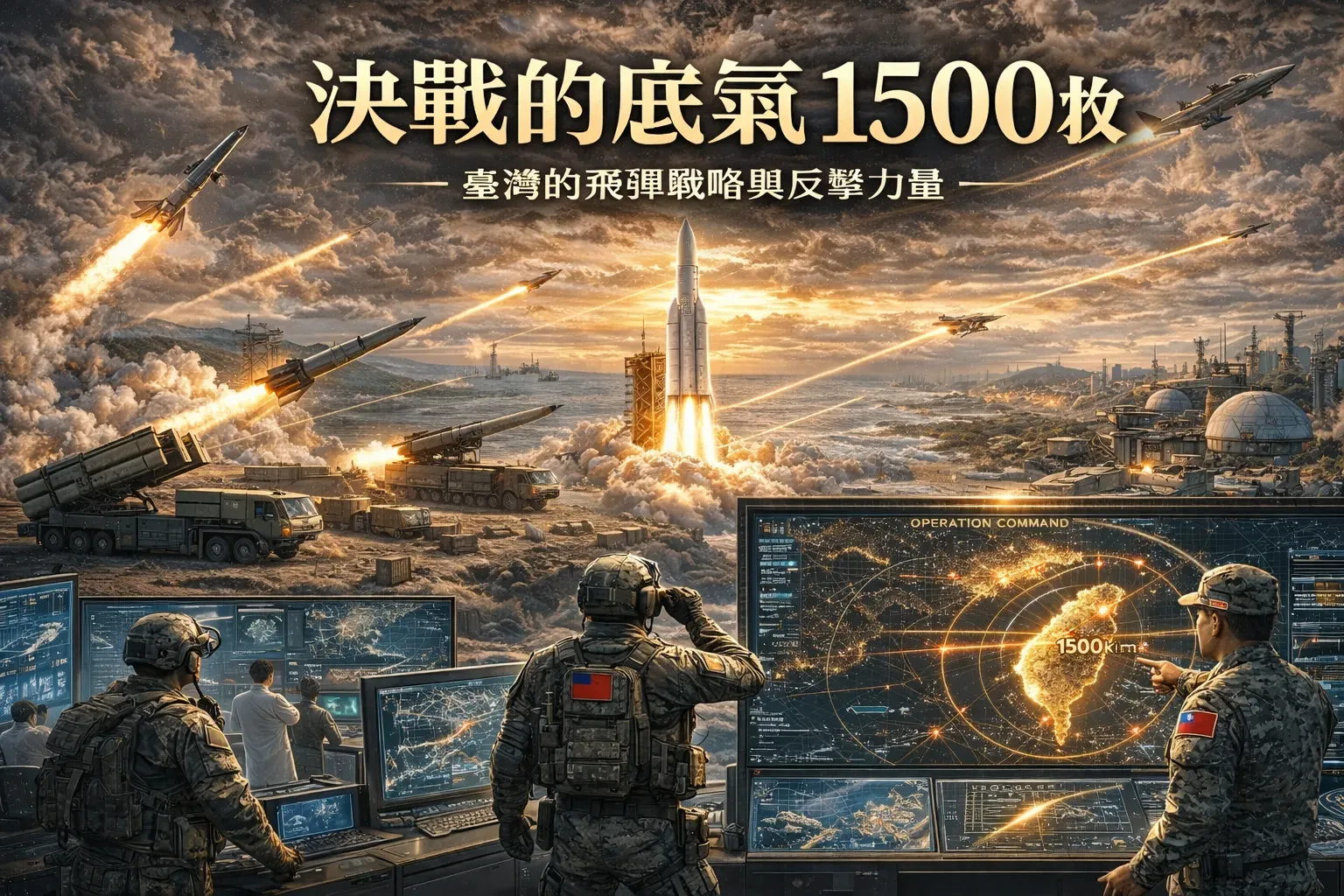
This article is independent research and does not represent the position of any political party, the military, or any government agency. All data is sourced from public materials, listed at the end of the article.
Introduction: A Counterintuitive Proposition
For most people, the phrase "defending Taiwan" intuitively conjures images of soldiers holding the beach, tanks parked by the shore. That image has a fundamental problem: it describes passive defense, and passive defense is almost certain to fail under an absolute manpower disadvantage.
Chapter One: The Fatal Blind Spot of Conventional Defense Thinking
The PLA's Eastern Theater Command can mobilize over 400,000 combat personnel, while Taiwan's standing force is roughly 170,000 and its fill rate has fallen to 78.6%. Once a frontal confrontation in a landing battle begins, Taiwan is using a shovel to fight a bulldozer.
The core logic of source interdiction: rather than fighting at your own front door, start fighting while the enemy is still forming up. The window when enemy forces are massing, loading onto ships, and crossing the strait — when targets are densely packed, moving slowly, and not yet in a protective formation — is the moment of highest strike efficiency. Ukraine's sustained destruction of Russian ammunition depots, command posts, and logistics nodes using HIMARS is a modern-day validation of exactly this logic.
Chapter Two: An Honest Accounting of Taiwan's Current Missile Capability
1,200–2,000km
600–1,000km
200km+
300km
Chapter Three: Why 1,500 Units Is the Minimum Effective Threshold
The Mathematical Logic of Saturation Attacks
(simultaneous)
What Can 1,500 Units Strike
In total, fully covering all targets requires 820–1,280 units. Adding a 20% allowance for technical-failure rates and strategic reserves, 1,500 units is the minimum requirement to fully cover all high-value targets.
Chapter Four: Obstacles to Expansion and a Path Forward
Where Things Are Stuck Today
Three main bottlenecks: ① imports of key components are restricted by the Missile Technology Control Regime (MTCR); ② the National Chung-Shan Institute of Science and Technology's expansion pace is constrained by factory capacity and a shortage of precision-manufacturing talent; ③ budget allocation priorities still lean toward conventional weapons procurement.
A Path Forward: A Workable Five-Year, NT$150 Billion Plan
Chapter Six: Cost-Benefit Analysis
- Adds 1,000–1,200 long-range precision missiles
- Covers all Tier A–E targets across the Eastern Theater Command
- Forms an effective saturation-attack capability (200–300 units launched simultaneously)
- Changes the PLA's risk calculus for an amphibious landing
- Deterrent effect: takes hold before a conflict occurs
- 5 IDS submarines (5 × NT$30 billion)
- Or 16 F-35As (16 × NT$9 billion)
- Requires large numbers of well-trained personnel to operate
- Easily suppressed by the PLA in a frontal confrontation
- Deterrent effect: can only be validated after combat begins
Chapter Seven: The Ethical Framework of Missile Strategy
Preemptive Strike or Counter-Strike?
The missile strategy discussed in this article is framed as a counter-strike, not a preemptive attack. The trigger condition is: the PLA has already begun massing for a landing or a strait-crossing operation, and Taiwan's air defense systems have already come under attack. Under that condition, striking the PLA's staging ports, command nodes, and logistics facilities is a militarily fully proportionate act of defense.
The Proportionality Principle in Target Selection
The target list contains no purely civilian facilities — power plants, hospitals, and civilian airports are not within scope. All Tier A–E targets are military infrastructure, consistent with international humanitarian law's Distinction Principle and Proportionality Principle.
Conclusion: Deterrence Is Not War — It Is the Prevention of War
The greatest value of 1,500 missiles is not using them in a war, but ensuring the other side of the strait never dares to let a war happen. When PLA strategic planners calculate "the cost of attacking Taiwan," every additional Taiwanese missile adds to that cost. Once that cost crosses a certain threshold, it exceeds an acceptable ceiling — and the war does not happen.
Missiles are Taiwan's cheapest insurance policy for peace.
Data Sources and References
- CSIS Missile Threat Database: "Cloud Peak / Qing Tian Hypersonic Cruise Missile"
- Liberty Times (2021.09): "Ching Tien Missile Can Reach Beijing, a Key Strategic Weapon for Taiwan"
- Liberty Times (2019.08): "Cloud Peak Missile Begins Mass Production With 10 Mobile Launch Systems"
- Liberty Military News Channel (2024.08): "Progress on Mass Production of the Hsiung Sheng Missile"
- The Epoch Times (2022): "Former Chung-Shan Institute Director Kung Chia-cheng Reveals External Pressure on Missile Development"
- Institute for National Defense and Security Research (2024): "Assessment of Taiwan's Precision Strike Capability"
Next in this series: <Defense Assets on Campus: A Map of the Military Potential of Taiwan's Space Academic Ecosystem>
ProfitVision LAB | US Equity Options × In-Depth Research × AI-Powered Investing