Taiwan's Hidden Champions: The Cost of a Broken Chain Is Worse Than an Oil Crisis
Taiwan's irreplaceability doesn't live only in TSMC's cleanrooms — it lives in Nantou's oil-seal plants, Kaohsiung's propeller factories, Tainan's fastener cluster, and Techman Robot's solution to submarine welding. A complete breakdown of twelve segments: if Taiwan's supply chain broke, on which day would the world feel it — and why the cost would be worse than the 1973 oil crisis, because Taiwan is harder to replace than oil.
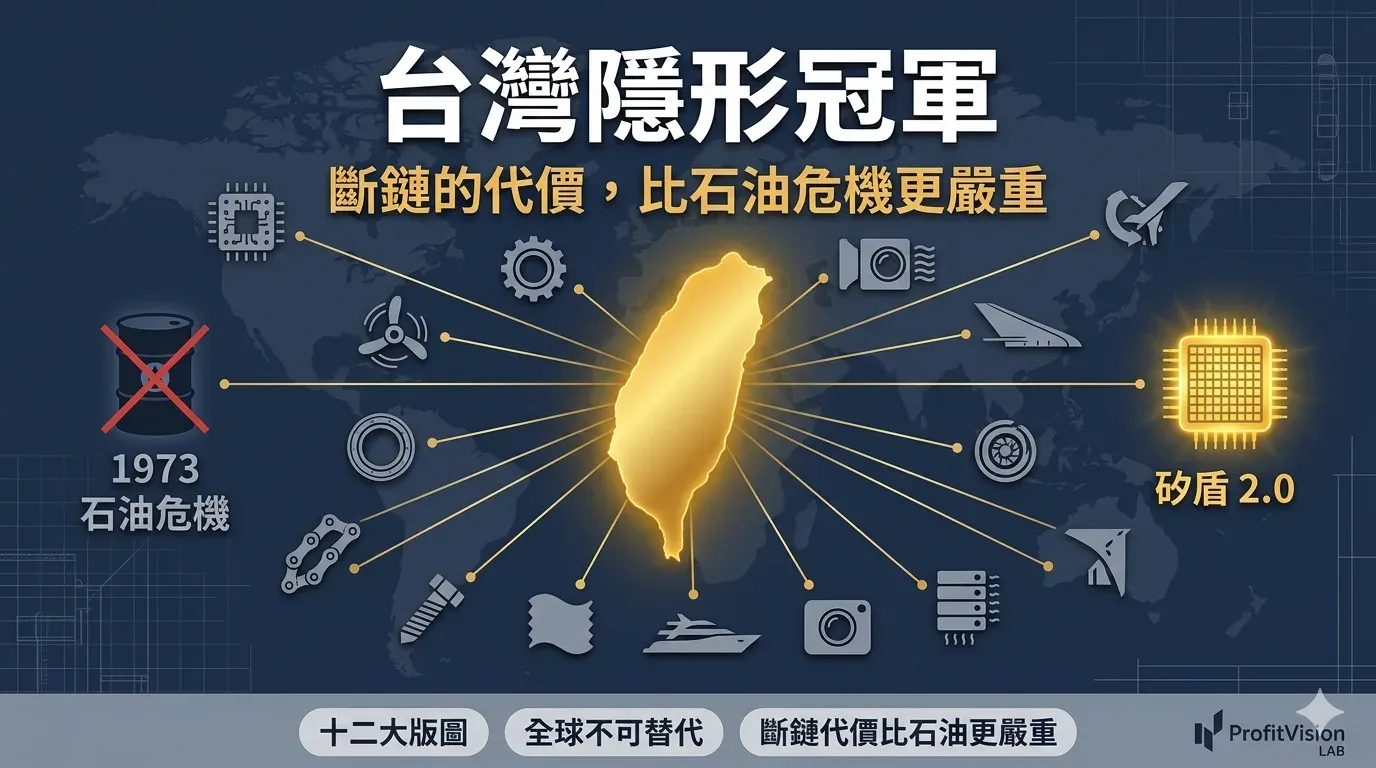
The 1973 oil embargo triggered a decade of global stagflation. But oil had substitutes. Taiwan's precision-manufacturing ecosystem does not — and the world hasn't yet grasped how serious that is.
Taiwan's role in the global supply chain runs far deeper and wider — and is far less replaceable — than the single narrative of "TSMC makes chips." From precision machine tools to specialty chemicals, from packaging and testing to aerospace components, Taiwan is a manufacturing node that cannot be backed up. This article runs a counterfactual scenario: if Taiwan's supply chain were severed, what would the world feel, and on which day? The conclusion: the cost of a broken chain would be worse than the 1973 oil crisis — not because Taiwan matters more than oil, but because Taiwan is harder to replace than oil.
I. That Winter in 1973
In October 1973, the Organization of Arab Petroleum Exporting Countries announced an oil embargo against Western nations that had supported Israel.
Gas stations across America saw lines stretch for blocks. Drivers waited from early morning, sometimes for three or four hours, just to fill their tanks. Cars with odd-numbered license plates could only fill up on odd-numbered days, even plates on even days. The federal government considered a 55-mile-per-hour speed limit to conserve fuel.
The crisis lasted five months, but its effects stretched across a decade. The world fell into stagflation — inflation and economic stagnation occurring simultaneously, a combination Keynesian textbooks had considered "impossible." US GDP contracted in 1974, unemployment climbed, and prices kept rising. It wasn't until the 1980s that the world fully recovered from the aftershocks of that crisis.
The oil crisis was one of the most severe supply-chain shocks of the twentieth century. It reshaped global energy policy, the automobile industry, building codes, and even consumer behavior.
Now let me ask you a question:
If Taiwan's supply chain broke tomorrow, would it be worse than that?
The answer is: yes. Far worse.
But before I lay out the argument, I need to establish a premise: what you know about "Taiwan's supply chain" is very likely just the tip of the iceberg.
II. The Taiwan You Know, and the Real Taiwan
Most people's understanding of Taiwan's supply chain goes something like this:
"TSMC makes chips, Foxconn assembles iPhones, MediaTek designs chipsets."
That understanding isn't wrong, but it captures only a small fraction of Taiwan's supply-chain strength. Taiwan's real moat is hidden inside a group of companies you've almost certainly never heard of — no consumer brand, no advertising budget, never on CNBC, never the subject of an analyst cover story. Yet what they make is indispensable, invisible infrastructure for global manufacturing.
These companies share a common name: Hidden Champions.
The term comes from German management scholar Hermann Simon, who used it to describe small and mid-sized firms that hold dominant global positions in specific niche markets while remaining almost unknown to the public. Germany is famous for having a large population of hidden champions. But measured per capita, Taiwan's density of hidden champions rivals Germany's.
III. The Complete Map of Taiwan's Hidden Champions — Far Beyond Semiconductors
If you think Taiwan's irreplaceability lives only in cleanrooms and fabs, this chapter will make you rethink Taiwan's true weight.
Taiwan's hidden champions are scattered across the propeller factories of Dafa Industrial Zone in Kaohsiung, the oil-seal plants beneath Baguashan in Nantou, the fastener cluster in Gangshan, Tainan, the bicycle chain factories of Changhua, the machine-tool workshops of Taichung, and inside the propulsion systems of nearly every commercial vessel and warship on Earth. They have no consumer brand, never appear on CNBC, never grace the cover of a financial magazine — yet what they produce forms the invisible backbone of modern civilization's infrastructure.
Below is the complete map — electronics, traditional manufacturing, defense industry, and maritime industry, all laid out together. Only together do they reveal Taiwan's true, full picture of irreplaceability.
ASE Technology: world's largest semiconductor packaging and testing provider, over 50% market share
CoWoS advanced packaging: Taiwan holds a near-monopoly, Nvidia's only approved source for mass production
Overall wafer foundry: Taiwan accounts for roughly 65% of global capacity
Elite Material: designated copper-clad laminate supplier for Nvidia's GB200
EMC (Nan Ya subsidiary): core substrate material for TSMC's CoWoS
Alternative sources (Japan's Panasonic, Hitachi): severely capacity-constrained, cannot fill the gap in the short term
Delta Electronics: over 30% global market share of data-center power supplies
AI server liquid-cooling systems: Taiwanese vendors hold over 70% of Nvidia's certified supply base
GB200 thermal demand up +400% year-over-year, and Taiwan is the only region that can deliver quickly at that scale
Airtac: largest pneumatic-component maker in Asia, top five globally
Techman Robot: top three globally in collaborative-robot shipments, used by 80–90% of Taiwan's semiconductor fabs
Taiwan machine tools: world's fifth-largest exporter, irreplaceable in mid-to-high-end precision machining
Genius Electronic Optical: key lens supplier for Apple Watch
Grinding yield: competitors need years to reach the same level
Taiwan is the world's second-largest exporter of contact lenses and holds the second-largest share of Japan's market
EVA Aviation Technologies: one of the largest MRO (aircraft maintenance) centers in the Asia-Pacific
Baotail Precision: part of the F-16 fighter jet parts supply chain, certified to US military specifications
Taiwan's aerospace industry generates over NT$150 billion in annual output
Global standing: Taiwan's largest and only publicly listed sealing-component maker, fifth largest in the world
The NAK brand is sold on all five continents, with operations in 70 countries
Record revenue of NT$4.16 billion in 2022, profitable every year since 1999
Applications: automotive engines, industrial machinery, agricultural equipment, new-energy vehicles, ships, railway rolling stock, home appliances — any mechanical equipment with a rotating shaft needs an oil seal
Key fact: current technology cannot invent a substitute for the function of an oil seal — this is not a matter of an alternative technical path, but a physical constraint
SOLAS (Taiwan): one of the world's best-known outboard-motor propeller brands, founded in 1985, with customers spanning nearly every major outboard-engine manufacturer worldwide
Taiwan's ship-propeller industry: propulsion systems are critical to warship construction; the self-manufacturing rate for propeller systems on Taiwan's frigates is around 5%, but the deep expertise in precision propeller design and machining is a niche capability built up over many years
What makes replacement hard: underwater hydrodynamic design, casting precision, and dynamic-balance testing for propellers are deep technical competencies held by only a handful of Taiwanese firms, with a high barrier to replication
Global market share: approximately 10.8%
In the US market: one out of every two screws is Made in Taiwan
The Gangshan (Kaohsiung)–Rende (Tainan) corridor accounts for over 90% of Taiwan's fastener output
Upgrade path: Taiwanese fasteners have entered the aerospace and medical supply chains; some of the screws and nuts used in Tesla EVs come from Tainan-based manufacturers
Of every 10 pairs of yoga pants sold in the US: 8 use Taiwanese fabric
Over half of the world's firefighter-suit fabric is Made in Taiwan (MIT)
A large share of the fabric used in high-end performance apparel from Nike, Lululemon, and Under Armour comes from Taiwan
Taiwan's textile industry exports over US$11 billion annually, the world's fifth-largest exporter
The niche lies in high-value-added functional materials — waterproofing, breathability, antimicrobial, and flame-retardant properties — technical barriers that low-cost countries cannot replicate
KMC: the world's largest bicycle chain manufacturer, producing enough chain each year to circle the equator five times
Yuan Hao: one of the few brake makers in the world capable of making Japan's Shimano nervous, having risen above 34 competitors
Electric bicycles: strong sales in Europe, with export value continuing to set new records
Taiwan's bicycle supply chain: no high-end global bicycle brand can fully bypass Taiwan
Ocean Alexander: the top-rated yacht brand in the US market; a large share of the world's wealthy private yachts are Made in Taiwan
Taiwan's yachts combine high-precision fiberglass composites, marine engineering, and precision hardware — the crystallization of a complete industrial chain
Military and commercial applications: Taiwan's marine hardware makers (Fong Shan, Wei Hang, and others) supply deck machinery used on commercial vessels and warships worldwide
Put these twelve segments together, and the full, true picture of Taiwan's hidden champions finally emerges:
From the oil-seal plants beneath Baguashan in Nantou, to the propeller factories of Dalin in Kaohsiung, from the fastener cluster in Gangshan, Tainan, to the bicycle chain factories of Changhua, from the semiconductor cleanrooms of the Hsinchu Science Park, to the precision machine-tool workshops of Taichung—
Taiwan's irreplaceability lives inside the oil seal of every engine on Earth, the screws in every car, the fabric in every pair of yoga pants, the thermal module in every server, the lens in every iPhone, the propeller in every warship, the packaging in every AI chip.
This is not the monopoly of a single industry — it is Taiwan's manufacturing civilization penetrating the very infrastructure layer of the entire world.
"You can copy TSMC's factory equipment, but you cannot copy Taiwan's thirty-year learning curve. That learning curve is the real moat — and it exists in every one of these segments, not just semiconductors." — Shiba the Disciplined
IV. Oil vs. Silicon — The Fundamental Difference Between Two Crises
Before running the counterfactual scenario, I need to establish a comparison framework: why would a Taiwan supply-chain break be worse than the oil crisis?
The worst consequence of the oil crisis was: you waited longer to fill your tank, heating cost more, prices rose. Your quality of life declined, but your life went on.
The consequence of a Taiwan supply-chain break would be: your iPhone stops being made, your car plant's line stops, hospital AI diagnostic systems shut down, data-center expansion halts, AI models can't be trained. It's not a decline in quality of life — it's a systemic regression, in the short term, of modern civilization's technological foundation.
V. Countdown to Collapse — A Counterfactual Scenario
Now we arrive at the core of this article.
Assume an extreme scenario: for some reason, Taiwan's manufacturing sector completely stops shipping on a given day. This is not a prediction of any event — it's an extreme hypothesis used to quantify the true weight of Taiwan's supply chain for the world.
This scenario is an extreme hypothesis, used to quantify the true weight of Taiwan's supply chain — not a prediction of any event.
But this exercise tells us something very important: the cost of a Taiwan supply-chain break isn't measured in "dollars lost" — it's measured in "years of human technological progress lost."
VI. Why Alternatives Barely Exist
After the oil crisis, the world found substitutes: the North Sea, Alaska's oil fields, and later the shale revolution and renewable energy. These alternatives gradually eased oil's geopolitical leverage over time.
Why doesn't Taiwan's supply chain have a similar path to substitution?
to build domestic advanced-process capacity
partial production at the earliest by 2030
produces only 12/16nm
not an advanced process
still shows a clear gap
versus TSMC's advanced processes
to build a complete
semiconductor ecosystem from scratch
The US has spent $40 billion trying to rebuild domestic advanced-chip manufacturing capability, yet TSMC's Arizona fab won't approach Taiwan's yields and scale until sometime in the 2030s at the earliest. This isn't a money problem — it's an accumulation problem involving technical know-how, talent ecosystems, and supply-chain clustering effects, all three of which take decades to build.
Oil substitution was feasible because oil extraction technology is relatively standardized — if you strike oil, you can produce oil. But the yield on TSMC's 3nm and 2nm processes depends on thousands of precisely controlled steps, and any deviation in a single step can collapse the yield. This technical knowledge isn't written in textbooks — it lives in the collective experience and intuition of Taiwan's semiconductor engineers, tacit knowledge accumulated over thirty years of trial and error.
"You can copy TSMC's factory equipment, but you cannot copy TSMC's thirty-year learning curve. That learning curve is the real moat." — Shiba the Disciplined
VII. How This Understanding Should Change Your Investment Framework
From an investor's perspective, the irreplaceability of Taiwan's supply chain carries three direct implications for investment decisions.
Implication One: Taiwan's Geopolitical Discount Is a Structural Undervaluation
If the market fully understood the true cost of a Taiwan supply-chain break, Taiwanese equities should trade at a higher valuation, not a lower one. Precisely because global markets fear "Taiwan Strait risk," Taiwanese stocks carry a discount relative to their fundamentals — and that discount is effectively a subsidy paid to long-term Taiwan investors, in the form of a lower opportunity cost of entry.
In other words: every sharp sell-off in Taiwanese equities triggered by cross-strait headlines is, in essence, the market pricing an improbable risk into an even bigger discount — because the cost of a Taiwan supply-chain break is so severe that no rational geopolitical actor can actually push that button.
Implication Two: Taiwan's Hidden Champions Are Structural Long-Term Holdings
Most of Taiwan's hidden champions hold near-monopoly niche positions in global competition, with extremely high switching costs and technical barriers, and they benefit from a durable macro trend: the ongoing shift of global manufacturing toward precision, AI, and automation.
The investment logic for these companies isn't "short-term earnings" — it's "the deepening of the moat." Every year they continue supplying irreplaceable components, they widen the gap that competitors must close.
Implication Three: The Breadth of Taiwan's Supply Chain Is the Most Underappreciated Asset in Taiwanese Equities
Most people simplify Taiwan's stock market into "TSMC + Foxconn + a handful of electronics names." But these twelve segments show that Taiwan's market spans the entire chain of global manufacturing, from the most upstream (raw materials, specialty chemicals) to the most downstream (packaging and testing, precision components, aerospace).
That breadth means, amid the current explosion in AI hardware demand, Taiwanese equities have far more beneficiary nodes than TSMC alone. Every AI server order simultaneously drives demand for Elite Material's copper-clad laminate, Auras Technology's thermal modules, Delta Electronics' power supplies, and ASE Technology's packaging and testing — Taiwan's stock market offers full-chain exposure to the AI capex cycle, not a single-point bet.
VIII. Silicon Shield 2.0 — Irreplaceability Is the Strongest Deterrent
The concept of the "Silicon Shield" was first proposed by journalist Craig Addison in 2001: Taiwan's semiconductor industry acts as a shield protecting Taiwan from military attack, because attacking Taiwan would mean attacking the global tech supply chain itself.
But the traditional Silicon Shield argument confined itself to TSMC's chip-manufacturing capability. The argument in this article is a Silicon Shield 2.0:
Taiwan's deterrent power doesn't come from TSMC alone — it comes from the entire irreplaceable manufacturing ecosystem. Together, these twelve segments form a systemic protective mechanism that no rational actor can absorb the cost of breaking, in the short term.
The Logic of Silicon Shield 2.0:
Any military action against Taiwan wouldn't just destroy TSMC's fabs — it would simultaneously destroy the global supply chain for AI server thermal management, the global supply chain for iPhone lenses, the global supply chain for precision aerospace components, the global supply chain for EV linear-transmission parts…
This isn't a question of "what Taiwan would lose." It's a question of "what the entire world would lose at the same time."
When the cost of attacking Taiwan is halting Nvidia's production, shutting down Apple's operations, and disrupting global AI development, that cost is unbearable for any actor who might launch such an attack.
Taiwan's irreplaceability is a more effective deterrent than nuclear weapons — because the threat of nuclear weapons is "we all perish together," while the threat of Taiwan's silicon shield is "your modern civilization gets thrown back ten years."
IX. Taiwanese Reader, Do You Know How Important Your Workplace Really Is
Let me turn back to the perspective of a citizen for one last point.
In Taiwan, millions of people go to work every day doing something whose full significance they may never fully register: keeping global manufacturing running.
The engineer at TSMC responsible for process yield — his work determines whether every AI server on Earth can ship. The technician operating a five-axis machining center in a precision factory in the Hsinchu Science Park — his parts may end up in the structural components of an Airbus aircraft. The technician grinding lenses at an optics plant in Tainan — her yield control determines whether the latest iPhone camera can launch on schedule.
These people's work holds up an entire critical layer of the global supply chain, and billions of people around the world depend on the fruits of their labor without ever knowing it.
This is Taiwan's true place in the world. Not a small island, not a geopolitical pawn, but an indispensable anchor of manufacturing civilization.
The next time someone tells you "Taiwan is just an OEM island," tell them this: an OEM island doesn't have a market-cap-to-GDP ratio of 423%. An OEM island doesn't hold 92% of the global market for advanced chip manufacturing. An OEM island doesn't wield global supply-chain deterrence on a scale beyond the oil crisis.
Taiwan is not an OEM island. Taiwan is the manufacturing core of modern civilization, and its moat — not a political statement, not military might, but thirty years of accumulated, irreplaceable technical knowledge — is more solid than any line of defense.
Anyone who understands this should look at where they stand with different eyes, and invest in it with different confidence.
X. The Underappreciated Cluster Effect — Why Taiwan Keeps Getting Harder to Replace
Understanding Taiwan's irreplaceability requires one more key concept that shouldn't be overlooked: the Cluster Effect.
Taiwan's semiconductor and precision-manufacturing ecosystem isn't a collection of isolated companies each independently providing services — it's a highly integrated geographic cluster. TSMC, ASE Technology, MediaTek, Elite Material, Auras Technology, Foxconn… these companies sit on the same island, their engineers ride the same commuter buses, meet at the same gatherings, cross-train one another's talent, share the same suppliers, and can call each other's engineers to the site to solve a problem within an hour.
The significance of this cluster effect is that no "distributed replication" strategy can fully reproduce it:
Why TSMC's US Plant Costs 50% More Than Its Taiwan Plants — the Price of Tacit Knowledge
TSMC's Arizona fab costs nearly 50% more to build than its Taiwan facilities. It's not simply because American labor is more expensive (though that's true too) — it's because the US lacks the ecosystem that surrounds TSMC in Taiwan:
In Taiwan, if a tool breaks down, the equipment supplier's engineer can be on-site within two hours. Specialty-chemical suppliers sit in the same industrial park. The mask shop is next door. The packaging plant is a twenty-minute drive away. Trained engineers can be poached from competitors because the entire industry's talent pool is concentrated in the same region.
In the US, all of this requires flights and time-zone coordination. The time to solve a problem goes from "two hours" to "two days," and yield improvement cycles go from "one-week iterations" to "one-month iterations."
But that's not even the deepest layer of the problem. The deepest layer is what management theory calls Tacit Knowledge — the technical intuition that cannot be written into an SOP manual and can only be acquired through long practice and person-to-person transmission.
Taiwan's AI server supply chain has an advantage that's nearly invisible from the outside: from thermal modules, circuit boards, and power supplies to full system assembly, Taiwan's ecosystem can complete a full-chain collaboration and design adjustment within a few weeks — while the same iteration in the US, Japan, or Europe requires months of cross-time-zone coordination. This capacity for "same-island, real-time collaboration" is the hardest-to-replicate competitive advantage of Taiwan's precision-manufacturing cluster, and it's why every "supply-chain diversification" effort around the world has consistently progressed more slowly than expected.
You can copy TSMC's factory buildings, but you cannot copy the collective technical intuition Taiwan's engineers have built over thirty years, and you certainly cannot, in the short term, rebuild a cluster ecosystem that generates tacit knowledge every single day.
How the Cluster Effect Makes Taiwan Progressively Harder to Replace
The cluster effect has one important property: it is self-reinforcing. The more companies concentrated in one place, the more suppliers, engineers, research institutions, and customers it attracts — forming an ever-deepening positive feedback loop.
Taiwan's manufacturing cluster deepens every year. New entrants in AI thermal management, silicon photonics, and new materials all make the ecosystem more complete and more irreplaceable. A significant share of Taiwan's 67 newly listed companies in 2024 are next-generation hidden champions that grew out of exactly this cluster effect.
This means Taiwan's irreplaceability is not static — it keeps deepening. Every year that passes, the cost and time required to replicate Taiwan go up a little more.
XI. AI-Enabled Precision Manufacturing — The Upgraded Version of Taiwan's Moat
There's an old impression of Taiwanese manufacturing that needs updating: "Taiwan is a cheap-labor OEM island."
That impression may have held some truth in the 1980s, but by 2026 it's simply wrong. Taiwan's hidden champions no longer compete on manual labor — they compete on a new form of moat built from AI + precision manufacturing, and that moat keeps widening the gap with competitors.
A few concrete examples:
AIDC's AIxWARE Smart Manufacturing Platform — Taiwan's aerospace precision-manufacturing leader, AIDC, drew on its own aerospace process experience to build the AIxWARE platform by integrating AIoT machine-connectivity and MES technology. The platform already connects over 60 equipment brands and more than 2,000 machines, lifting average production-line utilization by 20%, cutting annual energy consumption by more than 8%, and deploying 77 generative-AI applications that save roughly 130,000 labor hours per year. More importantly, AIDC has already begun exporting this platform externally, helping over 40 companies in precision machining, marine hardware, and medical devices with their digital transformation. AIDC is no longer just an aerospace-parts maker — it's becoming an AI-enablement infrastructure provider for Taiwan's precision manufacturing sector.
Techman Robot × CSBC Corporation: AI Collaborative Robots Enter Submarine Welding — This case is perhaps the most compelling microcosm of Taiwan's "AI + precision manufacturing" story. Techman launched the world's first collaborative robot with a built-in smart-vision system and a native AI engine, now used by 80–90% of Taiwan's semiconductor fabs. But even more striking is its entry into a far more demanding application: national-defense manufacturing.
Submarine welding is one of the most demanding technical challenges in shipbuilding. Welds on a submarine hull must guarantee 100% airtightness and watertightness, because even a microscopic bubble or crack can be fatal under deep-water, high-pressure conditions. As Taiwan pushed forward its indigenous submarine program, weld quality was exactly the bottleneck outside observers worried about most — the complexity of electric-arc welding on submarine steel plates far exceeds that of ordinary commercial ships, and the stability and consistency of traditional manual welding struggle to meet the standard.
Techman Robot partnered with CSBC Corporation and the American welding-technology supplier AMET Inc. to deploy an AI-driven smart-welding collaborative solution, letting robots move welding torches along precisely programmed paths while controlling welding speed, angle, and temperature; the system entered pilot production in 2026. Taiwan used its own AI collaborative robots to solve the technical challenge of submarine welding, achieving quality that meets military specifications.
The significance of this case goes far beyond a single technical breakthrough. It demonstrates Taiwan's capacity to integrate three separate threads — private-sector technology (Techman), the defense industry (CSBC), and international cooperation (AMET) — and that speed and efficiency of cross-domain integration is the most concrete expression of Taiwan's manufacturing cluster effect and tacit knowledge. Today it's submarine welding; tomorrow it could be any manufacturing scenario demanding the highest precision.
Takisawa's AI Thermal-Compensation Technology — Taiwanese machine-tool maker Takisawa developed the world's widest-range thermal-compensation technology (15°C to 35°C), solving the precision-machining error caused by thermal expansion and contraction across temperature swings. This technology lets Taiwanese machine tools maintain the same precision when exported to climates as varied as Southeast Asia, Europe, and the Middle East, while an AI-built temperature laboratory has also cut carbon emissions by 5% annually.
These three cases illustrate one point: Taiwan's hidden champions are not standing still. They are using AI to push already-hard-to-catch-up-with process barriers forward by another generation. The time competitors need to catch up to Taiwan's 2024 level is now longer than the time it once took to catch up to its 2020 level — because in those four years, Taiwan pulled further ahead.
This "constantly moving target" is what makes Taiwan's hidden champions hardest to replicate, and the fundamental reason the time cost of "replacing Taiwan" always runs higher than expected.
XII. Three Objections, Three Responses
This article's argument will draw three common objections, and I want to address them head-on.
Objection One: "Countries are already actively building domestic semiconductor capacity, so Taiwan's irreplaceability will decline"
Response: This is a correct observation, but the timeframe is wrong. The US CHIPS Act, Europe's Chips Act, Japan's semiconductor-rebuilding program — these efforts are real, but what they'll achieve by the 2030s is, at best, "partially filling" the gap in specific processes, not "replacing" Taiwan's overall capability.
Taiwan will still be 2–3 generations ahead of these new fabs in the 2030s. And more importantly: these diversification efforts are themselves the strongest evidence that "Taiwan is too important, and risk must be spread." The world's smartest governments are telling you, with real money, that Taiwan's irreplaceability is real.
Objection Two: "China is also aggressively developing semiconductors and will eventually catch up"
Response: China's semiconductor catch-up plan, under pressure from US chip export controls, faces fundamental obstacles at the equipment level. SMIC's most advanced mass-production process is currently around 7nm (with limited yield and capacity), still more than two generations behind TSMC's 2–3nm.
The more fundamental issue is: even if China's catch-up succeeds, it only narrows the gap at a single node — chip manufacturing. Taiwan's advantage is the entire cluster ecosystem across twelve segments — optics, thermal management, PCB materials, precision machinery, aerospace components… China has no systematic catch-up plan in these areas, and lacks the time and accumulated experience to build one.
Objection Three: "If Taiwan is this important, why isn't its stock market's P/E higher?"
Response: This is exactly the core argument of Part One of this series: Taiwan's stock-market P/E has already discounted cross-strait geopolitical risk. That discount is itself the opportunity for Taiwanese investors relative to foreign investors: what you're buying is a piece of the world's genuinely irreplaceable manufacturing core, marked down by "geopolitical panic."
Foreign investors hold 44.8% of Taiwanese equities — that tells you they've already run the numbers. They aren't "ignoring" the geopolitical discount; they're "accepting" that discount and still concluding that Taiwan's risk-adjusted returns are positive.
XIII. The People Behind the Numbers
Before closing this article, I want to look at these numbers from a different angle.
TSMC's 92% market share is backed by tens of thousands of engineers and technicians working in cleanrooms every single day. ASE Technology's packaging capacity is backed by workers in Kaohsiung, Taoyuan, and Zhongli precisely repeating every step of every operation. Largan Precision's lens yield is backed by technicians in Taichung factories grinding every single piece of glass.
These people are the true moat of Taiwan's hidden champions. Not the machines, not the factories, but the technical intuition and craft knowledge accumulated in their hands and minds — the hardest competitive advantage to replicate, and the deepest source of Taiwan's supply-chain irreplaceability.
The 1973 oil crisis taught the world that the geopolitics of energy is real, and that the risk of supply-chain concentration is real. But that crisis eventually gave rise to substitutes, and improved the global energy-security landscape over subsequent decades.
Taiwan's situation is different. Taiwan's supply chain is not waiting to be replaced — it is continuously deepening. Every year, Taiwan's accumulated technical expertise in precision manufacturing pushes the completion date of any "replace Taiwan" plan one more year into the future.
This is compounding, applied to technical knowledge: Taiwan's irreplaceability is deepening at a compounding rate.
Oil can be replaced. Taiwan's manufacturing ecosystem, for the foreseeable future, cannot.
This is why the cost of a broken chain would be worse than the oil crisis.
XIV. How Investors Should Think About Taiwan's Hidden Champions
This chapter returns to the language of investing, translating the argument above into concrete stock-selection thinking.
The investment logic behind Taiwan's hidden champions differs from that of typical growth stocks. It doesn't rely on P/E expansion or a reversal in market expectations, but on a slower, more durable mechanism: the ongoing deepening of switching costs and scale-based moats.
Three Core Investment Traits of Hidden Champions
Trait One: Customers Can't Leave (The Switching-Cost Moat) — Customers of Taiwan's hidden champions typically embed the supplier's specifications deep into their own product designs. Apple's iPhone lens specs are designed around Largan Precision's process; switching suppliers would mean redesigning the optical path, recertifying, and readjusting production lines — a cost that far exceeds the premium paid to Largan. This deep embedding is the strongest form of a switching-cost moat: not contractual lock-in, but technical dependency.
Trait Two: Your Yield Is Something No One Else Catches Up to in Twenty Years (The Technical-Barrier Moat) — Yield in precision manufacturing is one of the hardest competitive advantages to replicate. More importantly, this advantage shows up directly in the financials: look at the ROE figures of Taiwan's hidden champions — NAK (Sealing Technologies) has averaged EPS of NT$5.66 over the past nine years, with gross margin stable at 32–33%; Largan Precision's gross margin has stayed above 60% for years; Hiwin's ROE has consistently exceeded 15%. Behind these numbers lies pricing power — when customers can't easily switch away from you, you gain the ability to pass rising costs on to them, and that is exactly the core definition of the Quality Factor.
Trait Three: Your Market Is Growing, and the Bigger You Are the More You Win (The Scale-Effect Moat) — AI hardware demand, EV penetration, aerospace MRO demand… nearly every market Taiwan's hidden champions serve sits on a long-term growth wave. And these markets share a common trait: bigger players have more advantages in certification, scale, and supply-chain integration, producing a "winner-take-most" structure. During cyclical downturns, hidden champions with pricing power show far greater earnings resilience than typical manufacturers — and that is exactly where Taiwan's equity market's margin of safety is underappreciated.
Applying the Four-Layer Defensive Screen to Hidden Champions
Using ProfitVision LAB's Four-Layer Defensive Screen to evaluate Taiwan's hidden champions:
| Filter | Application to Hidden Champions | Key Question |
|---|---|---|
| Filter One: Institutional Flow | Are foreign institutions steadily accumulating? What's the A/D Rating trend? | Do institutional investors "know" this company's irreplaceability? |
| Filter Two: Moat | Is ROE sustained at ≥17%? Is EPS growth stable? | Does high ROE come from real switching costs and pricing power? |
| Filter Three: Volatility | Is IV Rank high enough to justify an options position? | Hidden champions typically have lower volatility — confirm there's enough IV to work with |
| Filter Four: Technicals | Is the stock holding above its 50-day moving average? Is it near a base? | Hidden champions with strong fundamentals often show relatively stable technicals too |
Taiwan hidden champions that clear all four filters tend to combine "a fundamental moat, a favorable industry tailwind, and institutional support" — making them core long-term holding candidates rather than short-term thematic plays.
XV. Taiwan's Unique Position on Earth
Let me close this article with one final perspective.
There are roughly 195 countries on Earth. Only one holds a 92% global market share in advanced semiconductor processes. Only one holds a top-three global competitive position simultaneously across six domains — wafer foundry, packaging and testing, PCB materials, precision machine tools, optical lenses, and AI thermal management. Only one has a market-cap-to-GDP ratio as high as 423%, far exceeding what its geographic size and population would suggest.
That country is called Taiwan.
In 1973, when OPEC announced its oil embargo and Americans lined up at gas stations, they eventually found a way out: fuel-efficient cars, nuclear power plants, the North Sea oil fields, the shale revolution.
If Taiwan's supply chain stopped operating one day, the world would not find a way out — not for at least a decade. Because what Taiwan has accumulated is not a natural resource that capital can quickly replicate, but the crystallization of decades of human intellect and craftsmanship, embedded in the skills of its engineers and the structure of its cluster ecosystem — something that cannot be dug up, loaded onto a ship, and moved elsewhere.
This is Taiwan's true weight.
Not a small island, not a geopolitical pawn, not an issue waiting to be unified or protected.
Taiwan is the one indispensable node on Earth that allows modern civilization's technological progress to keep moving forward.
The cost of a broken chain would be worse than the oil crisis.
And that cost is Taiwan's deepest moat.
Taiwan has an irreplaceable industrial ecosystem, the world's seventh-largest capital market, and thirty years of accumulated technical expertise. So how should Taiwan's capital work for Taiwan's future?
Norway turned its oil wealth into a sustainable national asset through its sovereign wealth fund. Singapore turned a city-state's capital into global influence through Temasek. Taiwan has $570 billion in foreign-exchange reserves, holds the world's most important semiconductor technology, and has a capital market on track to become one of the world's top three.
→ Part Five: Sovereign Fund × Sovereign AI — Taiwan Capital's Next Step
XVI. One Last Question for Yourself
Having finished this article, I want to leave you with one question.
If you were a global institutional investor today, having just seen the full map of Taiwan's supply chain — the twelve segments, the cluster effect, the difficulty of substitution, the counterfactual scenario of a supply-chain break — how would you allocate your capital?
The answer is already visible in the market: they hold 44.8% of Taiwanese equities.
Now ask yourself another question: do you understand the true weight of Taiwan's supply chain more deeply than these institutions, or less deeply?
If you live in Taiwan, work inside its supply chain, speak Mandarin, and know friends who work in the Hsinchu Science Park — your understanding of this ecosystem is, in fact, more direct and more substantive than most foreign analysts'. You see how this system runs from the inside, not a version analyzed from a distance in an English-language report.
This home-field understanding, if you're willing to turn it into investment action, has a name: Alpha.
Oil can be replaced. Taiwan's manufacturing ecosystem, for the foreseeable future, cannot.
And you live in this irreplaceable place.
This realization is worth more than any investing technique. Knowing where you stand is the best starting line there is.
© 2026 ProfitVision LAB · Shiba the Disciplined · Think with me, not just trade with me.
Data sources: TrendForce, SEMI, Bloomberg, Industrial Technology Research Institute (ITRI), company financial reports, publicly available research reports.