The Counter-Offensive — Ten Rebuttals from an Opponent, and the White Paper's Institutional Upgrades in Response
After publishing the "Sovereign Fund × Sovereign AI" white paper, ProfitVision LAB received an opponent-grade breakdown — ten structural attacks aimed squarely at insufficient institutional strength. We chose to meet it head-on: conceding the four points that hit the mark, clarifying three that were partly misread, and countering three that had blind spots of their own — then distilling five institutional upgrade provisions from the exchange. Where the opponent was right, we upgraded. Where they misread us, we clarified. Where their attack had a blind spot, we counter-struck. This is the dialectical maturity a think-tank white paper should have.
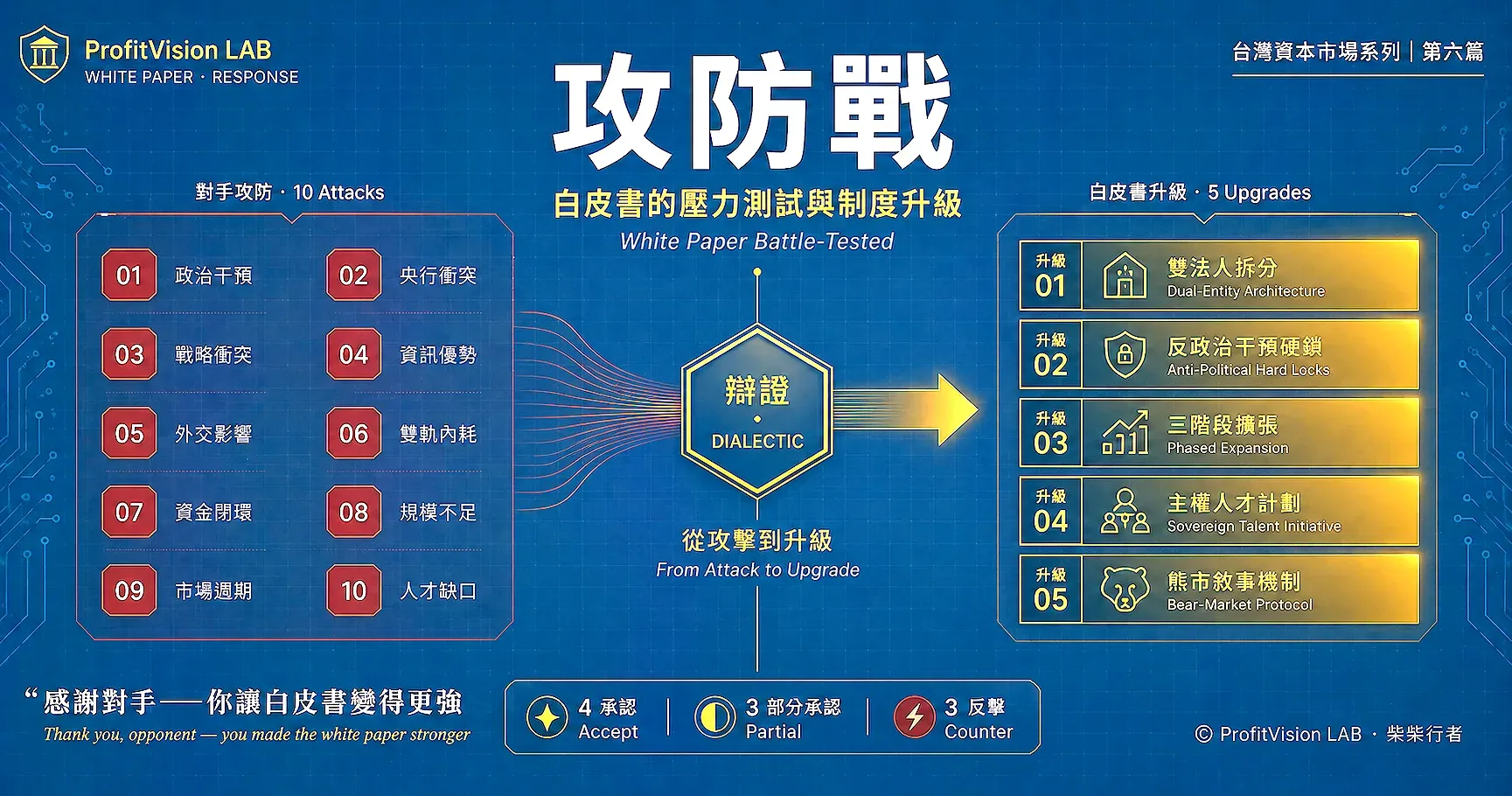
The Counter-Offensive
Ten Rebuttals from an Opponent, and the White Paper's Institutional Upgrades in Response
After the "Sovereign Fund × Sovereign AI" white paper was published, we received an opponent-grade breakdown from a third party. ProfitVision LAB chose to meet it head-on — because a white paper meant to serve as an actual policy reference must be able to withstand the sharpest opposing scrutiny.
The strategic framework ProfitVision LAB proposed in its earlier white paper ("Sovereign Fund × Sovereign AI — Taiwan Capital's Next Step") drew, after publication, a remarkably substantive third-party breakdown — ten structural attack points plus five optimization suggestions, aimed squarely at the white paper's "insufficient institutional strength" and "political-erosion risk."
This kind of high-intensity challenge from an opposing perspective is exactly the pressure test any genuine policy white paper needs most. ProfitVision LAB refuses both to retreat behind closed doors and to offer a wishy-washy non-answer — instead, we lay out all ten attack points one by one, sorted into three response categories: concede (the opponent hit the mark), partially concede (the attack has merit but needs clarification), and counter (the attack itself has a blind spot). Finally, we convert the conceded points into five institutional upgrade provisions and write them back into the white paper, making the entire framework more robust.
The purpose of this report is not to defend, but to let the white paper evolve through the opponent's breakdown. This is what genuine think-tank culture looks like — no covering for our own shortcomings, no dodging, no personal attacks — dealing only with the arguments themselves.
Part One: Four Attacks That Hit the Mark
Your argument leans bullish. But if the AI bubble bursts, tech stocks fall 50%, and political pressure explodes — "you lost the people's money" — you have no defensive narrative.
This one lands squarely. The white paper does indeed lean into a bullish narrative and is under-prepared for a "bad-era script." This is a fatal weakness in political reality — the moment any long-horizon fund posts even a single year of a 30%+ paper drawdown, the media and opposition parties will instantly weaponize it politically, even if the long-run compounding logic remains entirely sound.
Norway's sovereign fund lost nearly 23% during the 2008 financial crisis and 14% again in 2022, but the Norwegian government was able to absorb those drawdowns without being toppled politically — not because the returns actually looked good, but because they had a defensive narrative prepared in advance that could hold up in the media even amid losses. Taiwan's white paper must fill this gap.
New: Bear-Market Communication Protocol and Fiscal Buffer Mechanism
① The sovereign fund charter shall state explicitly: if annual losses exceed 15%, a "bear-market transparency mechanism" is automatically triggered, under which the investment committee reports monthly to the legislature and the public on position structure, long-term expectations, and why redemption should not be driven by panic. ② A dedicated "market-stress reserve" of 10–15%, held in highly liquid cash-equivalent instruments, ensures ample ammunition in any crisis. ③ A protective clause written into the charter stating that strategic positions may not be forced into liquidation under single-year loss pressure, preventing forced fire-sales driven by political pressure.
Taiwan has no world-class asset allocation team, no sovereign-fund experience. However good your institutions are, execution will fail. In the end you'll outsource to foreign firms — and lose sovereignty.
This attack is razor-sharp. "Recommendation One" in the white paper proposes a Fund-of-Funds structure that outsources to top global institutions — but the hidden cost of this design is that Taiwan itself never builds up its own sovereign-fund talent, and remains permanently dependent on foreign institutions' judgment. Left unchecked, the sovereign fund becomes a distorted structure — "Taiwan's money, someone else's brain."
The opponent is exactly right: however good the institutions, execution depends on people. The real competitive edge of Singapore's GIC and Temasek isn't their charters — it's the homegrown sovereign-fund talent pipeline they've systematically built over the past 40 years: high pay, global rotations, institutionalized succession. Taiwan's white paper must add this talent strategy.
New: Sovereign Investment Talent Initiative
① In its very first year, the sovereign fund establishes a "Global Sovereign Investment Academy," sending 30–50 top Taiwanese finance and technology talents each year to rotate for 2–3 years at Singapore's GIC, Norway's NBIM, and Abu Dhabi's ADIA. ② An "independent compensation structure" is established — investment staff at the sovereign fund are paid in line with international institutions (senior Singapore GIC investment officers earn $1.5–3 million annually), fully decoupled from the civil-service pay scale. ③ Outsourcing arrangements must mandatorily include a "knowledge-transfer clause": entrusted international institutions must accept Taiwanese seconded staff, allow observation of decision-making meetings, and transfer key methodologies to Taiwan's domestic team within five years. ④ Long-term goal: within 10 years, the domestic team should independently manage more than 50% of the fund's assets, no longer fully dependent on external outsourcing.
Taiwan is neither Norway nor Singapore — it's a market with high-frequency elections and intense media pressure. The 3% rule will morph into "3% → 5% → a special-case 10%," the "do not prop up the market" rule will get broken the moment there's a market crash, and strategic investments will be politically redefined. Your institutional design is "reasonable" but not "pressure-resistant" enough.
This one lands with precision. The white paper's original design of "1/3 government-appointed + 2/3 independently elected directors" is a good design, but the opponent correctly points out that Taiwan's political environment is more susceptible to electoral-cycle shocks than Singapore's or Norway's. A principle-based design is not sufficient to withstand real-world political pressure — it must be upgraded into a legally mandated "hard-lock" mechanism.
The direction the opponent proposes is entirely correct: institutions must be made stronger than any individual. This means the white paper cannot merely write down "principles" — it must write down "criminal penalty clauses."
New: Anti-Political-Interference Hard Locks
① The sovereign fund's enabling statute states explicitly: any administrative official who directs a specific investment decision in any form commits the crime of "obstructing sovereign fund operations," punishable by a minimum of five years' imprisonment. ② Investment committee members serve staggered 8-year terms and cannot be dismissed without cause during their term, except through impeachment approved by the Control Yuan. ③ Any investment exceeding the charter-mandated cap for a single asset class requires the approval of two-thirds of the investment committee and must be proactively disclosed; violating directors bear personal criminal liability. ④ The prohibition on "propping up the domestic stock market" is written into the charter as a mandatory clause; violation makes the fund chairperson personally criminally liable, with no exemption available on "public interest" grounds.
You want to simultaneously: make money (GPFG-style), position strategically (Temasek-style), and serve as a diplomatic tool. These three will conflict with each other. Strategic investments have lower IRR, diplomatic investments may be irrational, and the investment committee will lose focus. The end result: "trying to do everything means excelling at nothing."
This is the single most insightful cut in the entire breakdown. The opponent's proposed solution — splitting into two independent legal entities — is more sound and more resilient than my original design of "five sub-funds within one fund." The original design would leave the investment committee compromising every single day between "this investment's strategic score vs. its financial score," and in the end neither goal would be achieved well.
The correct approach is to fully split "strategic" and "financial" into two independent legal entities, each with its own independent KPIs, with no cross-subsidization allowed. This is the single most critical structural upgrade in the entire white paper.
Upgrade: Dual-Entity Architecture
The original "one sovereign fund + five investment tracks" is restructured into:
① Taiwan Alpha Fund (pure financial): modeled on Norway's GPFG, comprising 60–65% of total scale. Its sole KPI is risk-adjusted return. It may not take on any strategic or diplomatic mandate. The charter states explicitly that any instruction directing the Alpha Fund to make a strategic investment is unlawful.
② Taiwan Strategic Fund (strategic): modeled on Singapore's Temasek, comprising 35–40% of total scale. Its KPI is "degree of strategic-objective attainment × minimum return threshold." It may accept a lower IRR, but must submit a strategic-attainment report to the legislature every three years, audited by an independent third party.
This split solves three problems: ① the investment committee no longer has a role conflict; ② the public can clearly judge which fund should be evaluated by which standard; ③ strategic mandates no longer drag down financial performance.
Part Two: Three Attacks Partially Conceded — But Requiring Positional Clarification
Taiwan's central bank is an extremely conservative institution; its foreign exchange reserves are a currency-stability tool, not investment capital. Any large-scale transfer would shift exchange-rate expectations, and foreign investors would read it as a policy pivot. This is not a technical problem — it's a signaling problem.
The "signaling problem" the opponent identifies is entirely correct — any major adjustment to the central bank's foreign exchange reserves would be read by international markets as a monetary-policy pivot, and the risk is severe.
But this attack partially misreads the white paper's design. The white paper never proposed "large-scale use of foreign exchange reserves" — the original funding-source design was: a 10% contribution from the three major labor funds + treasury surplus + potential future special taxation, all of which fall under the Ministry of Finance's jurisdiction, not the central bank's foreign exchange reserves. Chapter Five of the white paper, "Closed-Loop Fund Design," already explicitly rejects the path of "directly drawing from foreign exchange reserves."
The reason this attack is partially valid is that the white paper should indeed state more explicitly that "the central bank's foreign exchange reserves are not a funding source for the sovereign fund." This boundary was not written clearly enough, and could easily be misread as "reaching into the central bank's money."
New: "Central Bank Signal Protection Clause"
The sovereign fund's enabling statute shall state explicitly: "The sovereign fund's sources of capital are entirely separated from the central bank's foreign exchange reserves; the scale, allocation, and use of the central bank's foreign exchange reserves shall remain entirely under the current regime, unaffected by the sovereign fund's establishment. No sovereign fund overseas investment may be conducted through central bank currency transfers, nor may it be linked to central bank operations." This clause institutionally severs any risk of the international market misreading a "policy pivot" signal from Taiwan.
Sovereign fund (external) + National Development Fund (domestic) — overlapping targets (AI / semiconductors), talent competition, inconsistent KPIs. The result: bureaucratic rivalry outweighs synergy.
This attack is half valid, half a misreading.
The valid part: the dual-track fund structure does carry the risk of talent competition and overlapping targets, and the white paper does not design a strong enough coordination mechanism.
The misread part: the white paper already explicitly designed an "external vs. domestic" split — the sovereign fund invests only overseas, and the National Development Fund invests only domestically. This boundary is fixed into the enabling statute and can significantly reduce target overlap. What truly needs to be added is a "horizontal coordination mechanism for talent and information" — not scrapping the dual-track design itself.
Moreover, after the structural upgrade in response to Attack 03 above, the dual-track has effectively become a triple-track: the Alpha Fund (external, pure finance) + the Strategic Fund (external, strategic) + the National Development Fund (domestic). All three have independent KPIs and independent boards, but share a "National Capital Strategy Coordination Council" for horizontal information sync.
New: National Capital Strategy Coordination Council (NCSCC)
An information-coordination mechanism (not a decision-making body) is established above the Alpha Fund, the Strategic Fund, and the National Development Fund. Convened by a minister without portfolio at the Executive Yuan, the chief investment officers of the three funds meet quarterly to share strategic perspective, avoid duplicate investments, and exchange talent information. Critically, this council "makes no decisions" — it only "exchanges information" — avoiding becoming yet another layer of bureaucracy.
What will actually happen: returns get absorbed into the government budget black hole and cannot truly be earmarked. National health insurance / childcare spending are political expenditures — it will be very hard to maintain "returns-only" usage. The closed loop will be broken.
The opponent has a strong point here. Any government return, in political reality, faces pressure to be diverted — Norway's sovereign fund has held the line precisely because its "maximum 3% of returns may be drawn annually" rule is written at the constitutional level, not in ordinary legislation. If Taiwan only writes the earmark clause into ordinary law, it would indeed be vulnerable to political diversion.
But this is a matter of "institutional design strength," not "a flaw in the closed-loop logic itself." The solution is to elevate the earmark to the highest legal tier and attach explicit criminal liability.
Upgrade: Constitutional-Level Earmark Protection Clause
① Pursue a constitutional amendment elevating the principle that "the sovereign fund's principal may not be drawn upon, and at most 3% of returns may be disbursed" to constitutional status, so that no ordinary law may contradict it. ② Return usage is restricted to four categories: (i) flowing back to individual accounts in the labor funds; (ii) supporting diplomatic and humanitarian missions; (iii) investing in next-generation education and basic scientific research; (iv) reinvestment into the fund itself. ③ Any politician who attempts to divert funds into the general government budget commits not only an administrative violation but the crime of "unconstitutional misappropriation."
Part Three: Counter-Attacks — Three Attacks That Have Blind Spots of Their Own
Engineers are not investors. Industry know-how is not the same as timing ability. Insider edge could be illegal. The advantage exists, but "cannot be directly converted into alpha."
This attack misreads the white paper's "information advantage" argument. The white paper never claimed that "Taiwanese engineers directly become sovereign fund investment managers," nor did it suggest exploiting insider information for arbitrage — that would of course be illegal.
The white paper's core claim is: systematically incorporate the professional judgment of Taiwan's industry sector into the investment committee's decision-making process, as "industry insight input." The concrete mechanism is: the investment committee holds a quarterly "industry expert consultation meeting," inviting senior engineers and R&D leaders from companies like TSMC, ASE, MediaTek, and HTC to offer forward-looking views on next-generation packaging technology, AI chip roadmaps, thermal solution trends, and similar topics. These forward-looking views are not "insider information" — they are "forward-looking perspectives derived from long-term industry observation" — the kind any qualified external research institution could also obtain, just at a far higher cost than a Taiwan-based fund would incur.
More importantly: when Norway's GPFG invests in TSMC, it can indeed only judge based on public financial reports. But when Taiwan's sovereign fund invests in AMD, NVIDIA, or ASML, it has the industry insight of the entire Taiwanese semiconductor ecosystem behind it as an input — this is not "turning engineers into investors," but "giving investment decisions richer industry-information inputs." This difference is a real, structural advantage.
Conclusion: the opponent is attacking something the white paper never said. The actual argument is a "systematic industry-insight input mechanism," not "letting engineers run the fund."
Great powers care about military and market access, not equity stakes. A 5% equity stake does not equal policy influence. Governments won't change their diplomatic stance for a shareholder. Only PIF / Temasek have real influence (due to their scale). Taiwan's initial scale is too small.
This attack has two logical gaps.
Gap One: conflating "the absolute influence of a diplomatic tool" with "marginal influence." True, a 5% equity stake cannot make a great power directly change its diplomatic stance — but the white paper never claimed this. What the white paper argues is: equity investment builds institutionalized, day-to-day connections — the industry ministries, legislators, and business leaders of the host country will maintain ongoing engagement with Taiwan simply because Taiwan is a significant local shareholder. These ongoing engagements accumulate into marginal diplomatic influence.
A concrete example: in 2021, Lithuania withstood Chinese pressure and allowed Taiwan to open a representative office, paying a price in trade retaliation. Had Taiwan already held a strategic investment in Lithuania's laser industry at that time, the political cost of "withstanding" pressure would have been lower and more stable for Lithuania — not because Taiwan "bought" a diplomatic stance, but because "Taiwan's presence delivers a real benefit to Lithuania's own industry." This is the real mechanism behind marginal influence.
Gap Two: using the logic that "if your scale can't match PIF, it's useless" to dismiss all latecomers. This argument is equivalent to saying "no emerging country should ever establish a sovereign fund, because its scale will never catch up to the Gulf states." But the historical reality is that Singapore's GIC started in 1981 with only a few billion dollars, and only after 40 years accumulated to $800 billion. The starting point isn't scale — it's institutionalized patience. If GIC had given up in 1981, it wouldn't exist today.
Conclusion: the opponent is measuring a "marginal influence" mechanism against an "absolute influence" standard — this is the wrong evaluative framework. What Taiwan needs to do is not replace PIF, but build its own long-term, institutionalized marginal influence.
GIC: $800 billion+, GPFG: $1.9 trillion. Starting at $30–50 billion is too small to enable strategic investment.
This attack shares the same logical flaw as the previous one — judging the reasonableness of a starting point by an end-point scale. But here I will partially absorb the opponent's constructive suggestion: the "phased expansion (Phase 1: $10B → Phase 2: $30B → Phase 3: $100B)" the opponent proposes later on is indeed a sounder path.
The white paper's original proposal to start at $30–50 billion does carry a problem of overreaching ambition to "go big from day one." Start small, get it right, build a track record, then scale up gradually — this logic is entirely consistent with the "40-year compounding mindset" that underpins sovereign funds in the first place.
So for this attack, I "counter the logic, but absorb the suggestion" —
Countered: scale is not a precondition for action — it's the result of gradual accumulation.
Absorbed: phased expansion is indeed better suited to Taiwan than a go-big-from-day-one approach.
Upgrade: Phased Expansion Roadmap
① Phase One (2026–2028): $10 billion pilot run. The pure-financial Alpha Fund launches first, establishing investment processes, the talent team, and the legal framework. The Strategic Fund does not launch yet.
② Phase Two (2028–2032): expand to $30 billion. The Strategic Fund launches and begins building out its strategic investment footprint. The mechanism for labor-fund contributions to formally enter equity stakes goes live.
③ Phase Three (from 2032): grow toward $100 billion. Once the institutions have matured, the fund begins taking on a full diplomatic leverage role, entering a strategic position as a "hybrid Asian GIC × Temasek."
The key to this roadmap is that each phase must first pass an independent audit and legislative review confirming the prior phase's institutions have matured before advancing to the next phase — avoiding a situation where scale outpaces institutional maturity.
Five Institutional Upgrade Provisions: Full Overview
Synthesizing the ten points of exchange above, ProfitVision LAB has added or upgraded the following institutional provisions in the white paper:
| Provision No. | Provision Name | Core Content |
|---|---|---|
| Upgrade 1 | Dual-Entity Split Architecture | Alpha Fund (pure financial) + Strategic Fund (strategic) + National Development Fund (domestic), split into three tracks with independent boards and KPIs, fully resolving the three-mission conflict |
| Upgrade 2 | Anti-Political-Interference Hard Locks | Directing a specific investment through administrative instruction constitutes a criminal offense; investment committee terms staggered at 8 years; directors personally criminally liable for charter violations; constitutional-level earmark protection |
| Upgrade 3 | Three-Phase Expansion Roadmap | Phase 1: $10B (2026–2028 pilot run) → Phase 2: $30B (2028–2032 institutional maturation) → Phase 3: $100B (2032+ full strategic deployment) |
| Upgrade 4 | Sovereign Investment Talent Initiative | Global Sovereign Investment Academy; independent compensation structure benchmarked internationally; mandatory knowledge-transfer clauses in outsourcing; domestic team to independently manage 50%+ within 10 years |
| Upgrade 5 | Bear-Market Communication Protocol and Fiscal Buffer Mechanism | Automatic transparency mechanism triggered by 15%+ annual losses; a 10–15% market-stress reserve; strategic positions may not be forced into liquidation under loss pressure |
Responding to the Opponent's Three "Final Conclusions"
The opponent offered three closing diagnoses at the end of their attack. ProfitVision LAB responds to each in turn:
"Strategically correct, but institutionally insufficient in strength"
We accept this diagnosis. The purpose of these five upgrade provisions is precisely to lift the white paper from "strategically correct" to "institutionally sufficient in strength." We thank the opponent for providing the trigger for this upgrade.
"Most likely outcome: a quasi-state investment institution eroded by politics"
It is precisely this warning that drove Upgrade 2 (the Anti-Political-Interference Hard Locks). Without this warning from the opponent, the white paper might still be resting at the level of "relying on governance principles," rather than upgrading to the strength of "relying on criminal liability and constitutional protection."
"If optimized, it could become a hybrid Asian GIC × Temasek"
This final assessment identifies the correct strategic target. Taiwan's sovereign fund should not be judged by "is it like Norway" or "is it like Singapore," but by whether it builds "a hybrid model unique to an Asian democratic society" — financial purity (the Alpha Fund) + strategic agency (the Strategic Fund) + domestic industrial cultivation (the National Development Fund) running in parallel across three tracks — a path neither Norway nor Singapore has taken. This is Taiwan's true historic opportunity with its own version of a sovereign fund.
The value of this counter-offensive lies not in how many points we "won" against the opponent, but in this — through the opponent's ten sharp attacks, the white paper has evolved from a "strategic argument" into the complete version of "strategic argument plus institutional strength."
A genuine think-tank white paper is not written in a vacuum — it matures through a continuous process of being questioned, broken down, and upgraded. This is exactly why we chose to meet the challenge head-on, respond point by point, and openly accept parts of the opponent's view — no covering for our own shortcomings, no dodging, dealing only with the arguments themselves.
Where the opponent was right, we upgraded; where they misread us, we clarified; where their attack had a blind spot, we counter-struck. This dialectical maturity is the true source of persuasive power in policy argumentation.
Thank you to our opponent — you made the white paper stronger. This capacity to "evolve because of being challenged" is precisely the most precious institutional capital of Taiwan's democratic society, and exactly the spirit that a sovereign fund's institutional design most needs to embody — not fearing being questioned, only fearing the absence of the courage to question.
© 2026 ProfitVision LAB · Shiba the Disciplined · Think with me, not just trade with me.
Source note: The ten attack points addressed in this article originate from a third-party reader's breakdown and critique of the white paper "Sovereign Fund × Sovereign AI." ProfitVision LAB thanks this reader for providing the high-intensity challenge that gave the white paper the opportunity to evolve into a more mature policy argument.