Schrödinger (SDGR): Not Making Drugs, But Holding the Long-Term Option on Future Drug Success
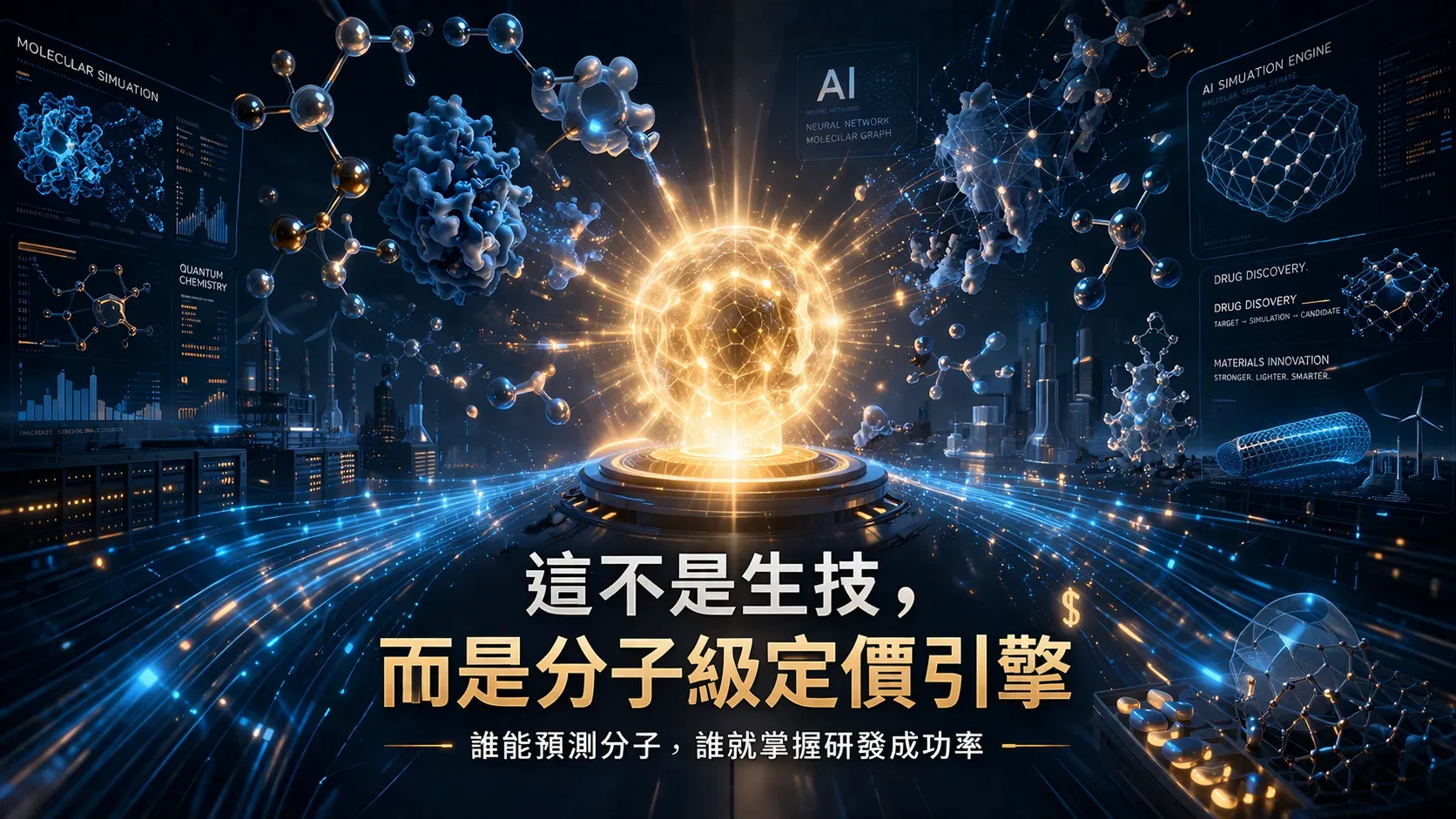
While the market debates how AI is changing drug discovery, Schrödinger has already positioned itself elsewhere — it doesn't need its own drug to succeed; it only needs "someone" to succeed to share in the payoff. This isn't a company. It's a payoff structure.
I. Starting From the Framework: Why You're Using the Wrong Analytical Tool
Over the course of this series, we've used a few different frameworks to analyze companies: for Tempus, it was "data flywheel velocity"; for Veeva, "the depth of switching costs"; for Illumina, "the compounding of installed base." These frameworks all share a common underlying assumption: revenue is continuous, growth can be modeled, and valuation can be approximated by discounting cash flows.
Schrödinger breaks that assumption.
If you look at it through a traditional fundamentals framework — what's the P/E, when will EBITDA turn positive, is revenue growth sustainable — you will almost certainly conclude that it is "overvalued," or be left confused about "how to even value it." That's not your fault; it's the framework's fault. Schrödinger's essence is not a company that needs to be evaluated with linear analytical tools — it's an investment structure that needs to be understood through options thinking.
What is options thinking? At its core, it's acknowledging uncertainty and converting that uncertainty into an asset that can be priced. The value of an option doesn't come from "how much money it's making now" — it comes from "how much it could be worth in some future scenario," multiplied by "the probability that scenario occurs." When that possible future is large enough, an option can carry substantial value even when the probability is low.
This is the essence of Schrödinger: it is a collection of options on "future drug success," supported by a software business that provides stable cash flow as a source of time value (Theta). Without understanding this structure, it's impossible to understand why a company that is continually losing money can still be a meaningful investment.
II. The Dual-Engine Model: Two Entirely Different Business Logics Under One Roof
Schrödinger's business model is a carefully designed binary structure — two engines, each following a completely different business logic, but sharing the same core technology. Understanding this design is the key to understanding the entire company.
The first engine is the software business. Schrödinger is built on more than thirty years of accumulated research in computational chemistry and quantum mechanics. Its core product is a computational platform for molecular modeling and property prediction that lets pharma scientists "virtually" screen and optimize candidate molecules on a computer instead of having to synthesize every possible compound in a lab. This sounds like a niche market, but in practice, nearly every top-tier pharmaceutical company uses similar computational chemistry tools, and Schrödinger's platform has long been considered by the industry to be among the most physically accurate available in terms of precision.
This software business has classic SaaS characteristics: high gross margin (over 70%), high retention (over 96% among large customers), an annual subscription model, and strong predictability. It doesn't need any single drug to succeed — it just needs customers to keep using the tool to keep generating revenue. This is the company's "floor" — a stable form of downside protection.
The second engine is drug discovery collaboration. Here the logic is completely different. Schrödinger uses its own platform to directly participate in the design of drug molecules, but instead of charging a consulting fee, it participates in value creation on a "share of outcome" basis. This means that when it helps a pharma partner design a candidate molecule, if that molecule eventually enters the clinic, gains regulatory approval, and is commercialized, Schrödinger can collect a percentage royalty on the sales.
The elegance of this design is that Schrödinger bears intellectual labor (designing molecules using its platform), not financial risk (it doesn't need to fund clinical trials). If the drug fails, its loss is just the opportunity cost of that project; if the drug succeeds, what it shares in is an almost pure-profit sales royalty. This "limited downside, open-ended upside" structure is, by definition, an option.
III. Physics + AI: Why Schrödinger's AI Is Different From Everyone Else's
In discussions of AI biotech, the word "AI" gets overused to the point of losing all discriminating power. Tempus's AI is a clinical prediction model trained on large-scale data; Veeva's AI is an automation tool embedded in workflows; Illumina's AI is the DRAGEN engine that accelerates genomic data analysis. Schrödinger's AI is something else entirely.
Schrödinger's core technological foundation is physics-first molecular simulation. Instead of learning patterns from biological data, it starts from first-principles physics, using quantum mechanics to calculate electron behavior within molecules and predict their three-dimensional structure, binding energy, and biological activity. This approach is computationally enormous — predicting how a molecule binds to a target protein can take weeks on a traditional computer — and what Schrödinger has done is combine this process with machine learning, letting AI learn from the results of physical simulation so it can dramatically speed up predictions while preserving physical accuracy.
This "Physics + ML" combination gives Schrödinger's predictive ability a systematic edge over purely data-driven AI methods on certain tasks. Pure ML approaches depend on the quantity and quality of training data and perform unreliably on new targets or novel molecule types where data is scarce; but physical simulation doesn't require large amounts of historical data, because it relies on the laws of nature, which apply to any new target. This difference gives Schrödinger a structural advantage when tackling "frontier problems" — that is, problems where data is scarce.
This also explains why Schrödinger's software business won't be easily displaced by the spread of large language models: solving a quantum mechanics equation is not something a language model can do — it requires precise physical computation, not statistical pattern recognition.
IV. Dissecting the Royalty Mechanism: Why "Someone Else's" Success Makes You Money
Royalties are the hardest part of Schrödinger's business model to understand, and the part most easily underestimated. They work in a way that's entirely different from the commercial logic we're used to in everyday life — understanding them requires setting aside the linear intuition of "you earn in proportion to the work you put in."
In a conventional business relationship, if Schrödinger helps a pharma company's scientists design a candidate molecule, it might charge a consulting fee — say $500,000. The work is done, the fee is paid, and afterward, whether that molecule succeeds or fails has nothing to do with Schrödinger's income. That's linear, certain — but also limited.
Schrödinger's royalty partnerships are completely different. It converts its intellectual contribution into "equity" in a future outcome. When a partnership agreement is signed, Schrödinger might receive a small upfront collaboration payment (a few million dollars), then a series of milestone payments as the drug advances through different clinical stages (ranging from a few million to tens of millions of dollars), and finally, if the drug is successfully commercialized, Schrödinger begins collecting a fixed percentage of sales as a royalty (typically 1-5%, depending on the contract).
The key to this structure is the marginal cost of the royalty: once royalty income starts flowing in, Schrödinger doesn't need to do any additional work — the drug has already been designed, the clinical trials have been funded by the partner pharma company, and commercialization has been executed by the partner pharma company. Schrödinger simply waits, and every quarter it receives a royalty check from its partner. If that drug sells $2 billion a year and the royalty rate is 2%, Schrödinger receives $40 million a year — almost pure profit.
Now multiply that logic by 16 partnered programs.
These 16 partnered programs represent 16 different "probabilities of future success." Each program, at a different clinical stage, has a different probability of success: drugs in Phase II have roughly a 30% average probability of eventually reaching market; Phase I is about 10%; Discovery-stage is lower still. But the potential scale of royalty income can far exceed any reasonable probability-discounted calculation, because the royalty income from a single blockbuster drug could, within a decade, exceed Schrödinger's entire current market cap.
V. Why the DCF Framework Systematically Fails Here
For any analyst trained in traditional finance, the first instinct in valuing Schrödinger is to build a DCF model: project revenue over the next ten years, estimate a discount rate, calculate a terminal value, and derive a valuation. But this process is almost certain to be inaccurate for Schrödinger — and the direction of that inaccuracy is systematic underestimation.
The reason is that DCF assumes revenue is continuously distributed — you can say "revenue will grow 15% in 2028" and then project forward year by year. But royalty income is not continuously distributed; it is discrete and event-driven: before a drug launches, royalty income is zero; in the first quarter after launch, royalty income can jump to tens of millions of dollars; if the drug becomes a blockbuster, royalty income keeps growing for years afterward. This "jump-shaped" revenue pattern makes DCF models naturally tend to "average out" or "underweight" the impact of these events.
Development
Path
Evaluation
Horizon
Patience
Horizon
An even deeper problem is the discount rate. In a DCF model, cash flow ten years from now, discounted at 10%, is worth only 38% of its face value today. In other words, even if you project that Schrödinger will earn $500 million a year in royalties ten years from now, in a DCF model, the present value of that income is only $190 million. But if that $500 million in royalties comes from a blockbuster with steadily growing sales, its terminal value could be far more than $500 million — perhaps $1 billion, $2 billion — and all of that gets compressed away by a single discount rate in the DCF framework.
This is why evaluating Schrödinger requires not a DCF, but a "Scenario-Weighted Expected Value" approach: model different scenarios based on how many royalty-eligible programs succeed, calculate the probability and payoff of each scenario, and then sum them on a weighted basis. This method isn't precise, but at least its framework is correct — whereas the DCF framework is simply wrong here.
VI. The Software Business: A Stable Engine Overshadowed by Royalty Glare
When discussing royalties, it's easy to overlook the real value of Schrödinger's software business — because the allure of royalty potential makes the software business look mundane by comparison. But that judgment is wrong. The software business isn't just "the floor" — it's the precondition that makes the entire business model viable.
Schrödinger's software customers include the vast majority of the world's top 20 pharmaceutical companies, along with major academic research institutions and biotech companies. Its core product suite — Maestro (molecular modeling), Glide (molecular docking), FEP+ (free-energy calculations) — enjoys extremely high recognition in the computational chemistry community and is considered one of the industry's most physically precise toolsets. That reputation wasn't built overnight — it's the result of more than thirty years of accumulated research and continuous technical iteration.
The software business's moat likewise comes from an asset that isn't easily replicated: validated physical accuracy. In drug discovery, computational predictions must ultimately be validated by lab experiments. Schrödinger's tools have remained in long-term use at major pharma companies because the consistency between its predictions and experimental results is backed by a large body of publicly documented validation cases across the industry. A new competitor, even with a similar technical architecture, would need years of accumulated use cases to build the same level of trust. This is a moat that takes a long time to build but is hard to replicate quickly.
More importantly, the software business creates a unique flywheel: when customers use Schrödinger's software for molecular design and come across a particularly promising candidate molecule, they naturally consider deepening the collaboration through a Schrödinger partnership program — and it's these deeper collaborations that generate royalties. The software business isn't just an independent revenue stream — it's also the top of the royalty-business funnel: customers use the software, discover value, deepen the partnership, and it turns into a royalty contract. These two engines aren't independent — they reinforce each other.
VII. The Market-Pricing Dilemma: Why This Is an "Interesting Mistake"
Having understood Schrödinger's business model, a natural question arises: if this model is so distinctive, why hasn't the market given it a higher valuation?
The answer is: the market did give it a rich valuation — but for the wrong reasons. At the height of the 2021 biotech bubble, Schrödinger's stock exceeded $100 and its market cap approached $10 billion, but that pricing came mainly from hype around the "AI drug discovery" narrative, not a deep understanding of the royalty structure. As interest rates rose and the biotech bubble burst, Schrödinger's stock fell sharply from its peak — not because the business model changed, but because the market's narrative framework changed.
The market's current pricing of Schrödinger may also be based on the wrong framework — this time, one that's too pessimistic. As the software business's growth slows (because major pharma companies' IT budgets are affected by the interest-rate environment), the market tends to interpret this through the lens of "a SaaS company's growth is slowing," and assigns a lower multiple accordingly. But this framework ignores the option value of the royalty business — a value that, as more partnered programs enter the clinic, may be larger than the market realizes.
VIII. The True Shape of the Risk: Waiting Is the Biggest Cost
Schrödinger's risk is fundamentally different from other companies' risk. It isn't competitive risk (competitors would find it hard to replicate its technical accumulation within five years); it isn't market risk (pharma demand for computational chemistry tools won't disappear in the short term); it isn't even primarily financial risk (the software business provides a sufficient cash-flow base). Its biggest risk is the cost of time.
Schrödinger's current expectation for turning profitable is around 2027-2028, premised on the software business continuing to grow and royalty income starting to contribute. If software growth slows (for instance, after mergers among large pharma customers cut budgets), or if the royalty-eligible programs fail in the clinic at a higher rate than expected, the profitability timeline could slip further. This would increase funding pressure and test investor patience.
The success rate for clinical trials, even at Phase II, is only about 30%. If Schrödinger's current 16 partnered programs broadly deliver poor clinical results in the coming years, market confidence in the expected value of royalties would drop sharply, and the valuation could be compressed. This isn't "Schrödinger's technology is bad" — it's simply that drug development is inherently a high-failure-rate industry.
Before turning profitable, Schrödinger still needs to rely on existing cash reserves and potential capital-markets financing to sustain operations. If interest rates remain elevated and the capital markets' tolerance for loss-making biotech companies declines, that could affect the company's ability to raise capital and its valuation. This risk is manageable as long as the software business keeps growing in a healthy way, but it needs to be monitored continuously.
These three risks share a common thread: they are all about "uncertainty before some future point in time," not about "whether the business model itself is sound." In other words, if your holding period and patience are long enough, the importance of these risks diminishes over time; but if you need to see results within two to three years, these risks are real and cannot be ignored.
IX. Investment Strategy: This Isn't a Buy-and-Hold — It's a Structural Bet
Given Schrödinger's payoff structure, its role in a portfolio should be very clearly defined: it is not a core, steady-allocation holding — it's a structural long-term bet used to provide a "source of nonlinear returns" for the portfolio.
This means the right way to hold Schrödinger is to size the position based on how much you can tolerate "no visible progress for a fairly long time," not to trade it based on "this quarter's earnings might beat expectations." If your investment framework operates on a quarterly cycle, Schrödinger will likely be a stock that keeps disappointing you, because it's losing money almost every quarter, and software growth won't suddenly accelerate.
Use a 1-2 year, deep-in-the-money Long Call to "replicate" the payoff structure of holding SDGR shares with a smaller amount of capital, while capping the maximum loss to the option premium. This strategy is particularly suited to the positioning phase before SDGR has a concrete pipeline catalyst (such as a Phase II data readout), using options to bet on a potential valuation rerating.
Hold SDGR shares long-term at no more than 2-3% of the portfolio, treating it as a "low-cost, long-dated options portfolio." Don't set short-term targets — instead, wait for these catalysts: a Phase II data readout, royalty income beginning to contribute, or a clear timeline to profitability. The triggering of any one of these catalysts could bring a rapid valuation rerating.
X. Series Conclusion: Four Investment Theses, Four Ways of Thinking
This is where the AI BioTech series completes something we've been building from the start: not four independent stock analyses, but a complete thinking framework around "the same industry, four completely different investment structures."
| Dimension | TEM | VEEV | ILMN | SDGR |
|---|---|---|---|---|
| Revenue Certainty | Medium | Highest | High | Lowest |
| Upside Potential | High | Medium | Medium | Highest |
| Required Holding Period | 2-3 years | Long-term | 2-4 years | 5-10 years |
| Options Strategy | Bull Put / LEAPS | Covered Call | Bull Put | LEAPS Call |
| Core Investment Thesis | Flywheel Velocity | Depth of Lock-In | Compounding Infrastructure | Options Portfolio |
Over the course of this whole series, we've tried to do something a bit unusual: not just analyze companies, but use company analysis as a medium to build a thinking framework that can be applied across companies and industries. Tempus taught us how to see "the structural inflection of a data flywheel"; Veeva taught us how to see "the depth and irreversibility of institutional embedding"; Illumina taught us how to see "the compounding flywheel created by an installed base"; Schrödinger taught us how to use "options thinking" to evaluate a business model with an asymmetric payoff distribution.
These four frameworks aren't just applicable to AI biotech — they apply to any investment situation that requires making meaningful decisions under uncertainty.
The series' closing line:
If Illumina is selling water, Veeva is collecting a toll, and Tempus is selling data, then what Schrödinger does is hold the right to future success — and the price of that right, more often than not, has already been quietly bought up by someone before it's truly understood.
📚 AI BioTech Series|Final Installment
- Part 1: Tempus AI — The Only AI Biotech Company That Directly Monetizes Its Data
- Part 2: Veeva — The Most Underappreciated Cash-Flow Machine of the AI Era
- Part 3: Illumina — The Water Seller's True Position in the AI Gold Rush
- Part 4: Schrödinger — Not Making Drugs, But Holding the "Long-Dated Option" on Future Success (this article)