Voyage Log|The True Layer of Risk Recognition: Avoid Dying From the Wrong Worldview
The real risk isn't a loss — it's that the market regime has already changed while I'm still trading with the old model. This piece breaks down the three chronic harms of regime mismatch, and the mandatory weekly self-calibration process.
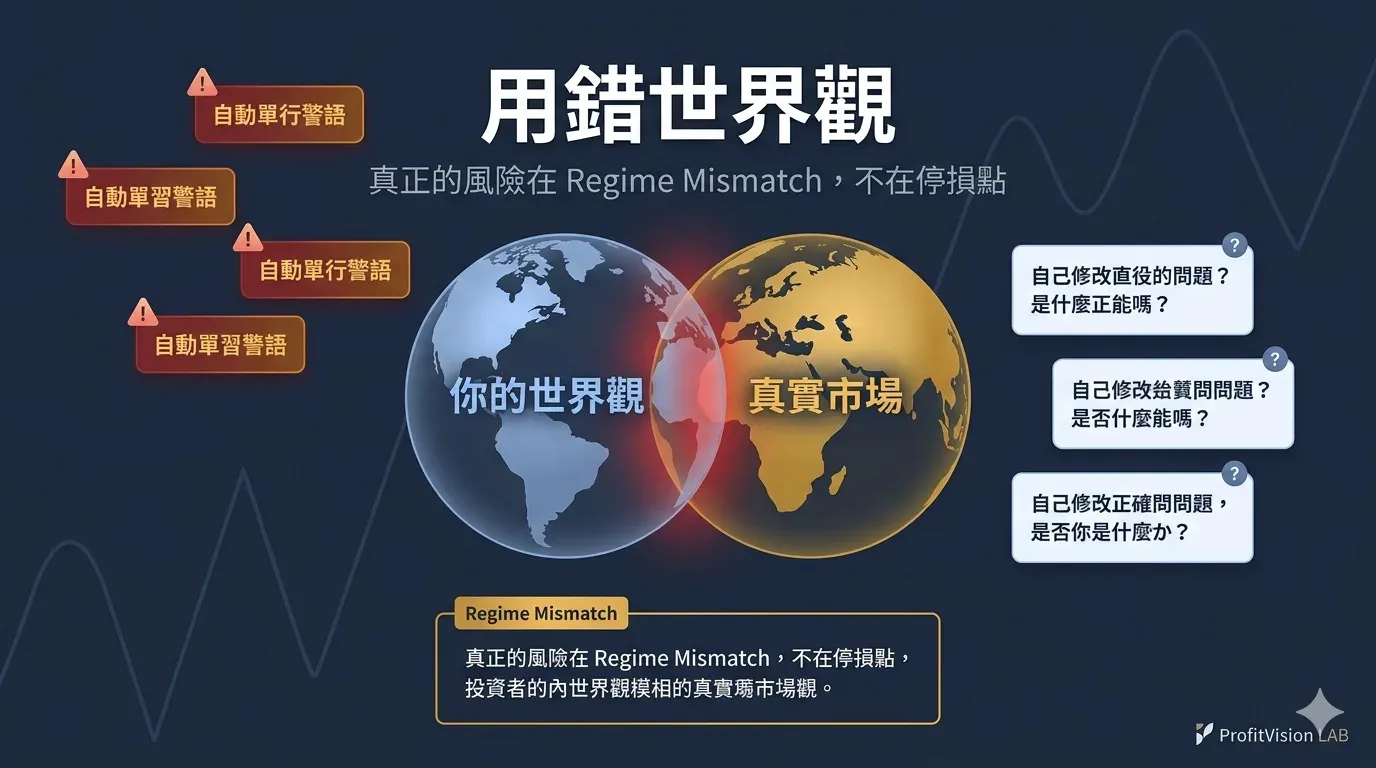
Voyage Log|The True Layer of Risk Recognition: Avoid Dying From the Wrong Worldview
The real risk isn't a loss — it's that the market's regime has already changed, but I'm still trading with the old model.
A Fact I Must First Admit
The market doesn't evolve linearly — it switches versions. Every regime shift is a rewrite of the rules, not an extension of the previous one.
When the regime changes: strategies that used to work, behaviors that used to be rewarded, drawdowns that used to be tolerable — all of them can, without warning, flip from "an edge" into "a source of risk."
Typical Errors of the Old Model (I Must Stay Alert)
These sentences sound like "wisdom," but after a regime shift, they are chronic poison hidden deep in one's thinking:
- "It always goes up in the long run"
- "A pullback is just an opportunity"
- "Just wait a bit longer and it'll come back"
- "I've always done it this way and it's been fine"
- "This is just a temporary rough patch"
Defining Regime Mismatch
Regime mismatch = my return assumptions × the actual market structure ≠ compatible
This mismatch doesn't blow up an account instantly, but it causes three kinds of chronic harm:
- Emotional depletion — reading the market through the wrong framework drains cognitive resources with every signal
- Delayed judgment — seeing the signal but being unable to react in time because the old model interferes
- Widening drawdowns that never get stopped — every add-on made while "waiting for it to come back" amplifies the mismatch
This then manifests as: "I actually know something's wrong, but I can't change it."
Daily / Weekly Self-Calibration Checklist (Mandatory)
This is not optional reflection — it is a mandatory process to prevent systemic drift. Every week, I must answer honestly:
-
1
Sideways-Market Survival Test If the market goes sideways for the next three years, can my strategy still survive? A strategy that depends on a trend or continued gains will be slowly bled to death in a structural sideways market.
-
2
Source-of-Return Review Is my current source of returns price movement, or structural design? Returns dependent on volatility disappear during low-volatility periods, while structural cash flow doesn't depend on market direction.
-
3
Anxiety-Origin Diagnosis Is my anxiety caused by the market, or by a mistaken expectation? Market-driven anxiety is acceptable; expectation-driven anxiety means there's a problem with the model itself.
From the Old World to the New World
Switching regimes isn't admitting defeat — it's updating. Every time I proactively update my model, I'm protecting the trades that haven't happened yet.
The Bottom-Line Principle of the Voyage Log
The moment I notice the market no longer rewards the behavior I'm familiar with, I must suspect the model first — not the market.
The market never owes me "behaving the way I expect it to." When expectation keeps diverging from reality, the first thing to suspect is always the map in my own hands.