[Trading System] NOW Systematic Position-Building Framework v2.1: Reading the Setup and Designing the Methodology Under the Three-Stage Framework
A general methodology framework for NOW's upgrade from cautious watching to a Stage 3 core position-building determination. When a selling climax, an accumulation prelude, and fundamentals validation stack together, how do you apply the Three-Stage Framework, how do you address the short-term noise of a Q2 cRPO guide of 19% and Adj OM guide of 26.5%, and how do you design tranche entries and stop conditions under your own risk-management rules. All specific position sizes, entry prices, and stop-loss levels are for each investor to decide.
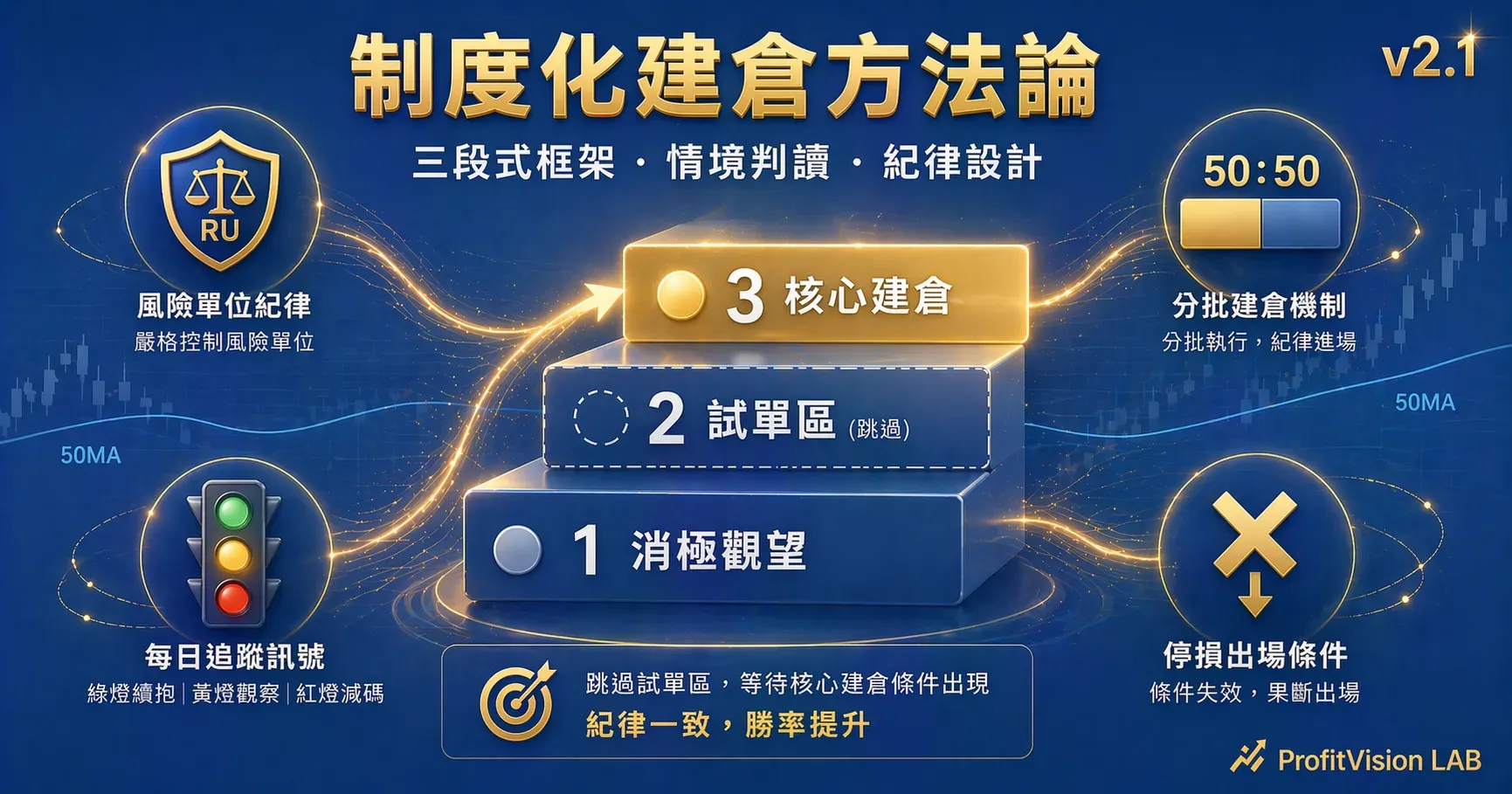
This is the Systematic Position-Building Framework v2.1 (updated after Q1 FY26 earnings). The Three-Stage principles from v2.0 (2026/02/09) remain unchanged; v2.1 adds guidance on: how to apply the Three-Stage Framework when the market shows a selling climax + accumulation prelude + fundamentals validation stacking together, and how to design your own tranche-entry and stop-condition rules. This piece provides a methodology framework — all specific parameters (position sizing ratio, per-tranche size, stop-loss levels) must be determined by each investor according to their own portfolio, risk tolerance, and risk-management discipline. Read alongside the v2.1 flagship research piece.
From Cautious Watching to Stage 3 Core Position-Building: 12 Trading Days Rewrote the Script
When I finished writing the v2.0 strategy piece, the path I assumed was a standard three-stage progression — first cautious watching in Stage 1, moving into Stage 2 trial positions only once the price stopped falling, and upgrading to Stage 3 core position-building only once the trial positions proved out. That path assumed "the valuation-reset period would fall for a while before forming higher lows."
The 12 trading days from April 10 to April 22, 2026 rewrote the script. On the day of the 4/10 UBS downgrade (price target $170→$100, cRPO estimate lowered to 16% from 20%), NOW shares surged on 47M volume (2x average) at $81.40, closing with a long lower shadow — the textbook technical-analysis signal of "heavy-volume long lower shadow + selling exhaustion" was confirmed that very day. Over the following 8 trading days, the stock accumulated up to $103.07, with seven up days against one down day, up-day volume exceeding the average, A/D improving from E to D, and RS improving from 5 to 9. Then Q1 FY26 earnings showed cRPO +22.5%, surpassing Q4 FY25's +21% cc, with full-year subscription revenue guidance raised — validating the fundamental logic behind this accumulation.
The result of these three layers of signal stacking together is this — what Stage 2's trial-position phase is meant to accomplish (using a small position to sense market signals) has already been completed by the market itself through 12 days of volume-price structure. The setup has been upgraded from cautious watching to a Stage 3 core position-building determination. But note — a setup determination is not an entry order. Whether to act, how large a scale, how many tranches, and where to place stops must all be decided by each investor according to their own portfolio and discipline rules. What this piece sets out to do is lay out the methodology for that determination and design clearly.
I. Shares vs. Options: The Right Tool for This Setup
The Discipline of Options's main battlefield has always been options-selling strategies. But in this particular NOW setup, an options structure isn't necessarily the most suitable tool, for three reasons:
Reason One: Strike Selection Is Constrained by Uncertainty in the Accumulation Structure
Although the accumulation structure has formed, a retest remains possible — bears could push the price back toward the 4/10 low to test the sincerity of the accumulation. In this setup, if a bull put spread's strike is placed above the selling-climax low, a retest touching that price would cause Delta to expand far more sharply than it would for shares outright.
Reason Two: Cash-Secured Puts Carry an Oversized Risk Unit for Small-to-Mid-Sized Accounts
NOW currently trades in the three-figure dollar range, and the margin requirement for a single cash-secured put contract makes it easy for a small-to-mid-sized account's single-position exposure to exceed its Risk Unit (RU) rules. That's not to say it can't be done — it means you must first confirm that strike price × 100 × number of contracts doesn't exceed your personal risk-management cap.
Reason Three: Shares Can Be Scaled Completely Freely
A share position can be scaled to "any number of shares, any dollar amount," proportionally sized to your own account — large accounts can buy hundreds of shares, mid-sized accounts dozens, and small accounts can buy just a handful of shares. There's no options-style Gamma amplification, no expiration-time pressure, no Theta decay. In a setup where "the trend is confirming but not yet complete," shares are actually the simplest, most easily scalable tool.
II. Reading the Setup Under the Three-Stage Framework
The Three-Stage Framework's three stages correspond to three different market setups. Determining which stage you're currently in is the key to deciding "what to do and what not to do."
| Stage | Setup Characteristics | Corresponding Action Principle |
|---|---|---|
| Stage 1 Cautious Watching |
A valuation reset has started, most of the Four-Layer Defensive Screen fails, A/D is deteriorating | Zero action, zero preparation |
| Stage 2 Trial Positions |
A selling climax may be forming, but the accumulation structure isn't yet confirmed, A/D is still at the bottom | A very small trial position, to sense market signals rather than pursue returns |
| Stage 3 Core Position-Building |
The selling climax has formed, the accumulation structure is confirmed, A/D is recovering, fundamentals are validated | Execute position-building per your own risk-management discipline, entering in tranches, with defined stop conditions |
NOW's current setup (as of 2026/04/23) corresponds to Stage 3: the selling climax formed on 4/10, the accumulation structure was confirmed over 4/13–4/22, Q1 FY26 earnings validated the fundamentals, and A/D has improved from E to D. But some conditions haven't fully cleared (A/D hasn't reached C+, the price is still below the 50MA), so this is early Stage 3 rather than mature Stage 3. This distinction matters — a mature stage supports entering all at once, whereas an early stage is better suited to tranches.
Two Short-Term Risk Signals That Must Be Weighed Alongside This
The early-Stage-3 determination holds, but two short-term negative signals must be acknowledged at the same time:
- Q2 cRPO guide of only 19% (19.5% cc): at first glance this looks like decelerating momentum, but it's actually the layering of three technical factors — the Armis contract's termination-for-convenience clause limiting cRPO recognition, the 75bps Middle East headwind carrying through the full year, and the CFO's habit of conservative guidance. The real counterargument lies in full-year subscription guidance being raised from $15.53–15.57B to $15.74–15.78B — the raised full-year guidance itself overturns the "decelerating momentum" narrative.
- Q2 Adj OM guide of only 26.5%: 550bps below Q1's actual 32%, primarily due to the Armis integration period bringing roughly 125bps of OM headwind. But FY26 full-year Adj OM guidance was maintained at 31.5%, implying management expects Q3/Q4 to recover the dip. This is disclosed, predictable, short-term margin pressure with a clear accounting cause.
In other words: the short-term signals look noisy, but the noise has a reasonable explanation. Not all noise can be explained away this cleanly — but in these two cases, the accounting cause is clear and the full-year guidance direction is consistent, placing them within the acceptable range of short-term noise. The early-Stage-3 determination isn't overturned by these two signals, but investors designing their tranche timing could consider delaying the second tranche until after observing actual Q2 numbers ahead of Q2 earnings (late July).
III. Methodology for Tranche Entry (General Framework)
Building a position in early Stage 3 isn't "buying it all today at once" — it's confirming signals progressively and adding in tranches. Below is a general framework — the specific size of each tranche, and what percentage of the portfolio a single position occupies, must be decided by each investor according to their own risk-management rules.
Step One: Set Your "Single-Position Cap" First
Before taking any entry action, clarify your own risk-management rules:
- Single-position Risk Unit (RU): typically 1–5% of account capital, depending on individual risk tolerance
- Single-stock exposure cap: typically no more than 10–20% of total account size
- Total exposure to a category (same industry/theme): typically no more than 30%
These caps must be set first, so you can work backward to "the maximum dollar amount/share count I can buy in this stock." Risk discipline must precede position-building — the cap comes first, then the position; not the other way around, where you build a position first and think about stops afterward.
Step Two: Split the Single-Position Cap into Two Tranches
Early Stage 3 is best split into two tranches, roughly 50:50:
| Tranche | Trigger Signal | Size (% of single-position cap) |
|---|---|---|
| First tranche | Setup determination confirmed, price in a reasonable range post-accumulation (not chasing highs, not chasing a rebound) | Roughly 50% |
| Second tranche | Trend-reversion signal confirmed (e.g., reclaiming a key moving average) | Remaining 50% |
Step Three: Choosing the Trigger Signal for the Second Tranche
There are two design approaches for the second tranche's trigger signal, each with its own trade-offs:
Design A: Wait for "reclaiming the 50MA and holding on a retest." The most conservative — adding only once the trend is fully confirmed. The downside is that if there's no retest (a strong rally straight up), the second tranche may never get its entry.
Design B: "Add on the day the 50MA is reclaimed." More aggressive — avoiding a missed add in a setup where accumulation is strong. The downside is that if it's a false breakout, the second tranche will see a temporary loss.
NOW's current accumulation structure leans strong (7 up days vs. 1 down day over 8 days, up-day volume exceeding the average), making Design B a better fit than Design A for this setup. But which one to ultimately choose still depends on how each investor weighs "false-breakout risk" against "missed-add risk."
IV. Designing Stop Conditions
Once the entry design is set, equally important is defining "under what circumstances position-building should stop or an exit should occur." Stop conditions aren't a technical question of where to place a stop-loss — they're a judgment question of "under what signal should my setup determination be overturned." Below are four categories of stop signals:
| Signal Type | Signal Content | Significance |
|---|---|---|
| Technical signal | Price breaks below the selling-climax low (for NOW, that's the 4/10 low of $81.40) | The accumulation structure is falsified |
| Institutional-flow signal (hard) | RS falls back to ≤ 5 (returning to the v2.0 bottom level) | Relative strength retreats to the pre-earnings low |
| Institutional-flow signal (soft) | A/D falls back to E | Possible restart of institutional exodus |
| Fundamentals signal | Management forward-looking commentary or an analyst call discloses weakening cRPO momentum | The premise of the setup determination is overturned |
These four signal types are designed in layers. The technical signal and fundamentals signal are "hard stops" — triggered means it's over; the institutional-flow signal (hard) is a "hard pause" — triggered should also mean exiting entirely; the institutional-flow signal (soft, A/D falling back to E for a single day) is a "soft pause," because A/D carries some short-term noise on its own, and a single day back at E isn't enough to overturn the entire accumulation structure — but if it holds at E for 5 consecutive trading days, that's equivalent to the structure failing, and that should also end the position.
As for the specific number of shares to exit (all or partial), that's for each investor to decide according to their own discipline. The Discipline of Options's principle is "execute immediately the day the signal triggers — don't wait for next-day confirmation, don't look for reasons in the news."
V. Daily Tracking Template
During the observation window ahead of Q2 FY26 earnings (2026/04–2026/07), it's recommended to track four metrics daily. This table is a tool for "outsourcing decisions to rules" — you don't need to re-read the news and rethink every day, just check the state of these four numbers.
| Metric | 🟢 Setup reinforced | 🟡 Setup weakened | 🔴 Setup reversed |
|---|---|---|---|
| RS Rating | ≥ 80 | Falls back to ≤ 6 | ≤ 5 |
| A/D Rating | ≥ C+ | Drops back to E (single day) | Stays at E for 5 consecutive days |
| Price vs. 50MA | Reclaims the 50MA | Breaks recent support | Breaks below the 4/10 low of $81.40 |
| Up-day volume | > average for three consecutive days | Up-day volume shrinks below average | Down-day volume keeps expanding |
| RS Rating | 9 (up 4 notches from 5 at the 4/10 low) |
| A/D Rating | D (up 1 grade from E on 4/10) |
| Price vs. 50MA | $103.07 vs. $107 (-4%) |
| Up-day volume | 7 up days vs. 1 down day over 8 days, up-day volume > average ✅ |
| IV Rank (supplementary) | 65 (down from 95 pre-earnings) |
The logic for using this table is: all four metrics green = setup reinforced; any single yellow = setup weakened; any single red = setup reversed. Spend two minutes each day after the close recording these four numbers, then close it out — there's no need to watch the tape hour by hour.
One thing worth flagging specifically: the market's reaction in extended trading after hours on 4/22 to the Q2 cRPO guide of 19% and the Q2 Adj OM guide of 26.5% skewed negative. After-hours extended trading isn't the same as a formal session signal — the actual impact can only be read once the four metrics are measured in the regular U.S. session on 4/23. This is the first observation window during the execution period of this setup determination, and also day one of the reader's own tracking discipline.
VI. Three Psychological Traps to Deliberately Avoid During Stage 3 Position-Building
Trap One: Wanting to Break Your RU Because You Called It Right
If the trend plays out as expected, a strong wave of "I should have bought more" hindsight will inevitably appear. The moment this thought turns into "next time I see a similar opportunity I'll size up," RU discipline starts to erode. A way to guard against it: write in your trading journal, "I really did leave some money on the table, but the cost of that was that when I'm wrong, I also only lose within my RU."
Trap Two: Turning Daily Tracking into Watching the Screen All Day
The purpose of daily tracking is two minutes filling out the table after the close, not checking the price every hour. Intraday fluctuations carry no signal value and will only trigger emotional reactions. Enforce discipline: schedule the tracking exercise for a fixed time (e.g., after the U.S. market close), and close it out once it's recorded.
Trap Three: Not Wanting to Admit It When a Stop Condition Triggers
If RS really does fall to 5 one day, or the price really does break below the 4/10 low, the first instinct will be "let's wait one more day and see." This is the starting point of every breakdown in discipline. A way to guard against it: execute immediately the day a stop condition triggers — don't wait for next-day confirmation, don't look for reasons in the news. Being shaken out on a false signal that you later discover was a mistake is far better than hesitation letting a loss grow larger.
Conclusion: The True Meaning of the Discipline of Options Is "Staying Disciplined Even When It's Time to Be Bold"
The conclusion of the v2.0 strategy piece was "doing nothing is the best action." v2.1 doesn't overturn that — it upgrades it. Now that the 4/10 selling climax and the 8-day accumulation structure have become clear, staying in Stage 1 cautious watching would mean missing the starting point of Stage 3 core position-building.
But the true meaning of the Discipline of Options has never been "go all-in because you called it right." Position-building size strictly follows each individual's own risk-management cap — even when the read is completely correct, the position is only scaled up within RU bounds; what that buys is intact Risk Unit discipline, a fully bearable loss if the read turns out wrong, and capital still available for the next, even better opportunity when it arrives.
This piece isn't telling anyone how to buy NOW — it's laying out the methodology of "what setup corresponds to Stage 3, and how Stage 3 should design its tranche and stop rules." Every investor needs to map this onto their own portfolio, their own risk tolerance, their own discipline rules — this piece only provides the framework for the determination and the design; the specific position size, entry price, and stop-loss level must be decided by you.
▸ Companion reading: the v2.1 flagship research piece (the 4/10 pivot day and the Four-Layer Defensive Screen rerun) | the Q1 FY26 earnings analysis (the business significance of the cRPO beat) ▸ Next update: when the setup signals show a significant change, or after Q2 FY26 earnings
⚠️ Disclaimer
This article is for educational and research purposes only and does not constitute investment advice. ProfitVision LAB is not a legally registered investment advisor in Taiwan. All content is based on personal research and analysis of publicly available information, with no guarantee of accuracy or completeness. Investing involves risk; please evaluate independently and bear the corresponding responsibility. This article provides a general methodology framework — all specific position sizes, entry prices, tranche rules, and stop-loss levels must be determined by each investor according to their own portfolio, risk tolerance, and discipline rules. This article does not constitute any entry, exit, or operational instruction.
ProfitVision LAB · Shiba the Disciplined | I teach you how to think, not just what to do