Exporting Tokens: A Beautiful but Dangerous AI Narrative
'Exporting tokens, cheap Chinese electricity, a compute export revolution' — this narrative does not survive financial scrutiny. A token is not a commodity, electricity on China's eastern coast is not actually cheap, and an OpenRouter ranking cannot represent the enterprise-grade market. DeepSeek's real significance is AI inference commoditization, not compute exports.
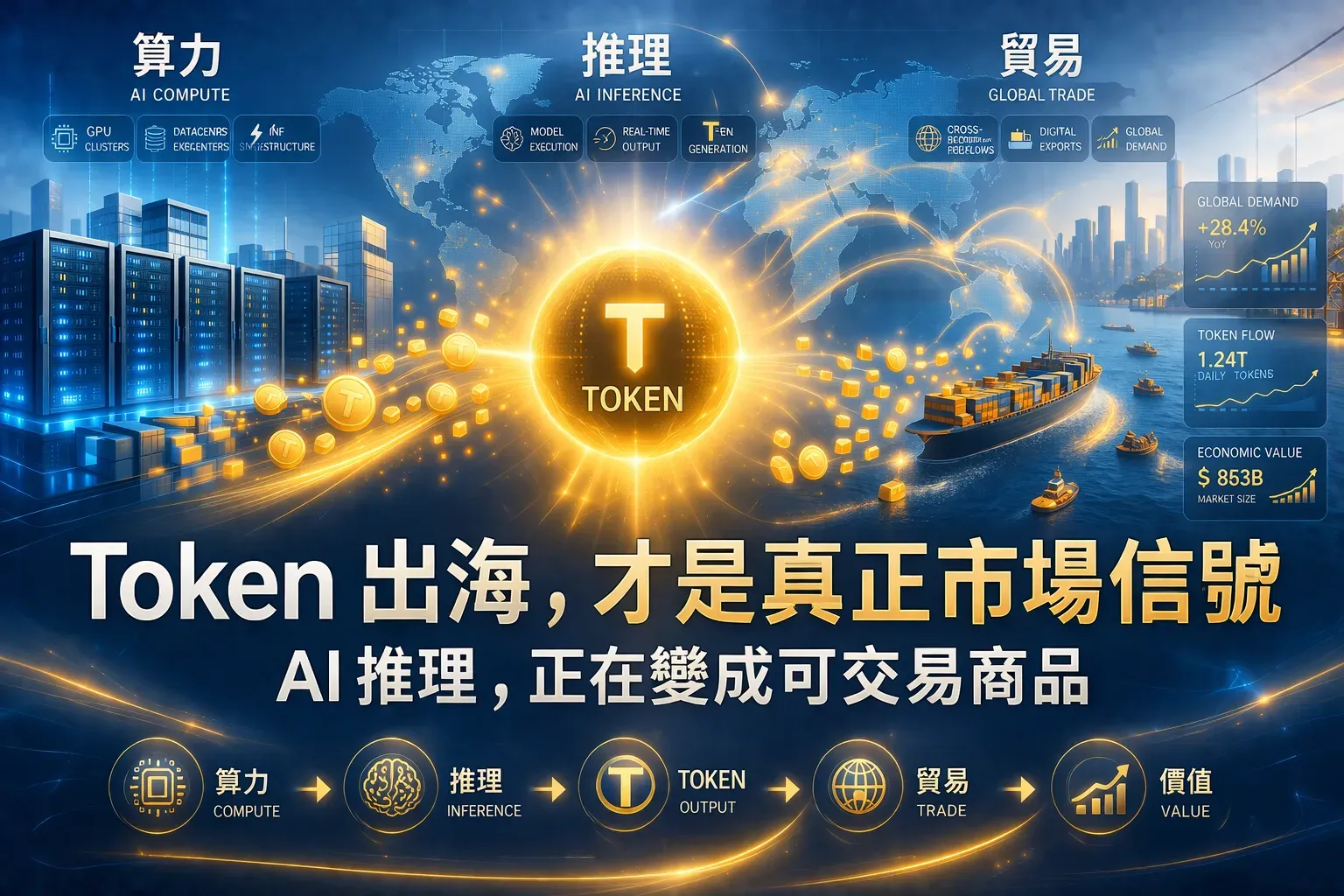
- A token is not a commodity, and certainly not an export — it is merely a billing unit for AI inference services. "Exporting tokens" conflates three completely different layers: technical specification, business model, and geopolitics
- The electricity-price advantage is being seriously overstated: power accounts for only 10–20% of AI inference cost, while GPU depreciation is the real driver (40–60%); China's 40%-lower electricity price has a far smaller actual impact on unit compute cost than claimed
- DeepSeek's pricing advantage is real — and dramatic (V3.2 costs about 1/40th of GPT-5.2) — but it's an architectural efficiency revolution, not "compute export." What it brings is accelerated commoditization of AI globally, not a new Chinese compute order
- The real US-China AI competition isn't about tokens — it's about the chip-sanctions line, cloud-ecosystem trust, and enterprise-grade compliance — three moats that cannot be broken through with low prices in the short term
- For investors, the real significance of the "exporting tokens" narrative is that AI inference is commoditizing, and pricing power is shifting from model companies to infrastructure and ecosystem providers — that is the correct framework for stock selection
1. When "Exporting Tokens" Becomes an Investment Narrative
A concept has recently become popular in tech and investing circles: China is exporting compute overseas through large-model APIs, with the token becoming a new "invisible export" — one that clears no customs and faces no tariffs — while China's low electricity prices give this competition a structural cost advantage.
This narrative sounds highly strategic, spreads easily, and can easily lead investors to form the wrong impression of related China-concept stocks. The problem is that it simultaneously conflates three completely different layers: technical specification, business model, and geopolitics.
2. What Is a Token, and Why Isn't It an "Export Commodity"?
To take this narrative apart, we first have to be clear about the underlying logic: what exactly is a token?
In financial and commercial terms, a token is simply the billing unit for the model's computation process. It is neither a commodity nor a physical service in itself. When a business or developer anywhere in the world calls an AI API, what they are actually purchasing is a "cloud inference service." A token, in relation to AI, is like:
- CPU-seconds in cloud computing
- The number of queries against a database
- Bandwidth billing for a CDN
No one says "we are exporting CPU-seconds to the world." This is a standard SaaS/PaaS cloud service — AWS, Azure, and Google Cloud have been doing exactly this for the past 20 years: American data centers process API requests from businesses worldwide and send the computed results back. The market has never defined this as "America exporting compute," because it is simply the standard cloud business model.
AI is just a new application built on top of this mature web-services foundation — not some novel form of trade that breaks the rules.
3. Breaking Down the Unit Economics: How Big Is the Electricity-Price Advantage, Really?
The core support for the "exporting tokens" thesis is: China's electricity price is 40% lower than America's, so it has an enormous cost moat. This claim seriously ignores the real cost structure of AI computation.
According to a Goldman Sachs industry report on AI infrastructure, the cost of the computing equipment (GPUs and servers) inside an AI data center is 3–4 times the cost of the physical data center itself (including power infrastructure). The real cost structure of AI inference looks like this:
But the claim that "China's electricity is 40% cheaper" is itself another layer of falsehood — because it treats China as a single, uniform electricity market.
The Geographic Trap of Electricity Prices: Cheap Power Exists Only in the Remote West, Not on the Eastern Coast Where the AI Industry Is Clustered
China's industrial electricity prices vary enormously by region. According to data from the National Development and Reform Commission's price-monitoring center, February 2026:
| Region | Representative Cities | Industrial Electricity Price (RMB/kWh) | Approx. USD | State of the AI Industry |
|---|---|---|---|---|
| Eastern coast (high-price zone) | Shanghai, Beijing, Guangdong | 0.70–0.80 | ~$0.10–0.11 | Where the AI industry is clustered — prices near US levels |
| Yangtze River Delta manufacturing belt | Zhejiang, Jiangsu, Suzhou | 0.60–0.65 | ~$0.083–0.090 | A major compute hub — prices only slightly below the US |
| Inland provinces (mid-range) | Chengdu and Chongqing, Sichuan | 0.46–0.77 | ~$0.064–0.106 | Large seasonal swings (over 30% gap between wet and dry seasons) |
| Remote northwest (low-price zone) | Xinjiang, Inner Mongolia, Qinghai | 0.24–0.36 | ~$0.033–0.050 | Lacking compute infrastructure, high network latency, insufficient talent |
Here's the key irony: the places where China's electricity prices are genuinely competitive are exactly the places where the AI industry isn't; and where the AI industry actually is, electricity isn't cheap at all.
China's core AI companies — Baidu, Alibaba, Tencent, ByteDance, and High-Flyer, the parent of DeepSeek — have their primary compute nodes concentrated in eastern-coastal cities like Shanghai, Beijing, Guangdong, and Hangzhou. Industrial electricity prices in these regions run about RMB 0.65–0.80/kWh (roughly $0.09–0.11), which is almost negligibly different from — and sometimes more expensive during certain periods than — the electricity prices at major US data-center locations ($0.05–0.10).
The Chinese government is indeed pushing its "East Data, West Computing" initiative — relocating compute demand to the cheaper-electricity west. But this plan faces a fundamental contradiction: western compute nodes sit over a thousand kilometers from the primary end users, and the resulting inference latency completely offsets any savings on electricity — making it entirely unusable for real-time AI applications.
Industrial electricity in Xinjiang runs about $0.033/kWh — genuinely cheap. But Xinjiang has no top-tier AI engineers, no mature data-center ecosystem, insufficient network backbone bandwidth, and latency to major markets exceeding 100ms.
Shanghai's industrial electricity price is about $0.097/kWh — almost no different from the price at data-center locations in Virginia (about $0.07–0.09).
The precise version of "China's electricity is cheap" should really be: "electricity is cheap in certain remote parts of China that are unsuitable for building AI data centers."
Doing the math: if power accounts for 15% of total inference cost, and the electricity price in China's core coastal AI regions is in fact less than 20% below the US, then the electricity-price advantage compresses total unit cost by no more than 3%. That's not a moat — that's noise.
What actually determines AI's unit compute cost remains:
- The cost of acquiring high-end chips — where China faces severe restrictions from export controls
- The ability to optimize the underlying compute architecture — MoE (mixture-of-experts), distillation techniques, KV cache efficiency
- Engineering efficiency — DeepSeek trained V3 on H800s for about $5.6 million, while OpenAI's training cost for GPT-4 is estimated to exceed $100 million; the gap comes from architectural efficiency, not electricity bills
4. The Real Numbers on Token Pricing: Where Does DeepSeek's Advantage Actually Lie, and Where Doesn't It?
DeepSeek's pricing advantage is real, and its scale is striking. Below is a comparison of major model API pricing as of March 2026:
| Model | Input ($/M tokens) | Output ($/M tokens) | Relative to GPT-5.2 |
|---|---|---|---|
| OpenAI GPT-5.2 | $1.75 | $14.00 | Baseline |
| OpenAI GPT-5.2 Pro | $21.00 | $168.00 | 12x more expensive |
| Claude Sonnet 4.6 | $3.00 | $15.00 | Roughly similar |
| Google Gemini 3.1 Pro | $2.00 | $12.00 | Slightly cheaper |
| DeepSeek V3.2 (cache miss) | $0.28 | $0.42 | 1/6 to 1/33 of GPT-5.2 |
| DeepSeek V3.2 (cache hit) | $0.028 | $0.42 | 1/63 to 1/33 of GPT-5.2 |
| DeepSeek R1 (reasoning model) | $0.55 | $2.19 | 96% cheaper than OpenAI o1 |
But there's a critical question that needs to be clarified here: does DeepSeek's price advantage come from "China's cheap electricity," or from an "architectural efficiency revolution"?
The answer is clear. DeepSeek V4 uses a MoE architecture with 671 billion total parameters, but activates only 37 billion parameters (about 5.5%) per inference. By comparison, GPT-4 is a dense model that activates all of its parameters during inference. DeepSeek V4's compute per token is roughly 250 GFLOPs, versus about 2,448 GFLOPs for a dense model of comparable capability — nearly a 10x difference in compute efficiency.
This distinction matters enormously to investors: if the low price comes from an electricity subsidy, that's a geopolitical moat. If it comes from architectural efficiency, that's a competition in engineering capability — and engineering capability can spread.
5. Why Doesn't an OpenRouter Ranking Represent the Global Market?
A piece of evidence often cited for the "exporting tokens" thesis is that Chinese models rank near the top on developer platforms like OpenRouter.
This commits a serious sampling bias. OpenRouter is merely an API aggregation platform for long-tail developers and independent users — it represents the user segment that is most price-sensitive and has the lowest compliance requirements.
- Synergy Research Group: global cloud-infrastructure market annual revenue has surpassed $400 billion, with AWS, Azure, and Google Cloud together holding more than 63% market share
- The truly massive enterprise-grade AI budgets are all locked inside closed, tightly security-regulated ecosystems like Azure OpenAI, Amazon Bedrock, and Google Vertex AI
- AI spending in finance, healthcare, and government is strictly constrained by compliance requirements like GDPR, SOC 2, and FedRAMP — Chinese models are essentially shut out of these use cases
- Cross-border API latency: a Chinese data center serving European or American businesses sees roughly 200–300ms of network latency, far above the 10–50ms of local deployment — a fatal flaw for real-time applications
Using a developer-community traffic leaderboard to declare a reshuffling of the global compute map is, without question, looking at the world through a keyhole.
6. The Real Map of US-China AI Competition: Strengths, Weaknesses, and Moats
Rejecting the exaggerated "exporting tokens" narrative does not mean denying China's real AI capabilities. The correct approach is precise positioning — where China genuinely has an advantage, where it genuinely has a disadvantage, and which moats cannot be breached in the short term.
This map makes clear: China's genuine advantages are concentrated in the cost efficiency of pure-text inference and the influence of its open-source ecosystem; against the three moats of enterprise-market access, chip-sanction barriers, and cloud-ecosystem stickiness, a low token price has almost no ability to break through.
7. The Real Market Signal Behind "Exporting Tokens": AI Inference Commoditization
Strip away the geopolitical packaging, and the real market phenomenon reflected in the "exporting tokens" thesis is that AI inference is commoditizing.
This is the signal genuinely worth an investor's careful thought:
- In 2023, GPT-4's inference cost was about $30 per million tokens; by 2026, a model of comparable capability costs $0.28–$1.75 — a decline of over 95%
- Once model inference becomes a commodity, pricing power shifts from model companies to whoever controls the infrastructure and the ecosystem
- DeepSeek's extremely low pricing has forced the entire market's token prices down — OpenAI's multiple significant price cuts across 2024–2025 are exactly a response to this pressure
8. A Framework for Investors: What Should You Actually Watch?
If "exporting tokens" isn't the real investment theme, what is? The genuine trend of AI inference commoditization carries the following implications for investors:
Conclusion: Strip the Narrative Back Down to the Numbers
"Exporting tokens" is a beautiful, easily-spread narrative — but it doesn't survive rigorous financial scrutiny.
A token is not a commodity, the electricity-price advantage has been overstated by roughly a factor of ten, and an OpenRouter ranking cannot represent the enterprise-grade market.
DeepSeek's real significance isn't "Chinese compute conquering the world" — it's that AI inference is commoditizing, and pricing power is shifting from model companies to infrastructure and ecosystems.
Whenever a concept simultaneously satisfies "it sounds novel," "it's easy for the public to understand," and "it slots effortlessly into a grand geopolitical narrative,"
that is exactly when, as investors, we need to return to the financial data and commercial substance and ask the simplest possible question:
Where are the numbers?
Disclaimer: everything in this article is for research and educational reference only and does not constitute investment advice. Any stocks or ETFs mentioned are for illustrative purposes only and do not represent any recommendation to buy or sell. Investors should assess their own risk tolerance, financial situation, and investment objectives, and bear the corresponding risk.