Why Is Every Country Suddenly Talking About 'Sovereign AI'? When Compute Becomes a Matter of National Survival
Sovereign AI is not techno-nationalism — it's a survival strategy against outsourcing both informational and economic sovereignty at once. From the UAE's Stargate to Saudi Arabia's Humain, the Middle East is providing the most real-world stress test of sovereign AI strategy on the planet.
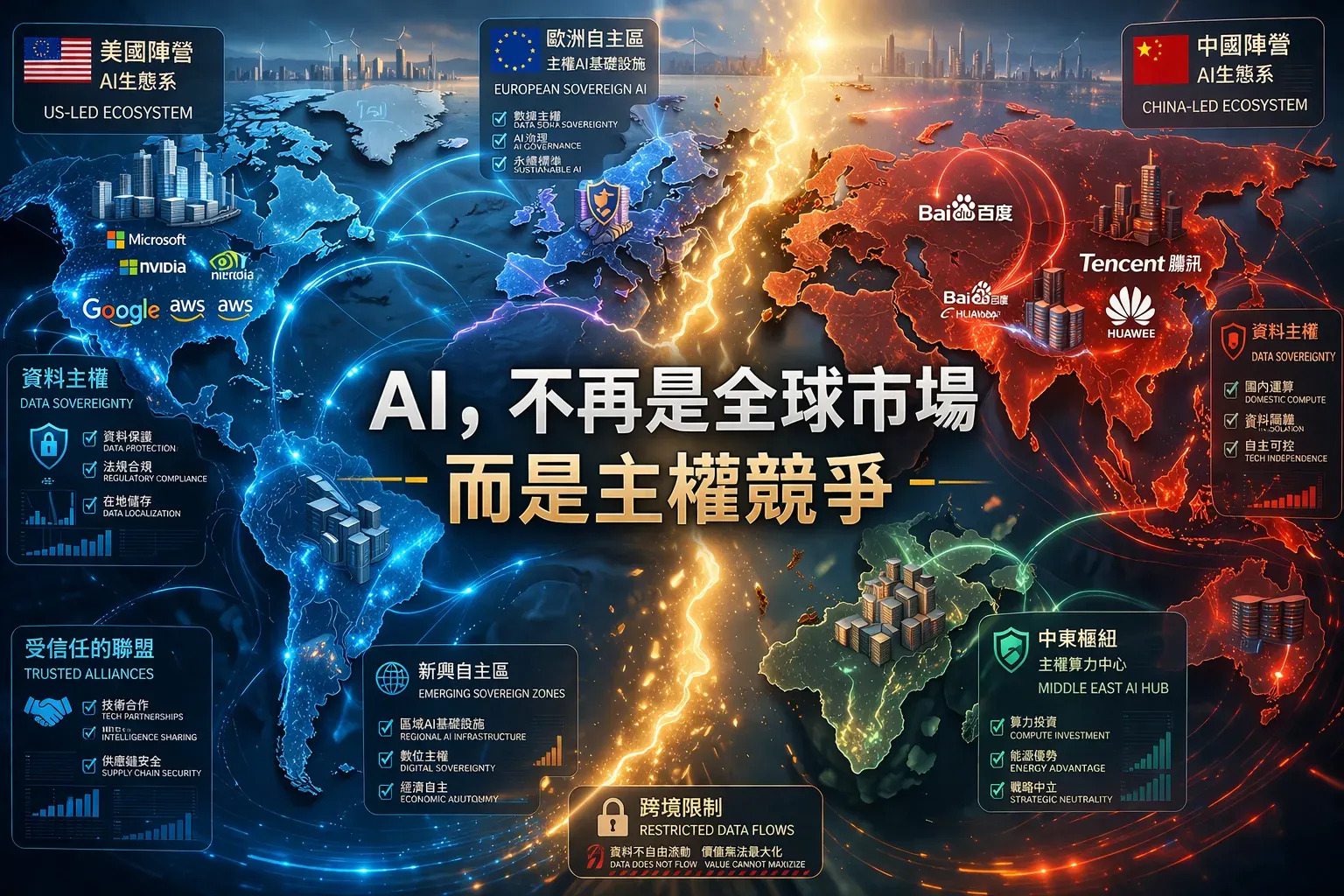
- AI has completed its paradigm shift from "application software" to "national-level infrastructure" — whoever controls AI effectively controls the national power grid of this new era
- The core of sovereign AI isn't "manufacturing every link of the chain in-house" — it's holding control over three specific stages, data, fine-tuning, and deployment, while embracing global division of labor everywhere else, including hardware
- The Middle East is becoming the frontline proxy battlefield in the US-China race for AI compute: Saudi Arabia's Humain has committed to deploying 600,000 NVIDIA GPUs, while DeepSeek simultaneously sets up a data center inside Aramco
- Middle Eastern petrodollars are transforming into "compute dollars" — the extension logic of energy hegemony has shifted from controlling oil pipelines to controlling GPU clusters and data centers
- AI competition is total war across three strategic layers — compute infrastructure, cognitive-engine models, and application-ecosystem workflows — a country that only holds the third layer will be reduced to a digital tenant farmer
In our previous analysis, we broke down the glamorous but dangerous narrative of "exporting tokens," and pointed to a harsh commercial reality: the token is merely the surface of billing — real industry power remains firmly in the hands of the chip makers, cloud infrastructure providers, and ecosystem giants sitting underneath.
When we lift our perspective from commercial competition to the level of national strategy, a deeper and more urgent issue surfaces: Sovereign AI.
Why are economically capable countries — from France, Germany, and Japan, to South Korea and Taiwan — pouring national resources into building their own large language models and compute centers? This isn't techno-nationalism — it's a cold-eyed calculation grounded in an existential crisis. Once AI is no longer just a productivity tool but the next generation's national-level infrastructure, "who controls AI" stops being a question on an income statement and becomes a question of sovereignty — one that determines the flow of information, the lifeline of the economy, and the survival of a culture.
1. The Paradigm Shift: AI's Transformation From "Application Software" Into "Foundational Infrastructure"
Looking back over 150 years of modernization, every infrastructure revolution has ruthlessly redistributed global wealth and national competitiveness:
- Railways and shipping — redefined the boundaries of physical goods movement
- Electricity and the power grid — unleashed the momentum of the second industrial revolution
- The internet and fiber optics — broke the physical limits on the transmission of information
- Cloud computing — turned IT resources into an on-demand public utility
Now generative AI is joining this list — and moving faster than any revolution that came before it.
The essence of AI has undergone a fundamental transformation — it is no longer just an algorithm for recognizing images or auto-replying to customers. It is becoming the foundational power grid of knowledge production, logical reasoning, and decision support.
Picture how business and society will operate in the future: finance relying on AI for risk modeling and earnings analysis; healthcare relying on AI for protein-folding prediction and image interpretation; government agencies relying on AI to draft regulations and allocate resources. When enterprises writing code, conducting research, designing products — and even government governance itself — all need to "plug into AI's power socket" to keep running, whoever provides that AI model effectively controls the national grid of this new era.
2. Informational Sovereignty: Whoever Controls the Model Defines "the World's Truth"
An AI model has never been an objective, neutral mathematical formula. It simultaneously plays three extremely sensitive roles: a knowledge filter, a content generator, and an information distribution node.
In the era of traditional search engines, Google decided which web pages you "saw"; but in the era of generative AI, ChatGPT or Claude decides what answer you "get directly." A search engine gives you options; a large language model gives you a conclusion.
What a model generates is deeply shaped by three factors:
The geopolitical bias of the training corpus: if a model absorbs 90% American internet data and less than 0.1% Taiwan-specific data, it will inevitably carry a strong, specific point of view when answering questions about history, politics, culture, or even local regulations.
The value alignment of RLHF: the cultural background and moral standards of the human labelers determine what the model considers a "safe, correct, polite" answer. This isn't a technical question — it's a question of who holds the right to interpret culture.
The commercial policy of the developing company: for compliance or business reasons, a foreign tech giant can adjust an API's filters at any time — softening certain sensitive viewpoints or amplifying particular narratives. In the context of information warfare, this is a very real sovereignty risk.
3. Economic Sovereignty: Avoiding Becoming a "Digital Tenant Farmer" at the Bottom of the AI Value Chain
Generative AI has redefined the global tech industry's value chain, and the hierarchy is more entrenched than ever before:
If a country entirely gives up on positioning itself at L2 and L3, it will inevitably become a pure end-user within the AI economic system. This creates three forms of long-term dependence: technical dependence (forced to comply whenever API specs change), pricing-power dependence (subject to a "token tax"), and productivity dependence (the pace of industrial upgrading constrained by the iteration speed of a foreign model).
4. The Invisible Barriers of Language, Culture, and Regulation
A globally generic large model has three fatal flaws that mean it can never fully satisfy local needs:
The Invisible Cost of Token Inequality
Most Western-led LLMs have a tokenizer optimized for English. Expressing the same concept in Traditional Chinese often consumes 2–3 times as many tokens as in English. This means a business in Taiwan or Japan, using the exact same foreign AI service, must pay several times what an American company pays — a hidden "language penalty" and "digital tariff."
Thin Local Knowledge and Hallucination
Ask a foreign large model about specific Taiwanese regulations (the fine print of the Labor Standards Act, local tax law) or the financial-statement details of a local company, and it's extremely prone to serious "hallucination" — because the weight given to that data in the training pool is too low. Taiwan's TAIDE project and Japan's Fugaku-LLM exist precisely to feed clean, legal, deeply locally-grounded data into a model that genuinely understands local rules.
The Regulatory Red Line on Cross-Border Data Transfer
Europe's GDPR and the AI Act set an extremely high bar for data privacy. A bank's customer transaction data, a hospital's patient records, a government's classified files — by regulation, these can never be transmitted to overseas servers for processing. Without locally controlled sovereign AI, these high-value core industries will never be able to enjoy the productivity boom generative AI promises.
5. The Middle East: Petrodollars Are Transforming Into Compute Dollars
If sovereign AI is an abstract strategic concept, then what's happening in the Middle East is the most concrete, largest-scale real-world demonstration of that concept.
Saudi Arabia and the UAE are doing something that, viewed through the lens of history, follows exactly the same logic as their control of oil pipelines 50 years ago: extending energy hegemony into compute hegemony. Only this time, the pipeline has been replaced by the GPU cluster, and the oil field by the data center.
Concrete commitments include: 600,000 NVIDIA GPUs (3 years) A 500MW xAI data center A $10B AMD partnership (500MW) 200MW of Qualcomm AI200 chips
Humain isn't just building server rooms — it's aiming for "full-stack" AI, from data centers, to its self-trained Arabic-language model ALAM, to its own AI operating system, Humain One. This is the most complete implementation of sovereign AI: buy the best chips, build the biggest facilities, train your own model, and control your own ecosystem.
Notably, Humain has already signed a 500MW data-center contract with Elon Musk's xAI, becoming Saudi sovereign AI's first global customer. Jensen Huang mentioned Humain three times on an earnings call — a company less than a year old is already one of NVIDIA's most important new customers.
A 5GW UAE-US AI Campus (the largest outside the US) A $15.2B Microsoft deal (2023–2029) Compute equivalent to 81,900 H100s
But G42 has previously found itself caught between the US and China: national-security officials under the Biden administration, worried about G42's ties to Chinese companies, once froze its NVIDIA chip export license. It wasn't until Microsoft took a $1.5 billion stake in G42, with the backing of the US government, that the regulatory channel for chip exports opened up. This case makes clear: the Middle East's compute market has long been a proxy battlefield in the US-China tech war.
The Most Critical Detail: DeepSeek Is Also in the Room
Even as NVIDIA and American tech giants pour into the Middle East, a fact that receives little coverage is this: DeepSeek is already operating out of a data center established at Saudi Aramco.
This is not merely the commercial expansion of a Chinese AI company. Tariq Amin, Aramco's former head of digital (who later also became Humain's CEO), said when announcing this at the 2025 LEAP tech conference: "Once data is used, it's stored locally — it never moves anywhere else."
That single sentence is a perfect articulation of the logic of sovereign AI — whether you're using an American model or a Chinese model, what matters most is that data and compute must be controlled locally.
- GCC data-center market size: $3.48B in 2024 → $9.49B in 2030, an 18.2% CAGR
- Regional compute capacity: 1GW in 2025 → 3.3GW in 2030, tripling in five years
- An electricity-cost advantage: Gulf states pay $0.05–0.06/kWh, far below the US's $0.09–0.15/kWh
- Humain's target: 6% of global AI compute by 2034, becoming one of the world's top three AI data-center providers
- The UAE-US AI Campus: 5GW, 10 square miles, the largest AI facility outside the United States
The Middle East's positioning reveals an important logic: sovereign AI is not a luxury reserved for poor countries, nor a game only major powers can play. It is a necessary investment for any economy with sufficient capital and strategic will to protect its own economic sovereignty in the AI era. The Middle East is buying compute with petrodollars, Taiwan is trading on the geopolitical advantage of its semiconductor supply chain, and South Korea is leveraging Samsung's and SK Hynix's HBM technology — different paths, the same underlying logic.
6. Debunking the Myth: Sovereign AI Does Not Mean Tech Isolationism
The most common criticism of sovereign AI is: "Besides the US and China, which country actually has the capital to compete on compute? Isn't this just reinventing the wheel?"
This is a misunderstanding of the concept of "sovereignty." The strategy of sovereign AI has never been about total closure — it's about ensuring that control over the critical links is never handed to someone else.
Modern national AI strategies adopt a highly pragmatic "hybrid model":
- The hardware layer: embrace globalized division of labor — keep buying NVIDIA GPUs or using cloud compute; there's no need to develop cutting-edge chips domestically in the short term
- The open-source foundation layer: stand on the shoulders of giants — make good use of powerful open-source models like Meta's Llama, Mistral, and Qwen as a base
- The sovereign core layer: control the data, the fine-tuning, and the deployment — inject confidential data, local-language corpora, and specialized knowledge bases into an open-source model through continued pre-training (CPT) or supervised fine-tuning (SFT)
- The governance layer: full local control — deploy in domestic data centers, ensure data never leaves the country, and hold complete control over API access
Europe's Mistral AI is the best example: it doesn't need to compete with OpenAI on parameter count — through a more efficient architecture and more precisely curated, high-quality data, it can still carve out a place for itself in the open-source ecosystem, preserving Europe's strategic depth in the field of AI.
7. Three Strategic Layers: A Sober Assessment of a Nation's AI Competitiveness
Assessing a nation's competitiveness in the AI era requires soberly breaking the industry chain down into three strategic layers:
8. The Ultimate Goal of Sovereign AI: Buying an Option in an Uncertain Age
The core purpose of pursuing sovereign AI is not to immediately surpass GPT-5 or Claude on a leaderboard. Its real purpose is to buy a strategic option for the nation and its enterprises:
The option to negotiate: when you own a locally usable model of your own, you have leverage and a fallback when a foreign cloud giant raises its API prices.
The option of data security: for the highest-classification national-security simulations or undisclosed R&D projects, you have a sandbox that "absolutely never transmits data overseas."
The option of cultural preservation: if a language can't be smoothly understood and generated by AI, that culture will be marginalized in the knowledge inheritance of the future. Sovereign AI is a seawall protecting a culture's voice in the digital age.
Conclusion: No Longer a Bystander, but a Co-Author of the Rules
Competition in AI has long since moved beyond benchmark scores and product-launch gimmicks. It is total war, blending compute infrastructure, the extraction of economic value along the chain, data-privacy regulation, and geopolitical maneuvering.
The Middle East's case tells us something important: sovereign AI is not an abstract policy discourse — it is a new geopolitical boundary being built, brick by brick, out of real capital and real compute. Saudi Arabia is building a wall out of 600,000 GPUs; the UAE is building a wall out of a 5GW data center; and DeepSeek is building a wall on the other side, out of a data center inside Aramco.
These walls will determine who has a seat at the table on the compute map twenty years from now.
Once we treat AI as a new generation of infrastructure — on the same level as electricity or the internet — every economy with a sense of its own agency must seriously answer a question:
In the next algorithm-driven industrial revolution, will we merely be end-users waiting to pay a "token tax," or will we be participants who hold the lifeline and command pricing power?
"Wherever data and compute flow, that is where a nation's industrial voice resides."
A beautiful story is easy to hide a complicated reality behind, but only sovereignty over the foundational infrastructure can carry you the full distance on AI's long, snow-covered slope.
Disclaimer: everything in this article is for research and educational reference only and does not constitute investment advice. Any stocks or companies mentioned are for illustrative purposes only and do not represent any recommendation to buy or sell. Investors should assess their own risk tolerance, financial situation, and investment objectives, and bear the corresponding risk.